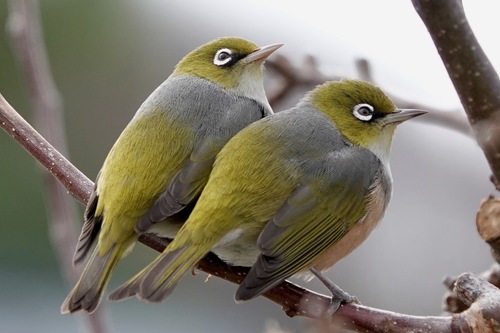
| Appearance | - The species has yellow-green upperparts extending from its forehead to the back of its neck and cheeks. English Wikipedia
- A black facial line extends from the side of the bill to the eye. English Wikipedia
- The upper body and most of the upper wing are yellow-green, with darker blackened feathers. English Wikipedia
- The tail is black or brown and has narrow green edges. English Wikipedia
- The chin and throat are yellow, while the sides are olive-green. English Wikipedia
- The central breast, belly, and undertail-coverts are yellow. English Wikipedia
- The species has a conspicuous white ring surrounding each eye. English Wikipedia
- Its iris is typically reddish to light brown. English Wikipedia
- The bill is black on its upper surface and gray underneath. English Wikipedia
- Kirk's white-eye has a small, sharp bill resembling that of a warbler. ebird.org
- The species has completely yellow underparts and broad white rings around its eyes. ebird.org
- Male and female Kirk's white-eyes show minimal or no visible differences. English Wikipedia
| |
|---|
| Size | - Kirk's white-eye measures approximately 10–12 centimetres in length. English Wikipedia
| |
|---|
| Habitat | - Kirk's white-eye occupies forests, savannas, shrublands, and grasslands. English Wikipedia
- The species is commonly found in habitats containing woody vegetation. ebird.org
| - The silvereye occurs in vegetated habitats other than open grasslands within its distribution range. English Wikipedia
- Its habitats include forests, scrub, horticultural blocks and urban gardens. English Wikipedia
|
|---|
| Diet | | - The silvereye feeds on small insects and spiders, as well as fruit and nectar. English Wikipedia
- Its diet includes berries in addition to insects, spiders, fruit and nectar. English Wikipedia
- In New Zealand, the silvereye consumes fruit from kahikatea and rimu trees. English Wikipedia
- Silvereyes consume insects that are harmful to garden and orchard produce, including aphids, scale insects and diamondback moths. English Wikipedia
|
|---|
| Behaviour | - The species obtains food by foraging. English Wikipedia
- Individuals sometimes probe for food while hanging upside down. English Wikipedia
- The species occurs in mixed flocks characterized by hyperactive activity. English Wikipedia
- Its vocalizations include loud, melodious calls dominated by downward-slurred notes. English Wikipedia
- Its most common calls include a high-pitched rising rattle and a descending chew note. English Wikipedia
- The descending chew note is also the principal component of the species' quiet, conversational song. English Wikipedia
- The species' calls have been described as resembling those of the nominate form of Zosterops maderaspatanus and the Serinus finch. English Wikipedia
- Kirk's white-eye is generally a fairly quiet bird. English Wikipedia
| - Silvereyes gather into flocks in late summer. English Wikipedia
- Many Australian silvereyes migrate northwards along the coast and mountain ranges. English Wikipedia
- Migrating silvereyes forage during the day and undertake long-distance flights at night. English Wikipedia
- Most of the Tasmanian population crosses Bass Strait and disperses into Victoria, New South Wales and south-eastern Queensland. English Wikipedia
- Northernmost populations of silvereyes in Australia remain resident throughout the year. English Wikipedia
- In western Australia, silvereyes have been recorded moving between the mainland and offshore islands. English Wikipedia
|
|---|
| Reproduction | No checked fact yet | - Silvereyes breed during spring and early summer, mainly between September and December. English Wikipedia
- Silvereyes construct small cup-shaped nests from grass, moss, hair, spiderweb and thistledown. English Wikipedia
- Silvereyes suspend their nests from branch forks in the outer portions of small trees or shrubs. English Wikipedia
- A silvereye clutch contains two to four pale blue eggs. English Wikipedia
- Silvereyes may raise two or three broods during one breeding season. English Wikipedia
- Silvereye eggs hatch after approximately 11 days of incubation. English Wikipedia
- Silvereye nestlings fledge approximately 10 days after hatching. English Wikipedia
- Juvenile silvereyes become independent at approximately three weeks of age. English Wikipedia
|
|---|
| Distribution | - Kirk's white-eye is endemic to the Comoros Islands. English Wikipedia
- The species occurs specifically on Ngazidja in the northwestern Comoros Islands. English Wikipedia
- The species remains on its islands throughout the year rather than migrating. English Wikipedia
| - The silvereye is native to Australia, New Zealand and several south-west Pacific island groups. English Wikipedia
- The silvereye is common to abundant in the relatively fertile south-western and south-eastern regions of Australia. English Wikipedia
- Its Australian distribution includes Tasmania and the Bass Strait islands. English Wikipedia
- The silvereye occurs along the well-watered coastal region of tropical Queensland, including Cape York Peninsula. English Wikipedia
- The species was first recorded in New Zealand in 1832 and arrived in greater numbers in 1856. English Wikipedia
|
|---|
| Conservation | - Kirk's white-eye is commonly observed even in plantations with relatively few bird species. English Wikipedia
- The species is no longer present on Mount Karthala, where Zosterops mouroniensis has replaced it. English Wikipedia
| |
|---|
| Uses | No checked fact yet | - Silvereyes provide a beneficial service in gardens and orchards by consuming insects that damage produce. English Wikipedia
- Silvereyes can be regarded as agricultural and horticultural pests because they consume fruit crops and pass through bird netting. English Wikipedia
- Silvereyes are attracted to apples, citrus, feijoas, figs, grapes, pears and persimmons. English Wikipedia
|
|---|
| Other | - Kirk's white-eye was formerly classified as a subspecies of the Malagasy white-eye. English Wikipedia
| No checked fact yet |
|---|