Comparison

Karthala White-eye vs Silvereye

Karthala White-eye (Zosterops mouroniensis) and Silvereye (Zosterops lateralis) both belong to the genus Zosterops (lesser white-eyes) and part ways below it.

Karthala White-eye

Zosterops mouroniensis
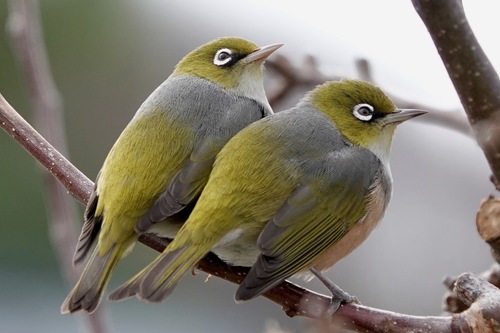
Silvereye

Silvereye

Zosterops lateralis

(c) BIHNZ, some rights reserved (CC BY), uploaded by BIHNZ, CC BY 4.0, via iNaturalist

Side by side

Karthala White-eyeSilvereye
Scientific nameZosterops mouroniensis Milne-Edwards & Oustalet, 1885Zosterops lateralis (Latham, 1802)
English nameKarthala White-eyeSilvereye
GroupBirdsBirds
ClassAves BirdAves Bird
OrderPasseriformes PasserinePasseriformes Passerine
FamilyZosteropidae White-eyeZosteropidae White-eye
GenusZosterops Lesser White-eyesZosterops Lesser White-eyes
Named in18851802
Red List categoryNear ThreatenedLeast Concern
Countries on record1 country7 countries
GBIF occurrence records69 records1,351,144 records

Rows where the two agree are shown in grey.

Where each is found

Only Karthala White-eye (1)

Only Silvereye (7)

From Catalogue of Life checklists and GBIF occurrence records. A country missing from a list means no record is held, which is not proof of absence.

Checked facts

Karthala White-eyeSilvereye
Appearance
  • The bird has olive upperparts and yellow-green underparts. English Wikipedia
  • The bird has a white ring around its eye. English Wikipedia
  • The species is described as a small bird with a sharp bill and a warbler-like appearance. ebird.org
Size
Habitat
  • The silvereye occurs in vegetated habitats other than open grasslands within its distribution range. English Wikipedia
  • Its habitats include forests, scrub, horticultural blocks and urban gardens. English Wikipedia
Diet
  • The silvereye feeds on small insects and spiders, as well as fruit and nectar. English Wikipedia
  • Its diet includes berries in addition to insects, spiders, fruit and nectar. English Wikipedia
  • In New Zealand, the silvereye consumes fruit from kahikatea and rimu trees. English Wikipedia
  • Silvereyes consume insects that are harmful to garden and orchard produce, including aphids, scale insects and diamondback moths. English Wikipedia
Behaviour
  • The species is common within its restricted upper-elevation range on Mount Karthala. datazone.birdlife.org
  • Silvereyes gather into flocks in late summer. English Wikipedia
  • Many Australian silvereyes migrate northwards along the coast and mountain ranges. English Wikipedia
  • Migrating silvereyes forage during the day and undertake long-distance flights at night. English Wikipedia
  • Most of the Tasmanian population crosses Bass Strait and disperses into Victoria, New South Wales and south-eastern Queensland. English Wikipedia
  • Northernmost populations of silvereyes in Australia remain resident throughout the year. English Wikipedia
  • In western Australia, silvereyes have been recorded moving between the mainland and offshore islands. English Wikipedia
ReproductionNo checked fact yet
  • Silvereyes breed during spring and early summer, mainly between September and December. English Wikipedia
  • Silvereyes construct small cup-shaped nests from grass, moss, hair, spiderweb and thistledown. English Wikipedia
  • Silvereyes suspend their nests from branch forks in the outer portions of small trees or shrubs. English Wikipedia
  • A silvereye clutch contains two to four pale blue eggs. English Wikipedia
  • Silvereyes may raise two or three broods during one breeding season. English Wikipedia
  • Silvereye eggs hatch after approximately 11 days of incubation. English Wikipedia
  • Silvereye nestlings fledge approximately 10 days after hatching. English Wikipedia
  • Juvenile silvereyes become independent at approximately three weeks of age. English Wikipedia
Distribution
  • The Karthala White-eye is endemic to Mount Karthala on the island of Grand Comore in the Comoros. English Wikipedia
  • The species is restricted to the upper reaches of Mount Karthala on Grand Comoro in the Comoro Islands. datazone.birdlife.org
  • The silvereye is native to Australia, New Zealand and several south-west Pacific island groups. English Wikipedia
  • The silvereye is common to abundant in the relatively fertile south-western and south-eastern regions of Australia. English Wikipedia
  • Its Australian distribution includes Tasmania and the Bass Strait islands. English Wikipedia
  • The silvereye occurs along the well-watered coastal region of tropical Queensland, including Cape York Peninsula. English Wikipedia
  • The species was first recorded in New Zealand in 1832 and arrived in greater numbers in 1856. English Wikipedia
Conservation
UsesNo checked fact yet
  • Silvereyes provide a beneficial service in gardens and orchards by consuming insects that damage produce. English Wikipedia
  • Silvereyes can be regarded as agricultural and horticultural pests because they consume fruit crops and pass through bird netting. English Wikipedia
  • Silvereyes are attracted to apples, citrus, feijoas, figs, grapes, pears and persimmons. English Wikipedia
Similar species
  • The Comoro White-eye is very similar in appearance to Kirk's White-eye. ebird.org
  • The Comoro White-eye differs from Kirk's White-eye by being slightly larger and duller olive-green. ebird.org
No checked fact yet

In brief

Karthala White-eye

Zosterops mouroniensis is endemic to Mount Karthala on the island of Grand Comore in the Comoros. It has olive upperparts, yellow-green underparts and a white ring around its eye. Full profile

Silvereye

The Silvereye is native to Australia, New Zealand and several south-west Pacific island groups. Full profile

Compare something else

Page built on 29 November 2026 from the data on the two species pages, where every source is listed.

Cite this page

ScientificNames.org. (2026). Karthala White-eye vs Silvereye. Retrieved November 29, 2026, from https://scientificnames.org/compare/karthala-white-eye-vs-silvereye