Comparison

Réunion Olive White-eye vs Silvereye

Réunion Olive White-eye (Zosterops olivaceus) and Silvereye (Zosterops lateralis) both belong to the genus Zosterops (lesser white-eyes) and part ways below it.

Réunion Olive White-eye

Réunion Olive White-eye

Zosterops olivaceus

Joss12000, Public domain, via Wikimedia Commons

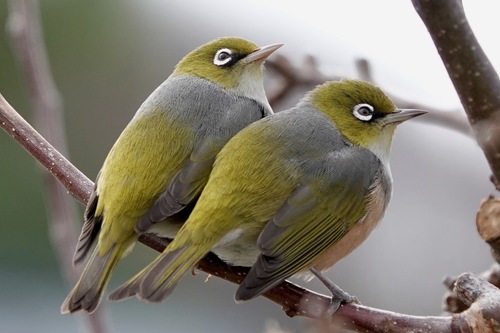
Silvereye

Silvereye

Zosterops lateralis

(c) BIHNZ, some rights reserved (CC BY), uploaded by BIHNZ, CC BY 4.0, via iNaturalist

Side by side

Réunion Olive White-eyeSilvereye
Scientific nameZosterops olivaceus (Linnaeus, 1766)Zosterops lateralis (Latham, 1802)
English nameRéunion Olive White-eyeSilvereye
GroupBirdsBirds
ClassAves BirdAves Bird
OrderPasseriformes PasserinePasseriformes Passerine
FamilyZosteropidae White-eyeZosteropidae White-eye
GenusZosterops Lesser White-eyesZosterops Lesser White-eyes
Named in17661802
Red List categoryLeast ConcernLeast Concern
Countries on record2 countries7 countries
GBIF occurrence records4,714 records1,351,144 records

Rows where the two agree are shown in grey.

Where each is found

Only Réunion Olive White-eye (2)

Only Silvereye (7)

From Catalogue of Life checklists and GBIF occurrence records. A country missing from a list means no record is held, which is not proof of absence.

Checked facts

Réunion Olive White-eyeSilvereye
Appearance
  • The bird has olive-green upperparts and a yellow rump. English Wikipedia
  • Its belly is gray and its head is black. English Wikipedia
  • The bird has a circle of white feathers surrounding its eye. English Wikipedia
  • Male and female individuals are not distinguishable by their described appearance. English Wikipedia
  • The species has dark plumage and a long, curved bill. ebird.org
  • The bird has olive-green upperparts, gray underparts, and a broad white eye-ring. ebird.org
SizeNo checked fact yet
Habitat
  • The species inhabits boreal forests and subtropical or tropical high-altitude grasslands. English Wikipedia
  • The species occurs at elevations between 500 and 2,500 metres. English Wikipedia
  • The species is frequently found in Réunion National Park and Bélouve forest. English Wikipedia
  • The bird favors locations where Hypericum lanceolatum grows. English Wikipedia
  • The silvereye occurs in vegetated habitats other than open grasslands within its distribution range. English Wikipedia
  • Its habitats include forests, scrub, horticultural blocks and urban gardens. English Wikipedia
Diet
  • The silvereye feeds on small insects and spiders, as well as fruit and nectar. English Wikipedia
  • Its diet includes berries in addition to insects, spiders, fruit and nectar. English Wikipedia
  • In New Zealand, the silvereye consumes fruit from kahikatea and rimu trees. English Wikipedia
  • Silvereyes consume insects that are harmful to garden and orchard produce, including aphids, scale insects and diamondback moths. English Wikipedia
Behaviour
  • Silvereyes gather into flocks in late summer. English Wikipedia
  • Many Australian silvereyes migrate northwards along the coast and mountain ranges. English Wikipedia
  • Migrating silvereyes forage during the day and undertake long-distance flights at night. English Wikipedia
  • Most of the Tasmanian population crosses Bass Strait and disperses into Victoria, New South Wales and south-eastern Queensland. English Wikipedia
  • Northernmost populations of silvereyes in Australia remain resident throughout the year. English Wikipedia
  • In western Australia, silvereyes have been recorded moving between the mainland and offshore islands. English Wikipedia
Reproduction
  • Silvereyes breed during spring and early summer, mainly between September and December. English Wikipedia
  • Silvereyes construct small cup-shaped nests from grass, moss, hair, spiderweb and thistledown. English Wikipedia
  • Silvereyes suspend their nests from branch forks in the outer portions of small trees or shrubs. English Wikipedia
  • A silvereye clutch contains two to four pale blue eggs. English Wikipedia
  • Silvereyes may raise two or three broods during one breeding season. English Wikipedia
  • Silvereye eggs hatch after approximately 11 days of incubation. English Wikipedia
  • Silvereye nestlings fledge approximately 10 days after hatching. English Wikipedia
  • Juvenile silvereyes become independent at approximately three weeks of age. English Wikipedia
Distribution
  • The silvereye is native to Australia, New Zealand and several south-west Pacific island groups. English Wikipedia
  • The silvereye is common to abundant in the relatively fertile south-western and south-eastern regions of Australia. English Wikipedia
  • Its Australian distribution includes Tasmania and the Bass Strait islands. English Wikipedia
  • The silvereye occurs along the well-watered coastal region of tropical Queensland, including Cape York Peninsula. English Wikipedia
  • The species was first recorded in New Zealand in 1832 and arrived in greater numbers in 1856. English Wikipedia
ConservationNo checked fact yet
UsesNo checked fact yet
  • Silvereyes provide a beneficial service in gardens and orchards by consuming insects that damage produce. English Wikipedia
  • Silvereyes can be regarded as agricultural and horticultural pests because they consume fruit crops and pass through bird netting. English Wikipedia
  • Silvereyes are attracted to apples, citrus, feijoas, figs, grapes, pears and persimmons. English Wikipedia

In brief

Réunion Olive White-eye

Zosterops olivaceus is found on the island of Réunion. It has olive-green upperparts, gray underparts, and a broad white eye-ring. Full profile

Silvereye

The Silvereye is native to Australia, New Zealand and several south-west Pacific island groups. Full profile

Compare something else

Page built on 27 November 2026 from the data on the two species pages, where every source is listed.

Cite this page

ScientificNames.org. (2026). Réunion Olive White-eye vs Silvereye. Retrieved November 27, 2026, from https://scientificnames.org/compare/reunion-olive-white-eye-vs-silvereye