Species · Fishes
Flat Needlefish Ablennes hians
The scientific name of the Flat Needlefish is Ablennes hians. It is a species of fish in the family Belonidae (needlefish), order Beloniformes. The name dates from 1846.
- Scientific name
- Ablennes hians (Valenciennes, 1846)
- Common name
- Flat Needlefish
- Genus
- Ablennes
- Family
- Belonidae (Needlefish)
- Order
- Beloniformes
- Class
- Teleostei
- Red List category
- LC Least Concern
- Environment
- brackish, marine
- Recorded in
- 60 countries
- Name status
- accepted in the Catalogue of Life

Overview
Ablennes hians usually inhabits neritic waters near islands, estuaries, and coastal rivers. It has an elongated, strongly compressed body, a relatively short beak, and approximately 12 black vertical bars or elongated blotches on its sides.
Written 26 November 2026 from the sources listed below. Each statement was checked against the passage it cites; statements that could not be supported were removed.
Appearance
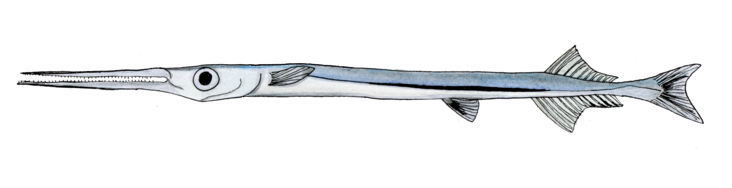
The Flat Needlefish has a strongly compressed and elongated body, with elongated jaws forming a relatively short beak. It has numerous needle-like teeth.[1][2]
Its dorsal fin has 23–26 rays, while its pectoral fins have 13–15 rays. Its dorsal and anal fins have long, concave front lobes, and the dorsal fin has a large, dark rear lobe.[3][4][5][6]
Its tail fin is strongly concave, and its compressed tail base lacks a keel. Its pectoral and anal fins are scythe-shaped.[7][8][9]
The species has 470–525 scales in front of its dorsal fin and 86–93 vertebrae. Its dorsal fin has approximately 23–26 soft rays, and its anal fin has 24–28 soft rays.[10][11][12]
Its upper body is dark bluish, and its underside is silvery white. Its sides have approximately 12 black vertical bars or elongated blotches.[13][14]
The longest recorded specimen measured 140 cm. The largest recorded weight is 4.8 kg.[15][16]
Habitat
The Flat Needlefish inhabits estuaries and usually occurs in neritic waters near islands, estuaries, and coastal rivers.[17][18]
Diet
The Flat Needlefish feeds on smaller fish.[19]
Behaviour
Individuals occasionally gather in large schools.[20]
Reproduction and life cycle
The Flat Needlefish lays eggs that attach to floating debris through filaments on their surfaces.[21]
Only the left gonad develops in both sexes. The right gonad is sometimes completely absent in males.[22][23]
Uses
The Flat Needlefish is considered a gamefish and is frequently caught using artificial lights. It is not often eaten because its flesh is green.[24][25][26]
Classification of the Flat Needlefish
| Kingdom | Animalia |
|---|---|
| Phylum | Chordata |
| Subphylum | Vertebrata |
| Infraphylum | Gnathostomata |
| Parvphylum | Osteichthyes |
| Gigaclass | Actinopterygii |
| Superclass | Actinopteri |
| Class | Teleostei (Teleost) |
| Order | Beloniformes |
| Family | Belonidae (Needlefish) |
| Genus | Ablennes |
| Species | Ablennes hians (Valenciennes, 1846) |
Where the Flat Needlefish is found
Checklists and occurrence records place Ablennes hians in 60 countries. GBIF holds 1,605 georeferenced records of it.
Countries
- Australia 173
- Bahamas 33
- Bangladesh 6
- Barbados 4
- Belize 6
- Benin 6
- Bermuda 9
- Bonaire, Saint Eustatius and Saba 10
- Cameroon 3
- China 8
- Costa Rica 3
- Cuba 11
- Dominican Republic 4
- Egypt 5
- Eritrea 4
- French Polynesia 6
- Ghana 5
- Guadeloupe 27
- Haiti 3
- Honduras 5
- India 17
- Indonesia 28
- Israel 4
- Ivory Coast 3
- Jamaica 4
- Japan 222
- Liberia 3
- Madagascar 5
- Malaysia 6
- Martinique 9
- Mayotte 3
- Mexico 103
- Mozambique 371
- Myanmar 9
- New Caledonia 6
- Oman 9
- Pakistan 9
- Panama 14
- Philippines 49
- Puerto Rico 15
- Reunion 3
- Saint Barthelemy 3
- Saudi Arabia 3
- Senegal 7
- Seychelles 6
- Sierra Leone 5
- Singapore 3
- South Africa 26
- South Korea 11
- Sri Lanka 11
- Taiwan 29
- Tanzania 4
- Thailand 15
- Trinidad and Tobago 3
- Turkey 10
- U.S. Virgin Islands 3
- United Arab Emirates 8
- United States 223
- Vietnam 9
- Yemen 3
Regions and cities with the most records
- Vilankulo, Mozambique 124
- Taiwan, Taiwan 16
- Sainte-Rose, Guadeloupe 13
- Kaseda-shirakame, Japan 12
- Minamisatsuma, Japan 12
- Scottburgh, South Africa 10
- eMkhomazi, South Africa 10
- eMuziwezinto, South Africa 10
- Capesterre-Belle-Eau, Guadeloupe 9
- KwaZulu-Natal, South Africa 9
- Acapulco de Juárez, Mexico 8
- Baie-Mahault, Guadeloupe 8
- Basse-Terre, Guadeloupe 8
- Dawei, Myanmar 8
- Ducos, Martinique 8
- Fort-de-France, Martinique 8
- Iloilo, Philippines 8
- Kralendijk, Bonaire, Saint Eustatius and Saba 8
- Le Lamentin, Martinique 8
- New South Wales, Australia 8
- Petit-Bourg, Guadeloupe 8
- Tanintharyi Region, Myanmar 8
- Busan, South Korea 7
- Florida, United States 7
- Hamilton, Bermuda 7
- Ja Ela, Sri Lanka 7
- Karachi, Pakistan 7
- Kushima, Japan 7
- Pointe-à-Pitre, Guadeloupe 7
- Sindh, Pakistan 7
- Ibusuki, Japan 6
- Kandana, Sri Lanka 6
- Katunayaka, Sri Lanka 6
- Le Gosier, Guadeloupe 6
- Les Abymes, Guadeloupe 6
- Negombo, Sri Lanka 6
8 more countries have a few records outside this range
These countries hold a few records of Ablennes hians but lie outside the range the checklists give for it. Such records are often zoo or garden specimens, museum material or vagrants, so the species is not counted as occurring there.
A number beside a place is its count of GBIF occurrence records. A place without a number comes from a checklist alone. Records show where a species has been observed or collected, which can include escapes and vagrants.
Common names
English
- Flat Needlefish
- Barred Long-tom
- Barred Longtom
- Barred Needle Fish
- Gar Fish
Names in 12 other languages
- Arabic
- Musaffaha, سمك الإبرة المسطح, سمك الإبرة المقلم
- Chinese
- 倒吊學, 學仔, 扁鶴鱵, 橫帶扁頜針魚, 白天青旗, 青旗, 青痣
- Czech
- jehlice obecná
- Danish
- Flad hornfisk
- French
- Orphie coutelas, Orphie plate
- Japanese
- ハマダツ
- Korean
- 물동갈치
- Papiamento
- Guepi Machete
- Portuguese
- agulha, agulha-da-areia, agulha-lisa, agulheta-imperial-da-guiné, carapiá, miriassanga, zambaia-taba
- Russian
- Лентовидный сарган, плоскотелый сарган, пятнистый сарган, пятнистый стрелохвост
- Spanish
- agujón sable, sauro atlántico
- Thai
- ปลากระทุงเหวบั้ง, ปลาเต็กเล้ง
Synonyms
14 other scientific names have been used for this species and are now treated as synonyms of Ablennes hians.
- Ablenes hians (Valenciennes, 1846)
- Ablennes hians pacificus Walford, 1936
- Ablennes pacificus Walford, 1936
- Athlennes hians (Valenciennes, 1846)
- Belone hians Valenciennes, 1846
- Belone maculata Poey, 1860
- Belone melanostigma Valenciennes, 1846
- Belone schismatorhynchus Bleeker, 1850
- Blennes hians (Valenciennes, 1846)
- Mastaccembelus melanostigma (Valenciennes, 1846)
- Mastacembelus fasciatus Bleeker, 1872
- Tylosurus caeruleofasciatus Stead, 1908
- Tylosurus hians (Valenciennes, 1846)
- Tylosurus schismatorhynchus (Bleeker, 1850)
Related species
-
 GarfishBelone belone
-
 HoundfishTylosurus crocodilus
-
 Atlantic NeedlefishStrongylura marina
-
 Asian NeedlefishXenentodon cancila
-
 Red Sea HoundfishTylosurus choram
-
 Mexican NeedlefishTylosurus fodiator
-
 Keeltail NeedlefishPlatybelone argalus
- Long TomStrongylura krefftii
Compare
Questions and answers
What is the scientific name of the Flat Needlefish?
The scientific name of the Flat Needlefish is Ablennes hians. Written with its author, the full name is Ablennes hians (Valenciennes, 1846).
Which family does the Flat Needlefish belong to?
Ablennes hians belongs to the family Belonidae, in the order Beloniformes and the class Teleostei.
Where is the Flat Needlefish found?
Checklists and occurrence records place Ablennes hians in 60 countries, including Mozambique, United States, Japan, Australia, Mexico and Philippines.
What is the conservation status of the Flat Needlefish?
The IUCN Red List category recorded for Ablennes hians is Least Concern (LC).
What other names does the Flat Needlefish have?
Ablennes hians is also known in English as Barred Long-tom, Barred Longtom, Barred Needle Fish and Gar Fish.
What does a needlefish eat?
The Flat Needlefish feeds on smaller fish.[19]
Where do needlefish live?
The Flat Needlefish has a circumtropical distribution across the Indian, Pacific, and Atlantic Oceans. In the eastern Atlantic, it occurs from Cape Verde and Dakar to Moçamedes in Angola. In the western Atlantic, it occurs from Chesapeake Bay south to Brazil. It occurs throughout the Indian Ocean and in the western Pacific from the southern Japanese islands to Australia and Tuvalu. It has also been recorded in the Mediterranean Sea from Syria to Israel, where specimens are considered likely migrants from the Red Sea.[27][28][29][30][31][32][33]
Sources
Passages the profile rests on
- The species has a strongly compressed and elongated body with elongated jaws forming a relatively short beak. Source passage: “Body strongly compressed; elongate jaws form a relatively short beak, with numerous needle-like teeth” — biogeodb.stri.si.edu
- The species has numerous needle-like teeth. Source passage: “numerous needle-like teeth” — biogeodb.stri.si.edu
- Its dorsal fin has 23–26 rays. Source passage: “dorsal fin with large, dark rear lobe, with 23-26 rays” — biogeodb.stri.si.edu
- Its pectoral fins have 13–15 rays. Source passage: “pectorals concave 13-15” — biogeodb.stri.si.edu
- Its dorsal and anal fins have long, concave front lobes. Source passage: “dorsal and anal fins with long concave front lobes” — biogeodb.stri.si.edu
- Its dorsal fin has a large, dark rear lobe. Source passage: “dorsal fin with large, dark rear lobe” — biogeodb.stri.si.edu
- Its tail fin is strongly concave. Source passage: “tail fin strongly concave” — biogeodb.stri.si.edu
- Its tail base is compressed and lacks a keel. Source passage: “tail base compressed, without a keel” — biogeodb.stri.si.edu
- Its pectoral and anal fins are scythe-shaped. Source passage: “with scythe-shaped pectoral and anal fins.” — English Wikipedia
- The species has 470–525 scales in front of its dorsal fin. Source passage: “470-525 scales in front of dorsal fin” — biogeodb.stri.si.edu
- Its dorsal fin has approximately 23–26 soft rays and its anal fin has 24–28 soft rays. Source passage: “About 23-26 rays are on the dorsal fin and 24-28 are on the anal fin.” — English Wikipedia
- The species has 86–93 vertebrae. Source passage: “They have 86-93 vertebrae.” — English Wikipedia
- Its upper body is dark bluish and its underside is silvery white. Source passage: “Dark bluish above, silvery white below” — biogeodb.stri.si.edu
- Its sides have approximately 12 black vertical bars or elongated blotches. Source passage: “~12 black bars or vertically elongated blotches on sides.” — biogeodb.stri.si.edu
- The longest recorded specimen measured 140 cm. Source passage: “The longest recorded flat needlefish measured 140 cm.” — English Wikipedia
- The largest recorded weight for the species is 4.8 kg. Source passage: “The largest recorded weight for a flat needlefish was 4.8 kg.” — English Wikipedia
- The species inhabits estuaries. Source passage: “Estuary Water column Reef associated” — biogeodb.stri.si.edu
- The species usually inhabits neritic waters near islands, estuaries, and coastal rivers. Source passage: “Flat needlefish usually live in neritic ocean waters near islands, estuaries, and near coastal rivers” — English Wikipedia
- The species feeds on smaller fish. Source passage: “where they feed on smaller fish” — English Wikipedia
- Individuals occasionally gather in large schools. Source passage: “occasionally gather in large schools.” — English Wikipedia
- The species lays eggs that attach to floating debris through filaments on their surfaces. Source passage: “Flat needlefish lay eggs, which attach themselves to floating debris by filaments on the surface of each egg.” — English Wikipedia
- Only the left gonad develops in both sexes. Source passage: “Only the left gonad in both sexes is developed” — English Wikipedia
- The right gonad is sometimes completely absent in males. Source passage: “in males, the right gonad is sometimes wholly absent.” — English Wikipedia
- The species is considered a gamefish. Source passage: “Flat needlefish are considered gamefish” — English Wikipedia
- The species is frequently caught using artificial lights. Source passage: “frequently caught with the help of artificial lights” — English Wikipedia
- The species is not often eaten because its flesh is green. Source passage: “but are not often eaten because of their green-colored flesh.” — English Wikipedia
- The species has a circumtropical distribution across the Indian, Pacific, and Atlantic Oceans. Source passage: “Circumtropical ( Indian + Pacific + Atlantic Oceans)” — biogeodb.stri.si.edu
- In the eastern Atlantic, the species occurs from Cape Verde and Dakar to Moçamedes in Angola. Source passage: “In the Eastern Atlantic, they are known from Cape Verde and Dakar to Moçamedes in Angola.” — English Wikipedia
- In the western Atlantic, the species occurs from Chesapeake Bay south to Brazil. Source passage: “In the western Atlantic, they are known from the Chesapeake Bay south to Brazil.” — English Wikipedia
- The species occurs throughout the Indian Ocean. Source passage: “They are found throughout the Indian Ocean” — English Wikipedia
- In the western Pacific, the species occurs from the southern Japanese islands to Australia and Tuvalu. Source passage: “in the western Pacific from the southern islands of Japan to Australia and Tuvalu.” — English Wikipedia
- The species has been recorded in the Mediterranean Sea from Syria to Israel. Source passage: “A few specimens have been collected from Syria to Israel in the Mediterranean Sea” — English Wikipedia
- The Mediterranean specimens are considered likely migrants from the Red Sea. Source passage: “likely migrants from the Red Sea.” — English Wikipedia
Data
- Catalogue of Life, 2026-10-16 XR cc by
- Global Biodiversity Information Facility CC BY 4.0
- Wikidata CC0
- GeoNames CC BY 4.0
- Wikimedia Commons per image; credit shown with each image
- Within the Catalogue of Life, this name comes from World Register of Marine Species cc by
References
- Cuvier and Valenciennes, 1846 where the name was published
This species in other databases
- Catalogue of Life 8L46
- Wikidata Q2530772
- iNaturalist 135196
- WoRMS urn:lsid:marinespecies.org:taxname:159246
- ITIS 165548
Page built on 28 November 2026. See how the catalog is made and all sources and licences.
Cite this page
ScientificNames.org. (2026). Ablennes hians (Flat Needlefish). Retrieved November 28, 2026, from https://scientificnames.org/species/ablennes-hians
“Ablennes hians (Flat Needlefish).” ScientificNames.org, 2026, scientificnames.org/species/ablennes-hians. Accessed 28 Nov. 2026.
ScientificNames.org. “Ablennes hians (Flat Needlefish).” Accessed November 28, 2026. https://scientificnames.org/species/ablennes-hians.
@misc{scientificnames_ablennes_hians_flat_needlefish,
  author = {{ScientificNames.org}},
  title = {Ablennes hians (Flat Needlefish)},
  year = {2026},
  url = {https://scientificnames.org/species/ablennes-hians},
  note = {Accessed 2026-11-28}
}