Species · Flowering plants
Buffalo Sallow Wattle Acacia phlebophylla
The scientific name of the Buffalo Sallow Wattle is Acacia phlebophylla. It is a species of flowering plant in the family Fabaceae (bean), order Fabales.
- Scientific name
- Acacia phlebophylla F.Muell. ex H.B.Will.
- Common name
- Buffalo Sallow Wattle
- Genus
- Acacia
- Family
- Fabaceae (Bean)
- Order
- Fabales
- Class
- Magnoliopsida
- Red List category
- CR Critically Endangered
- Environment
- terrestrial
- Recorded in
- 1 country
- Name status
- accepted in the Catalogue of Life
Overview
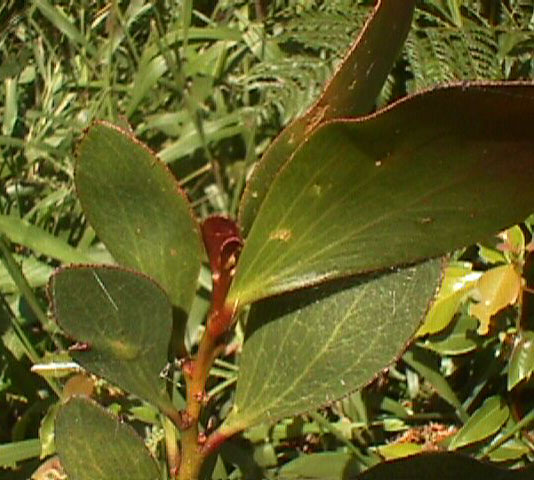
Acacia phlebophylla is distinguished by its wide, rounded, asymmetrical phyllodes and deep yellow, rod-shaped flowers.
Written 26 November 2026 from the sources listed below. Each statement was checked against the passage it cites; statements that could not be supported were removed.
Appearance
Buffalo Sallow Wattle is a shrub or small tree that commonly grows to 3 metres tall but can occasionally reach 6 metres. Its phyllodes are oblanceolate, obovate or elliptic and commonly asymmetrical.[1][2][3]
The phyllodes measure 4–14 cm long and 1.5–6 cm wide, with prominent nerves and reticulated veins. The flowers are deep yellow and rod-shaped, scattered across one or two spikes per axil, with each spike measuring 4–7 cm long.[4][5][6]
Its fruits are straight or slightly curved legumes measuring 7–10 cm long.[7]
Reproduction and life cycle
The fruits appear between November and March. Each fruit releases between five and ten elliptical seeds.[8][9]
Habitat
Buffalo Sallow Wattle occurs mainly in woodlands and heathlands on steep slopes, at elevations between 500 and 1,200 metres above sea level. It grows in shallow to skeletal granite soils, often among boulders.[10][11][12]
Conservation
Buffalo Sallow Wattle is classified as critically endangered on the IUCN Red List. Its estimated extent of occurrence is less than 100 square kilometres, and its estimated population consists of 250–500 mature individuals.[13][14][15]
Its known range contains an estimated 25–40 subpopulations, and the species is restricted to a few sites on the Mount Buffalo massif. The current population trend is unknown.[16][17][18]
Infection by the gall fungus Uromycladium tepperianum is identified as a major threat. Increasing wildfire frequency and intensity and collection for psychotropic use also threaten the species.[19][20][21]
Attempts to cultivate the species outside its natural habitat have mostly been unsuccessful. Cultivated plants have usually died at approximately three years of age.[22][23]
Healthy cultivated plants have been reported in private gardens near Gatton in Queensland, near Meadows in South Australia, and in Ireland.[24]
Uses
Buffalo Sallow Wattle contains dimethyltryptamine as its predominant alkaloid throughout its tissues. It is described as one of the purest natural sources of dimethyltryptamine.[25][26]
Similar species
Buffalo Sallow Wattle is closely related to Acacia alpina. Acacia alpina differs by being larger in all parts, having irregularly resinous margins and having a woodier fruit.[27][28]
Hybrids involving Acacia phlebophylla and Acacia alpina are recorded from Mount Buffalo, Victoria. Hybridization with Acacia dallachiana occurs as Buffalo Sallow Wattle approaches that species' taller forest habitat.[29][30]
Classification of the Buffalo Sallow Wattle
| Kingdom | Plantae |
|---|---|
| Subkingdom | Pteridobiotina |
| Phylum | Tracheophyta |
| Class | Magnoliopsida |
| Order | Fabales |
| Family | Fabaceae (Bean) |
| Genus | Acacia (Wattle) |
| Section | sect. Juliflorae |
| Species | Acacia phlebophylla F.Muell. ex H.B.Will. |
Where the Buffalo Sallow Wattle is found
Checklists and occurrence records place Acacia phlebophylla in 1 country across Oceania. GBIF holds 132 georeferenced records of it.
Countries
Regions and cities with the most records
Range as the checklists state it
Australia, Victoria
A number beside a place is its count of GBIF occurrence records. A place without a number comes from a checklist alone. Records show where a species has been observed or collected, which can include escapes and vagrants.
Common names
English
- Buffalo Sallow Wattle
- Buffalo Sallow-wattle
Names in 1 other language
- Chinese
- 水牛山相思
Synonyms
4 other scientific names have been used for this species and are now treated as synonyms of Acacia phlebophylla.
- Acacia longifolia var. phlebophylla F.Muell.
- Acacia longifolia var. phlebophylla F.Muell. ex Benth.
- Acacia sophorae var. montana F.Muell.
- Racosperma phlebophyllum (F.Muell. ex H.B.Will.) Pedley
Related species
-
 Golden WattleAcacia pycnantha
-
 Silver WattleAcacia dealbata
-
 Black WattleAcacia mearnsii
-
 KoaAcacia koa
-
 BlackwoodAcacia melanoxylon
-
 Ear-pod WattleAcacia auriculiformis
-
 Formosan KoaAcacia confusa
-
 MulgaAcacia aneura
Compare
Questions and answers
What is the scientific name of the Buffalo Sallow Wattle?
The scientific name of the Buffalo Sallow Wattle is Acacia phlebophylla. Written with its author, the full name is Acacia phlebophylla F.Muell. ex H.B.Will..
Which family does the Buffalo Sallow Wattle belong to?
Acacia phlebophylla belongs to the family Fabaceae, in the order Fabales and the class Magnoliopsida.
Where is the Buffalo Sallow Wattle found?
Checklists and occurrence records place Acacia phlebophylla in 1 country: Australia.
What is the conservation status of the Buffalo Sallow Wattle?
The IUCN Red List category recorded for Acacia phlebophylla is Critically Endangered (CR).
What other names does the Buffalo Sallow Wattle have?
Acacia phlebophylla is also known in English as Buffalo Sallow-wattle.
Sources
Passages the profile rests on
- Acacia phlebophylla is a shrub or small tree with wide, rounded, asymmetrical phyllodes. Source passage: “It grows up to a maximum of 6 metres (20 ft) tall and has wide, rounded asymmetrical phyllodes.” — English Wikipedia
- The species commonly grows to 3 metres tall but can occasionally reach 6 metres. Source passage: “growing up to 3 metres (9.8 ft) tall and occasionally reaching heights of up to 6 m (20 feet) tall.” — English Wikipedia
- Its phyllodes are oblanceolate, obovate or elliptic and commonly asymmetrical. Source passage: “Its phyllodes are oblanceolate, obovate or elliptic and commonly asymmetrical in shape” — English Wikipedia
- Its phyllodes measure 4–14 cm long and 1.5–6 cm wide and have prominent nerves and reticulated veins. Source passage: “4–14cm long and 1.5–6cm wide with prominent nerves and reticulated veins.” — English Wikipedia
- The species produces deep yellow, rod-shaped flowers. Source passage: “Deep yellow rod-like flowers appear in June–December” — English Wikipedia
- Its flowers are scattered across one or two spikes per axil, with each spike measuring 4–7 cm long. Source passage: “widely scattered on 1-2 spikes per axil 4–7cm long.” — English Wikipedia
- Its fruits are straight or slightly curved legumes measuring 7–10 cm long. Source passage: “The fruits are straight or slightly curved legumes, 7–10cm long” — English Wikipedia
- The fruits appear between November and March. Source passage: “appear in November–March” — English Wikipedia
- Each fruit releases between five and ten elliptical seeds. Source passage: “releasing 5–10 elliptical seeds” — English Wikipedia
- The species occurs mainly in woodlands and heathlands on steep slopes. Source passage: “It mostly occurs woodlands and heathlands on steep slopes” — English Wikipedia
- It occurs at elevations between 500 and 1,200 metres above sea level. Source passage: “between 500-1200m above sea level.” — English Wikipedia
- It grows in shallow to skeletal granite soils, often among boulders. Source passage: “It grows in shallow to skeletal soils of granite, often amongst boulders.” — English Wikipedia
- Acacia phlebophylla is classified as critically endangered on the IUCN Red List. Source passage: “Acacia phlebophylla is listed as critically endangered on the IUCN Red List of Threatened Species” — English Wikipedia
- The species has an estimated extent of occurrence of less than 100 square kilometres. Source passage: “with an estimated extent of occurrence of less than 100 km2” — English Wikipedia
- Its estimated population consists of 250–500 mature individuals. Source passage: “population estimates range from 250-500 mature individuals.” — English Wikipedia
- Its known range contains an estimated 25–40 subpopulations. Source passage: “with an estimated 25 to 40 subpopulations.” — English Wikipedia
- The species is restricted to a few sites on the Mount Buffalo massif. Source passage: “It is restricted to the single location of a few sites on the Mount Buffalo massif” — English Wikipedia
- The current population trend of the species is unknown. Source passage: “Its current population trend is unknown” — English Wikipedia
- Infection by the gall fungus Uromycladium tepperianum is identified as a major threat. Source passage: “infection by the gall fungus Uromycladium tepperianum” — English Wikipedia
- Increasing wildfire frequency and intensity threaten the species. Source passage: “an increase in wildfire frequency and intensity” — English Wikipedia
- Collection for psychotropic use is identified as a threat to the species. Source passage: “collection for use for use as a psychotropic.” — English Wikipedia
- Attempts to cultivate the species outside its natural habitat have mostly been unsuccessful. Source passage: “Attempts at ex-situ cultivation have been mostly unsuccessful” — English Wikipedia
- Cultivated plants have usually died at approximately three years of age. Source passage: “have usually resulted in plants dying at 3 years.” — English Wikipedia
- Healthy cultivated plants have been reported in private gardens near Gatton in Queensland, near Meadows in South Australia, and in Ireland. Source passage: “Healthy plants exist in private gardens near Gatton, Queensland as well near Meadows in South Australia and in Ireland” — English Wikipedia
- The plant contains dimethyltryptamine as its predominant alkaloid throughout its tissues. Source passage: “which occurs as the predominant alkaloid throughout the plant.” — English Wikipedia
- The species is described as one of the purest natural sources of dimethyltryptamine. Source passage: “Acacia phlebophylla is one of the purest natural sources of the psychedelic drug dimethyltryptamine” — English Wikipedia
- Acacia phlebophylla is closely related to Acacia alpina. Source passage: “This species is closely related to A. alpina” — English Wikipedia
- Acacia alpina differs by being larger in all parts, having irregularly resinous margins and having a woodier fruit. Source passage: “which can be distinguished by being much larger in all parts, having irregularly resinous margins and having a woodier fruit.” — English Wikipedia
- Hybridization with Acacia dallachiana occurs as the species approaches that species' taller forest habitat. Source passage: “and A. dallachiana as it approaches the taller forest habitat of the species.” — English Wikipedia
- Hybrids involving Acacia phlebophylla and Acacia alpina are recorded from Mount Buffalo, Victoria. Source passage: “Hybrids between Acacia phlebophylla and A. alpina and A. dallachiana are recorded from Mt Buffalo, Vic.” — bie.ala.org.au
Data
- Catalogue of Life, 2026-10-16 XR cc by
- Global Biodiversity Information Facility CC BY 4.0
- Wikidata CC0
- GeoNames CC BY 4.0
- Wikimedia Commons per image; credit shown with each image
- Within the Catalogue of Life, this name comes from World Wide Wattle cc by
References
- Fl. Victoria : 607 (1931) where the name was published
- F.Muell. ex H.B.Will. (1931).
This species in other databases
Page built on 29 November 2026. See how the catalog is made and all sources and licences.
Cite this page
ScientificNames.org. (2026). Acacia phlebophylla (Buffalo Sallow Wattle). Retrieved November 29, 2026, from https://scientificnames.org/species/acacia-phlebophylla
“Acacia phlebophylla (Buffalo Sallow Wattle).” ScientificNames.org, 2026, scientificnames.org/species/acacia-phlebophylla. Accessed 29 Nov. 2026.
ScientificNames.org. “Acacia phlebophylla (Buffalo Sallow Wattle).” Accessed November 29, 2026. https://scientificnames.org/species/acacia-phlebophylla.
@misc{scientificnames_acacia_phlebophylla_buffalo_sallow_wattle,
  author = {{ScientificNames.org}},
  title = {Acacia phlebophylla (Buffalo Sallow Wattle)},
  year = {2026},
  url = {https://scientificnames.org/species/acacia-phlebophylla},
  note = {Accessed 2026-11-29}
}