Species · Flowering plants
Greater Burnet Acaena magellanica
The scientific name of the Greater Burnet is Acaena magellanica. It is a species of flowering plant in the family Rosaceae (rose family), order Rosales.
- Scientific name
- Acaena magellanica (Lam.) Vahl
- Common name
- Greater Burnet
- Genus
- Acaena
- Family
- Rosaceae (Rose Family)
- Order
- Rosales
- Class
- Magnoliopsida
- Recorded in
- 9 countries
- Name status
- accepted in the Catalogue of Life

Overview
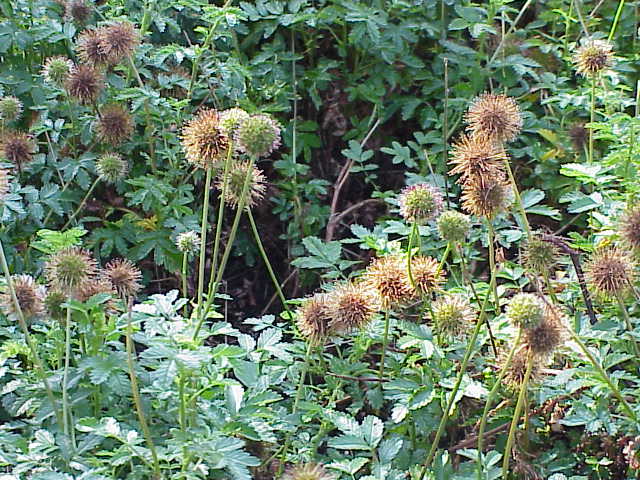
Greater Burnet is a perennial flowering plant in the genus Acaena and family Rosaceae. It is native to the southern part of South America, including Argentina, Chile, the Falkland Islands, the Kerguelen Islands, the Prince Edward Islands, South Georgia and the South Sandwich Islands, and the Heard Island and McDonald Islands. It forms mats with creeping stems and produces brown seed heads covered with prickles.
Written 26 November 2026 from the sources listed below. Each statement was checked against the passage it cites; statements that could not be supported were removed.
Appearance
Greater Burnet is a perennial plant that forms mats and has creeping stems. It grows to a maximum height of approximately 14 cm.[1][2][3]
Its leaves are oblong to linear-lanceolate, with between five and ten pairs of ovate leaflets on each leaf. Its globular flower heads grow on wiry stems above the foliage.[4][5][6]
The plant produces brown seed heads covered with prickles.[7]
Habitat
Greater Burnet typically grows in damp environments and along stream banks. It occurs from sea level to approximately 4,200 metres elevation.[8][9][10]
Behaviour
In South Georgia, Greater Burnet can form dense patches covering the ground.[11]
Reproduction and life cycle
Its seeds have small hooks that allow them to attach to clothing, feathers, and fur.[12]
Conservation
Greater Burnet failed to recover after rabbit eradication because prolonged grazing had depleted its seed bank.[13]
Introduced annual meadow grass, mouse-ear chickweed, and dandelion competed with Greater Burnet and other native forbs.[14][15][16]
Classification of the Greater Burnet
| Kingdom | Plantae |
|---|---|
| Subkingdom | Pteridobiotina |
| Phylum | Tracheophyta |
| Class | Magnoliopsida |
| Order | Rosales |
| Family | Rosaceae (Rose Family) |
| Subfamily | Rosoideae |
| Tribe | Agrimonieae |
| Subtribe | Sanguisorbinae |
| Genus | Acaena (Bidibid) |
| Species | Acaena magellanica (Lam.) Vahl |
Where the Greater Burnet is found
Checklists and occurrence records place Acaena magellanica in 9 countries across Asia, Europe, Oceania and South America. GBIF holds 1,603 georeferenced records of it.
Countries where it is native or its origin is not stated
- Argentina 575
- Australia 187
- Chile 397
- Falkland Islands 92
- Georgia
- New Zealand 9
- Peru
- South Georgia and the South Sandwich Islands 338
Countries where it has been introduced
Regions and cities with the most records
- Tierra del Fuego, Argentina 305
- Grytviken, South Georgia and the South Sandwich Islands 211
- Ushuaia, Argentina 201
- Tasmania, Australia 154
- Santa Cruz, Argentina 49
- Aysén, Chile 33
- Stanley, Falkland Islands 31
- Rio Negro, Argentina 20
- Santiago Metropolitan, Chile 16
- Catamarca, Argentina 13
- Punta Arenas, Chile 13
- San Juan, Argentina 12
- Chubut, Argentina 10
- El Calafate, Argentina 10
- Atacama, Chile 8
- Río Grande, Argentina 8
- Los Lagos Region, Chile 7
- Valparaiso, Chile 7
- Antofagasta, Chile 6
- Araucania, Chile 6
- Maule Region, Chile 6
- Puerto Natales, Chile 6
- Coyhaique, Chile 5
- Mendoza, Argentina 5
- Neuquen, Argentina 5
- Coquimbo Region, Chile 4
- San Carlos de Bariloche, Argentina 4
- North Rhine-Westphalia, Germany 3
- Biobio, Chile 1
- La Rioja, Argentina
- Salta, Argentina
- Tarapacá, Chile
- Ñuble, Chile
7 more countries have a few records outside this range
These countries hold a few records of Acaena magellanica but lie outside the range the checklists give for it. Such records are often zoo or garden specimens, museum material or vagrants, so the species is not counted as occurring there.
Range as the checklists state it
Germany [I]; New Zealand; Peru; Argentina (Catamarca, Chubut, La Rioja, Mendoza, Neuquén, Rio Negro, Salta, Santa Cruz, San Juan, Tierra del Fuego); Chile (Arica y Parinacota, Tarapacá, Antofagasta, Atacama, Coquimbo, Valparaíso, Metropolitana de Santiago, O'Higgins, Maule, Ñuble, Biobío, Araucanía, Los Rios, Los Lagos, Aisén, Magallanes); Macquarie Isl.; Heard Isl.; Macdonald Isl.; Marion Isl.; Prince Edward Isl.; Îles Crozet; Îles Kerguélen; Falkland Isl.; South Georgia Isl.
A number beside a place is its count of GBIF occurrence records. A place without a number comes from a checklist alone. Records show where a species has been observed or collected, which can include escapes and vagrants.
Common names
English
- Greater Burnet
- Prickly-burr
Names in 7 other languages
- Finnish
- tulimaanakeena
- German
- Magellan-Stachelnüsschen, Magellanen-Stachelnüsschen
- Polish
- Acena sina
- Russian
- Ацена магелланская
- Slovak
- acéna magalhaeská
- Spanish
- Cadillo
- Swedish
- patagonisk taggpimpinell
Synonyms
112 other scientific names have been used for this species and are now treated as synonyms of Acaena magellanica.
- Acaena acroglochin Bitter
- Acaena acutifida Bitter
- Acaena adscendens (Lam.) Vahl
- Acaena adscendens subsp. cardiostemon Bitter
- Acaena adscendens subsp. georgiae-australis Bitter
- Acaena adscendens var. glabriscapa Bitter
- Acaena adscendens var. incisa Bitter
- Acaena adscendens var. luxurians Bitter
- Acaena adscendens var. macrochaeta Franch.
- Acaena adscendens var. majuscula Bitter
- Acaena adscendens var. minuscula Bitter
- Acaena adscendens var. pilosiscapa Bitter
- Acaena adscendens var. semperpilosa Bitter
- Acaena adscendens var. utrinqueglabrescens Bitter
- Acaena affinis Hook.fil.
- Acaena alboffii Macloskie
- Acaena ascendens var. macrochaeta Franch.
- Acaena basibullata Bitter
- Acaena brachyglochin Bitter
- Acaena cadilla Hook.fil.
- Acaena cadilla f. epistemonocoma Bitter
- Acaena cadilla f. pusilla Bitter
- Acaena calvivagina Bitter
- Acaena canescens Phil.
- Acaena chamacaena Bitter
- Acaena closiana Gay
- Acaena colchaguensis Bitter
- Acaena compacta Hauman
- Acaena coxi Phil.
- Acaena depauperata Bitter
- Acaena deserticola Phil.
- Acaena exaltata Bitter
- Acaena floribunda Bitter
- Acaena glandulifera Bitter
- Acaena glandulifera subsp. nordenskjoeldii Bitter
- Acaena glaucella Bitter
- Acaena glaucophylla Bitter
- Acaena grahamiana Gillies ex Walp.
- Acaena grandistipula Bitter
- Acaena grossifolia Bitter
Showing 40 of 112.
Related species
-
 Biddy-biddyAcaena novae-zelandiae
-
 Bronze Piri-piri-burAcaena anserinifolia
-
 Sheep's BurrAcaena echinata
-
 New Zealand-burAcaena microphylla
-
 Two-spine AcaenaAcaena ovalifolia
-
 Spineless AcaenaAcaena inermis
- Lesser BurnetAcaena tenera
-
 Glaucous Pirri-pirri-burAcaena caesiiglauca
Compare
Questions and answers
What is the scientific name of the Greater Burnet?
The scientific name of the Greater Burnet is Acaena magellanica. Written with its author, the full name is Acaena magellanica (Lam.) Vahl.
Which family does the Greater Burnet belong to?
Acaena magellanica belongs to the family Rosaceae, in the order Rosales and the class Magnoliopsida.
Where is the Greater Burnet found?
Checklists and occurrence records place Acaena magellanica in 9 countries, including Argentina, Chile, South Georgia and the South Sandwich Islands, Australia, Falkland Islands and New Zealand.
What other names does the Greater Burnet have?
Acaena magellanica is also known in English as Prickly-burr.
Sources
Passages the profile rests on
- Acaena magellanica is a perennial plant that forms mats and has creeping stems. Source passage: “Acaena magellanica is a perennial, mat-forming plant with creeping stems” — English Wikipedia
- The plant grows to a maximum height of approximately 14 cm. Source passage: “up to 14 cm (6 in) high.” — English Wikipedia
- Acaena magellanica is a perennial plant. Source passage: “Acaena magellanica is a perennial” — English Wikipedia
- Its leaves are oblong to linear-lanceolate in shape. Source passage: “The leaves are oblong to linear-lanceolate” — English Wikipedia
- Each leaf has between five and ten pairs of ovate leaflets. Source passage: “with 5 to 10 pairs of ovate leaflets.” — English Wikipedia
- Its globular flower heads grow on wiry stems positioned above the foliage. Source passage: “The flower heads are globular and grow on wiry stems well clear of the foliage.” — English Wikipedia
- The plant produces brown seed heads covered with prickles. Source passage: “They are followed by brown, prickly seed heads” — English Wikipedia
- The species typically grows in damp environments. Source passage: “Its typical habitat is damp places” — English Wikipedia
- The species grows along stream banks. Source passage: “the banks of streams” — English Wikipedia
- Acaena magellanica occurs from sea level to approximately 4,200 metres elevation. Source passage: “It grows from sea level to an altitude of about 4,200 m (13,800 ft).” — English Wikipedia
- In South Georgia, the species can form dense patches covering the ground. Source passage: “In South Georgia, Acaena magellanica may cover the ground in dense patches.” — English Wikipedia
- Its seeds have small hooks that allow them to attach to clothing, feathers, and fur. Source passage: “the seeds have small hooks which enables them to adhere to clothing, feathers or fur.” — English Wikipedia
- Acaena magellanica failed to recover after rabbit eradication because prolonged grazing had depleted its seed bank. Source passage: “A. magellanica and other forbs failed to recover because years of herbivory had depleted their seed banks” — English Wikipedia
- Introduced annual meadow grass competed with Acaena magellanica and other native forbs in the Kerguelen Islands. Source passage: “introduced species such as annual meadow grass (Poa annua)” — English Wikipedia
- Introduced mouse-ear chickweed competed with Acaena magellanica and other native forbs. Source passage: “mouse-ear chickweed (Cerastium fontanum)” — English Wikipedia
- Introduced dandelion competed with Acaena magellanica and other native forbs. Source passage: “dandelion (Taraxacum officinale) out-competed them.” — English Wikipedia
Data
- Catalogue of Life, 2026-10-16 XR cc by
- Global Biodiversity Information Facility CC BY 4.0
- Wikidata CC0
- GeoNames CC BY 4.0
- Wikimedia Commons per image; credit shown with each image
- Within the Catalogue of Life, this name comes from Synonymic Checklists of the Vascular Plants of the World cc by
References
- Vahl. (1804). Enum. Pl. [Vahl] 1: 297 (1804). where the name was published
This species in other databases
- Catalogue of Life 8QFX
- Wikidata Q4671623
- iNaturalist 83487
- World Flora Online wfo-0000985090
- GRIN 417168
Page built on 29 November 2026. See how the catalog is made and all sources and licences.
Cite this page
ScientificNames.org. (2026). Acaena magellanica (Greater Burnet). Retrieved November 29, 2026, from https://scientificnames.org/species/acaena-magellanica
“Acaena magellanica (Greater Burnet).” ScientificNames.org, 2026, scientificnames.org/species/acaena-magellanica. Accessed 29 Nov. 2026.
ScientificNames.org. “Acaena magellanica (Greater Burnet).” Accessed November 29, 2026. https://scientificnames.org/species/acaena-magellanica.
@misc{scientificnames_acaena_magellanica_greater_burnet,
  author = {{ScientificNames.org}},
  title = {Acaena magellanica (Greater Burnet)},
  year = {2026},
  url = {https://scientificnames.org/species/acaena-magellanica},
  note = {Accessed 2026-11-29}
}