Species · Flowering plants
Bear's Breech Acanthus montanus
The scientific name of the Bear's Breech is Acanthus montanus. It is a species of flowering plant in the family Acanthaceae (acanthus family), order Lamiales.
- Scientific name
- Acanthus montanus (Nees) T.Anderson
- Common name
- Bear's Breech
- Genus
- Acanthus
- Family
- Acanthaceae (Acanthus Family)
- Order
- Lamiales
- Class
- Magnoliopsida
- Red List category
- LC Least Concern
- Recorded in
- 26 countries
- Name status
- accepted in the Catalogue of Life

Overview
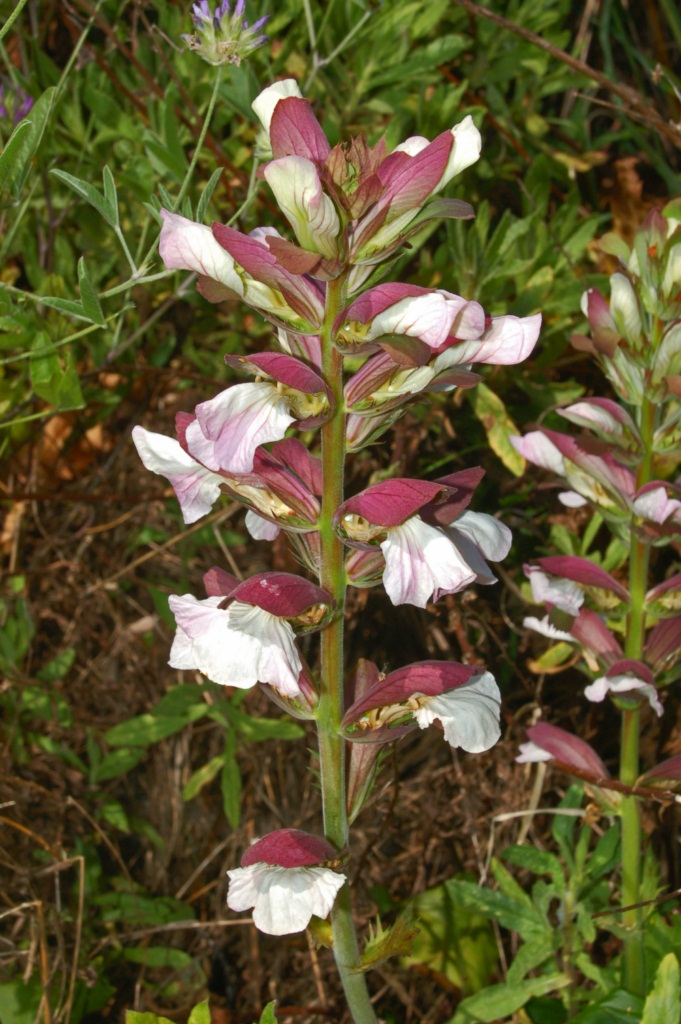
Acanthus montanus is native to tropical Africa, with a documented native range including Sierra Leone, Zambia and Angola. It is distinguished by glossy, dark green leaves with silver markings, wavy thorny margins, and pale pink flowers growing in spikes.
Written 26 November 2026 from the sources listed below. Each statement was checked against the passage it cites; statements that could not be supported were removed.
Appearance
Bear's breech has thinly branched growth with basal clusters of glossy, dark green leaves. Its leaves are oblong to lance-shaped, with silver markings, wavy margins and thorns.[1][2]
The plant has a woody stem base and hairy stem nodes. Its flowers are pale pink and grow in spikes.[3][4]
Its leaves can reach 30 cm in length. The plant can grow up to 1.8 m tall and reach approximately 61 cm in width.[5][6][7]
Habitat
Bear's breech grows naturally in wet and shady places. Its natural habitats include stream borders in Sierra Leone.[8][9]
In cultivation, the species prefers shady growing conditions but tolerates sunny and dry conditions.[10][11]
Behaviour
Bear's breech has aggressive roots.[12]
Uses
Bear's breech is well suited for planting on slopes because of its aggressive roots. In cultivation, the species benefits from occasional deep watering.[12][13][14]
Reproduction and life cycle
Bear's breech produces pale pink flowers in spikes from summer through fall.[15]
Classification of the Bear's Breech
| Kingdom | Plantae |
|---|---|
| Subkingdom | Pteridobiotina |
| Phylum | Tracheophyta |
| Class | Magnoliopsida |
| Order | Lamiales |
| Family | Acanthaceae (Acanthus Family) |
| Subfamily | Acanthoideae |
| Tribe | Acantheae |
| Subtribe | Acanthinae |
| Genus | Acanthus (Bear's Breech) |
| Species | Acanthus montanus (Nees) T.Anderson |
Where the Bear's Breech is found
Checklists and occurrence records place Acanthus montanus in 26 countries across Africa and North America. GBIF holds 945 georeferenced records of it.
Countries where it is native or its origin is not stated
- Angola 29
- Benin 11
- Cameroon 258
- Central African Republic 27
- Chad
- Costa Rica 3
- Democratic Republic of the Congo 198
- Dominican Republic 1
- El Salvador 6
- Equatorial Guinea 35
- Ethiopia 9
- Gabon 120
- Ghana 4
- Honduras
- Ivory Coast 7
- Liberia 3
- Malawi 4
- Mozambique
- Nigeria 127
- Republic of the Congo 21
- Sao Tome and Principe 32
- Tanzania 16
- United States 32
- Zambia 2
- Zimbabwe
Countries where it has been introduced
Regions and cities with the most records
- South-West, Cameroon 69
- Tshopo, Democratic Republic of the Congo 46
- Centre, Cameroon 41
- Estuaire, Gabon 39
- East, Cameroon 32
- Delta, Nigeria 24
- Yangambi, Democratic Republic of the Congo 23
- Ogooué-Ivindo, Gabon 22
- South, Cameroon 22
- Yaoundé, Cameroon 21
- Équateur, Democratic Republic of the Congo 19
- Libreville, Gabon 18
- West, Cameroon 18
- Buea, Cameroon 16
- Adamaoua, Cameroon 15
- Mutengene, Cameroon 15
- Kekem, Cameroon 14
- Melong, Cameroon 14
- Tiko, Cameroon 14
- Limbe, Cameroon 13
- North-West, Cameroon 13
- Owendo, Gabon 13
- Rivers State, Nigeria 13
- Kumba, Cameroon 11
- Príncipe, Sao Tome and Principe 11
- Bas-Uele, Democratic Republic of the Congo 10
- Loum, Cameroon 10
- Nkongsamba, Cameroon 10
- Tombel, Cameroon 10
- Bafang, Cameroon 9
- Bolenge, Democratic Republic of the Congo 9
- Manjo, Cameroon 9
- Mbandaka, Democratic Republic of the Congo 9
- Badessa, Ethiopia 8
- Bodītī, Ethiopia 8
- Ekiti State, Nigeria 8
7 more countries have a few records outside this range
These countries hold a few records of Acanthus montanus but lie outside the range the checklists give for it. Such records are often zoo or garden specimens, museum material or vagrants, so the species is not counted as occurring there.
Range as the checklists state it
Benin; Nigeria; Cameroon; Bioko Isl. [Fernando Poo]; Principe Isl.; São Tomé; Equatorial Guinea; Gabon; Congo [Brazzaville]; Central African Republic; D. R. Congo [Zaire]; S-Chad; Angola; Zambia; Zimbabwe; Mozambique; Mauritius [I]; Honduras [c]; Hispaniola [c] (Dominican Republic [c])
A number beside a place is its count of GBIF occurrence records. A place without a number comes from a checklist alone. Records show where a species has been observed or collected, which can include escapes and vagrants.
Common names
English
- Bear's Breech
- Mountain Thistle
Names in 5 other languages
- Czech
- paznehtník horský
- Dutch
- Bergacanthus
- Estonian
- mägi-karusõrg
- German
- Gebirgs-Akanthus
- Slovak
- akant horský
Synonyms
3 other scientific names have been used for this species and are now treated as synonyms of Acanthus montanus.
- Acanthus barteri T.Anderson
- Acanthus caudatus Lindau
- Cheilopsis montana Nees
Related species
-
 Bear's BreechAcanthus mollis
-
 Spiny Bear's-BreechAcanthus spinosus
-
 Holly MangroveAcanthus ilicifolius
-
 Sea HollyAcanthus ebracteatus
-
 Hungarian Bear’s-BreechesAcanthus hungaricus
-
 Syrian AcanthusAcanthus hirsutus
-
 Bear's BreechesAcanthus polystachyus
-
 Ethiopian AcanthusAcanthus sennii
Compare
Questions and answers
What is the scientific name of the Bear's Breech?
The scientific name of the Bear's Breech is Acanthus montanus. Written with its author, the full name is Acanthus montanus (Nees) T.Anderson.
Which family does the Bear's Breech belong to?
Acanthus montanus belongs to the family Acanthaceae, in the order Lamiales and the class Magnoliopsida.
Where is the Bear's Breech found?
Checklists and occurrence records place Acanthus montanus in 26 countries, including Cameroon, Democratic Republic of the Congo, Nigeria, Gabon, Equatorial Guinea and Sao Tome and Principe.
What is the conservation status of the Bear's Breech?
The IUCN Red List category recorded for Acanthus montanus is Least Concern (LC).
What other names does the Bear's Breech have?
Acanthus montanus is also known in English as Mountain Thistle.
Sources
Passages the profile rests on
- Acanthus montanus has thinly branched growth with basal clusters of glossy, dark green leaves. Source passage: “It is a thinly branched perennial with basal clusters of oblong to lance-shaped glossy, dark green leaves” — English Wikipedia
- Its leaves are oblong to lance-shaped, with silver markings, wavy margins, and thorns. Source passage: “The leaves have silver marks, wavy margins and thorns.” — English Wikipedia
- The plant has a woody stem base and hairy stem nodes. Source passage: “The base of the stem is woody, and the nodes of the stem are hairy.” — English Wikipedia
- Its flowers are pale pink and grow in spikes. Source passage: “Spikes of pale pink flowers appear summer to fall.” — English Wikipedia
- Its leaves can reach 30 cm in length. Source passage: “reaching up to 12 inches (30 cm) long.” — English Wikipedia
- The plant can grow up to 1.8 m tall. Source passage: “It reaches up to 6 feet (1.8 m) tall” — English Wikipedia
- The plant can reach approximately 61 cm in width. Source passage: “about 24 inches (61 cm) wide.” — English Wikipedia
- Acanthus montanus grows naturally in wet and shady places. Source passage: “growing in wet and shady places” — English Wikipedia
- Its natural habitats include stream borders in Sierra Leone. Source passage: “like stream borders in Sierra Leone in West Africa” — English Wikipedia
- In cultivation, the species prefers shady growing conditions. Source passage: “In cultivation it prefers shady situations” — English Wikipedia
- The species tolerates sunny and dry growing conditions. Source passage: “but tolerates sunny, dry situations too.” — English Wikipedia
- Acanthus montanus has aggressive roots. Source passage: “Its aggressive roots” — English Wikipedia
- The species is well suited for planting on slopes because of its aggressive roots. Source passage: “make this plant well suited to slopes.” — English Wikipedia
- In cultivation, the species benefits from occasional deep watering. Source passage: “occasional deep watering” — English Wikipedia
- The species produces pale pink flowers in spikes from summer through fall. Source passage: “Spikes of pale pink flowers appear summer to fall.” — English Wikipedia
Data
- Catalogue of Life, 2026-10-16 XR cc by
- Global Biodiversity Information Facility CC BY 4.0
- Wikidata CC0
- GeoNames CC BY 4.0
- Wikimedia Commons per image; credit shown with each image
- Within the Catalogue of Life, this name comes from Synonymic Checklists of the Vascular Plants of the World cc by
References
- Anderson, T. (1864). J. Proc. Linn. Soc., Bot. 7: 37 (1864). where the name was published
This species in other databases
- Catalogue of Life 92TC
- Wikidata Q4672080
- iNaturalist 188926
- World Flora Online wfo-0000513865
- GRIN 450110
Page built on 28 November 2026. See how the catalog is made and all sources and licences.
Cite this page
ScientificNames.org. (2026). Acanthus montanus (Bear's Breech). Retrieved November 28, 2026, from https://scientificnames.org/species/acanthus-montanus
“Acanthus montanus (Bear's Breech).” ScientificNames.org, 2026, scientificnames.org/species/acanthus-montanus. Accessed 28 Nov. 2026.
ScientificNames.org. “Acanthus montanus (Bear's Breech).” Accessed November 28, 2026. https://scientificnames.org/species/acanthus-montanus.
@misc{scientificnames_acanthus_montanus_bears_breech,
  author = {{ScientificNames.org}},
  title = {Acanthus montanus (Bear's Breech)},
  year = {2026},
  url = {https://scientificnames.org/species/acanthus-montanus},
  note = {Accessed 2026-11-28}
}