Species · Fishes
Brown Sole Achirus klunzingeri
The scientific name of the Brown Sole is Achirus klunzingeri. It is a species of fish in the family Achiridae (american sole), order Pleuronectiformes. The name dates from 1880.
- Scientific name
- Achirus klunzingeri (Steindachner, 1880)
- Common name
- Brown Sole
- Genus
- Achirus
- Family
- Achiridae (American Sole)
- Order
- Pleuronectiformes
- Class
- Teleostei
- Red List category
- LC Least Concern
- Environment
- marine
- Recorded in
- 5 countries
- Name status
- accepted in the Catalogue of Life

Overview
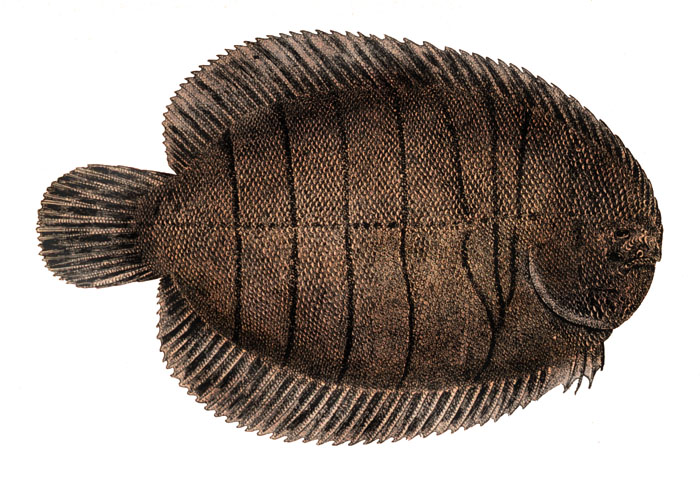
The brown sole is native to the eastern Pacific, ranging from central Mexico to northernmost Peru, and inhabits soft seabeds at depths of 10–40 m. It has an oval, uniformly brown body with both eyes on its right side and rough scales bearing black, hair-like filaments on the eyed side.
Written 27 November 2026 from the sources listed below. Each statement was checked against the passage it cites; statements that could not be supported were removed.
Appearance
The brown sole has an oval body with both eyes positioned on its right side. Its snout is rounded, and its small, arched mouth is positioned slightly below the snout. The lower lip on the eyed side is fringed, and the front margin of the head bears short tentacles.[1][2][3][4]
The rear edge of the preopercle is covered with skin and appears as a superficial groove. The gill openings are wide and join before the pelvic fins, while an opening connects the gill chambers on both sides of the body.[5][6][7]
The dorsal fin originates approximately above the eye, and the pelvic fin on the eyed side is fused to the anal fin. The pectoral fins may be present or absent.[8][9][10]
The lateral line extends in a straight course from the head to the tail, with perpendicular branches crossing the body. It has more than 77 scales.[11][12]
The body is covered with rough scales, and the scales on the eyed side bear black, hair-like filaments. The species is more or less uniformly brown, sometimes with faint dark cross-lines.[13][14][15]
The brown sole grows to a length of up to 23 cm.[16]
Habitat
The brown sole inhabits sandy and muddy seabeds at depths of 10–40 m. It occurs in soft-bottom habitats including mud, sand, gravel, beaches, estuaries, mangroves and seagrass areas.[17][18]
The species may enter freshwater environments in estuaries and mangroves.[19]
Diet
The brown sole feeds on invertebrates, small fishes, pelagic eggs and larvae. Recorded food categories also include bony fishes, detritus and mobile benthic crustaceans.[20][21]
Behaviour
The brown sole is demersal.[22]
Classification of the Brown Sole
| Kingdom | Animalia |
|---|---|
| Phylum | Chordata |
| Subphylum | Vertebrata |
| Infraphylum | Gnathostomata |
| Parvphylum | Osteichthyes |
| Gigaclass | Actinopterygii |
| Superclass | Actinopteri |
| Class | Teleostei (Teleost) |
| Order | Pleuronectiformes |
| Suborder | Pleuronectoidei |
| Family | Achiridae (American Sole) |
| Genus | Achirus (Hogchokers) |
| Species | Achirus klunzingeri (Steindachner, 1880) |
Where the Brown Sole is found
Checklists and occurrence records place Achirus klunzingeri in 5 countries. GBIF holds 75 georeferenced records of it.
Countries
Regions and cities with the most records
- Buenaventura, Colombia 12
- Valle del Cauca Department, Colombia 9
- Buenaventura, Colombia 5
- Chacarita, Costa Rica 4
- Chocó, Colombia 3
- Guayas, Ecuador 3
- Puntarenas, Costa Rica 3
A number beside a place is its count of GBIF occurrence records. A place without a number comes from a checklist alone. Records show where a species has been observed or collected, which can include escapes and vagrants.
Common names
English
- Brown Sole
- Klunzinger's Sole
Names in 3 other languages
- French
- Sole Garde-bouée
- Portuguese
- Linguado-de-Klunzinger
- Spanish
- Guardaboya, Lenguado, Suela Guardaboya, suela plomiza
Synonyms
One other scientific name has been used for this species and is now treated as a synonym of Achirus klunzingeri.
- Solea klunzingeri Steindachner, 1880
Related species
-
 Lined SoleAchirus lineatus
-
 Drab SoleAchirus achirus
-
 Mazatlan SoleAchirus mazatlanus
-
 Plainfin SoleAchirus declivis
-
 Network SoleAchirus scutum
- Mucuri SoleAchirus mucuri
- Orinoco Freshwater SoleAchirus novoae
- Tehuantepec SoleAchirus zebrinus
Compare
Questions and answers
What is the scientific name of the Brown Sole?
The scientific name of the Brown Sole is Achirus klunzingeri. Written with its author, the full name is Achirus klunzingeri (Steindachner, 1880).
Which family does the Brown Sole belong to?
Achirus klunzingeri belongs to the family Achiridae, in the order Pleuronectiformes and the class Teleostei.
Where is the Brown Sole found?
Checklists and occurrence records place Achirus klunzingeri in 5 countries: Colombia, Panama, Ecuador, Costa Rica and El Salvador.
What is the conservation status of the Brown Sole?
The IUCN Red List category recorded for Achirus klunzingeri is Least Concern (LC).
What other names does the Brown Sole have?
Achirus klunzingeri is also known in English as Klunzinger's Sole.
Sources
Passages the profile rests on
- The species has an oval body, with both eyes positioned on its right side. Source passage: “Body oval; eyes on right side” — biogeodb.stri.si.edu
- The species has a rounded snout and a small, arched mouth positioned slightly below the snout. Source passage: “snout rounded; mouth small, arched, a little below snout” — biogeodb.stri.si.edu
- The lower lip on the eyed side is fringed. Source passage: “lower lip on eyed side fringed” — biogeodb.stri.si.edu
- The front margin of the head bears short tentacles. Source passage: “front margin of head with short tentacles” — biogeodb.stri.si.edu
- The rear edge of the preopercle is covered with skin and appears as a superficial groove. Source passage: “rear edge of preopercle covered with skin, visible as a superficial groove” — biogeodb.stri.si.edu
- The gill openings are wide and join before the pelvic fins. Source passage: “gill openings wide, united before pelvic fins” — biogeodb.stri.si.edu
- An opening connects the gill chambers on both sides of the body. Source passage: “an opening connects gill chambers on both sides” — biogeodb.stri.si.edu
- The dorsal fin originates approximately above the eye. Source passage: “dorsal origin ~ above eye” — biogeodb.stri.si.edu
- The pelvic fin on the eyed side is fused to the anal fin. Source passage: “pelvic on eye side fused to anal” — biogeodb.stri.si.edu
- The pectoral fins may be present or absent. Source passage: “pectorals present or absent” — biogeodb.stri.si.edu
- The lateral line extends from the head to the tail in a straight course, with perpendicular branches crossing the body. Source passage: “lateral line from head to tail, straight, with perpendicular branches running across body” — biogeodb.stri.si.edu
- The lateral line has more than 77 scales. Source passage: “lateral line with >77 scales.” — biogeodb.stri.si.edu
- The body is covered with rough scales. Source passage: “body covered with rough scales” — biogeodb.stri.si.edu
- The scales on the eyed side bear black, hair-like filaments. Source passage: “scales on eyed side with black hair-like filaments” — biogeodb.stri.si.edu
- The species is more or less uniformly brown, sometimes with faint dark cross-lines. Source passage: “More or less uniform brown, sometimes with faint dark cross-lines.” — biogeodb.stri.si.edu
- The species grows to a length of up to 23 cm. Source passage: “This demersal species growth up to 23 cm (9.1 in).” — English Wikipedia
- The species inhabits sandy and muddy seabeds at depths of 10–40 m. Source passage: “It is found at depths of 10–40 m on sandy and muddy grounds” — English Wikipedia
- The species occurs in soft-bottom habitats including mud, sand, gravel, beaches, estuaries, mangroves and seagrass areas. Source passage: “Soft bottom (mud/sand/gravel/beach/estuary/mangrove/seagrass)” — biogeodb.stri.si.edu
- The species may enter freshwater environments in estuaries and mangroves. Source passage: “may enter fresh waters in estuaries and mangroves.” — English Wikipedia
- The species feeds on invertebrates, small fishes, pelagic eggs and larvae. Source passage: “Its diet consists of invertebrates, small fishes, pelagic eggs and larvae.” — English Wikipedia
- The recorded food categories for the species include bony fishes, detritus and mobile benthic crustaceans. Source passage: “Bony fishes Detritus Mobile benthic crustacea (shrimps/crabs)” — biogeodb.stri.si.edu
- The species is demersal. Source passage: “This demersal species growth up to 23 cm (9.1 in).” — English Wikipedia
Data
- Catalogue of Life, 2026-10-16 XR cc by
- Global Biodiversity Information Facility CC BY 4.0
- Wikidata CC0
- GeoNames CC BY 4.0
- Wikimedia Commons per image; credit shown with each image
- Within the Catalogue of Life, this name comes from World Register of Marine Species cc by
This species in other databases
- Catalogue of Life 97XF
- Wikidata Q2277119
- iNaturalist 93133
- WoRMS urn:lsid:marinespecies.org:taxname:279492
- ITIS 616216
Page built on 28 November 2026. See how the catalog is made and all sources and licences.
Cite this page
ScientificNames.org. (2026). Achirus klunzingeri (Brown Sole). Retrieved November 28, 2026, from https://scientificnames.org/species/achirus-klunzingeri
“Achirus klunzingeri (Brown Sole).” ScientificNames.org, 2026, scientificnames.org/species/achirus-klunzingeri. Accessed 28 Nov. 2026.
ScientificNames.org. “Achirus klunzingeri (Brown Sole).” Accessed November 28, 2026. https://scientificnames.org/species/achirus-klunzingeri.
@misc{scientificnames_achirus_klunzingeri_brown_sole,
  author = {{ScientificNames.org}},
  title = {Achirus klunzingeri (Brown Sole)},
  year = {2026},
  url = {https://scientificnames.org/species/achirus-klunzingeri},
  note = {Accessed 2026-11-28}
}