Species · Flowering plants
Devil's Horsewhip Achyranthes aspera
The scientific name of the Devil's Horsewhip is Achyranthes aspera. It is a species of flowering plant in the family Amaranthaceae (amaranth family), order Caryophyllales.
- Scientific name
- Achyranthes aspera L.
- Common name
- Devil's Horsewhip
- Genus
- Achyranthes
- Family
- Amaranthaceae (Amaranth Family)
- Order
- Caryophyllales
- Class
- Magnoliopsida
- Recorded in
- 143 countries
- Name status
- accepted in the Catalogue of Life

Overview
Devil's horsewhip is an erect, branched flowering herb in the family Amaranthaceae, order Caryophyllales and class Magnoliopsida. It is distributed throughout tropical regions worldwide and grows in many locations as an introduced plant and common weed. It has small, green, spinescent flowers arranged in spikes and black seeds measuring 2 mm in length.
Written 26 November 2026 from the sources listed below. Each statement was checked against the passage it cites; statements that could not be supported were removed.
Appearance
Devil's horsewhip is an erect, branched herb with a cylindrical stem that is hairy and longitudinally striated. Its opposite leaves are ovate or obovate, with entire margins and hairs covering their surfaces.[1][2]
The flowers are small, green and spinescent, arranged in spikes with reflexed flowers. The fruits are oblong utricles.[3][4]
The seeds are black and oblong, with an endospermic structure and a curved embryo. They measure 2 mm in length.[5][6]
Habitat
Devil's horsewhip grows in many locations as an introduced plant and common weed. It is distributed throughout tropical regions worldwide.[7][8]
Behaviour
Devil's horsewhip is invasive in some regions, including many Pacific Islands environments.[9]
Reproduction and life cycle
The flowers are hermaphroditic and contain both male and female reproductive structures. Each flower has a gynoecium containing one ovule with basal placentation.[10][11]
The plant produces flowers and fruits between September and April.[12]
Uses
The plant's juice is used as an ingredient in mixtures for wall plaster.[13]
In the Caribbean during the twentieth century, the plant was used in traditional medicine as tea made by boiling its leaves and roots.[14]
Classification of the Devil's Horsewhip
| Kingdom | Plantae |
|---|---|
| Subkingdom | Pteridobiotina |
| Phylum | Tracheophyta |
| Class | Magnoliopsida |
| Order | Caryophyllales |
| Family | Amaranthaceae (Amaranth Family) |
| Subfamily | Amaranthoideae |
| Tribe | Achyrantheae |
| Genus | Achyranthes (Chaff Flower) |
| Species | Achyranthes aspera L. |
Where the Devil's Horsewhip is found
Checklists and occurrence records place Achyranthes aspera in 143 countries across Africa, Asia, Europe, North America, Oceania and South America. GBIF holds 19,332 georeferenced records of it.
Countries where it is native or its origin is not stated
- Afghanistan 6
- Algeria 34
- American Samoa 21
- Angola 37
- Australia 3,146
- Bangladesh 13
- Bhutan 10
- Botswana 63
- British Indian Ocean Territory 20
- Burkina Faso 230
- Burundi 26
- Cabo Verde 31
- Cambodia 8
- Central African Republic 3
- China 831
- Christmas Island 28
- Cocos Islands 8
- Comoros 29
- Cook Islands 26
- Democratic Republic of the Congo 91
- Equatorial Guinea 11
- Eritrea 10
- Eswatini 19
- Ethiopia 176
- French Polynesia 146
- Gabon 30
- Gambia 8
- Guam 15
- Guinea 13
- Guinea-Bissau 10
- Hong Kong 24
- India 948
- Indonesia 180
- Iran 1
- Israel 764
- Japan 292
- Kenya 392
- Kiribati 4
- Laos 5
- Lebanon 3
- Lesotho 5
- Liberia 5
- Madagascar 106
- Malawi 60
- Malaysia 12
- Maldives 2
- Mali 42
- Marshall Islands 13
- Mauritania 9
- Mauritius 15
- Mayotte 96
- Micronesia 62
- Morocco 15
- Mozambique 74
- Myanmar 14
- Nauru
- Nepal 64
- Niger 217
- Nigeria 51
- Norfolk Island 36
- Northern Mariana Islands 29
- Oman 30
- Pakistan 375
- Palau 30
- Palestinian Territory 4
- Papua New Guinea 46
- Philippines 110
- Reunion 922
- Rwanda 42
- Samoa 42
- Saudi Arabia 34
- Seychelles 93
- Sierra Leone 14
- Singapore 1
- Solomon Islands 8
- Somalia 7
- South Africa 1,077
- South Korea 4
- South Sudan 2
- Spain 801
- Sri Lanka 57
- Sudan 29
- Syria 6
- Taiwan 1,244
- Tanzania 335
- Thailand 72
- Timor Leste 3
- Togo 8
- Tuvalu 5
- Uganda 99
- United Arab Emirates 11
- Vietnam 31
- Wallis and Futuna 4
- Yemen 49
- Zambia 11
- Zimbabwe 36
Countries where it has been introduced
- Aruba 3
- Barbados 4
- Belize
- Benin 428
- Bolivia 46
- Bonaire, Saint Eustatius and Saba 20
- Brazil 224
- Cameroon 247
- Chad 139
- Colombia 404
- Costa Rica 122
- Cuba 89
- Curacao 51
- Dominican Republic 77
- Ecuador 127
- Egypt 7
- El Salvador 77
- Fiji 58
- French Guiana 7
- Germany 3
- Ghana 22
- Guadeloupe 71
- Guatemala 39
- Guyana 18
- Haiti 34
- Honduras 33
- Italy 95
- Ivory Coast 8
- Jamaica 39
- Martinique 38
- Mexico 969
- Namibia 59
- New Caledonia 98
- Nicaragua 157
- Niue 13
- Panama 41
- Peru 40
- Pitcairn 29
- Portugal 390
- Puerto Rico 106
- Sao Tome and Principe 12
- Senegal 75
- Suriname 16
- Tonga 70
- United States 315
- Vanuatu 59
- Venezuela 72
Regions and cities with the most records
- Queensland, Australia 1,469
- Northern Territory, Australia 840
- Canary Islands, Spain 672
- Saint-Leu, Reunion 572
- Piton Saint-Leu, Reunion 540
- Taiwan, Taiwan 521
- Saint-Paul, Reunion 504
- Le Port, Reunion 390
- Saint-Louis, Reunion 383
- La Possession, Reunion 346
- Veracruz, Mexico 329
- Madeira, Portugal 322
- Hadera, Israel 283
- KwaZulu-Natal, South Africa 276
- Le Tampon, Reunion 267
- Saint-Pierre, Reunion 261
- Western Australia, Australia 255
- Jisr ez Zarqā, Israel 254
- Bāqa el Gharbīya, Israel 253
- Netanya, Israel 250
- Kfar Yona, Israel 248
- Binyamina-Giv'at Ada, Israel 245
- Binyamina-Giv‘at ‘Ada, Israel 245
- Zikhron Ya‘aqov, Israel 244
- Punjab, Pakistan 243
- Qalansuwa, Israel 242
- Haifa, Israel 241
- Kadima Zoran, Israel 241
- Or Akiva, Israel 238
- Ţūlkarm, Palestinian Territory 238
- Even Yehuda, Israel 233
- Fengshan, Taiwan 224
- Funchal, Portugal 224
- Kaohsiung, Taiwan 223
- Pardés H̱anna Karkur, Israel 222
- Santo António, Portugal 222
22 more countries have a few records outside this range
These countries hold a few records of Achyranthes aspera but lie outside the range the checklists give for it. Such records are often zoo or garden specimens, museum material or vagrants, so the species is not counted as occurring there.
- Antigua and Barbuda 12
- Bahamas 23
- British Virgin Islands 5
- Cayman Islands 6
- Dominica 15
- France 15
- French Southern Territories 53
- Gibraltar 40
- Grenada 9
- Malta 3
- Montserrat 19
- Saint Barthelemy 13
- Saint Kitts and Nevis 39
- Saint Lucia 6
- Saint Martin 5
- Saint Vincent and the Grenadines 7
- Sint Maarten 9
- Switzerland 5
- Trinidad and Tobago 40
- Turks and Caicos Islands 4
- U.S. Virgin Islands 31
- United Kingdom 10
Range as the checklists state it
Germany [I]; Sicily [I]; Egypt [I] (Nile Delta [I], Nile Valley [I], SE-Egypt [I]); Azores [I] (Sao Miguel Isl. [I], Faial [I]); Madeira [I] (Madeira Isl. [I]); Senegal [I]; Ivory Coast [I]; Ghana [I]; Benin [I]; Cameroon [I]; Principe Isl. [I]; E-D. R. Congo [Zaire]; Rwanda; Burundi; Chad [I]; South Sudan; Ethiopia; Somalia; Samha Isl.; Soqotra; Uganda; Kenya; Tanzania; Malawi; Zimbabwe; Mozambique; Namibia [I]; South Africa (KwaZulu-Natal); Eswatini [Swaziland]; St. Helena [I]; Madagascar; Comores (incl. Mayotte); Mozambique Channel Isl. [Îles Éparses] [I] (Juan de Nova Isl. [I]); Aldabra (Aldabra Isl., Asuncio Isl., Cosmoledo Isl., Astove Isl., St. Pierre Isl., Farquhar Isl.); Îles Glorieuses [I]; Seychelles (incl. African Banks Isl., Remire Isl., Coetivy Isl., Darros Isl.); Iran (S-Iran); Afghanistan (Kunar / Nuristan); Lebanon (coastal W-Lebanon); Israel (coastal W-Israel, Rift Valley, N-Israel); Jordania (W-Jordania); Saudi Arabia (N-Saudi Arabia, Hejaz, Asir); United Arab Emirates; Oman (Dhofar, Mascat & Oman); Yemen (Aden Desert, coastal Hadhramaut, Inner Hadhramaut, N-Inner Yemen, SW-Yemen, Tihama, W-Yemen); China (Fujian, Guangdong, Guangxi, Guizhou, Hainan, Hubei, Hunan, Jiangxi, Sichuan, Yunnan, Zhejiang); Ryukyu Isl.; Ogasawara Isl. (Keetaajima, Chichijima, Hahajima, Imohtojima); Volcano Isl. (Kita-Iwojima, Iwojima, Minami-Iwojima); Taiwan; Pakistan (Sind, Baluchistan, Waziristan, N. W. Frontier Prov., Swat, Pakistani Punjab, Rawalpindi, Hazara); Nepal; Bhutan; India (throughout); Lakshadweep Isl. [Laccadives]; Maldives; Sri Lanka; Bangladesh; Andaman Isl. (South Andaman Isl.); Nicobar Isl.; Myanmar (Magway, Yangon); Thailand; Laos; Cambodia; Vietnam; South China Sea Isl.; peninsular Malaysia (throughout); Singapore; Sumatera; Borneo; Sulawesi; Philippines; Jawa; Lesser Sunda Isl. (Bali, etc.); Moluccas; Cocos [Keeling] Isl.; North Keeling Isl.; Christmas Isl. [Austr.]; New Guinea [I]; Bismarck Arch.; Solomon Isl.; Australia (Western Australia, Northern Territory, Queensland, New South Wales); Lord Howe Isl. (incl. Roach Isl.); Norfolk Isl. (Nepean Isl.); New Caledonia [I]; Vanuatu [I]; Rotuma Isl.; Tonga (Late Isl. [I], Tongatapu, 'Eua, Lifuka, Vava'u); Niue [I]; Fiji [I]; American Samoa (Tutuila, Aunu'u, Ofu, Olosega, Ta'u); [Western] Samoa (Aleipata Islands, 'Upolu, Savai'i); Tuvalu (Nui Atoll); Gilbert Isl.; Nauru; N-Line Isl. [I] (Tabueran [I]); Cook Isl. [I] (Rarotonga [I], Mangaia [I], Aitutaki [I], Ngaputoru Group [I]); Marquesas Isl. [I] (Nuku Hiva [I], Ua Pou [I], Hiva Oa [I], Fatu Hiva [I], Mohotani [I], Tahuata [I], Ua Huka [I]); Society Isl. [I] (Tahiti [I], Raiatea [I], Bora Bora [I], Huahine [I], Mehetia [I]); Gambier Isl. (Aukena, Mangareva); Tuamotu Arch. [I] (Makatea Isl. [I], Rangiroa Atoll [I], Hao [I]); Austral Isl. [I] (Rimatara [I], Rurutu [I], Raivavae [I], Rapa Iti [I], Tubuai [I]); Oeno Atoll; Pitcairn Isl. [I]; Palau (Ngeanges, Peleliu, Angaur, Sonsorol, Tobi); Northern Marianas (Agrihan, Pagan, Maug, Asuncion, Agrihan, Saipan, Tinian, Rota); Guam; Fed. States of Micronesia (Ulithi, Fais, Eauripik, Woleai, Faraulep, Ifalik, Satawal, Namonuito, Murilo, Nomwin, Truk, Piis, Nama, Namoluk, Lukunor, Satawan, Kapingamarangi, Mokil, Pohnpei); Marshall Isl. (Enewetok, Bikini, Rongelap, Taka, Utirik, Jemo); Hawaii [I] (Oahu [I], Molokai [I], Hawaii Isl. [I], Laysan Isl. [I]); USA [I] (Alabama [I], Florida [I], Louisiana [I]); Mexico [I] (widespread); Guatemala [I]; Belize [I]; El Salvador [I]; Honduras [I]; Nicaragua [I]; Costa Rica [I]; Panama [I]; Clipperton Isl. [I]; Cuba [I]; Jamaica [I]; Hispaniola [I]; Puerto Rico [I]; Navassa Isl. [I]; Virgin Isl. [I] (Guana [I], St. Croix [I], St. John [I], St. Thomas [I], Tortola [I], Virgin Gorda [I]); Saba [I]; Antigua [I]; Guadeloupe [I]; Martinique [I]; St. Lucia [I]; St. Vincent [I]; Barbados [I]; Aruba [I]; Bonaire [I]; Curacao [I]; Colombia [I]; Isla Margarita [I]; Venezuela [I]; Guyana [I]; Surinam [I]; French Guiana [I]; Ecuador [I]; Galápagos [I]; Peru [I]; Bolivia [I]; Brazil [I]
A number beside a place is its count of GBIF occurrence records. A place without a number comes from a checklist alone. Records show where a species has been observed or collected, which can include escapes and vagrants.
Common names
English
- Devil's Horsewhip
- Chaff-flower
- Crocus Stuff
- Crokars Staff
- Devil’s Horsewhip
- Man Better Man
- Prickly Chaff Flower
- Worry Vine
- Burweed
- Chaffbur
- Prickly Chaff-flower
Names in 27 other languages
- Afrikaans
- grootklits, haak-en-steek-klitsbossie, knapsekêrel, langklits, langklitskafblom
- Arabic
- na'eem
- Bengali
- অপাঙ্গ, অপামার্গ
- Chinese
- tu niu xi, 七牛膝, 云牛膝, 倒扣草, 土牛膝, 土牛膝(粗毛牛膝、倒扣草), 杜牛夕
- Gujarati
- અઘેડો, અપામાર્ગ
- Hindi
- अघाड़ा, उल्टा कांटा, चिरचिटा, चिरचिरा, लटजीरा
- Kannada
- ಉತ್ತರಾಣಿ, ಉತ್ತರೇಣಿ, ಮಯೂರ, ಮಯೂರಕ, ಶೈಖರಿಕ
- Malayalam
- കടലാടി, വൻകടലാടി
- Marathi
- अघाडा, किणी, खरमंजरी, सूराट
- Nepali
- अकमारो, उल्टो कुरो, काली झार, जम्दी, दतिवन
- Papiamento
- Coriente, Katuna di Seda, Koriente
- Punjabi
- ਪੁੱਠ ਕੰਡਾ
- Sotho
- bohomane
- Tamil
- அபாமார்க்கம், ஆகாடம், நாயுரீஇ
- Telugu
- అంటీశ, అపామార్గము, ఉత్తరేణు, దుబ్బిన చెట్టు, ప్రత్యక్పుష్పి
- Urdu
- اگهاڙا, چرچرا
- Zulu
- ibundlubundlu, isinama, ulimilwengwe, usibambangubo
- asm
- অপমাগ, ওভটাশোধ, ওভতকাটা, বনশোধ
- bod
- ཨ་པ་མ་རྒ
- lus
- Bu-chhawl, Ui-hlo
- mis
- champangmichel, કાંઢેરો આઘાડો
- mni
- ꯈꯨꯖꯨꯝꯄꯦꯔꯦ
- ori
- ଅପାମାର୍ଗ
- pli
- मोरगु
- rwr
- आघीजाडो
- san
- अपामार्ग, खरमञ्जरी, मयूरः, शैखरिकः
- tcy
- ಉತ್ತರಣೆ
Synonyms
37 other scientific names have been used for this species and are now treated as synonyms of Achyranthes aspera.
- Achyranthes argentea var. obovata Moq.
- Achyranthes aspera f. robustiformis Suess.
- Achyranthes aspera f. subgrandifolia Suess.
- Achyranthes aspera var. aspera
- Achyranthes aspera var. australis (R.Br.) Domin
- Achyranthes aspera var. canescens (R.Br.) Drake
- Achyranthes aspera var. indica L.
- Achyranthes aspera var. nigro-olivacea Suess.
- Achyranthes aspera var. nuristanica Kitam.
- Achyranthes aspera var. obovata Moq.
- Achyranthes aspera var. obtusifolia (Lam.) Suess.
- Achyranthes aspera var. simplex Millsp.
- Achyranthes aspera var. villosior (Hensl.) D.M.Porter
- Achyranthes aspera var. virgata (Moq.) Boerl.
- Achyranthes asperoides Pires de Lima
- Achyranthes australis R.Br.
- Achyranthes canescens R.Br.
- Achyranthes daito-insularis Tawada
- Achyranthes ellipticifolia Stokes
- Achyranthes grandifolia Moq.
- Achyranthes indica (L.) Mill.
- Achyranthes obovatifolia Stokes
- Achyranthes obtusifolia Lam.
- Achyranthes okinawensis Tawada
- Achyranthes sicula Roth
- Achyranthes tenuifolia Steud.
- Cadelaria indica (L.) Raf.
- Cadelaria punctata Raf.
- Centrostachys aspera (L.) Standl.
- Centrostachys australis (R.Br.) Standl.
- Centrostachys canescens (R.Br.) Standl.
- Centrostachys grandifolia (Moq.) Standl.
- Centrostachys indica (L.) Standl.
- Stachyarpagophora aspera (L.) M.Gómez
- Achyranthes fruticosa Desf. ambiguous synonym
- Achyranthes obovata Peter ambiguous synonym
- Achyranthes virgata Poir. ambiguous synonym
Subspecies and varieties
- Achyranthes aspera var. argentea variety
- Achyranthes aspera var. pubescens (Devil's Horsewhip) variety
- Achyranthes aspera var. rubrofusca variety
Related species
-
 Ox KneeAchyranthes bidentata
- Hawai'i Chaff FlowerAchyranthes atollensis
-
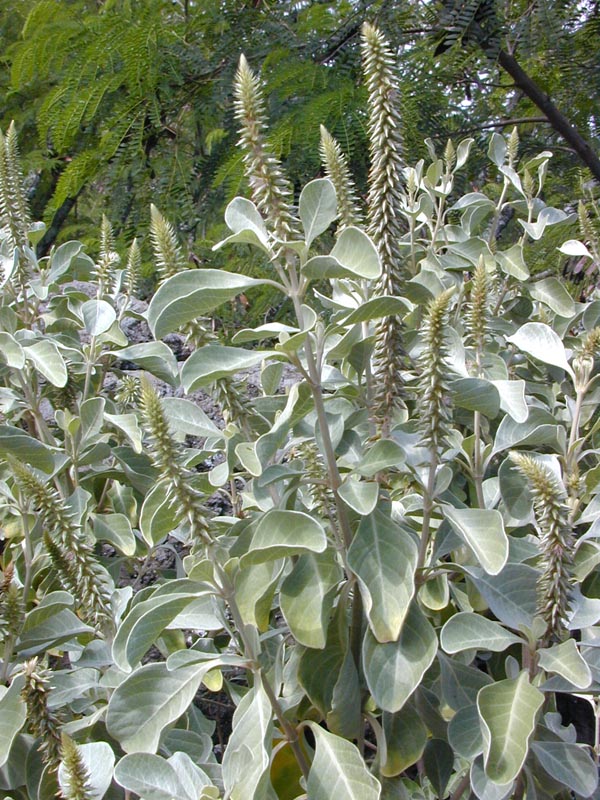 Maui Chaff FlowerAchyranthes splendens
-
 Achyranthes arborescens
- Na Pali RockwortAchyranthes divaricata
-
 Blunt Chaff FlowerAchyranthes mutica
- Achyranthes margaretarum
- Kaala RockwortAchyranthes humilis
Compare
Questions and answers
What is the scientific name of the Devil's Horsewhip?
The scientific name of the Devil's Horsewhip is Achyranthes aspera. Written with its author, the full name is Achyranthes aspera L..
Which family does the Devil's Horsewhip belong to?
Achyranthes aspera belongs to the family Amaranthaceae, in the order Caryophyllales and the class Magnoliopsida.
Where is the Devil's Horsewhip found?
Checklists and occurrence records place Achyranthes aspera in 143 countries, including Australia, Taiwan, South Africa, India, Reunion and China.
What other names does the Devil's Horsewhip have?
Achyranthes aspera is also known in English as Chaff-flower, Crocus Stuff, Crokars Staff, Devil’s Horsewhip, Man Better Man and Prickly Chaff Flower.
What is Achyranthes aspera used for?
Its juice is used as an ingredient in mixtures for wall plaster. In the Caribbean during the twentieth century, its leaves and roots were boiled to make tea used in traditional medicine.[13][14]
What are the medicinal uses of Devil's horse whip?
In the Caribbean during the twentieth century, the plant was used in traditional medicine as tea made by boiling its leaves and roots.[14]
Sources
Passages the profile rests on
- Achyranthes aspera is an erect, branched herb with a cylindrical stem that is hairy and longitudinally striated. Source passage: “Stem: herbaceous but woody below, erect, branched, cylindrical, solid, angular, hairy, longitudinally striated” — English Wikipedia
- The plant has opposite, ovate or obovate leaves with entire margins and hairs covering their surfaces. Source passage: “Leaves: ramal and cauline, simple, exstipulate, opposite decussate, petiolate, ovate or obovate, entire, acute or acuminate, hairy all over” — English Wikipedia
- Its flowers are small, green, spinescent, and arranged in spikes with reflexed flowers. Source passage: “Inflorescence: a spike with reflexed flowers arranged on long peduncle. Flowers: bracteate, bracteolate, bracteoles two, shorter than perianth, dry, membranous and persistent, sessile, complete, hermaphrodite, actinomorphic, pentamerous, hypogynous, small, spinescent, green.” — English Wikipedia
- The fruits are oblong utricles. Source passage: “Fruits: oblong utricle” — English Wikipedia
- The seeds are black, oblong, and have an endospermic structure with a curved embryo. Source passage: “Seeds: endospermic with curved embryo, 2 mm long, oblong black.” — English Wikipedia
- The seeds measure 2 mm in length. Source passage: “Seeds: endospermic with curved embryo, 2 mm long, oblong black.” — English Wikipedia
- The species grows in many locations as an introduced plant and common weed. Source passage: “It can be found in many places growing as an introduced species and a common weed.” — English Wikipedia
- Achyranthes aspera is distributed throughout tropical regions worldwide. Source passage: “It is distributed throughout the tropical world.” — English Wikipedia
- The species is invasive in some regions, including many Pacific Islands environments. Source passage: “It is an invasive species in some areas, including many Pacific Islands environments.” — English Wikipedia
- The plant has hermaphroditic flowers containing both male and female reproductive structures. Source passage: “Flowers: bracteate, bracteolate, bracteoles two, shorter than perianth, dry, membranous and persistent, sessile, complete, hermaphrodite, actinomorphic, pentamerous, hypogynous, small, spinescent, green.” — English Wikipedia
- Each flower has a gynoecium containing one ovule with basal placentation. Source passage: “Gynoecium: it is bicarpellary, syncarpous, superior, unilocular, ovule one, basal placentation” — English Wikipedia
- The plant produces flowers and fruits between September and April. Source passage: “Flowering and Fruiting time: September to April” — English Wikipedia
- The plant's juice is used as an ingredient in mixtures for wall plaster. Source passage: “The juice of this plant is a potent ingredient for a mixture of wall plaster” — English Wikipedia
- In the Caribbean during the twentieth century, the plant was used in traditional medicine as tea made by boiling its leaves and roots. Source passage: “In the Caribbean region during the 20th century, A. aspera was used in traditional medicine as a decoction tea of boiled leaves and roots.” — English Wikipedia
Data
- Catalogue of Life, 2026-10-16 XR cc by
- Global Biodiversity Information Facility CC BY 4.0
- Wikidata CC0
- GeoNames CC BY 4.0
- Wikimedia Commons per image; credit shown with each image
- Within the Catalogue of Life, this name comes from Synonymic Checklists of the Vascular Plants of the World cc by
References
- L. (1753). Sp. Pl. [Linnaeus] 1: 204 (1753), nom. cons. where the name was published
This species in other databases
Page built on 28 November 2026. See how the catalog is made and all sources and licences.
Cite this page
ScientificNames.org. (2026). Achyranthes aspera (Devil's Horsewhip). Retrieved November 28, 2026, from https://scientificnames.org/species/achyranthes-aspera
“Achyranthes aspera (Devil's Horsewhip).” ScientificNames.org, 2026, scientificnames.org/species/achyranthes-aspera. Accessed 28 Nov. 2026.
ScientificNames.org. “Achyranthes aspera (Devil's Horsewhip).” Accessed November 28, 2026. https://scientificnames.org/species/achyranthes-aspera.
@misc{scientificnames_achyranthes_aspera_devils_horsewhip,
  author = {{ScientificNames.org}},
  title = {Achyranthes aspera (Devil's Horsewhip)},
  year = {2026},
  url = {https://scientificnames.org/species/achyranthes-aspera},
  note = {Accessed 2026-11-28}
}