Species · Insects
Buff Button Acleris permutana
The scientific name of the Buff Button is Acleris permutana. It is a species of insect in the family Tortricidae (tortricids), order Lepidoptera. The name dates from 1836.
- Scientific name
- Acleris permutana (Duponchel, 1836)
- Common name
- Buff Button
- Genus
- Acleris
- Family
- Tortricidae (Tortricids)
- Order
- Lepidoptera
- Class
- Insecta
- Environment
- terrestrial
- Recorded in
- 11 countries
- Name status
- accepted in the Catalogue of Life
Overview
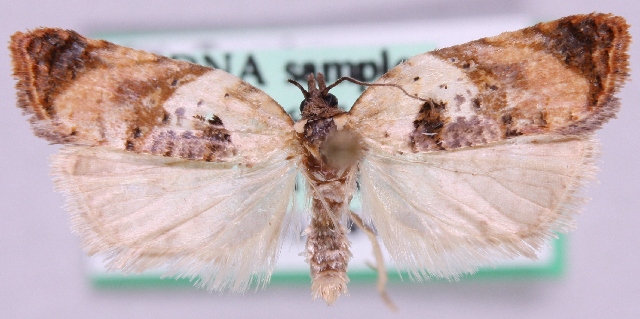
Acleris permutana occurs in Ireland, Great Britain, Portugal, Spain, France, Belgium, the Netherlands, Germany, Denmark, Sweden, Austria, Italy, the Czech Republic, Slovakia, Slovenia, Croatia, Hungary, Romania, North Macedonia and Russia, inhabiting coastal sandhills and limestone environments. Adults have reddish-ochreous forewings with a triangular dark reddish-fuscous dorsal spot mixed with leaden-grey and a brown central fascia.
Written 28 November 2026 from the sources listed below. Each statement was checked against the passage it cites; statements that could not be supported were removed.
Habitat
The Buff Button occurs in Ireland, Great Britain, Portugal, Spain, France, Belgium, the Netherlands, Germany, Denmark, Sweden, Austria, Italy, the Czech Republic, Slovakia, Slovenia, Croatia, Hungary, Romania, North Macedonia and Russia.[1]
The species inhabits coastal sandhills and limestone environments.[2]
Appearance
Adults have a wingspan of 15–22 mm. The head is dark brown and the thorax is whitish-ochreous.[3][4]
The forewings are oblong and reddish-ochreous. Their basal half is whitish-ochreous, with darker strigulae and a triangular dark reddish-fuscous dorsal spot mixed with leaden-grey.[5][6]
The triangular dorsal spot has a scale-tuft at its apex. The central brown fascia has an undefined posterior edge, and its anterior edge bears small scale tufts, including one larger tuft in the middle.[7][8][9]
The costal patch is reddish-fuscous and connects underneath with the termen. The hindwings are whitish-fuscous.[10][11]
Behaviour
Adult moths are active from August to September.[12]
The larvae feed inside the spun shoots and leaves of their host plants. They can be found from June to August.[13][14]
Classification of the Buff Button
| Kingdom | Animalia |
|---|---|
| Phylum | Arthropoda |
| Subphylum | Hexapoda |
| Class | Insecta (Insect) |
| Order | Lepidoptera |
| Superfamily | Tortricoidea |
| Family | Tortricidae (Tortricids) |
| Subfamily | Tortricinae |
| Tribe | Tortricini |
| Genus | Acleris |
| Species | Acleris permutana (Duponchel, 1836) |
Where the Buff Button is found
Checklists and occurrence records place Acleris permutana in 11 countries. GBIF holds 393 georeferenced records of it.
Countries
- Austria 3
- Belgium 3
- Denmark 101
- France 44
- Germany 15
- Italy 4
- Russia 3
- Spain 6
- Sweden 55
- The Netherlands 141
- United Kingdom 18
Regions and cities with the most records
- Castricum, The Netherlands 71
- Heemskerk, The Netherlands 71
- Krommenie, The Netherlands 70
- Beverwijk, The Netherlands 69
- Zealand, Denmark 61
- Alkmaar, The Netherlands 51
- Bergen, The Netherlands 51
- Heiloo, The Netherlands 51
- Heerhugowaard, The Netherlands 50
- Zandvoort, The Netherlands 47
- Den Helder, The Netherlands 43
- Kalundborg, Denmark 42
- Schagen, The Netherlands 42
- Gotland, Sweden 39
- Julianadorp, The Netherlands 28
- Grand Est, France 18
- Kalmar, Sweden 15
- Provence-Alpes-Côte d'Azur, France 14
- Bavaria, Germany 10
- Central Jutland, Denmark 9
- South Denmark, Denmark 9
- England, United Kingdom 8
- Laxou, France 6
- Nancy, France 6
- Vandœuvre-lès-Nancy, France 6
- Villers-lès-Nancy, France 6
- Wales, United Kingdom 6
- Auvergne-Rhône-Alpes, France 5
- Nykøbing Falster, Denmark 5
- Nördlingen, Germany 5
- Pont-à-Mousson, France 5
- Bourgogne-Franche-Comté, France 4
- Chenôve, France 4
- Dijon, France 4
- Toul, France 4
- Baden-Wurttemberg, Germany 3
A number beside a place is its count of GBIF occurrence records. A place without a number comes from a checklist alone. Records show where a species has been observed or collected, which can include escapes and vagrants.
Common names
English
- Buff Button
Names in 4 other languages
- Dutch
- Rozenboogbladroller
- French
- Acléride du Rosier pimprenelle
- Slovak
- obaľovač štetičkatý
- Swedish
- nyponhöstvecklare, rödanlupen nyponhöstvecklare
Synonyms
5 other scientific names have been used for this species and are now treated as synonyms of Acleris permutana.
- Acleris permutanana Herrich-Schäffer, 1851
- Glyphiptera permutana Duponchel, 1836
- Teras permutana (Duponchel, 1836)
- Tortrix (Teras) permutanana Herrich-Schäffer, 1851
- Tortrix permutanana Herrich-Schäffer, 1851
Related species
-
 Garden Rose TortrixAcleris variegana
-
 Oak Leafshredder MothAcleris semipurpurana
-
 Maple LeaftierAcleris forsskaleana
- Sallow ButtonAcleris hastiana
-
 Ashy ButtonAcleris sparsana
-
 Tufted ButtonAcleris cristana
-
 Schaller's Acleris MothAcleris schalleriana
-
 Rusty Oak ButtonAcleris ferrugana
Compare
Questions and answers
What is the scientific name of the Buff Button?
The scientific name of the Buff Button is Acleris permutana. Written with its author, the full name is Acleris permutana (Duponchel, 1836).
Which family does the Buff Button belong to?
Acleris permutana belongs to the family Tortricidae, in the order Lepidoptera and the class Insecta.
Where is the Buff Button found?
Checklists and occurrence records place Acleris permutana in 11 countries, including The Netherlands, Denmark, Sweden, France, United Kingdom and Germany.
Sources
Passages the profile rests on
- Acleris permutana occurs in Ireland, Great Britain, Portugal, Spain, France, Belgium, the Netherlands, Germany, Denmark, Sweden, Austria, Italy, the Czech Republic, Slovakia, Slovenia, Croatia, Hungary, Romania, North Macedonia and Russia. Source passage: “It is found in Ireland, Great Britain, Portugal, Spain, France, Belgium, the Netherlands, Germany, Denmark, Sweden, Austria, Italy, the Czech Republic, Slovakia, Slovenia, Croatia, Hungary, Romania, North Macedonia and Russia.” — English Wikipedia
- The species inhabits coastal sandhills and limestone environments. Source passage: “The habitat consists of coastal sandhills and limestone.” — English Wikipedia
- Adults have a wingspan of 15–22 mm. Source passage: “The wingspan is 15–22 mm.” — English Wikipedia
- The adult has a dark brown head and a whitish-ochreous thorax. Source passage: “The head is dark brown, thorax whitish-ochreous.” — English Wikipedia
- Its forewings are oblong and reddish-ochreous. Source passage: “The forewings are oblong, reddish-ochreous;” — English Wikipedia
- The basal half of each forewing is whitish-ochreous and has darker strigulae and a triangular dark reddish-fuscous dorsal spot mixed with leaden-grey. Source passage: “basal half before central fascia whitish-ochreous with a few darker strigulae, enclosing a triangular dark reddish -fuscous dorsal spot mixed with leaden-grey” — English Wikipedia
- The triangular dorsal spot on the forewing has a scale-tuft at its apex. Source passage: “with a scale-tuft in its apex.” — English Wikipedia
- The central forewing fascia is brown and has an undefined posterior edge. Source passage: “The central fascia is brown, posteriorly undefined,” — English Wikipedia
- The anterior edge of the central fascia bears small scale tufts, including one larger tuft in the middle. Source passage: “with small scale tufts on the anterior edge, one in middle larger.” — English Wikipedia
- The forewing costal patch is reddish-fuscous and connects underneath with the termen. Source passage: “The costal patch is reddish-fuscous, connected beneath with termen.” — English Wikipedia
- The hindwings are whitish-fuscous. Source passage: “The hindwings are whitish-fuscous.” — English Wikipedia
- Adult moths are active from August to September. Source passage: “Adults are on wing from August to September.” — English Wikipedia
- The larvae feed inside the spun shoots and leaves of their host plants. Source passage: “They feed within the spun shoots and leaves of their host plant.” — English Wikipedia
- Larvae can be found from June to August. Source passage: “Larvae can be found from June to August.” — English Wikipedia
Data
- Catalogue of Life, 2026-10-16 XR cc by
- Global Biodiversity Information Facility CC BY 4.0
- Wikidata CC0
- GeoNames CC BY 4.0
- Wikimedia Commons per image; credit shown with each image
- Within the Catalogue of Life, this name comes from World Catalogue of the Tortricidae cc by
References
- Duponchel, & in Godart. (1836). Hist. Nat. Lpid. Papillons Fr., 9, 499. where the name was published
This species in other databases
Page built on 30 November 2026. See how the catalog is made and all sources and licences.
Cite this page
ScientificNames.org. (2026). Acleris permutana (Buff Button). Retrieved November 30, 2026, from https://scientificnames.org/species/acleris-permutana
“Acleris permutana (Buff Button).” ScientificNames.org, 2026, scientificnames.org/species/acleris-permutana. Accessed 30 Nov. 2026.
ScientificNames.org. “Acleris permutana (Buff Button).” Accessed November 30, 2026. https://scientificnames.org/species/acleris-permutana.
@misc{scientificnames_acleris_permutana_buff_button,
  author = {{ScientificNames.org}},
  title = {Acleris permutana (Buff Button)},
  year = {2026},
  url = {https://scientificnames.org/species/acleris-permutana},
  note = {Accessed 2026-11-30}
}