Species · Flowering plants
Indian Aconite Aconitum ferox
The scientific name of the Indian Aconite is Aconitum ferox. It is a species of flowering plant in the family Ranunculaceae (crowfoot family), order Ranunculales.
- Scientific name
- Aconitum ferox Wall. ex Ser.
- Common name
- Indian Aconite
- Genus
- Aconitum
- Family
- Ranunculaceae (Crowfoot Family)
- Order
- Ranunculales
- Class
- Magnoliopsida
- Recorded in
- 3 countries
- Name status
- accepted in the Catalogue of Life

Overview
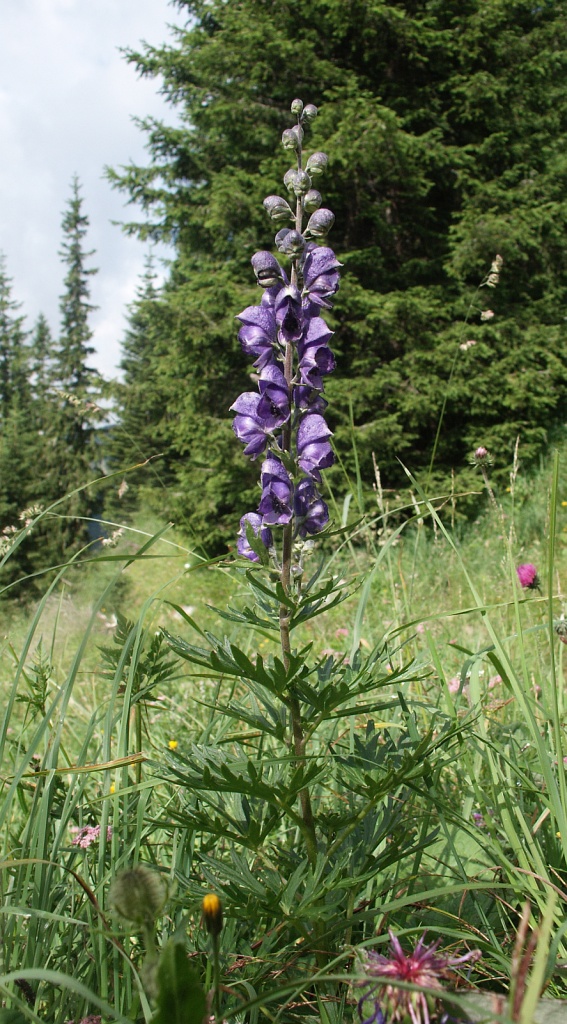
Indian aconite is a tuberous-rooted herbaceous perennial plant belonging to the family Ranunculaceae and the genus Aconitum. It is native to the eastern Himalayas, extending from central Nepal eastward through northern West Bengal, Sikkim, Bhutan and Arunachal Pradesh to Assam. Indian aconite contains large quantities of the highly toxic alkaloid pseudaconitine and is described as the most poisonous plant found in the Himalaya.
Written 26 November 2026 from the sources listed below. Each statement was checked against the passage it cites; statements that could not be supported were removed.
Similar species
Aconitum virorum is listed as a synonym of Indian aconite.[1]
Appearance
Indian aconite is a tuberous-rooted herbaceous perennial plant. It can reach a height of 1.0 metre and a width of 0.5 metres.[2][3]
Habitat
Indian aconite grows at elevations between 2,100 and 3,600 metres. It favours shrubberies and forest clearings.[4][5]
The species tolerates many soil types.[6]
Reproduction and life cycle
Indian aconite flowers between August and October.[7]
Uses
Indian aconite is a principal source of the Indian poisons known as bikh, bish and nabee.[8]
Indian aconite has been used in traditional medicine for diabetes mellitus, asthma, ear and nasal infections, leprosy, paralysis and arthritis.[9]
Plant material or extracts from Indian aconite have occasionally been added to Himalayan alcoholic drinks to increase their intoxicating effects.[10]
The dried roots of Indian aconite are smoked with cannabis flowers in a practice described among Aghori Shaivites.[11]
Classification of the Indian Aconite
| Kingdom | Plantae |
|---|---|
| Subkingdom | Pteridobiotina |
| Phylum | Tracheophyta |
| Class | Magnoliopsida |
| Order | Ranunculales |
| Family | Ranunculaceae (Crowfoot Family) |
| Subfamily | Ranunculoideae |
| Tribe | Aconiteae |
| Genus | Aconitum (Monkshood) |
| Species | Aconitum ferox Wall. ex Ser. |
Where the Indian Aconite is found
Checklists and occurrence records place Aconitum ferox in 3 countries across Asia. GBIF holds 98 georeferenced records of it.
Countries
Regions and cities with the most records
Range as the checklists state it
Nepal; Bhutan; N-India (Arunachal Pradesh, Sikkim)
A number beside a place is its count of GBIF occurrence records. A place without a number comes from a checklist alone. Records show where a species has been observed or collected, which can include escapes and vagrants.
Common names
English
- Indian Aconite
Synonyms
6 other scientific names have been used for this species and are now treated as synonyms of Aconitum ferox.
- Aconitum ferox Wall.
- Aconitum ferox var. ferox
- Aconitum hamiltonii G.Don
- Nirbisia codua G.Don
- Nirbisia hamiltonii G.Don
- Aconitum atrox Walp. ambiguous synonym
Related species
-
 MonkshoodAconitum napellus
-
 Wolf's-BaneAconitum lycoctonum
- Yellow Monk's-hoodAconitum anthora
-
 Northern MonkshoodAconitum noveboracense
-
 Manchurian MonkshoodAconitum variegatum
-
 Columbia MonkshoodAconitum columbianum
-
 Aconitum firmum
-
 Azure MonkshoodAconitum fischeri
Compare
Questions and answers
What is the scientific name of the Indian Aconite?
The scientific name of the Indian Aconite is Aconitum ferox. Written with its author, the full name is Aconitum ferox Wall. ex Ser..
Which family does the Indian Aconite belong to?
Aconitum ferox belongs to the family Ranunculaceae, in the order Ranunculales and the class Magnoliopsida.
Where is the Indian Aconite found?
Checklists and occurrence records place Aconitum ferox in 3 countries: Nepal, India and Bhutan.
How poisonous is aconite?
Indian aconite contains large quantities of the highly toxic alkaloid pseudaconitine, also known as nepaline. It is described as the most poisonous plant found in the Himalaya. Poisoning can cause numbness of the mouth and throat, vomiting and a fall in heart rate to between 30 and 40 beats per minute.[12][13][14][15][16]
Where does Aconitum grow?
Indian aconite is native to the eastern Himalayas, extending from central Nepal eastward through northern West Bengal, Sikkim, Bhutan and Arunachal Pradesh to Assam. It grows at elevations between 2,100 and 3,600 metres and favours shrubberies and forest clearings.[4][5][17]
Sources
Passages the profile rests on
- Aconitum ferox is listed with Aconitum virorum as a synonym. Source passage: “Aconitum ferox (syn. A. virorum)” — English Wikipedia
- Aconitum ferox is a tuberous-rooted herbaceous perennial plant. Source passage: “A tuberous-rooted, herbaceous perennial” — English Wikipedia
- Aconitum ferox can reach a height of 1.0 metre and a width of 0.5 metres. Source passage: “reaching 1.0 metre tall by 0.5 metres wide” — English Wikipedia
- Aconitum ferox grows at elevations between 2,100 and 3,600 metres. Source passage: “A. ferox grows at altitudes of 2,100-3,600m” — English Wikipedia
- The species favours shrubberies and forest clearings. Source passage: “favouring shrubberies and forest clearings.” — English Wikipedia
- Aconitum ferox tolerates many soil types. Source passage: “tolerant of many soil types” — English Wikipedia
- Aconitum ferox flowers between August and October. Source passage: “The flowering period is from August to October.” — English Wikipedia
- Aconitum ferox is a principal source of the Indian poisons known as bikh, bish and nabee. Source passage: “forms the principal source of the Indian poison known variously as bikh, bish, and nabee.” — English Wikipedia
- Aconitum ferox has been used in traditional medicine for diabetes mellitus, asthma, ear and nasal infections, leprosy, paralysis and arthritis. Source passage: “include diabetes mellitus, asthma, ear infections, nasal infections, leprosy, paralysis and arthritis.” — English Wikipedia
- Plant material or extracts from Aconitum ferox have occasionally been added to Himalayan alcoholic drinks to increase their intoxicating effects. Source passage: “Plant material or extracts derived from various Aconitum spp. including A. ferox have, on occasion, been added in small quantities to Himalayan alcoholic drinks” — English Wikipedia
- The dried roots of Aconitum ferox are smoked with cannabis flowers in a practice described among Aghori Shaivites. Source passage: “Aghori, left-hand path, tantric, Shaivites (devotees of the Hindu deity Shiva) smoke the dried roots of Aconitum ferox, combined in a mixture with cannabis flowers” — English Wikipedia
- Aconitum ferox contains large quantities of the highly toxic alkaloid pseudaconitine. Source passage: “It contains large quantities of the extremely toxic alkaloid pseudaconitine” — English Wikipedia
- Pseudaconitine is also known as nepaline. Source passage: “also known as nepaline, after Nepal” — English Wikipedia
- Aconitum ferox is described as the most poisonous plant found in the Himalaya. Source passage: “is considered to be the most poisonous plant found in the Himalaya.” — English Wikipedia
- Symptoms of Aconitum ferox poisoning include numbness of the mouth and throat and vomiting. Source passage: “consist of numbness of the mouth and throat and vomiting.” — English Wikipedia
- Aconitum ferox poisoning can cause the heart rate to fall to between 30 and 40 beats per minute. Source passage: “the heart rate slows to 30-40 beats per minute.” — English Wikipedia
- Aconitum ferox is native to the eastern Himalayas, extending from central Nepal eastward through northern West Bengal, Sikkim, Bhutan and Arunachal Pradesh to Assam. Source passage: “The species is native to the eastern Himalayas from central Nepal eastward through the north of West Bengal, Sikkim, Bhutan and Arunachal Pradesh to Assam.” — English Wikipedia
Data
- Catalogue of Life, 2026-10-16 XR cc by
- Global Biodiversity Information Facility CC BY 4.0
- Wikidata CC0
- GeoNames CC BY 4.0
- Wikimedia Commons per image; credit shown with each image
- Within the Catalogue of Life, this name comes from Synonymic Checklists of the Vascular Plants of the World cc by
References
- Wall. ex Ser. (1823). Mus. Helv. Bot. [Seringe] 1: 160, t. 15, f. 43 & 44 (1823). where the name was published
This species in other databases
Page built on 27 November 2026. See how the catalog is made and all sources and licences.
Cite this page
ScientificNames.org. (2026). Aconitum ferox (Indian Aconite). Retrieved November 27, 2026, from https://scientificnames.org/species/aconitum-ferox
“Aconitum ferox (Indian Aconite).” ScientificNames.org, 2026, scientificnames.org/species/aconitum-ferox. Accessed 27 Nov. 2026.
ScientificNames.org. “Aconitum ferox (Indian Aconite).” Accessed November 27, 2026. https://scientificnames.org/species/aconitum-ferox.
@misc{scientificnames_aconitum_ferox_indian_aconite,
  author = {{ScientificNames.org}},
  title = {Aconitum ferox (Indian Aconite)},
  year = {2026},
  url = {https://scientificnames.org/species/aconitum-ferox},
  note = {Accessed 2026-11-27}
}