Species · Insects
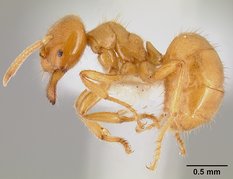
Acropyga exsanguis
Acropyga exsanguis has no English name on record in the checklists used here. It is a species of insect in the family Formicidae (ant), order Hymenoptera. The name dates from 1909.
- Scientific name
- Acropyga exsanguis (Wheeler, 1909)
- Genus
- Acropyga
- Family
- Formicidae (Ant)
- Order
- Hymenoptera
- Class
- Insecta
- Recorded in
- 10 countries
- Name status
- accepted in the Catalogue of Life
Overview
Acropyga exsanguis inhabits wet or moist lowland rainforest, mesophyll forest, and montane wet forest. It lives in symbiosis with several species of mealybugs that inhabit its underground nest.
Written 27 November 2026 from the sources listed below. Each statement was checked against the passage it cites; statements that could not be supported were removed.
Diet
Acropyga exsanguis feeds on honeydew secreted by mealybugs living in its nest. Mealybug species found in its nests include Geococcus coffeae, Rhizoecus coffeae, Pseudorhizoecus proximus, Rhizoecus caladii, and Rhizoecus falcifer.[1][2]
Behaviour
Acropyga exsanguis moves its nest vertically through the soil in response to changing soil conditions. Colonies move their nests deeper into the ground when the soil becomes dry.[3][4]
Acropyga exsanguis lives in symbiosis with several species of mealybugs that inhabit its nest.[5]
The species is difficult to detect during ant surveys because it lives underground. It has most frequently been discovered by sifting through leaf litter and has occasionally been observed beneath stones or visiting bait.[6][7][8]
Large swarms of male Acropyga exsanguis ants were observed twice at La Selva Biological Station in 1991 during the wet season.[9]
Reproduction and life cycle
Acropyga exsanguis colonies contain multiple queens. Multiple queens in nests may result from foundation by several newly mated reproductives, and colonies may acquire additional queens after their establishment.[10][11][12]
Queens have been observed carrying fertilised female mealybugs during nuptial flights.[13]
Similar species
Acropyga exsanguis is difficult to distinguish from closely related ant species.[14]
Classification of Acropyga exsanguis
| Kingdom | Animalia |
|---|---|
| Phylum | Arthropoda |
| Subphylum | Hexapoda |
| Class | Insecta (Insect) |
| Order | Hymenoptera (Ants) |
| Suborder | Apocrita (Ants) |
| Infraorder | Aculeata |
| Superfamily | Formicoidea |
| Family | Formicidae (Ant) |
| Subfamily | Formicinae |
| Tribe | Plagiolepidini |
| Genus | Acropyga |
| Species | Acropyga exsanguis (Wheeler, 1909) |
Where Acropyga exsanguis is found
Checklists and occurrence records place Acropyga exsanguis in 10 countries. GBIF holds 714 georeferenced records of it.
Countries
- Brazil 10
- Colombia 90
- Costa Rica 398
- Ecuador 3
- Guatemala 75
- Honduras 47
- Mexico 33
- Nicaragua 23
- Panama 25
- Peru 10
Regions and cities with the most records
- Alajuela Province, Costa Rica 212
- Heredia Province, Costa Rica 133
- Caquetá, Colombia 36
- Petén, Guatemala 36
- Izabal Department, Guatemala 33
- Morales, Guatemala 33
- Panamá Oeste Province, Panama 23
- Cartago Province, Costa Rica 20
- Gracias a Dios Department, Honduras 19
- Puntarenas Province, Costa Rica 19
- Siquirres, Costa Rica 17
- Amazonas Department, Colombia 15
- Chiapas, Mexico 15
- Cofradía, Honduras 14
- Cortés Department, Honduras 14
- Atlántida Department, Honduras 13
- Valle del Cauca Department, Colombia 13
- Veracruz, Mexico 9
- Arizona, Honduras 8
- Oaxaca, Mexico 8
- Puerto Wilches, Colombia 8
- Santander Department, Colombia 8
- El Cerrito, Colombia 7
- Guacarí, Colombia 7
- Limón Province, Costa Rica 7
- Tela, Honduras 7
- Banderilla, Mexico 6
- Guadalajara de Buga, Colombia 6
- Norte de Santander Department, Colombia 6
- Puerto Santander, Colombia 6
- Roldanillo, Colombia 6
- Sevilla, Colombia 6
- Xico, Mexico 6
- Zarzal, Colombia 6
- Cuzco Department, Peru 5
- La Ceiba, Honduras 5
A number beside a place is its count of GBIF occurrence records. A place without a number comes from a checklist alone. Records show where a species has been observed or collected, which can include escapes and vagrants.
Synonyms
5 other scientific names have been used for this species and are now treated as synonyms of Acropyga exsanguis.
- Acropyga bruchi Santschi, 1929
- Acropyga paramaribensis Borgmeier, 1933
- Acropyga robae Donisthorpe, 1936
- Acropyga wheeleri Mann, 1922
- Rhizomyrma exsanguis Wheeler, 1909
Related species
- Acropyga glaesaria
-
 Acropyga acutiventris
-
 Acropyga myops
-
 Acropyga silvestrii
- Acropyga rubescens
-
 Acropyga smithii
- Yellow Forest Sugar AntAcropyga arnoldi
-
 Acropyga bakwele
Compare
Sources
Passages the profile rests on
- Acropyga exsanguis feeds on honeydew secreted by mealybugs living in its nest. Source passage: “the ants feed on the honeydew that the mealybugs secrete.” — English Wikipedia
- Mealybug species found in Acropyga exsanguis nests include Geococcus coffeae, Rhizoecus coffeae, Pseudorhizoecus proximus, Rhizoecus caladii, and Rhizoecus falcifer. Source passage: “Species of mealybug found in the nest include Geococcus coffeae, Rhizoecus coffeae, Pseudorhizoecus proximus, Rhizoecus caladii, and Rhizoecus falcifer” — English Wikipedia
- Acropyga exsanguis moves its nest vertically through the soil in response to changing soil conditions. Source passage: “The ants move the nest upwards and downwards according to the conditions of the soil” — English Wikipedia
- Acropyga exsanguis colonies move their nests deeper into the ground when the soil becomes dry. Source passage: “descending deeper when the ground becomes dry.” — English Wikipedia
- Acropyga exsanguis lives in symbiosis with several species of mealybugs that inhabit its nest. Source passage: “This ant lives in symbiosis with several species of mealybug which live in its nest” — English Wikipedia
- Acropyga exsanguis is difficult to detect during ant surveys because it lives underground. Source passage: “this subterranean existence means it is poorly represented in ant surveys” — English Wikipedia
- Acropyga exsanguis has most frequently been discovered by sifting through leaf litter. Source passage: “it has been found most often by sifting through leaf litter” — English Wikipedia
- Acropyga exsanguis has occasionally been observed beneath stones or visiting bait. Source passage: “but has occasionally been observed under stones or visiting bait.” — English Wikipedia
- Large swarms of male Acropyga exsanguis ants were observed twice at La Selva Biological Station in 1991 during the wet season. Source passage: “the vast swarms of males that were seen twice in 1991 at La Selva Biological Station during the wet season.” — English Wikipedia
- Acropyga exsanguis colonies contain multiple queens. Source passage: “The nests have multiple queens” — English Wikipedia
- Multiple queens in Acropyga exsanguis nests may result from foundation by several newly mated reproductives. Source passage: “either because they were founded by several newly-mated reproductives” — English Wikipedia
- Acropyga exsanguis colonies may acquire additional queens after their establishment. Source passage: “or because they have recruited further queens since their foundation.” — English Wikipedia
- Acropyga exsanguis queens have been observed carrying fertilised female mealybugs during nuptial flights. Source passage: “queen ants have been observed setting off on their nuptial flight carrying a fertilised female mealybug.” — English Wikipedia
- Acropyga exsanguis is difficult to distinguish from closely related ant species. Source passage: “A. exsanguis is not easy to distinguish from related species.” — English Wikipedia
Data
- Catalogue of Life, 2026-10-16 XR cc by
- Global Biodiversity Information Facility CC BY 4.0
- Wikidata CC0
- GeoNames CC BY 4.0
- Within the Catalogue of Life, this name comes from An Online Catalog of the Ants of the World cc by
References
- Wheeler, W. M. (1909). Ants collected by Prof. F. Silvestri in Mexico. Bollettino Del Laboratorio Di Zoologia Generale E Agraria Della Reale Scuola Superiore d’Agricoltura. Portici, 3, 228–238. https://antcat.org/documents/3443/10556.pdf Link where the name was published
This species in other databases
Page built on 28 November 2026. See how the catalog is made and all sources and licences.
Cite this page
ScientificNames.org. (2026). Acropyga exsanguis. Retrieved November 28, 2026, from https://scientificnames.org/species/acropyga-exsanguis
“Acropyga exsanguis.” ScientificNames.org, 2026, scientificnames.org/species/acropyga-exsanguis. Accessed 28 Nov. 2026.
ScientificNames.org. “Acropyga exsanguis.” Accessed November 28, 2026. https://scientificnames.org/species/acropyga-exsanguis.
@misc{scientificnames_acropyga_exsanguis,
  author = {{ScientificNames.org}},
  title = {Acropyga exsanguis},
  year = {2026},
  url = {https://scientificnames.org/species/acropyga-exsanguis},
  note = {Accessed 2026-11-28}
}