Species · Other invertebrates
Mediterranean Beadlet Anemone Actinia mediterranea
The scientific name of the Mediterranean Beadlet Anemone is Actinia mediterranea. It is a species of animal in the family Actiniidae (actiniid sea anemones), order Actiniaria. The name dates from 1971.
- Scientific name
- Actinia mediterranea Schmidt, 1971
- Common name
- Mediterranean Beadlet Anemone
- Genus
- Actinia
- Family
- Actiniidae (Actiniid Sea Anemones)
- Order
- Actiniaria
- Class
- Anthozoa
- Environment
- marine
- Recorded in
- 11 countries
- Name status
- accepted in the Catalogue of Life
Overview
Actinia mediterranea occurs along rocky shores throughout the Mediterranean Sea and along the coast of northwestern Africa. It has a smooth, bright-red body with a fine blue border at the base of its foot.
Written 26 November 2026 from the sources listed below. Each statement was checked against the passage it cites; statements that could not be supported were removed.
Appearance
The Mediterranean Beadlet Anemone has a smooth, bright-red body with a fine blue border at the base of its foot. Underwater, it displays numerous short, retractable tentacles arranged in six concentric rows.[1][2]
At low tide, its retracted tentacles make it resemble a compact red blob. It measures approximately 5–7 cm.[3][4]
Habitat
The species inhabits the intertidal zone and attaches itself to rocks in both exposed and sheltered rocky locations. It usually occupies locations protected from direct sunlight.[5][6]
It tolerates tidal changes, temperature variations, salinity variations and desiccation.[7]
Diet
The Mediterranean Beadlet Anemone is an active carnivore. It consumes zooplankton, small fish, tiny crustaceans and organic detritus drifting in the water.[8][9]
Behaviour
The species is solitary and leads a benthic lifestyle. It attaches to rocks using its cylindrical foot as a suction pad.[10][11]
It catches prey at night using its stinging tentacles.[12]
Similar species
The Mediterranean Beadlet Anemone closely resembles Actinia equina, and the two species are frequently confused. The blue border at the base of the foot distinguishes the Mediterranean Beadlet Anemone from Actinia equina.[13][14]
The Mediterranean Beadlet Anemone is larger than Actinia equina, measuring 5–7 cm compared with 3–5 cm.[15]
Classification of the Mediterranean Beadlet Anemone
| Kingdom | Animalia |
|---|---|
| Phylum | Cnidaria |
| Class | Anthozoa |
| Subclass | Hexacorallia |
| Order | Actiniaria (Sea Anemone) |
| Suborder | Enthemonae |
| Superfamily | Actinioidea |
| Family | Actiniidae (Actiniid Sea Anemones) |
| Genus | Actinia |
| Species | Actinia mediterranea Schmidt, 1971 |
Where the Mediterranean Beadlet Anemone is found
Checklists and occurrence records place Actinia mediterranea in 11 countries. GBIF holds 2,857 georeferenced records of it.
Countries
- Croatia 575
- Cyprus 14
- France 657
- Greece 320
- Italy 417
- Malta 15
- Monaco 4
- Montenegro 27
- Portugal 14
- Slovenia 26
- Spain 788
Regions and cities with the most records
- Roses, Spain 370
- Catalonia, Spain 239
- Provence-Alpes-Côte d'Azur, France 225
- Pula, Croatia 152
- Marseille 09, France 141
- Marseille 11, France 140
- Marseille 10, France 139
- Marseille 12, France 138
- Marseille 02, France 137
- Marseille 03, France 137
- Marseille 07, France 137
- Marseille, France 136
- Marseille 01, France 136
- Marseille 06, France 136
- Marseille 04, France 135
- Marseille 05, France 135
- Marseille 08, France 135
- Marseille 13, France 135
- Marseille 16, France 135
- Marseille 14, France 133
- Marseille 15, France 129
- Primorje-Gorski Kotar, Croatia 127
- Allauch, France 121
- Aubagne, France 79
- Corsica, France 77
- Marignane, France 76
- Sicily, Italy 72
- Palafrugell, Spain 71
- Occitanie, France 69
- Balearic Islands, Spain 67
- Les Pennes-Mirabeau, France 67
- Palamós, Spain 64
- Ajaccio, France 63
- Antibes, France 56
- Mandelieu-la-Napoule, France 56
- Cagnes-sur-Mer, France 55
5 more countries have a few records outside this range
These countries hold a few records of Actinia mediterranea but lie outside the range the checklists give for it. Such records are often zoo or garden specimens, museum material or vagrants, so the species is not counted as occurring there.
A number beside a place is its count of GBIF occurrence records. A place without a number comes from a checklist alone. Records show where a species has been observed or collected, which can include escapes and vagrants.
Common names
English
- Mediterranean Beadlet Anemone
Names in 8 other languages
- Catalan
- Tomàquet de mar, Tomàtiga de Mar, Tomàtiga de la Mar
- Croatian
- Sredozemna crvena moruzgva
- French
- Actinie de Méditerranée, Actinie rouge de Méditerranée, Tomate de mer, Tomate de mer de Méditerranée
- German
- Mittelmeer-Purpurrose
- Greek
- Μεσογειακή Ανεμώνη Ντομάτα
- Italian
- pomodoro di mare mediterraneo
- Portuguese
- Anêmona-vermelha-do-Mediterrâneo
- Russian
- Актиния средиземноморская
Synonyms
2 other scientific names have been used for this species and are now treated as synonyms of Actinia mediterranea.
- Actinia equina mediterranea Schmidt, 1971
- Actinia schmidti Monteiro, Sole-Cava & Thorpe, 1997
Related species
-
 Beadlet AnemoneActinia equina
-
 Waratah AnemoneActinia tenebrosa
-
 Strawberry AnemoneActinia fragacea
-
 Maroon AnemoneActinia bermudensis
-
 Actinia striata
-
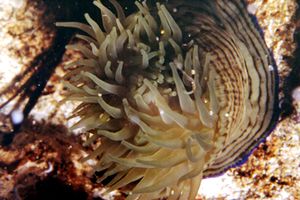 Girdle AnemoneActinia cari
- Actinia australiensis
- Actinia grobbeni
Compare
Questions and answers
What is the scientific name of the Mediterranean Beadlet Anemone?
The scientific name of the Mediterranean Beadlet Anemone is Actinia mediterranea. Written with its author, the full name is Actinia mediterranea Schmidt, 1971.
Which family does the Mediterranean Beadlet Anemone belong to?
Actinia mediterranea belongs to the family Actiniidae, in the order Actiniaria and the class Anthozoa.
Where is the Mediterranean Beadlet Anemone found?
Checklists and occurrence records place Actinia mediterranea in 11 countries, including Spain, France, Croatia, Italy, Greece and Montenegro.
What do beadlet anemones eat?
The Mediterranean Beadlet Anemone is an active carnivore. It consumes zooplankton, small fish, tiny crustaceans and organic detritus drifting in the water.[8][9]
What habitat do sea anemones live in?
The Mediterranean Beadlet Anemone inhabits the intertidal zone and attaches itself to rocks in exposed and sheltered rocky locations, usually protected from direct sunlight.[5][6]
What foods do sea anemones eat?
The Mediterranean Beadlet Anemone consumes zooplankton, small fish, tiny crustaceans and organic detritus drifting in the water.[9]
Sources
Passages the profile rests on
- The species has a smooth, bright-red body with a fine blue border at the base of its foot. Source passage: “The soft body is smooth and bright red with a fine blue border at the foot base.” — English Wikipedia
- Underwater, the species displays numerous short, retractable tentacles arranged in six concentric rows. Source passage: “Underwater, this anemone displays a large number of short and retractable tentacles arranged in six concentric rows.” — English Wikipedia
- At low tide, the retracted tentacles make the species resemble a compact red blob. Source passage: “During low tide, the tentacles retract and the anemone resembles a compact blob of red like a small tomato.” — English Wikipedia
- The species measures approximately 5–7 cm. Source passage: “size also can help as Actinia mediterranea is a bit larger (5 to 7 cm)” — English Wikipedia
- The species inhabits the intertidal zone and attaches itself to rocks, usually in locations protected from direct sunlight. Source passage: “Actinia mediterranea lives in the intertidal zone, fixed on rocks usually hidden from the direct sunlight” — English Wikipedia
- The species occurs in both exposed and sheltered rocky locations. Source passage: “and can be found both in exposed and sheltered places.” — English Wikipedia
- The species tolerates tidal changes, temperature variations, salinity variations and desiccation. Source passage: “can tolerate tides, temperature and salinity variations and also desiccation.” — English Wikipedia
- The species is an active carnivore. Source passage: “is an active carnivore” — English Wikipedia
- The species consumes zooplankton, small fish, tiny crustaceans and organic detritus drifting in the water. Source passage: “Its diet consists in zooplankton, small fish, tiny crustaceans and organic detritus drifting in the water.” — English Wikipedia
- The species is solitary and attaches to rocks using its cylindrical foot as a suction pad. Source passage: “Actinia mediterranea is a solitary anemone fixed on rocks with its cylindrical foot used as a suction pad.” — English Wikipedia
- The species leads a benthic lifestyle. Source passage: “Actinia mediterranea leads a benthic way of life” — English Wikipedia
- The species catches prey at night using its stinging tentacles. Source passage: “catching its prey at night by displaying its stinging tentacles.” — English Wikipedia
- The species closely resembles Actinia equina, and the two are frequently confused. Source passage: “Because of its strong resemblance with Actinia equina, they are often confused” — English Wikipedia
- The blue border at the base of the foot distinguishes this species from Actinia equina. Source passage: “This characteristic blue border is a distinctive point to make the difference with Actinia equina” — English Wikipedia
- Actinia mediterranea is larger than Actinia equina, measuring 5–7 cm compared with 3–5 cm. Source passage: “Actinia mediterranea is a bit larger (5 to 7 cm) than its close relative (3 to 5 cm).” — English Wikipedia
Data
- Catalogue of Life, 2026-10-16 XR cc by
- Global Biodiversity Information Facility CC BY 4.0
- Wikidata CC0
- GeoNames CC BY 4.0
- Within the Catalogue of Life, this name comes from World Register of Marine Species cc by
This species in other databases
- Catalogue of Life 9T9P
- Wikidata Q61655554
- iNaturalist 627669
- WoRMS urn:lsid:marinespecies.org:taxname:854459
Page built on 28 November 2026. See how the catalog is made and all sources and licences.
Cite this page
ScientificNames.org. (2026). Actinia mediterranea (Mediterranean Beadlet Anemone). Retrieved November 28, 2026, from https://scientificnames.org/species/actinia-mediterranea
“Actinia mediterranea (Mediterranean Beadlet Anemone).” ScientificNames.org, 2026, scientificnames.org/species/actinia-mediterranea. Accessed 28 Nov. 2026.
ScientificNames.org. “Actinia mediterranea (Mediterranean Beadlet Anemone).” Accessed November 28, 2026. https://scientificnames.org/species/actinia-mediterranea.
@misc{scientificnames_actinia_mediterranea_mediterranean_beadlet_anemone,
  author = {{ScientificNames.org}},
  title = {Actinia mediterranea (Mediterranean Beadlet Anemone)},
  year = {2026},
  url = {https://scientificnames.org/species/actinia-mediterranea},
  note = {Accessed 2026-11-28}
}