Species · Insects
Gall Adelgid Adelges (Gilletteella) cooleyi
The scientific name of the Gall Adelgid is Adelges (Gilletteella) cooleyi. It is a species of insect in the family Adelgidae (pine aphids), order Hemiptera. The name dates from 1907.
- Scientific name
- Adelges (Gilletteella) cooleyi (Gillette, 1907)
- Common name
- Gall Adelgid
- Genus
- Adelges
- Family
- Adelgidae (Pine Aphids)
- Order
- Hemiptera
- Class
- Insecta
- Environment
- terrestrial
- Recorded in
- 14 countries
- Name status
- accepted in the Catalogue of Life

Overview
Adelges (Gilletteella) cooleyi inhabits spruce and Douglas fir trees. It induces pineapple-shaped galls on spruce branches.
Written 26 November 2026 from the sources listed below. Each statement was checked against the passage it cites; statements that could not be supported were removed.
Appearance
The galls induced by the Gall Adelgid have a pineapple-like shape and range in colour from pink and red to deep purple. Spruce needles generally remain green, and the galls measure between 0.5 and 8 cm in length, depending on the growth capacity of the host tree.[1][2][3]
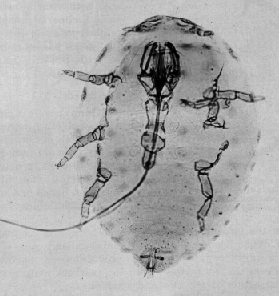
Immature females are small, globular and wingless. Newly hatched nymphs are light brown, becoming black after settling in gall chambers, and have flattened oval bodies covered by a fringe of white wax.[4][5][6]
Mature adults on Douglas fir are oval and light to dark brown, becoming covered in white waxy wool. Winged adult females emerging from spruce galls are dark red-brown and have a heavily sclerotized thorax.[7][8][9]
Habitat
The Gall Adelgid inhabits spruce and Douglas fir trees. It can also infest Sitka, Engelmann and white spruce.[10][11]
On spruce, it forms galls at the growing tips of branches. On Douglas fir, it feeds on the needles.[12][13]
Females overwinter on spruce trees and preferentially occupy sheltered areas, particularly locations protected from wind.[14][15]
Diet
On spruce, the Gall Adelgid feeds on parenchyma tissue inside the galls. Newly hatched nymphs feed around the bases of needles in developing spruce buds.[16][17]
On Douglas fir, it feeds on phloem sap from the needles. Female mouthparts contain thread-like stylets used to penetrate vascular bundles for feeding.[18][19]
Behaviour
Nymphal saliva triggers changes in spruce development that produce the characteristic gall structure.[20]
Feeding on Douglas fir causes needle discoloration and cosmetic damage. Severe infestations can cause foliage to become completely chlorotic and drop prematurely.[21][22]
Reproduction and life cycle
The Gall Adelgid has a two-year life cycle that normally requires both spruce and Douglas fir. Populations have occasionally been documented living exclusively on spruce.[23][24]
On spruce, the species reproduces sexually and asexually across several generations. Females lay several hundred eggs on branches near developing buds in spring, protecting the deposits with individual tufts of white waxy threads.[25][26][27]
On Douglas fir, the species reproduces asexually. Wingless asexual individuals can remain on Douglas fir and continue reproducing there.[28][29]
Winged asexual individuals emerge from spruce galls in summer and migrate to Douglas fir. Winged generations return from Douglas fir to spruce the following summer.[30][31]
Winged adult females emerge when spruce gall chambers open around August to September.[32]
Classification of the Gall Adelgid
| Kingdom | Animalia |
|---|---|
| Phylum | Arthropoda |
| Subphylum | Hexapoda |
| Class | Insecta (Insect) |
| Order | Hemiptera |
| Suborder | Sternorrhyncha |
| Infraorder | Aphidomorpha |
| Superfamily | Adelgoidea |
| Family | Adelgidae (Pine Aphids) |
| Genus | Adelges |
| Subgenus | Adelges (Gilletteella) |
| Species | Adelges (Gilletteella) cooleyi (Gillette, 1907) |
Where the Gall Adelgid is found
Checklists and occurrence records place Adelges (Gilletteella) cooleyi in 14 countries. GBIF holds 2,367 georeferenced records of it.
Countries
- Belarus 5
- Belgium 14
- Canada 582
- Denmark 221
- France 187
- Germany 29
- Poland 49
- Portugal 18
- Romania 9
- Slovakia 19
- Sweden 4
- The Netherlands 124
- United Kingdom 203
- United States 903
Regions and cities with the most records
- British Columbia, Canada 332
- Colorado, United States 198
- Alberta, Canada 142
- Washington, United States 89
- Saskatchewan, Canada 76
- Scotland, United Kingdom 70
- Utah, United States 66
- Idaho, United States 54
- Pennsylvania, United States 53
- Zealand, Denmark 51
- Central Jutland, Denmark 49
- Grand Est, France 49
- Calgary, Canada 44
- South Denmark, Denmark 44
- Capital Region, Denmark 39
- England, United Kingdom 39
- Fort Collins, United States 38
- Auvergne-Rhône-Alpes, France 35
- Windsor, United States 35
- Arizona, United States 34
- Boulder, United States 34
- Oregon, United States 34
- California, United States 32
- Connecticut, United States 32
- Louisville, United States 32
- Montana, United States 32
- Wyoming, United States 32
- Ansonia, United States 30
- Bourgogne-Franche-Comté, France 30
- Hamden, United States 30
- Lafayette, United States 30
- Naugatuck, United States 30
- New Haven, United States 30
- Seymour, United States 30
- Shelton, United States 30
- West Haven, United States 30
1 more country has a few records outside this range
These countries hold a few records of Adelges (Gilletteella) cooleyi but lie outside the range the checklists give for it. Such records are often zoo or garden specimens, museum material or vagrants, so the species is not counted as occurring there.
A number beside a place is its count of GBIF occurrence records. A place without a number comes from a checklist alone. Records show where a species has been observed or collected, which can include escapes and vagrants.
Common names
English
- Gall Adelgid
- Cooley Spruce Gall Adelgid
- Douglas Fir Adelgid
Names in 6 other languages
- Czech
- korovnice douglasková
- Danish
- Douglasbladlus, Douglasgranlus
- French
- Puceron à galle allongée de l'épinette, puceron de l'épinette de Sitka
- Polish
- ochojnik daglezjowy
- Russian
- Хермес Кули
- Slovak
- kôrovnica duglasková
Synonyms
3 other scientific names have been used for this species and are now treated as synonyms of Adelges (Gilletteella) cooleyi.
- Chermes cooleyi Gillette, 1907
- Gillettea cooleyi (Gillette, 1907)
- Gilletteella cooleyi (Gillette, 1907)
Related species
-
 Balsam Woolly AdelgidAdelges (Dreyfusia) piceae
-
 Pineapple Gall AdelgidAdelges (Sacchiphantes) abietis
- Adelges (Sacchiphantes) kitamiensis
- Adelges (Sacchiphantes) segregis
- Hemlock Woolly AdelgidAdelges (Annandina) tsugae
- Adelges (Gilletteella) glandulae
- Adelges (Dreyfusia) merkeri
- Adelges (Dreyfusia) prelli
Compare
Questions and answers
What is the scientific name of the Gall Adelgid?
The scientific name of the Gall Adelgid is Adelges (Gilletteella) cooleyi. Written with its author, the full name is Adelges (Gilletteella) cooleyi (Gillette, 1907).
Which family does the Gall Adelgid belong to?
Adelges (Gilletteella) cooleyi belongs to the family Adelgidae, in the order Hemiptera and the class Insecta.
Where is the Gall Adelgid found?
Checklists and occurrence records place Adelges (Gilletteella) cooleyi in 14 countries, including United States, Canada, Denmark, United Kingdom, France and The Netherlands.
What other names does the Gall Adelgid have?
Adelges (Gilletteella) cooleyi is also known in English as Cooley Spruce Gall Adelgid and Douglas Fir Adelgid.
What is the life cycle of a spruce gall adelgid?
The Gall Adelgid has a two-year life cycle that normally involves both spruce and Douglas fir. It reproduces sexually and asexually across several generations on spruce and asexually on Douglas fir. Winged individuals migrate between the two host trees, with generations returning to spruce the following summer.[23][25][28][30][31]
Sources
Passages the profile rests on
- The galls induced by this species have a pineapple-like shape. Source passage: “The galls are characterized by this pineapple-like form” — English Wikipedia
- The galls range in colour from pink and red to deep purple, while the spruce needles generally remain green. Source passage: “Most galls take on a pink, red, or even deep purple colour while the needles usually remain green.” — English Wikipedia
- The galls measure between 0.5 and 8 cm in length, depending on the growth capacity of the host tree. Source passage: “with a length of 0.5 cm to 8 cm depending on the growth capacity of the tree.” — English Wikipedia
- Immature females are small, globular and wingless. Source passage: “the immature female adelgid, small, globular, and wingless (1.2–1.7 mm)” — English Wikipedia
- Newly hatched nymphs are light brown and become black after settling in gall chambers. Source passage: “The nymphs are light brown when first hatched, becoming black when settled in gall chamber” — English Wikipedia
- The nymphs have flattened oval bodies and secrete a fringe of white wax. Source passage: “they are flattened oval in shape and secrete a fringe of white wax.” — English Wikipedia
- Mature adults on Douglas fir are oval and light to dark brown. Source passage: “On Douglas fir, adults are about 0.1 cm long, oval, and light to dark brown in colour.” — English Wikipedia
- Mature adults on Douglas fir become covered in white waxy wool. Source passage: “At maturity, they are completely covered with white, waxy wool” — English Wikipedia
- Winged adult females emerging from spruce galls are dark red-brown and have a heavily sclerotized thorax. Source passage: “These winged adult females have dark red-brown colour, with a heavily sclerotized thorax.” — English Wikipedia
- This species inhabits spruce and Douglas fir trees. Source passage: “Adelges cooleyi feeds on spruce (Picea) species and Douglas fir (Pseudotsuga menziesii).” — pmc.ncbi.nlm.nih.gov
- The species can also infest Sitka, Engelmann and white spruce. Source passage: “They may also attack Sitka, Engelmann, or white spruce.” — English Wikipedia
- On spruce, this species forms galls at the growing tips of branches. Source passage: “On spruce, the insect induces the formation of large galls at the growing tips of branches” — pmc.ncbi.nlm.nih.gov
- On Douglas fir, this species feeds on the needles. Source passage: “Once on Douglas fir, the adelgids consume the needles, but do not form galls.” — English Wikipedia
- Females overwinter on spruce trees. Source passage: “finds a spruce on which to overwinter.” — English Wikipedia
- Females preferentially occupy sheltered areas of spruce trees, particularly locations protected from wind. Source passage: “The females prefer areas on the spruce where they have greater protection from the elements, especially wind.” — English Wikipedia
- On spruce, this species feeds on parenchyma tissue inside the galls. Source passage: “feeds on parenchyma tissue within the gall” — pmc.ncbi.nlm.nih.gov
- Newly hatched nymphs feed around the bases of needles in developing spruce buds. Source passage: “Once hatched, the young nymphs begin feeding around the base of the needles in a new bud.” — English Wikipedia
- On Douglas fir, this species feeds on phloem sap from the needles. Source passage: “On Douglas fir, it feeds on the phloem sap of needles” — pmc.ncbi.nlm.nih.gov
- The mouthparts of females contain thread-like stylets used to penetrate vascular bundles for feeding. Source passage: “Their mouthparts consist of thread-like stylets which are used to penetrate into vascular bundles for feeding.” — English Wikipedia
- Nymphal saliva triggers changes in spruce development that produce the characteristic gall structure. Source passage: “The nymphs' saliva introduced into the plant trigger the changes in development of the plant” — English Wikipedia
- On Douglas fir, feeding by this species causes needle discoloration and cosmetic damage. Source passage: “discoloring the needles and causing cosmetic damage” — pmc.ncbi.nlm.nih.gov
- Severe infestations can cause Douglas fir foliage to become completely chlorotic and drop prematurely. Source passage: “Severely infested foliage may be completely chlorotic and drop prematurely.” — English Wikipedia
- This species has a two-year life cycle that normally requires both spruce and Douglas fir. Source passage: “Both trees are required to complete its 2-year life cycle” — pmc.ncbi.nlm.nih.gov
- Populations of this species have occasionally been documented living exclusively on spruce. Source passage: “although cases of populations residing exclusively on spruce have been documented” — pmc.ncbi.nlm.nih.gov
- On spruce, this species reproduces sexually and asexually across several generations. Source passage: “On spruce, the insects reproduce both sexually and asexually over the course of several generations” — pmc.ncbi.nlm.nih.gov
- Females lay several hundred eggs on spruce branches near developing buds in spring. Source passage: “lays some eggs in what resembles sacks (totalling several hundred eggs) on the branches near the developing buds.” — English Wikipedia
- Female egg deposits are protected by individual tufts of white waxy threads. Source passage: “individual tufts of white waxy threads that protect the eggs.” — English Wikipedia
- On Douglas fir, this species reproduces asexually. Source passage: “On Douglas fir, they reproduce asexually” — pmc.ncbi.nlm.nih.gov
- Wingless asexual individuals can remain on Douglas fir and continue reproducing there. Source passage: “or wingless asexuals can continue to reproduce on Douglas fir.” — pmc.ncbi.nlm.nih.gov
- Winged asexual individuals emerge from spruce galls in summer and migrate to Douglas fir. Source passage: “winged asexuals emerge from galls to fly to Douglas fir in the summer” — pmc.ncbi.nlm.nih.gov
- Winged generations return from Douglas fir to spruce the following summer. Source passage: “winged generations return to spruce the following summer” — pmc.ncbi.nlm.nih.gov
- Winged adult females emerge when spruce gall chambers open around August to September. Source passage: “By midsummer (August to September), the galls begin to dry out, the chambers open and winged forms of the adelgids emerge.” — English Wikipedia
Data
- Catalogue of Life, 2026-10-16 XR cc by
- Global Biodiversity Information Facility CC BY 4.0
- Wikidata CC0
- GeoNames CC BY 4.0
- Wikimedia Commons per image; credit shown with each image
- Within the Catalogue of Life, this name comes from Aphid Species File cc by
References
- Gillette, C.P. (1907) Chermes of Colorado conifers. Proceedings of the Academy of Natural Sciences of Philadelphia, 54(1), 3–22. where the name was published
- Schneider-Orelli, O. (1949) Richtlinien zur Bekämpfung der Weißtannenläuse Dreyfusia nüsslini und Dreyfusia piceae für 1949. Schweizer. Zeitschrift für Forstwesen, 1949(7), 1–4.
This species in other databases
Page built on 27 November 2026. See how the catalog is made and all sources and licences.
Cite this page
ScientificNames.org. (2026). Adelges (Gilletteella) cooleyi (Gall Adelgid). Retrieved November 27, 2026, from https://scientificnames.org/species/adelges-gilletteella-cooleyi
“Adelges (Gilletteella) cooleyi (Gall Adelgid).” ScientificNames.org, 2026, scientificnames.org/species/adelges-gilletteella-cooleyi. Accessed 27 Nov. 2026.
ScientificNames.org. “Adelges (Gilletteella) cooleyi (Gall Adelgid).” Accessed November 27, 2026. https://scientificnames.org/species/adelges-gilletteella-cooleyi.
@misc{scientificnames_adelges_gilletteella_cooleyi_gall_adelgid,
  author = {{ScientificNames.org}},
  title = {Adelges (Gilletteella) cooleyi (Gall Adelgid)},
  year = {2026},
  url = {https://scientificnames.org/species/adelges-gilletteella-cooleyi},
  note = {Accessed 2026-11-27}
}