Species · Flowering plants
Summer Pheasant's-eye Adonis aestivalis
The scientific name of the Summer Pheasant's-eye is Adonis aestivalis. It is a species of flowering plant in the family Ranunculaceae (crowfoot family), order Ranunculales.
- Scientific name
- Adonis aestivalis L.
- Common name
- Summer Pheasant's-eye
- Genus
- Adonis
- Family
- Ranunculaceae (Crowfoot Family)
- Order
- Ranunculales
- Class
- Magnoliopsida
- Recorded in
- 57 countries
- Name status
- accepted in the Catalogue of Life

Overview
Summer Pheasant's-eye is an annual flowering herb in the family Ranunculaceae, order Ranunculales and class Magnoliopsida. The species is native to Europe and Asia. It has orange to red flowers with black markings at the base of each petal.
Written 26 November 2026 from the sources listed below. Each statement was checked against the passage it cites; statements that could not be supported were removed.
Appearance
Summer Pheasant's-eye has erect stems with simple, pinnately dissected leaves arranged alternately. It can grow up to approximately one metre tall.[1][2]
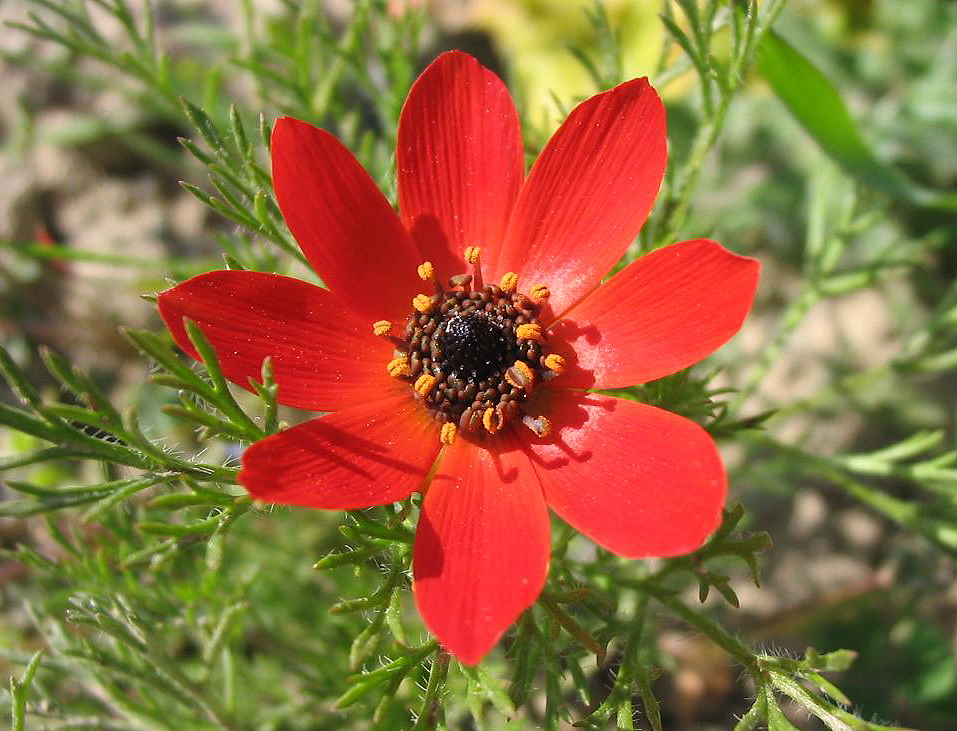
The flowers are radially symmetrical and range in colour from orange to red. Each petal has a black marking at its base and curves into a cup-like shape.[3][4][5]
The fruit is an achene.[6]
Habitat
Summer Pheasant's-eye has been found invading alfalfa fields.[7]
Reproduction and life cycle
A single flower can produce between 50 and 100 seeds. The species produces achenes as its fruit.[8][9]
Uses
Summer Pheasant's-eye is cultivated or used as an ornamental plant.[10]
In European folk medicine, the species has been used to stimulate cardiac activity in people with weak hearts. It has also been prepared as a tonic by drying the plant and combining it with water.[11][12]
The species has been used to treat coughs and spasms, as a diuretic and sleeping aid, and in Iran to treat rheumatism and heart disease. It is also used in homeopathy as a remedy for heart and kidney diseases.[13][14][15][16]
Classification of the Summer Pheasant's-eye
| Kingdom | Plantae |
|---|---|
| Subkingdom | Pteridobiotina |
| Phylum | Tracheophyta |
| Class | Magnoliopsida |
| Order | Ranunculales |
| Family | Ranunculaceae (Crowfoot Family) |
| Subfamily | Ranunculoideae |
| Tribe | Helleboreae |
| Genus | Adonis (Pheasant's-eye) |
| Species | Adonis aestivalis L. |
Where the Summer Pheasant's-eye is found
Checklists and occurrence records place Adonis aestivalis in 57 countries across Africa, Asia, Europe and North America. GBIF holds 22,158 georeferenced records of it.
Countries where it is native or its origin is not stated
- Afghanistan 25
- Algeria 29
- Armenia 135
- Austria 674
- Azerbaijan 31
- Belgium 104
- Bulgaria 31
- China 81
- Croatia 6
- Cyprus 3
- Czechia 1,120
- Finland 7
- France 6,617
- Georgia 76
- Greece 17
- Hungary 183
- India 31
- Iran 80
- Iraq 11
- Israel 204
- Italy 125
- Jordan 17
- Kazakhstan 162
- Kosovo 3
- Kyrgyzstan 24
- Lebanon 5
- Libya 3
- Luxembourg 61
- Malta 1
- Moldova 7
- Montenegro
- Morocco 88
- Nepal 2
- North Macedonia 8
- Pakistan 32
- Palestinian Territory 4
- Poland 780
- Portugal 16
- Romania 77
- Russia 339
- Serbia 8
- Slovakia 263
- Slovenia 4
- Spain 1,454
- Sweden 9
- Switzerland 1,188
- Syria 37
- Tajikistan 17
- The Netherlands 49
- Tunisia 12
- Turkey 188
- Turkmenistan 11
- Ukraine 228
- United Kingdom 24
- Uzbekistan 68
Countries where it has been introduced
Regions and cities with the most records
- Bavaria, Germany 3,953
- Provence-Alpes-Côte d'Azur, France 1,988
- Auvergne-Rhône-Alpes, France 1,527
- Grand Est, France 890
- Thuringia, Germany 866
- Valais, Switzerland 861
- Baden-Wurttemberg, Germany 746
- Le Puy-en-Velay, France 554
- Centre-Val de Loire, France 553
- Bad Neustadt an der Saale, Germany 510
- Sierre, Switzerland 495
- Saxony-Anhalt, Germany 481
- Bourgogne-Franche-Comté, France 480
- Bad Kissingen, Germany 425
- Schweinfurt, Germany 391
- Lower Austria, Austria 368
- Sitten, Switzerland 368
- Hauts-de-France, France 304
- Hesse, Germany 292
- Weißenburg in Bayern, Germany 274
- Issoire, France 246
- Lichtenfels, Germany 229
- Occitanie, France 228
- Coburg, Germany 212
- Gap, France 210
- Nördlingen, Germany 208
- Manosque, France 195
- Catalonia, Spain 191
- Karlstadt, Germany 191
- As Samū‘, Palestinian Territory 175
- Valencia, Spain 174
- Aragon, Spain 171
- Beroun, Czechia 167
- Kuseifa, Israel 165
- Yaţţā, Palestinian Territory 162
- Kulmbach, Germany 161
A number beside a place is its count of GBIF occurrence records. A place without a number comes from a checklist alone. Records show where a species has been observed or collected, which can include escapes and vagrants.
Common names
English
- Summer Pheasant's-eye
- Summer Pheasant's Eye
- Summer Pheasants-eye
Names in 27 other languages
- Arabic
- أدونيس صيفي
- Azerbaijani
- Yay xoruzgülü
- Basque
- Udako adonis
- Bulgarian
- летен гороцвет
- Chinese
- 夏侧金盏花
- Czech
- hlaváček letní
- Dutch
- Zomeradonis
- Finnish
- kesäruusuleinikki
- French
- Adonis d'ete, Adonis d'été, adonis dété
- German
- Blutauge, Kleines Teufelsauge, Sommer-Adonisröschen, Sommeradonisröschen, Sommerblutströpfchen
- Hebrew
- דמומית עבת-שיבולת
- Hungarian
- Nyári hérics
- Italian
- Adonide estiva
- Lithuanian
- Vasarinis adonis
- Norwegian Bokmål
- sommeradonis
- Polish
- Miłek letni
- Portuguese
- casadinhos, gotas-de-sangue
- Russian
- adonis letniĭ, Адонис летний
- Slovak
- hlaváčik letný
- Slovenian
- poletni zajčji mak
- Spanish
- adonis estival, angelico, angélico, fleja de Aragón, flor de Adonis, gota de sangre, ojo de perdiz, ranúnculo rojo
- Swedish
- sommaradonis
- Turkish
- Kan damlası
- Welsh
- Llygad y goediar hafaidd
- dsb
- Lěśojska adonisowa rožycka
- hsb
- Lěćna horiwka
- oss
- Куысойн
Synonyms
3 other scientific names have been used for this species and are now treated as synonyms of Adonis aestivalis.
- Adonis aestivalis var. aestivalis
- Adonis ambigua var. flavus Gaudin
- Adonis crinita Hoffm.
Subspecies and varieties
- Adonis aestivalis subsp. aestivalis subspecies
- Adonis aestivalis subsp. parviflora subspecies
- Adonis aestivalis subsp. squarrosa subspecies
Related species
-
 Pheasant's EyeAdonis annua
-
 Spring AdonisAdonis vernalis
-
 Amur AdonisAdonis amurensis
-
 Large Pheasant's-eyeAdonis flammea
-
 Small-fruit Pheasant's-eyeAdonis microcarpa
-
 Adonis volgensis
- Adonis cyllenea
-
 Adonis turkestanica
Compare
Questions and answers
What is the scientific name of the Summer Pheasant's-eye?
The scientific name of the Summer Pheasant's-eye is Adonis aestivalis. Written with its author, the full name is Adonis aestivalis L..
Which family does the Summer Pheasant's-eye belong to?
Adonis aestivalis belongs to the family Ranunculaceae, in the order Ranunculales and the class Magnoliopsida.
Where is the Summer Pheasant's-eye found?
Checklists and occurrence records place Adonis aestivalis in 57 countries, including France, Spain, Switzerland, Czechia, Poland and Austria.
What other names does the Summer Pheasant's-eye have?
Adonis aestivalis is also known in English as Summer Pheasant's Eye and Summer Pheasants-eye.
Sources
Passages the profile rests on
- Adonis aestivalis has erect stems with simple, pinnately dissected leaves arranged alternately. Source passage: “The stems are erect with simple, pinnately-dissected, alternate leaves and a small, terminal flower.” — English Wikipedia
- Adonis aestivalis can grow up to approximately one metre tall. Source passage: “It is an annual herb that grows up 1m (roughly 3 feet) tall.” — English Wikipedia
- The flowers are radially symmetrical and range in colour from orange to red. Source passage: “The radially symmetrical flowers are an orange to red colour” — English Wikipedia
- Each flower petal has a black marking at its base. Source passage: “each petal has a black splotch at its base.” — English Wikipedia
- The petals curve into a cup-like shape. Source passage: “Its petals curl to form a cup-like shape.” — English Wikipedia
- The fruit of this species is an achene. Source passage: “The fruit is an achene.” — English Wikipedia
- Adonis aestivalis has been found invading alfalfa fields. Source passage: “it has been known to invade alfalfa fields” — English Wikipedia
- A single flower of Adonis aestivalis can produce between 50 and 100 seeds. Source passage: “A single flower can produce 50 to 100 seeds.” — English Wikipedia
- The species produces achenes as its fruit. Source passage: “The fruit is an achene.” — English Wikipedia
- Adonis aestivalis is cultivated or used as an ornamental plant. Source passage: “Adonis aestivalis, the summer pheasant's-eye, is a medicinal and ornamental plant.” — English Wikipedia
- The species has been used in European folk medicine to stimulate cardiac activity in people with weak hearts. Source passage: “A. aestivalis has been used in European folk medicine to treat weak hearts by stimulating cardiac activity.” — English Wikipedia
- The plant has been prepared as a tonic by drying it and combining it with water. Source passage: “The plant is dried out and combined with some water to form a tonic.” — English Wikipedia
- Adonis aestivalis has also been used to treat coughs and spasms. Source passage: “It is also used to treat coughs and spasms” — English Wikipedia
- The species has been used as a diuretic and sleeping aid. Source passage: “and as a diuretic and sleeping aid.” — English Wikipedia
- In Iran, Adonis aestivalis has been used to treat rheumatism and heart disease. Source passage: “It has also been used in Iran to treat rheumatism and heart disease.” — English Wikipedia
- The species is used in homeopathy as a remedy for heart and kidney diseases. Source passage: “It is used in the homeopathic community as a remedy for heart and kidney diseases.” — English Wikipedia
- Adonis aestivalis is an annual herb. Source passage: “It is an annual herb.” — English Wikipedia
Data
- Catalogue of Life, 2026-10-16 XR cc by
- Global Biodiversity Information Facility CC BY 4.0
- Wikidata CC0
- GeoNames CC BY 4.0
- Wikimedia Commons per image; credit shown with each image
- Within the Catalogue of Life, this name comes from Synonymic Checklists of the Vascular Plants of the World cc by
References
- L. where the name was published
This species in other databases
Page built on 27 November 2026. See how the catalog is made and all sources and licences.
Cite this page
ScientificNames.org. (2026). Adonis aestivalis (Summer Pheasant's-eye). Retrieved November 27, 2026, from https://scientificnames.org/species/adonis-aestivalis
“Adonis aestivalis (Summer Pheasant's-eye).” ScientificNames.org, 2026, scientificnames.org/species/adonis-aestivalis. Accessed 27 Nov. 2026.
ScientificNames.org. “Adonis aestivalis (Summer Pheasant's-eye).” Accessed November 27, 2026. https://scientificnames.org/species/adonis-aestivalis.
@misc{scientificnames_adonis_aestivalis_summer_pheasants_eye,
  author = {{ScientificNames.org}},
  title = {Adonis aestivalis (Summer Pheasant's-eye)},
  year = {2026},
  url = {https://scientificnames.org/species/adonis-aestivalis},
  note = {Accessed 2026-11-27}
}