Species · Flowering plants
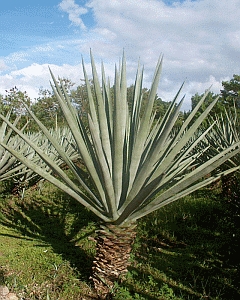
Pulque Agave Agave atrovirens
The scientific name of the Pulque Agave is Agave atrovirens. It is a species of flowering plant in the family Asparagaceae (asparagus family), order Asparagales.
- Scientific name
- Agave atrovirens Karw. ex Salm-Dyck
- Common name
- Pulque Agave
- Genus
- Agave
- Family
- Asparagaceae (Asparagus Family)
- Order
- Asparagales
- Class
- Liliopsida
- Red List category
- LC Least Concern
- Recorded in
- 4 countries
- Name status
- accepted in the Catalogue of Life

Overview
Agave atrovirens is native to the Mexican states of Oaxaca, Puebla and Veracruz and grows naturally at elevations between 1,800 and 3,400 metres. It is used to produce pulque from its fermented sap, known as aguamiel.
Written 26 November 2026 from the sources listed below. Each statement was checked against the passage it cites; statements that could not be supported were removed.
Appearance
The flowering stalk can exceed 12 metres in height, and the plant can occasionally reach a total weight of two tonnes.[1][2]
Habitat
The pulque agave grows naturally at elevations between 1,800 and 3,400 metres. It occurs in areas where cloud cover is more frequent.[3][4]
It is native to the Mexican states of Oaxaca, Puebla and Veracruz.[5]
Reproduction and life cycle
After many years of growth, the pulque agave produces a flowering panicle from the centre of its rosette. Each rosette flowers and produces fruit only once before dying.[6][7]
The plant also produces vegetative offsets known as pups.[8]
Uses
The pulque agave is used as a source plant for producing pulque. Its sap, known as aguamiel, is fermented to produce the drink.[9][10]
It belongs to the restricted group of agave species used for pulque production. Wild plants are also collected for mezcal production.[11][12]
Classification of the Pulque Agave
| Kingdom | Plantae |
|---|---|
| Subkingdom | Pteridobiotina |
| Phylum | Tracheophyta |
| Class | Liliopsida |
| Order | Asparagales |
| Family | Asparagaceae (Asparagus Family) |
| Genus | Agave (Agaves) |
| Species | Agave atrovirens Karw. ex Salm-Dyck |
Where the Pulque Agave is found
Checklists and occurrence records place Agave atrovirens in 4 countries across Africa, Europe and North America. GBIF holds 619 georeferenced records of it.
Countries where it is native or its origin is not stated
Countries where it has been introduced
Regions and cities with the most records
- Oaxaca, Mexico 315
- Oaxaca, Mexico 80
- Santa María Atzompa, Mexico 80
- San Antonio de la Cal, Mexico 78
- Coahuila, Mexico 32
- Puebla, Mexico 30
- Miahuatlán de Porfirio Díaz, Mexico 25
- Nuevo León, Mexico 18
- Michoacán, Mexico 17
- Santa Cruz Xoxocotlán, Mexico 13
- Tlaxcala, Mexico 12
- Veracruz, Mexico 12
- Acajete, Mexico 11
- Chiapas, Mexico 11
- Querétaro, Mexico 11
- Ciudad Mendoza, Mexico 10
- Comitán, Mexico 10
- Cuauhtémoc, Mexico 10
- Guanajuato, Mexico 10
- Hidalgo, Mexico 10
- Huamantla, Mexico 10
- Las Margaritas, Mexico 10
- Miguel Hidalgo, Mexico 10
- México, Mexico 10
- San Luis Potosí, Mexico 10
- Benito Juarez, Mexico 9
- Iztacalco, Mexico 9
- Iztapalapa, Mexico 9
- Mexico City, Mexico 9
- Nogales, Mexico 9
- San Miguel Topilejo, Mexico 9
- Xochimilco, Mexico 9
- Río Blanco, Mexico 8
- San Miguel Ajusco, Mexico 8
- Tlalpan, Mexico 8
- Azcapotzalco, Mexico 7
1 more country has a few records outside this range
These countries hold a few records of Agave atrovirens but lie outside the range the checklists give for it. Such records are often zoo or garden specimens, museum material or vagrants, so the species is not counted as occurring there.
A number beside a place is its count of GBIF occurrence records. A place without a number comes from a checklist alone. Records show where a species has been observed or collected, which can include escapes and vagrants.
Common names
English
- Pulque Agave
Names in 5 other languages
- Estonian
- meskiagaav, pulkeagaav, tumeroheline agaav
- Polish
- agawa ciemnozielona
- Russian
- Агава тёмно-зелёная
- Slovak
- agáva tmavozelená
- Spanish
- Maguey Blanco, Maguey cimarrón, Maguey del Cumbre, Maguey pulquero, Tepeme, maguey de la cumbre
Subspecies and varieties
- Agave atrovirens var. atrovirens (White Agave) variety
- Agave atrovirens var. mirabilis (Ash-colored Maguey) variety
Related species
-
 Blue AgaveAgave tequilana
-
 SisalAgave sisalana
-
 Century-plantAgave americana
-
 Swan-neck AgaveAgave attenuata
-
 Caribbean AgaveAgave angustifolia
-
 Parry's AgaveAgave parryi
-
 Queen Victoria AgaveAgave victoriae-reginae
-
 Lecheguilla AgaveAgave lechuguilla
Compare
Questions and answers
What is the scientific name of the Pulque Agave?
The scientific name of the Pulque Agave is Agave atrovirens. Written with its author, the full name is Agave atrovirens Karw. ex Salm-Dyck.
Which family does the Pulque Agave belong to?
Agave atrovirens belongs to the family Asparagaceae, in the order Asparagales and the class Liliopsida.
Where is the Pulque Agave found?
Checklists and occurrence records place Agave atrovirens in 4 countries, including Mexico and United States.
What is the conservation status of the Pulque Agave?
The IUCN Red List category recorded for Agave atrovirens is Least Concern (LC).
Sources
Passages the profile rests on
- The flowering stalk of Agave atrovirens can exceed 12 metres in height. Source passage: “but later grows to more than 12 m (39 ft) height” — English Wikipedia
- Agave atrovirens can occasionally reach a total weight of two tonnes. Source passage: “occasionally reaching a weight of 2 t (2.0 long tons; 2.2 short tons).” — English Wikipedia
- Agave atrovirens grows naturally at elevations between 1,800 and 3,400 metres. Source passage: “It grows naturally only between 1,800–3,400 m (5,900–11,200 ft)” — English Wikipedia
- Agave atrovirens naturally grows in areas where cloud cover is more frequent. Source passage: “where cloud cover is more frequent.” — English Wikipedia
- Agave atrovirens is native to the Mexican states of Oaxaca, Puebla and Veracruz. Source passage: “native to Oaxaca, Puebla and Veracruz states in Mexico.” — English Wikipedia
- Agave atrovirens produces a flowering panicle from the centre of its rosette after many years of growth. Source passage: “from the center of which, after many years, a panicle of flowers emerges” — English Wikipedia
- Each rosette of Agave atrovirens flowers and produces fruit only once before dying. Source passage: “Each rosette flowers and fruits once, then dies.” — English Wikipedia
- Agave atrovirens produces vegetative offsets known as pups. Source passage: “this is one of the species which makes offsets or "pups".” — English Wikipedia
- Agave atrovirens is used as a source plant for producing pulque. Source passage: “A. atrovirens is a pulque agave” — English Wikipedia
- The sap of Agave atrovirens, known as aguamiel, is fermented to produce pulque. Source passage: “Pulque is made by fermenting the agave sap or aguamiel of Agave atrovirens” — science.gov
- Wild Agave atrovirens plants are collected for mezcal production. Source passage: “also collected from the wild for making mezcal.” — English Wikipedia
- Agave atrovirens is among the restricted group of agave species used for pulque production. Source passage: “A restricted number of species are devoted to pulque including A. atrovirens, A. americana, A. salmiana, and A. mapisaga” — pmc.ncbi.nlm.nih.gov
Data
- Catalogue of Life, 2026-10-16 XR cc by
- Global Biodiversity Information Facility CC BY 4.0
- Wikidata CC0
- GeoNames CC BY 4.0
- Wikimedia Commons per image; credit shown with each image
- Within the Catalogue of Life, this name comes from The World Checklist of Vascular Plants (WCVP) cc by
References
- Hort. Dyck.: 302 (1834) where the name was published
This species in other databases
- Catalogue of Life 65QY4
- Wikidata Q2714978
- iNaturalist 273689
- World Flora Online wfo-0000754159
- GRIN 410673
Page built on 27 November 2026. See how the catalog is made and all sources and licences.
Cite this page
ScientificNames.org. (2026). Agave atrovirens (Pulque Agave). Retrieved November 27, 2026, from https://scientificnames.org/species/agave-atrovirens
“Agave atrovirens (Pulque Agave).” ScientificNames.org, 2026, scientificnames.org/species/agave-atrovirens. Accessed 27 Nov. 2026.
ScientificNames.org. “Agave atrovirens (Pulque Agave).” Accessed November 27, 2026. https://scientificnames.org/species/agave-atrovirens.
@misc{scientificnames_agave_atrovirens_pulque_agave,
  author = {{ScientificNames.org}},
  title = {Agave atrovirens (Pulque Agave)},
  year = {2026},
  url = {https://scientificnames.org/species/agave-atrovirens},
  note = {Accessed 2026-11-27}
}