Species · Flowering plants
Baja California Sur Century Agave Agave aurea
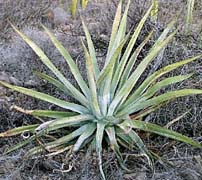
The scientific name of the Baja California Sur Century Agave is Agave aurea. It is a species of flowering plant in the family Asparagaceae (asparagus family), order Asparagales.
- Scientific name
- Agave aurea Brandegee
- Common name
- Baja California Sur Century Agave
- Genus
- Agave
- Family
- Asparagaceae (Asparagus Family)
- Order
- Asparagales
- Class
- Liliopsida
- Red List category
- LC Least Concern
- Recorded in
- 2 countries
- Name status
- accepted in the Catalogue of Life
Overview
Wikidata describes Agave aurea as “species of plant”.
Classification of the Baja California Sur Century Agave
| Kingdom | Plantae |
|---|---|
| Subkingdom | Pteridobiotina |
| Phylum | Tracheophyta |
| Class | Liliopsida |
| Order | Asparagales |
| Family | Asparagaceae (Asparagus Family) |
| Genus | Agave (Agaves) |
| Species | Agave aurea Brandegee |
Where the Baja California Sur Century Agave is found
Checklists and occurrence records place Agave aurea in 2 countries across North America. GBIF holds 684 georeferenced records of it.
Countries
Regions and cities with the most records
- Baja California Sur, Mexico 532
- Cabo San Lucas, Mexico 89
- Colonia del Sol, Mexico 89
- La Paz, Mexico 46
- San José del Cabo, Mexico 36
- Baja California, Mexico 4
- Zacatecas, Mexico 4
- Arizona, United States 3
- Chandler, United States 3
- Gilbert, United States 3
- Mesa, United States 3
- Phoenix, United States 3
- Scottsdale, United States 3
- Tempe, United States 3
- Tempe Junction, United States 3
A number beside a place is its count of GBIF occurrence records. A place without a number comes from a checklist alone. Records show where a species has been observed or collected, which can include escapes and vagrants.
Common names
English
- Baja California Sur Century Agave
Names in 1 other language
- Spanish
- Lechuguilla
Synonyms
One other scientific name has been used for this species and is now treated as a synonym of Agave aurea.
- Agave campaniflora Trel.
Subspecies and varieties
- Agave aurea var. aurea variety
- Agave aurea var. capensis variety
- Agave aurea var. promontorii variety
Related species
-
 Blue AgaveAgave tequilana
-
 SisalAgave sisalana
-
 CenturyplantAgave americana
-
 Swan-neck AgaveAgave attenuata
-
 Mescal AgaveAgave angustifolia
-
 Parry's AgaveAgave parryi
-
 Royal AgaveAgave victoriae-reginae
-
 Lecheguilla AgaveAgave lechuguilla
Compare
Questions and answers
What is the scientific name of the Baja California Sur Century Agave?
The scientific name of the Baja California Sur Century Agave is Agave aurea. Written with its author, the full name is Agave aurea Brandegee.
Which family does the Baja California Sur Century Agave belong to?
Agave aurea belongs to the family Asparagaceae, in the order Asparagales and the class Liliopsida.
Where is the Baja California Sur Century Agave found?
Checklists and occurrence records place Agave aurea in 2 countries: Mexico and United States.
What is the conservation status of the Baja California Sur Century Agave?
The IUCN Red List category recorded for Agave aurea is Least Concern (LC).
Sources
Data
- Catalogue of Life, 2026-10-16 XR cc by
- Global Biodiversity Information Facility CC BY 4.0
- Wikidata CC0
- GeoNames CC BY 4.0
- Wikimedia Commons per image; credit shown with each image
- Within the Catalogue of Life, this name comes from The World Checklist of Vascular Plants (WCVP) cc by
References
- Proc. Calif. Acad. Sci., ser. 2, 2: 207 (1889) where the name was published
This species in other databases
Page built on 25 November 2026. See how the catalog is made and all sources and licences.
Cite this page
ScientificNames.org. (2026). Agave aurea (Baja California Sur Century Agave). Retrieved November 25, 2026, from https://scientificnames.org/species/agave-aurea
“Agave aurea (Baja California Sur Century Agave).” ScientificNames.org, 2026, scientificnames.org/species/agave-aurea. Accessed 25 Nov. 2026.
ScientificNames.org. “Agave aurea (Baja California Sur Century Agave).” Accessed November 25, 2026. https://scientificnames.org/species/agave-aurea.
@misc{scientificnames_agave_aurea_baja_california_sur_century_agave,
  author = {{ScientificNames.org}},
  title = {Agave aurea (Baja California Sur Century Agave)},
  year = {2026},
  url = {https://scientificnames.org/species/agave-aurea},
  note = {Accessed 2026-11-25}
}