Species · Flowering plants
Tonto Basin Agave Agave delamateri
The scientific name of the Tonto Basin Agave is Agave delamateri. It is a species of flowering plant in the family Asparagaceae (asparagus family), order Asparagales.
- Scientific name
- Agave delamateri W.C.Hodgs. & Slauson
- Common name
- Tonto Basin Agave
- Genus
- Agave
- Family
- Asparagaceae (Asparagus Family)
- Order
- Asparagales
- Class
- Liliopsida
- Recorded in
- 1 country
- Name status
- accepted in the Catalogue of Life
Overview
Agave delamateri is endemic to central Arizona in the United States, with known populations in Gila, Maricopa, and Yavapai Counties. It grows in trunkless rosettes with bluish-green, toothed leaves and cream-colored flowers with a greenish tinge.
Written 27 November 2026 from the sources listed below. Each statement was checked against the passage it cites; statements that could not be supported were removed.
Appearance
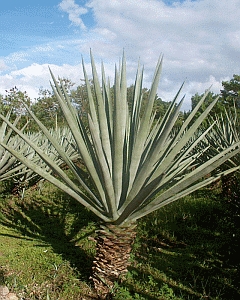
Tonto Basin Agave grows without a visible trunk and forms rosettes. Its leaves have a bluish-green appearance due to a waxy coating, with teeth along their margins and at their tips.[1][2][3]
Its flowers are cream-colored with a greenish tinge. Its surviving clones exhibit practically no variation among themselves.[4][5]
Its rosettes can reach 100 cm in diameter, and its leaves can reach 70 cm in length. Its flowering stalk can reach 6 m in height.[6][7][8]
Habitat
Tonto Basin Agave generally grows on gravelly soils in desert scrub. It sometimes occurs in pinyon-juniper woodland.[9][10]
Its occurrences are often near Mogollon or Salado archaeological sites.[11]
Reproduction and life cycle
The documented plants are clones that do not produce fertile seeds. Mature plants reproduce by producing pups from their bases.[12][13]
The oldest surviving mature clones may be hundreds of years old. Long-lived, primarily asexually reproducing agaves have left surviving clonal populations in the modern landscape.[14][15]
Conservation
The documented population consists of approximately 70 to 90 individuals.[16]
Similar species
The studied pre-contact agave domesticates are morphologically and genetically distinct from wild agaves of the southwestern United States and northern Mexico.[17]
Uses
Agave delamateri is included among six pre-contact agave domesticates identified in Arizona. Its surviving clones may descend from a population cultivated by pre-Columbian peoples.[18][19]
Pre-contact agricultural features associated with domesticated agaves include rock structures. Taxonomic evidence indicates that pre-contact farmers selected desirable characteristics in cultivated agaves, initiating domestication processes.[20][21]
Classification of the Tonto Basin Agave
| Kingdom | Plantae |
|---|---|
| Subkingdom | Pteridobiotina |
| Phylum | Tracheophyta |
| Class | Liliopsida |
| Order | Asparagales |
| Family | Asparagaceae (Asparagus Family) |
| Genus | Agave (Agaves) |
| Species | Agave delamateri W.C.Hodgs. & Slauson |
Where the Tonto Basin Agave is found
Checklists and occurrence records place Agave delamateri in 1 country across North America. GBIF holds 388 georeferenced records of it.
Countries
Regions and cities with the most records
A number beside a place is its count of GBIF occurrence records. A place without a number comes from a checklist alone. Records show where a species has been observed or collected, which can include escapes and vagrants.
Common names
English
- Tonto Basin Agave
Synonyms
One other scientific name has been used for this species and is now treated as a synonym of Agave delamateri.
- Agave repanda Trel. ex Gentry
Related species
-
 Blue AgaveAgave tequilana
-
 SisalAgave sisalana
-
 Century-plantAgave americana
-
 Swan-neck AgaveAgave attenuata
-
 Caribbean AgaveAgave angustifolia
-
 Parry's AgaveAgave parryi
-
 Queen Victoria AgaveAgave victoriae-reginae
-
 Lecheguilla AgaveAgave lechuguilla
Compare
Questions and answers
What is the scientific name of the Tonto Basin Agave?
The scientific name of the Tonto Basin Agave is Agave delamateri. Written with its author, the full name is Agave delamateri W.C.Hodgs. & Slauson.
Which family does the Tonto Basin Agave belong to?
Agave delamateri belongs to the family Asparagaceae, in the order Asparagales and the class Liliopsida.
Where is the Tonto Basin Agave found?
Checklists and occurrence records place Agave delamateri in 1 country: United States.
Sources
Passages the profile rests on
- The species grows without a visible trunk and forms rosettes. Source passage: “Agave delamateri is an acaulescent (trunkless) species forming rosettes” — English Wikipedia
- Its leaves have a bluish-green appearance due to a waxy coating. Source passage: “Leaves are up to 70 cm (28 inches) long, with a waxy coat giving them a bluish-green appearance.” — English Wikipedia
- Its leaves have teeth along their margins and at their tips. Source passage: “Leaves are well-armed, with teeth along the margins and on the tip.” — English Wikipedia
- Its flowers are cream-colored with a greenish tinge. Source passage: “with flowers cream-colored with a greenish tinge.” — English Wikipedia
- The surviving clones exhibit practically no variation among themselves. Source passage: “there is practically no variation between them.” — English Wikipedia
- Its rosettes can reach 100 cm in diameter. Source passage: “forming rosettes up to 100 cm (40 inches) in diameter.” — English Wikipedia
- Its leaves can reach 70 cm in length. Source passage: “Leaves are up to 70 cm (28 inches) long” — English Wikipedia
- Its flowering stalk can reach 6 m in height. Source passage: “The flowering stalk can be up to 6 m (20 feet) tall” — English Wikipedia
- The species generally grows on gravelly soils in desert scrub. Source passage: “It is generally found on gravelly soils in desert scrub” — English Wikipedia
- It sometimes occurs in pinyon-juniper woodland. Source passage: “and sometimes pinyon-juniper woodland” — English Wikipedia
- Its occurrences are often near Mogollon or Salado archaeological sites. Source passage: “often near Mogollon or Salado archaeological sites.” — English Wikipedia
- The documented plants are clones that do not produce fertile seeds. Source passage: “These plants are all clones producing no fertile seed.” — English Wikipedia
- Mature plants reproduce by producing pups from their bases. Source passage: “The mature plant reproduces by sprouting "pups" from its base.” — English Wikipedia
- The oldest surviving mature clones may be hundreds of years old. Source passage: “The oldest existing mature clones may be hundreds of years old” — English Wikipedia
- Long-lived, primarily asexually reproducing agaves have left surviving clonal populations in the modern landscape. Source passage: “Because of the longevity and primarily asexual reproduction of these agaves, relict clones have persisted to the present day” — pmc.ncbi.nlm.nih.gov
- The documented population consists of approximately 70 to 90 individuals. Source passage: “This species is only known from a population of about 70 to 90 individuals” — English Wikipedia
- The studied pre-contact agave domesticates are morphologically and genetically distinct from wild agaves of the southwestern United States and northern Mexico. Source passage: “These agaves are morphologically and genetically distinct from Southwest US and northern Mexico wild agaves” — pmc.ncbi.nlm.nih.gov
- The surviving clones may descend from a population cultivated by pre-Columbian peoples. Source passage: “The clones may be descendants of a cultivated population bred by pre-Columbian peoples.” — English Wikipedia
- Agave delamateri is included among six pre-contact agave domesticates identified in Arizona. Source passage: “These PCADs are Agave murpheyi, A. delamateri, A. phillipsiana, A. sanpedroensis, A. verdensis and A. yavapaiensis.” — pmc.ncbi.nlm.nih.gov
- Pre-contact agricultural features associated with domesticated agaves include rock structures. Source passage: “associated with pre-contact agricultural features, such as rock structures.” — pmc.ncbi.nlm.nih.gov
- Taxonomic evidence indicates that pre-contact farmers selected desirable characteristics in cultivated agaves, initiating domestication processes. Source passage: “Taxonomic data imply that pre-contact farmers selected desirable attributes, initiating domestication processes that resulted in discrete lineages.” — pmc.ncbi.nlm.nih.gov
- The species is endemic to central Arizona in the United States. Source passage: “It is endemic to central Arizona in the United States.” — English Wikipedia
Data
- Catalogue of Life, 2026-10-16 XR cc by
- Global Biodiversity Information Facility CC BY 4.0
- Wikidata CC0
- GeoNames CC BY 4.0
- Within the Catalogue of Life, this name comes from The World Checklist of Vascular Plants (WCVP) cc by
References
- Haseltonia 3: 133 (1995) where the name was published
This species in other databases
Page built on 29 November 2026. See how the catalog is made and all sources and licences.
Cite this page
ScientificNames.org. (2026). Agave delamateri (Tonto Basin Agave). Retrieved November 29, 2026, from https://scientificnames.org/species/agave-delamateri
“Agave delamateri (Tonto Basin Agave).” ScientificNames.org, 2026, scientificnames.org/species/agave-delamateri. Accessed 29 Nov. 2026.
ScientificNames.org. “Agave delamateri (Tonto Basin Agave).” Accessed November 29, 2026. https://scientificnames.org/species/agave-delamateri.
@misc{scientificnames_agave_delamateri_tonto_basin_agave,
  author = {{ScientificNames.org}},
  title = {Agave delamateri (Tonto Basin Agave)},
  year = {2026},
  url = {https://scientificnames.org/species/agave-delamateri},
  note = {Accessed 2026-11-29}
}