Species · Flowering plants
Hohokam Agave Agave murpheyi
The scientific name of the Hohokam Agave is Agave murpheyi. It is a species of flowering plant in the family Asparagaceae (asparagus family), order Asparagales.
- Scientific name
- Agave murpheyi Gibson
- Common name
- Hohokam Agave
- Genus
- Agave
- Family
- Asparagaceae (Asparagus Family)
- Order
- Asparagales
- Class
- Liliopsida
- Recorded in
- 3 countries
- Name status
- accepted in the Catalogue of Life

Overview
Hohokam agave (Agave murpheyi Gibson) is a flowering plant in the family Asparagaceae, order Asparagales, and class Liliopsida. The species occurs at archaeological sites in southern Arizona and northern Sonora, Mexico. It is distinguished by its primarily asexual reproduction through bulbils and its persistence at archaeological sites after more than 500 years without cultivation.
Written 26 November 2026 from the sources listed below. Each statement was checked against the passage it cites; statements that could not be supported were removed.
Appearance
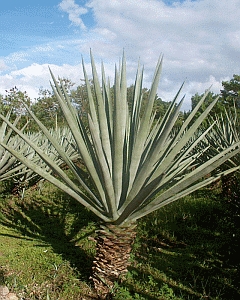
The plant forms a basal rosette of firm, ascending leaves that are light glaucous green to yellow-green and often have pale cross-banding. The leaf margins bear mostly 3–4 mm teeth spaced approximately 1–2 cm apart, and the leaves terminate in dark brown to grayish conical spines measuring 1.2–2 cm.[1][2][3]
The leaves develop red coloration during flowering. The flowering stalk bears greenish flowers with purplish or brownish tips, and the flowers have a cream-colored perianth with purplish or brownish tips.[4][5][6]
The leaves measure approximately 50–80 cm long and 6–10 cm wide. Individual flowers measure approximately 5.1–7.5 cm long, and fruit capsules measure approximately 5–7 cm long.[7][8][9]
The plant typically reaches approximately 3 ft in height and 3 ft in width. Its flowering stalk can reach approximately 12 ft in height.[10][11]
Habitat
The species thrives in the terrace Rain Garden Zone. It can be planted in locations with adequately draining soil and full sun.[12][13]
Reproduction and life cycle
The species reproduces through bulbils rather than viable seeds. Its flowers frequently abort before fruits develop.[14][15][16]
The flowering stalk produces small bulbils after the flowers fall. The species can be propagated through offsets, aerial plants, or seeds.[17][18]
Conservation
Plants of this species have continued growing at some archaeological sites after more than 500 years without cultivation. Relict clones have persisted into the present because of their longevity and primarily asexual reproduction.[19][20]
The number of known archaeological sites containing the species declined from approximately six in 1935 to two in 1970. The species persists at some archaeological sites despite more than five centuries without active cultivation.[21][22]
Uses
The Hohokam cultivated this species as a source of food and fiber. The basal rosette was harvested shortly before the flowering stalk emerged because its sugar concentration was then highest.[23][24]
Harvested rosettes weighed approximately 4.1 kg. They were cooked for two or three days in pits containing hot stones and covered with hot coals and dirt.[25][26]
A baked rosette contains approximately 347 calories and 3.5 grams of protein per 100 grams. The species is valued for its sweet taste, large size, and ease of harvesting and processing.[27][28]
The Hohokam cultivated the species in rockpiles measuring approximately 1.5 m across and 0.61 m high. The rockpiles helped retain moisture and prevent rodent predation.[29][30]
The leaves contain fine fibers associated with resistance to rot. They are less caustic than those of many other agave species, making them easier to handle.[31][32]
The species is cultivated as an ornamental plant and as a hedgerow.[33]
Classification of the Hohokam Agave
| Kingdom | Plantae |
|---|---|
| Subkingdom | Pteridobiotina |
| Phylum | Tracheophyta |
| Class | Liliopsida |
| Order | Asparagales |
| Family | Asparagaceae (Asparagus Family) |
| Genus | Agave (Agaves) |
| Species | Agave murpheyi Gibson |
Where the Hohokam Agave is found
Checklists and occurrence records place Agave murpheyi in 3 countries across Europe and North America. GBIF holds 236 georeferenced records of it.
Countries where it is native or its origin is not stated
Countries where it has been introduced
Regions and cities with the most records
- Arizona, United States 19
- Sonora, Mexico 6
- Scottsdale, United States 4
- Chandler, United States 3
- Gilbert, United States 3
- Mesa, United States 3
- Phoenix, United States 3
- Tempe, United States 3
- Tempe Junction, United States 3
A number beside a place is its count of GBIF occurrence records. A place without a number comes from a checklist alone. Records show where a species has been observed or collected, which can include escapes and vagrants.
Common names
English
- Hohokam Agave
- Murphey Agave
- Murphey's Century Plant
Names in 1 other language
- Russian
- Агава Мерфи
Related species
-
 Blue AgaveAgave tequilana
-
 SisalAgave sisalana
-
 Century-plantAgave americana
-
 Swan-neck AgaveAgave attenuata
-
 Caribbean AgaveAgave angustifolia
-
 Parry's AgaveAgave parryi
-
 Queen Victoria AgaveAgave victoriae-reginae
-
 Lecheguilla AgaveAgave lechuguilla
Compare
Questions and answers
What is the scientific name of the Hohokam Agave?
The scientific name of the Hohokam Agave is Agave murpheyi. Written with its author, the full name is Agave murpheyi Gibson.
Which family does the Hohokam Agave belong to?
Agave murpheyi belongs to the family Asparagaceae, in the order Asparagales and the class Liliopsida.
Where is the Hohokam Agave found?
Checklists and occurrence records place Agave murpheyi in 3 countries, including United States and Mexico.
What other names does the Hohokam Agave have?
Agave murpheyi is also known in English as Murphey Agave and Murphey's Century Plant.
What is the scientific name of the agave plant?
The scientific name of Hohokam agave is Agave murpheyi Gibson.[34]
What is agave mainly used for?
The Hohokam cultivated Hohokam agave as a source of food and fiber. It is also cultivated as an ornamental plant and as a hedgerow.[23][33]
Sources
Passages the profile rests on
- The plant forms a basal rosette of firm, ascending leaves that are light glaucous green to yellow-green and often have pale cross-banding. Source passage: “Leaves ascending, 50–80 × 6–10 cm; blade light glaucous green to yellow green, frequently lightly cross-zoned, spatulate, firm” — English Wikipedia
- The leaf margins bear mostly 3–4 mm teeth spaced approximately 1–2 cm apart. Source passage: “teeth single, well defined, mostly 3–4 mm, ca. 1–2 cm apart” — English Wikipedia
- The leaves terminate in dark brown to grayish conical spines measuring 1.2–2 cm. Source passage: “apical spine dark brown to grayish, conical, 1.2–2 cm.” — English Wikipedia
- The leaves develop red coloration during flowering. Source passage: “They develop a red coloration during flowering.” — English Wikipedia
- The flowering stalk bears greenish flowers with purplish or brownish tips. Source passage: “The flowers are greenish with purple or brown tips” — English Wikipedia
- The flowers have a cream-colored perianth with purplish or brownish tips. Source passage: “perianth cream, apex purplish or brownish” — English Wikipedia
- The plant's leaves measure approximately 50–80 cm long and 6–10 cm wide. Source passage: “Leaves ascending, 50–80 × 6–10 cm” — English Wikipedia
- Individual flowers measure approximately 5.1–7.5 cm long. Source passage: “Flowers 12–21 per cluster, erect, (5.1–)6–7.5 cm” — English Wikipedia
- The fruit capsules measure approximately 5–7 cm long. Source passage: “Capsules short-pedicellate, obovate to oblong or ovate, 5–7 cm” — English Wikipedia
- The plant typically reaches approximately 3 ft in height and 3 ft in width. Source passage: “A murpheyi is a slow growing, evergreen perennial reaching 3 ft high and 3 ft wide.” — arboretum.arizona.edu
- Its flowering stalk can reach approximately 12 ft in height. Source passage: “The flowering stalk of the agave typically grows up to 12 ft” — arboretum.arizona.edu
- The species thrives in the terrace Rain Garden Zone. Source passage: “A. murpheyi thrives in the terrace Rain Garden Zone” — arboretum.arizona.edu
- The species can be planted in locations with adequately draining soil and full sun. Source passage: “Plant in areas with adequately draining soil and full sun.” — arboretum.arizona.edu
- The species reproduces through bulbils rather than viable seeds. Source passage: “This agave produces only by bulbils” — English Wikipedia
- Its flowers frequently abort before fruits develop. Source passage: “these are rarely produced with the flowers aborting before the fruits form.” — English Wikipedia
- The species does not produce viable seeds according to the cultivation description. Source passage: “but sets no viable seed.” — arboretum.arizona.edu
- The flowering stalk produces small bulbils after the flowers fall. Source passage: “After the flowers drop, small bulbils form on the bloom stalk” — arboretum.arizona.edu
- The species can be propagated through offsets, aerial plants, or seeds. Source passage: “A murpheyi may be propagated by offsets, aerial plants, or seeds.” — arboretum.arizona.edu
- Plants of this species have continued growing at some archaeological sites after more than 500 years without cultivation. Source passage: “Despite being untended for more than 500 years Hohokam agave continue to grow at a few old archaeological sites.” — English Wikipedia
- Relict clones of this species have persisted into the present because of their longevity and primarily asexual reproduction. Source passage: “Because of the longevity and primarily asexual reproduction of these agaves, relict clones have persisted to the present day” — pmc.ncbi.nlm.nih.gov
- The number of known archaeological sites containing the species declined from approximately six in 1935 to two in 1970. Source passage: “In 1935, there were reported half a dozen sites and in 1970 only two were known.” — English Wikipedia
- The species persists at some archaeological sites despite more than five centuries without active cultivation. Source passage: “Despite being untended for more than 500 years Hohokam agave continue to grow at a few old archaeological sites.” — English Wikipedia
- The Hohokam cultivated this species as a source of food and fiber. Source passage: “It appears to be a cultivar grown by the Hohokam for food and fiber.” — English Wikipedia
- The basal rosette was harvested shortly before the flowering stalk emerged because its sugar concentration was then highest. Source passage: “For food the basal rosette was harvested just before the Hohokam agave sent up a flower stalk. At this time the concentration of sugars in the rosette is at its highest.” — English Wikipedia
- Harvested rosettes weighed approximately 4.1 kg. Source passage: “The rosettes, weighing about 9 pounds (4.1 kg)” — English Wikipedia
- The harvested rosettes were cooked for two or three days in pits containing hot stones and covered with hot coals and dirt. Source passage: “were cooked for two or three days in a pit filled with hot stones and covered with hot coals and dirt.” — English Wikipedia
- A baked rosette contains approximately 347 calories and 3.5 grams of protein per 100 grams. Source passage: “nutritious with 347 calories and 3.5 grams of protein per 100 grams.” — English Wikipedia
- The species is valued for its sweet taste, large size, and ease of harvesting and processing. Source passage: “A. murpheyi was and is prized for its particularly sweet taste, large size, and ease in harvesting and processing.” — arboretum.arizona.edu
- The species was cultivated by the Hohokam in rockpiles measuring approximately 1.5 m across and 0.61 m high. Source passage: “The Hohokam planted agave in rockpiles about 5 ft (1.5 m) across and 2 ft (0.61 m) high.” — English Wikipedia
- Rockpiles surrounding the plants helped retain moisture and prevent rodent predation. Source passage: “The pile of rocks around the base of the agave plant act as a mulch to help preserve moisture and prevent rodent predation.” — English Wikipedia
- The leaves contain fine fibers associated with resistance to rot. Source passage: “Additionally, the leaves contain fine fibers that lead to rot resistance.” — arboretum.arizona.edu
- Its leaves are less caustic than those of many other agave species, making them easier to handle. Source passage: “the leaves of A. murpheyi are less caustic and therefore easier to handle.” — arboretum.arizona.edu
- The species is cultivated as an ornamental plant and as a hedgerow. Source passage: “A. murpheyi is grown as ornamentals and as hedgerows.” — arboretum.arizona.edu
- The species is considered one of six pre-contact agave domesticates cultivated by the Hohokam and other cultures. Source passage: “These PCADs are Agave murpheyi, A. delamateri, A. phillipsiana, A. sanpedroensis, A. verdensis and A. yavapaiensis.” — pmc.ncbi.nlm.nih.gov
- The species occurs at archaeological sites in southern Arizona and northern Sonora, Mexico. Source passage: “found growing only at a few dozen archaeological sites of the ancient Hohokam Indians in southern Arizona and northern Sonora, Mexico.” — English Wikipedia
- The species has been recorded at only a few dozen archaeological sites associated with the ancient Hohokam. Source passage: “found growing only at a few dozen archaeological sites of the ancient Hohokam Indians” — English Wikipedia
- Its documented archaeological distribution includes southern Arizona and northern Sonora, Mexico. Source passage: “in southern Arizona and northern Sonora, Mexico.” — English Wikipedia
Data
- Catalogue of Life, 2026-10-16 XR cc by
- Global Biodiversity Information Facility CC BY 4.0
- Wikidata CC0
- GeoNames CC BY 4.0
- Wikimedia Commons per image; credit shown with each image
- Within the Catalogue of Life, this name comes from The World Checklist of Vascular Plants (WCVP) cc by
References
- Contr. Boyce Thompson Inst. 7: 83 (1935) where the name was published
This species in other databases
Page built on 27 November 2026. See how the catalog is made and all sources and licences.
Cite this page
ScientificNames.org. (2026). Agave murpheyi (Hohokam Agave). Retrieved November 27, 2026, from https://scientificnames.org/species/agave-murpheyi
“Agave murpheyi (Hohokam Agave).” ScientificNames.org, 2026, scientificnames.org/species/agave-murpheyi. Accessed 27 Nov. 2026.
ScientificNames.org. “Agave murpheyi (Hohokam Agave).” Accessed November 27, 2026. https://scientificnames.org/species/agave-murpheyi.
@misc{scientificnames_agave_murpheyi_hohokam_agave,
  author = {{ScientificNames.org}},
  title = {Agave murpheyi (Hohokam Agave)},
  year = {2026},
  url = {https://scientificnames.org/species/agave-murpheyi},
  note = {Accessed 2026-11-27}
}