Species · Flowering plants
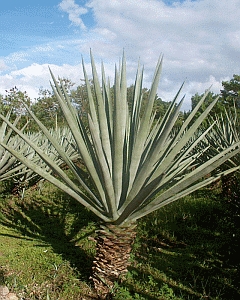
Palmer Agave Agave palmeri
The scientific name of the Palmer Agave is Agave palmeri. It is a species of flowering plant in the family Asparagaceae (asparagus family), order Asparagales.
- Scientific name
- Agave palmeri Engelm.
- Common name
- Palmer Agave
- Genus
- Agave
- Family
- Asparagaceae (Asparagus Family)
- Order
- Asparagales
- Class
- Liliopsida
- Red List category
- LC Least Concern
- Recorded in
- 2 countries
- Name status
- accepted in the Catalogue of Life

Overview
Palmer agave is a medium to large perennial succulent in the family Asparagaceae, order Asparagales and class Liliopsida. Its native range includes southern Arizona, southwestern New Mexico, Sonora, Mexico, and Chihuahua, Mexico. It produces a basal rosette of fleshy, upright green leaves and a flower spike that can reach five metres in height.
Written 26 November 2026 from the sources listed below. Each statement was checked against the passage it cites; statements that could not be supported were removed.
Appearance
Palmer agave produces a basal rosette of fleshy, upright green leaves with jagged edges. Each leaf terminates in a sharp, thick spine.[1][2]
Its flower buds are purplish, while its flowers are pale yellow and green, with six segments and stamens.[3][4]
Its leaves can reach 120 centimetres in length, and its leaf spines measure 3–6 centimetres long. Its flowers measure 4–5 centimetres in length.[5][6][7]
Palmer agave is an especially large member of the genus Agave and is the largest Agave species growing in the United States.[8][9]
Habitat
Palmer agave occurs in dry, rocky areas.[10]
Diet
Its flowers are foraged upon by Mexican long-tongued bats, Mexican long-nosed bats, and lesser long-nosed bats.[11][12][13]
Reproduction and life cycle
Palmer agave blooms between June and August. Its flowers grow on branches originating from the upper third of the flower spike.[14][15]
Its flower spike can reach five metres in height.[16]
Uses
Native Americans have used Palmer agave as food, to make drinks and soap, as a source of fiber, and medicinally.[17][18][19][20][21]
Palmer agave is frequently cultivated as an ornamental plant outside its native range.[22]
Classification of the Palmer Agave
| Kingdom | Plantae |
|---|---|
| Subkingdom | Pteridobiotina |
| Phylum | Tracheophyta |
| Class | Liliopsida |
| Order | Asparagales |
| Family | Asparagaceae (Asparagus Family) |
| Genus | Agave (Agaves) |
| Species | Agave palmeri Engelm. |
Where the Palmer Agave is found
Checklists and occurrence records place Agave palmeri in 2 countries across North America. GBIF holds 5,272 georeferenced records of it.
Countries
Regions and cities with the most records
- Arizona, United States 4,593
- Sierra Vista, United States 574
- Green Valley, United States 231
- New Mexico, United States 219
- Tanque Verde, United States 198
- Rio Rico, United States 133
- Sonora, Mexico 132
- Catalina Foothills, United States 100
- Nogales, United States 99
- Nogales, Mexico 78
- Oro Valley, United States 74
- Tucson, United States 56
- Casas Adobes, United States 53
- Flowing Wells, United States 44
- Chihuahua, Mexico 41
- Sahuarita, United States 19
- Agua Prieta, Mexico 9
- Douglas, United States 9
- Drexel Heights, United States 8
- Magdalena de Kino, Mexico 7
- Cananea, Mexico 5
- Chandler, United States 4
- Gilbert, United States 4
- Mesa, United States 4
- Phoenix, United States 4
- Scottsdale, United States 4
- Tempe, United States 4
- Tempe Junction, United States 4
A number beside a place is its count of GBIF occurrence records. A place without a number comes from a checklist alone. Records show where a species has been observed or collected, which can include escapes and vagrants.
Common names
English
- Palmer Agave
- Palmer's Agave
Names in 4 other languages
- Spanish
- Lechuguilla
- mfy
- juya cuu
- sei
- hamoc
- yua
- chelem
Related species
-
 Blue AgaveAgave tequilana
-
 SisalAgave sisalana
-
 Century-plantAgave americana
-
 Swan-neck AgaveAgave attenuata
-
 Caribbean AgaveAgave angustifolia
-
 Parry's AgaveAgave parryi
-
 Queen Victoria AgaveAgave victoriae-reginae
-
 Lecheguilla AgaveAgave lechuguilla
Compare
Questions and answers
What is the scientific name of the Palmer Agave?
The scientific name of the Palmer Agave is Agave palmeri. Written with its author, the full name is Agave palmeri Engelm..
Which family does the Palmer Agave belong to?
Agave palmeri belongs to the family Asparagaceae, in the order Asparagales and the class Liliopsida.
Where is the Palmer Agave found?
Checklists and occurrence records place Agave palmeri in 2 countries: United States and Mexico.
What is the conservation status of the Palmer Agave?
The IUCN Red List category recorded for Agave palmeri is Least Concern (LC).
What other names does the Palmer Agave have?
Agave palmeri is also known in English as Palmer's Agave.
How do you describe agave?
Palmer agave is a medium to large perennial succulent that produces a basal rosette of fleshy, upright green leaves. Its leaves have jagged edges and terminate in sharp, thick spines. Its flowers are pale yellow and green, and its flower spike can reach five metres in height.[1][2][4][16][23]
Sources
Passages the profile rests on
- Agave palmeri produces a basal rosette of fleshy, upright green leaves. Source passage: “It produces a basal leaf rosette of fleshy, upright green leaves” — English Wikipedia
- The leaves have jagged edges and terminate in sharp, thick spines. Source passage: “with jagged edges and ending in sharp, thick spines” — English Wikipedia
- The flower buds of this species are purplish. Source passage: “The buds are purplish.” — English Wikipedia
- Its flowers are pale yellow and green and have six segments and stamens. Source passage: “the flowers are pale yellow and green; they are 4–5 cm (1+1⁄2–2 in) long with six segments and stamens” — English Wikipedia
- Its leaves can reach 120 centimetres in length. Source passage: “of up to 120 centimetres (4 feet) in length” — English Wikipedia
- Its leaf spines measure 3–6 centimetres long. Source passage: “spines of 3–6 cm (1+1⁄4–2+1⁄4 inches) long.” — English Wikipedia
- Its flowers measure 4–5 centimetres in length. Source passage: “they are 4–5 cm (1+1⁄2–2 in) long” — English Wikipedia
- Agave palmeri is the largest Agave species growing in the United States. Source passage: “Agave palmeri is the largest Agave species growing in the United States.” — English Wikipedia
- Palmer agave is an especially large member of the genus Agave. Source passage: “is an especially large member of the genus Agave” — inaturalist.org
- This species occurs in dry, rocky areas. Source passage: “It can be found in dry, rocky areas.” — English Wikipedia
- Palmer agave flowers are foraged upon by Mexican long-tongued bats. Source passage: “These bats include the Mexican long-tongued bat (Choeronycteris mexicana)” — wildlife.dgf.nm.gov
- Palmer agave flowers are foraged upon by Mexican long-nosed bats. Source passage: “Mexican long-nosed bat (Leptonycteris nivalis)” — wildlife.dgf.nm.gov
- Palmer agave flowers are foraged upon by lesser long-nosed bats. Source passage: “lesser long-nosed bat (Leptonycteris yerbabuenae).” — wildlife.dgf.nm.gov
- Palmer agave blooms between June and August. Source passage: “Blooming from June to August” — English Wikipedia
- Its flowers grow on branches originating from the upper third of the flower spike. Source passage: “growing on branches from the upper third of the flower spike” — English Wikipedia
- Its flower spike can reach five metres in height. Source passage: “which can be up to 5 metres (16 ft) tall.” — English Wikipedia
- Palmer agave has been used by Native Americans as food. Source passage: “The plant was used by Native Americans for food” — English Wikipedia
- Native Americans used Palmer agave to make drinks. Source passage: “food, drink, fiber, soap, medicine and to make lances.” — English Wikipedia
- Native Americans used Palmer agave as a source of fiber. Source passage: “food, drink, fiber, soap, medicine and to make lances.” — English Wikipedia
- Native Americans used Palmer agave to make soap. Source passage: “food, drink, fiber, soap, medicine and to make lances.” — English Wikipedia
- Native Americans used Palmer agave medicinally. Source passage: “food, drink, fiber, soap, medicine and to make lances.” — English Wikipedia
- Palmer agave is frequently cultivated as an ornamental plant outside its native range. Source passage: “The plant is frequently cultivated as an ornamental in other regions.” — English Wikipedia
- Palmer agave is described as a medium to large perennial succulent. Source passage: “A medium to large perennial succulent” — arboretum.arizona.edu
Data
- Catalogue of Life, 2026-10-16 XR cc by
- Global Biodiversity Information Facility CC BY 4.0
- Wikidata CC0
- GeoNames CC BY 4.0
- Wikimedia Commons per image; credit shown with each image
- Within the Catalogue of Life, this name comes from The World Checklist of Vascular Plants (WCVP) cc by
References
- Trans. Acad. Sci. St. Louis 3: 319 (1875) where the name was published
This species in other databases
Page built on 27 November 2026. See how the catalog is made and all sources and licences.
Cite this page
ScientificNames.org. (2026). Agave palmeri (Palmer Agave). Retrieved November 27, 2026, from https://scientificnames.org/species/agave-palmeri
“Agave palmeri (Palmer Agave).” ScientificNames.org, 2026, scientificnames.org/species/agave-palmeri. Accessed 27 Nov. 2026.
ScientificNames.org. “Agave palmeri (Palmer Agave).” Accessed November 27, 2026. https://scientificnames.org/species/agave-palmeri.
@misc{scientificnames_agave_palmeri_palmer_agave,
  author = {{ScientificNames.org}},
  title = {Agave palmeri (Palmer Agave)},
  year = {2026},
  url = {https://scientificnames.org/species/agave-palmeri},
  note = {Accessed 2026-11-27}
}