Species · Mammals
Bolivian Red Howler Alouatta sara
The scientific name of the Bolivian Red Howler is Alouatta sara. It is a species of mammal in the family Atelidae (atelids), order Primates. The name dates from 1910.
- Scientific name
- Alouatta sara Elliot, 1910
- Common name
- Bolivian Red Howler
- Genus
- Alouatta
- Family
- Atelidae (Atelids)
- Order
- Primates
- Class
- Mammalia
- Red List category
- NT Near Threatened
- Recorded in
- 3 countries
- Name status
- accepted in the Catalogue of Life

Overview
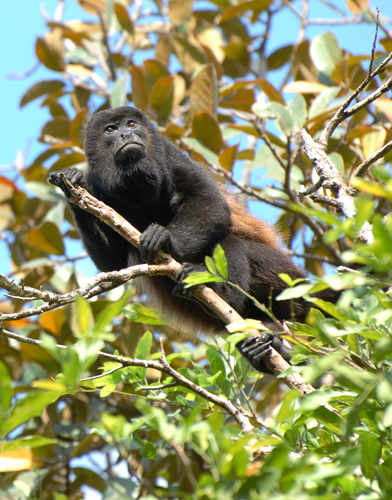
Alouatta sara inhabits rain forests, tropical forests, and humid and dry high terra firma forests, including forests above 1,000 metres in elevation. It is distinguished by brick-red fur, a muscular prehensile tail, and loud vocalizations amplified by its large hyoid bone.
Written 26 November 2026 from the sources listed below. Each statement was checked against the passage it cites; statements that could not be supported were removed.
Appearance
The Bolivian Red Howler has brick-red fur, with slightly darker, redder coloration on its limbs, head, and tail base. Its muscular prehensile tail helps it grasp branches and swing between them.[1][2]
Adult males have an average head-and-body length of 52.3–57 cm, while adult females average 46.8–49.7 cm. Males weigh approximately 6–7.6 kg and females approximately 4.5–6.3 kg.[3][4][5][6]
The prehensile tail averages 65.5 cm in length. The Bolivian Red Howler is larger in body size than Alouatta seniculus.[7][8]
Habitat
The Bolivian Red Howler inhabits rain forests, including riverine and seasonally flooded forests. It also occurs in tropical forests and humid and dry high terra firma forests.[9][10]
The species occurs in forests above 1,000 metres in elevation.[11]
Diet
The Bolivian Red Howler feeds primarily on leaves. Its recorded additional foods include nuts, seeds, fruit, and flowers.[12][13]
Behaviour
The Bolivian Red Howler lives in groups containing one to three males and two to seven females. Male red howlers in bachelor groups attempt to take control of female groups by fighting the dominant male.[14][15]
Males produce loud calls early in the morning that can be heard up to two miles away. Groups produce additional howls at night before sleeping, and males from other groups answer their calls, helping communicate territorial locations.[16][17][18]
The species spends most of its time in trees and sleeps approximately 15 hours per day. It can swim and cross moving water bodies at least 200 metres wide.[19][20][21]
The species most frequently travels along tree branches and lianas. Clambering is its most important form of locomotion, followed by quadrupedal walking and running, and it primarily uses slow quadrupedal movement when travelling.[22][23][24]
The species generally crosses canopy gaps by bridging while maintaining contact with supporting structures and rarely uses leaping to cross gaps. During group movements, it can cross savannah and other open ground on foot.[25][26][27]
The species produces vocalizations amplified by its large hyoid bone. The hyoid bone exhibits pronounced sexual dimorphism, with male hyoids averaging 69.5 ml and female hyoids averaging 12.5 ml.[28][29]
Reproduction and life cycle
Mating occurs throughout the year, and the gestation period is approximately six months. Females generally give birth to one offspring at a time and usually have their first offspring at five years of age.[30][31][32][33]
Newborns are born with fur and initially cling to their mothers' bellies. Young individuals can hang from their mothers using their tails by approximately one month of age and can ride on their mothers' backs by approximately one year of age.[34][35][36]
Infants nurse for approximately 18–24 months. Adult females without infants may cuddle and play with other females' babies, and male howlers show affection toward their own young.[37][38][39]
Classification of the Bolivian Red Howler
| Kingdom | Animalia |
|---|---|
| Phylum | Chordata |
| Subphylum | Vertebrata |
| Infraphylum | Gnathostomata |
| Parvphylum | Osteichthyes |
| Megaclass | Tetrapoda |
| Class | Mammalia (Mammal) |
| Subclass | Theria |
| Infraclass | Eutheria |
| Order | Primates (Primate) |
| Suborder | Haplorrhini |
| Infraorder | Simiiformes |
| Family | Atelidae (Atelids) |
| Subfamily | Alouattinae |
| Genus | Alouatta (Howler Monkey) |
| Species | Alouatta sara Elliot, 1910 |
Where the Bolivian Red Howler is found
Checklists and occurrence records place Alouatta sara in 3 countries across South America. GBIF holds 343 georeferenced records of it.
Countries
Regions and cities with the most records
- Madre de Dios, Peru 163
- Beni Department, Bolivia 67
- Santa Cruz Department, Bolivia 42
- Puerto Maldonado, Peru 39
- La Paz Department, Bolivia 32
- Trinidad, Bolivia 31
- Tambopata, Peru 18
- Pando, Bolivia 6
- Riberalta, Bolivia 3
Range as the checklists state it
South America
A number beside a place is its count of GBIF occurrence records. A place without a number comes from a checklist alone. Records show where a species has been observed or collected, which can include escapes and vagrants.
Common names
English
- Bolivian Red Howler
- Bolivian Red Howler Monkey
- Bolivian Red Howling Monkey
Names in 14 other languages
- Arabic
- عواء بوليفي أحمر
- Chinese
- 帚吼猴
- Czech
- vřešťan bolivijský
- Dutch
- Boliviaanse Rode Brulaap
- Finnish
- bolivianmölyapina
- French
- Hurleur de Bolivie, Singe Hurleur de Bolivie
- German
- Bolivianischer Brüllaffe, Bolivien-Brüllaffe
- Greek
- Μυκητής της Βολιβίας
- Japanese
- ボリビアアカホエザル
- Polish
- wyjec boliwijski
- Portuguese
- Bugio-vermelho-boliviano, Bugio-vermelho-da-bolívia
- Russian
- Боливийский ревун
- Spanish
- Aullador Rojo, Coto mono rojo, Manechi, Manechi Colorado, Mono aullador rojo de Bolivia
- Turkish
- Bolivya uluyan maymunu
Synonyms
One other scientific name has been used for this species and is now treated as a synonym of Alouatta sara.
- Alouatta seniculus sara Eliot, 1910
Related species
-
 Mantled HowlerAlouatta palliata
-
 Black HowlerAlouatta caraya
-
 Colombian Red HowlerAlouatta seniculus
-
 Yucatán Black HowlerAlouatta pigra
-
 Brown HowlerAlouatta guariba
-
 Guyanan Red HowlerAlouatta macconnelli
-
 Red-handed HowlerAlouatta belzebul
-
 Ursine HowlerAlouatta arctoidea
Compare
Questions and answers
What is the scientific name of the Bolivian Red Howler?
The scientific name of the Bolivian Red Howler is Alouatta sara. Written with its author, the full name is Alouatta sara Elliot, 1910.
Which family does the Bolivian Red Howler belong to?
Alouatta sara belongs to the family Atelidae, in the order Primates and the class Mammalia.
Where is the Bolivian Red Howler found?
Checklists and occurrence records place Alouatta sara in 3 countries: Bolivia, Peru and Brazil.
What is the conservation status of the Bolivian Red Howler?
The IUCN Red List category recorded for Alouatta sara is Near Threatened (NT).
What other names does the Bolivian Red Howler have?
Alouatta sara is also known in English as Bolivian Red Howler Monkey and Bolivian Red Howling Monkey.
Sources
Passages the profile rests on
- The Bolivian red howler has brick-red fur with slightly darker, redder coloration on its limbs, head, and tail base. Source passage: “Bolivian red howlers (Alouatta sara) are brick red, with slightly darker and more reddish limbs, head and base of tail.” — primate.wisc.edu
- The species has a muscular prehensile tail that helps it grasp branches and swing between them. Source passage: “Red howler monkeys have a muscular, prehensile tail that enables them to grasp branches or even swing from them.” — English Wikipedia
- Adult males have an average head-and-body length of 52.3–57 cm. Source passage: “Head and body length in adults averages 52.3 and 57.0 cm (20.6 and 22.4 in) in males” — primate.wisc.edu
- Adult females have an average head-and-body length of 46.8–49.7 cm. Source passage: “46.8 and 49.7 cm (18.4 and 19.6 in) in females” — primate.wisc.edu
- Adult males weigh approximately 6–7.6 kg. Source passage: “Average weights for males can range between 6 and 7.6 kg (13.2-16.8 lbs)” — primate.wisc.edu
- Adult females weigh approximately 4.5–6.3 kg. Source passage: “female weight averages range between 4.5 and 6.3 kg (9.9-13.9 lbs)” — primate.wisc.edu
- The prehensile tail averages 65.5 cm in length. Source passage: “averaging 65.5 cm (Thorington et al. 1979; Bergeson 1993; Richard-Hansen et al. 1999).” — primate.wisc.edu
- The Bolivian red howler is larger in body size than Alouatta seniculus. Source passage: “In addition, their body size is larger than A. seniculus (Groves 2001).” — primate.wisc.edu
- The species inhabits rain forests, including riverine and seasonally flooded forests. Source passage: “It can be found in rain forests, including riverine and seasonally flooded forests.” — English Wikipedia
- The species occurs in tropical forests and humid and dry high terra firma forests. Source passage: “They can be largely found in tropical forests, as well as in riverine and seasonally swamped woodlands and in forests above 1000 meters (3280 feet) above sea level, humid and dry forest high terra firma.” — English Wikipedia
- The species occurs in forests above 1,000 metres in elevation. Source passage: “in forests above 1000 meters (3280 feet) above sea level” — English Wikipedia
- The species feeds primarily on leaves. Source passage: “They feed mostly on leaves” — English Wikipedia
- Its recorded additional foods include nuts, seeds, fruit, and flowers. Source passage: “they also enjoy nuts, seeds, fruit, and flowers.” — English Wikipedia
- The species lives in groups containing one to three males and two to seven females. Source passage: “The red howlers live in groups with one to three males, and two to seven females.” — English Wikipedia
- Male red howlers in bachelor groups attempt to take control of female groups by fighting the dominant male. Source passage: “Males living in bachelor groups attempt to gain control of the female group by fighting the lead male.” — English Wikipedia
- Males produce loud calls early in the morning that can be heard up to two miles away. Source passage: “The male red howler wakes up early in the morning and wakes the forest up with their loud howls that can be heard up to 2 miles.” — English Wikipedia
- Groups produce additional howls at night before sleeping. Source passage: “They howl again at night, before they go to sleep” — English Wikipedia
- Males from other groups answer their calls, helping communicate territorial locations. Source passage: “the calls are answered by males from other red howler groups, to let them know their location so that their territories do not overlap.” — English Wikipedia
- The species spends most of its time in trees. Source passage: “even though they spend most of their time in the tree.” — English Wikipedia
- The species sleeps approximately 15 hours per day. Source passage: “they sleep for 15 hours per day.” — English Wikipedia
- The species can swim and cross moving water bodies at least 200 metres wide. Source passage: “Red howlers are capable of swimming and are able to cross moving water 200 m (656.2 ft) or greater in width” — primate.wisc.edu
- The species most frequently travels along tree branches and lianas. Source passage: “Red howlers travel most frequently occurs on tree branches and lianas” — primate.wisc.edu
- Clambering is the species' most important form of locomotion, followed by quadrupedal walking and running. Source passage: “The most important mode of movement is clambering, followed by quadrupedal walking and running” — primate.wisc.edu
- The species primarily uses slow quadrupedal movement when travelling. Source passage: “Travel is mostly slow quadrupedal progression” — primate.wisc.edu
- The species generally crosses canopy gaps by bridging while maintaining contact with supporting structures. Source passage: “Gap crossing, especially in the upper canopy, is mainly by bridging” — primate.wisc.edu
- The species rarely uses leaping to cross gaps. Source passage: “Leaping is rarely used to cross gaps” — primate.wisc.edu
- The species can cross savannah and other open ground on foot during group movements. Source passage: “the species will also cross savannah and other types of open ground on foot, often during group movements” — primate.wisc.edu
- The species produces vocalizations amplified by its large hyoid bone. Source passage: “One of the most characteristic features of the red howler, and indeed of the genus Alouatta as a whole, is the large hyoid bone, functioning to deepen the pitch, resonate, and amplify the species’ vocalizations” — primate.wisc.edu
- The red howler's hyoid bone exhibits pronounced sexual dimorphism, with male hyoids averaging 69.5 ml and female hyoids averaging 12.5 ml. Source passage: “male hyoid volume averaging 69.5 ml (2.4 oz) and female hyoids averaging 12.5 ml (0.4 oz)” — primate.wisc.edu
- Mating occurs throughout the year. Source passage: “Mating occurs throughout the year.” — English Wikipedia
- The gestation period is approximately six months. Source passage: “After the pregnancy period, which is six months” — English Wikipedia
- Females generally give birth to one offspring at a time. Source passage: “the female generally gives birth to one offspring at a time.” — English Wikipedia
- Females usually have their first offspring at five years of age. Source passage: “Females usually first give birth when they reach five years” — English Wikipedia
- Newborns are born with fur and initially cling to their mothers' bellies. Source passage: “Newborns are born with fur and must hang onto their mother's belly.” — English Wikipedia
- Young individuals can hang from their mothers using their tails by approximately one month of age. Source passage: “When baby howlers reach one month they can now hang from their mothers with their tails” — English Wikipedia
- Young individuals can ride on their mothers' backs by approximately one year of age. Source passage: “can eventually ride on her back when they reach one year.” — English Wikipedia
- Infants nurse for approximately 18–24 months. Source passage: “Baby howlers nurse for 18 to 24 months.” — English Wikipedia
- Adult females without infants may cuddle and play with other females' babies. Source passage: “especially those without an infant, are very fond of other females babies and will cuddle and play with them.” — English Wikipedia
- Male howlers show affection toward their own young. Source passage: “The male howlers, on the other hand, are very affectionate to youngsters but only to their own.” — English Wikipedia
Data
- Catalogue of Life, 2026-10-16 XR cc by
- Global Biodiversity Information Facility CC BY 4.0
- Wikidata CC0
- GeoNames CC BY 4.0
- Wikimedia Commons per image; credit shown with each image
- Within the Catalogue of Life, this name comes from The Integrated Taxonomic Information System cc0
References
- Elliot, D. G. (1910). Descriptions of new species of monkeys of the genera Galago, Cebus, Alouatta, and Cercopithecus. Annals and Magazine of Natural History: Zoology, Botany, and Geology, Series 8, Vol. 5, No. 25. Link where the name was published
- Wilson, Don E., and DeeAnn M. Reeder, eds. (1993). Mammal Species of the World: A Taxonomic and Geographic Reference, 2nd Ed., 3rd Printing.
- Wilson, Don E., and F. Russell Cole. (2000). Common Names of Mammals of the World.
- Wilson, Don E., and DeeAnn M. Reeder, eds. (2005). Mammal Species of the World: A Taxonomic and Geographic Reference, 3rd Ed., Vol. 1.
- Mittermeier, Rusell A., Anthony B. Rylands, and Don E. Wilson, eds. (2013). Handbook of the Mammals of the World. Volume 3. Primates.
This species in other databases
Page built on 29 November 2026. See how the catalog is made and all sources and licences.
Cite this page
ScientificNames.org. (2026). Alouatta sara (Bolivian Red Howler). Retrieved November 29, 2026, from https://scientificnames.org/species/alouatta-sara
“Alouatta sara (Bolivian Red Howler).” ScientificNames.org, 2026, scientificnames.org/species/alouatta-sara. Accessed 29 Nov. 2026.
ScientificNames.org. “Alouatta sara (Bolivian Red Howler).” Accessed November 29, 2026. https://scientificnames.org/species/alouatta-sara.
@misc{scientificnames_alouatta_sara_bolivian_red_howler,
  author = {{ScientificNames.org}},
  title = {Alouatta sara (Bolivian Red Howler)},
  year = {2026},
  url = {https://scientificnames.org/species/alouatta-sara},
  note = {Accessed 2026-11-29}
}