Species · Crustaceans
Alpheus fasqueli
Alpheus fasqueli has no English name on record in the checklists used here. It is a species of crustacean in the family Alpheidae (snapping shrimps), order Decapoda. The name dates from 2001.
- Scientific name
- Alpheus fasqueli Anker, 2001
- Genus
- Alpheus
- Family
- Alpheidae (Snapping Shrimps)
- Order
- Decapoda
- Class
- Malacostraca
- Environment
- marine
- Name status
- accepted in the Catalogue of Life
Overview
The species was first recorded in Sri Lanka. It is distinguished by its red coloration with whitish patches, transparent orbital hoods and a well-developed descending rostrum.
Written 27 November 2026 from the sources listed below. Each statement was checked against the passage it cites; statements that could not be supported were removed.
Appearance
The carapace has scattered dorsal setae and shallow grooves in its latero-anterior region. The rostrum is well developed and descends from the carapace, while the orbital hoods are inflated and lack teeth.[1][2][3]
The corneas are well developed, and the eyes have small anterior processes. The antennular peduncles are stout, and the antennal basicerite bears an acute ventrolateral tooth.[4][5][6]
The incisor process of the mouthparts has fewer than ten teeth. The epipodial plate on the coxa of the third maxilliped bears thick, blunt setae.[7][8]
The merus has a slightly crenellated mesial margin and lacks teeth. The carpus is very short.[9][10]
The uropodal exopod has a moderately developed lateral spine and a sinuous diaresis. The telson is broad, tapers distally and bears two pairs of dorsal spines.[11][12]
The carapace is bright red with circular and elongated whitish patches. The rostrum is red, and the orbital hoods are transparent.[13][14]
The antennal and antennular peduncles are reddish, while both flagella are purplish red. Both major and minor chelipeds are red, with a distal white patch on the merus.[15][16]
The chelae are deep red, with white tips on the fingers. The abdomen is red, with bordeaux red coloration on the ventral pleura.[17][18]
The uropods and telson are red.[19]
Classification of Alpheus fasqueli
| Kingdom | Animalia |
|---|---|
| Phylum | Arthropoda |
| Subphylum | Crustacea |
| Class | Malacostraca |
| Order | Decapoda |
| Suborder | Pleocyemata |
| Infraorder | Caridea |
| Superfamily | Alpheoidea |
| Family | Alpheidae (Snapping Shrimps) |
| Genus | Alpheus (Pistol Shrimps) |
| Species | Alpheus fasqueli Anker, 2001 |
Where Alpheus fasqueli is found
Range as the checklists state it
Indo-West Pacific
A number beside a place is its count of GBIF occurrence records. A place without a number comes from a checklist alone. Records show where a species has been observed or collected, which can include escapes and vagrants.
Related species
-
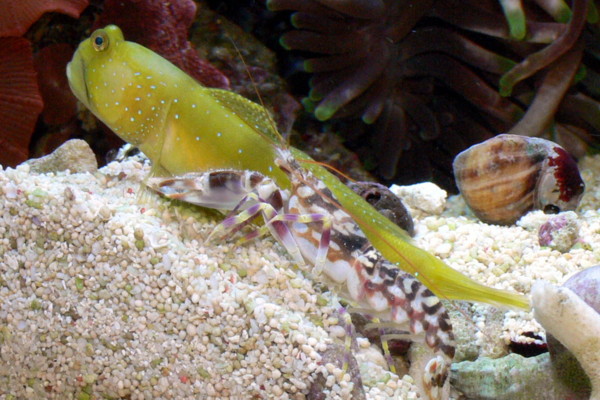 Tiger Pistol ShrimpAlpheus bellulus
-
 Bigclaw Snapping ShrimpAlpheus heterochaelis
-
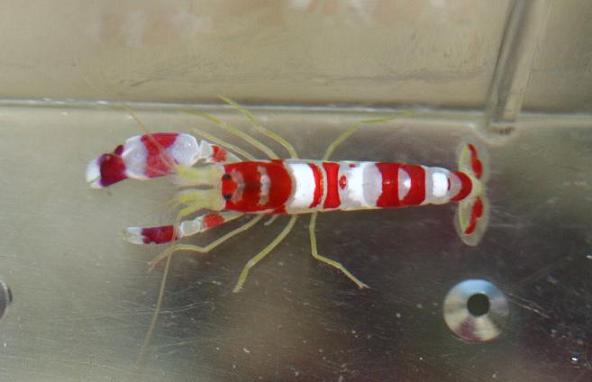 Randall's Pistol ShrimpAlpheus randalli
-
 Forceps Snapping ShrimpAlpheus digitalis
-
 Brown Snapping ShrimpAlpheus armatus
-
 Narrow Snapping ShrimpAlpheus astrinx
-
 Snapping PrawnAlpheus macrocheles
-
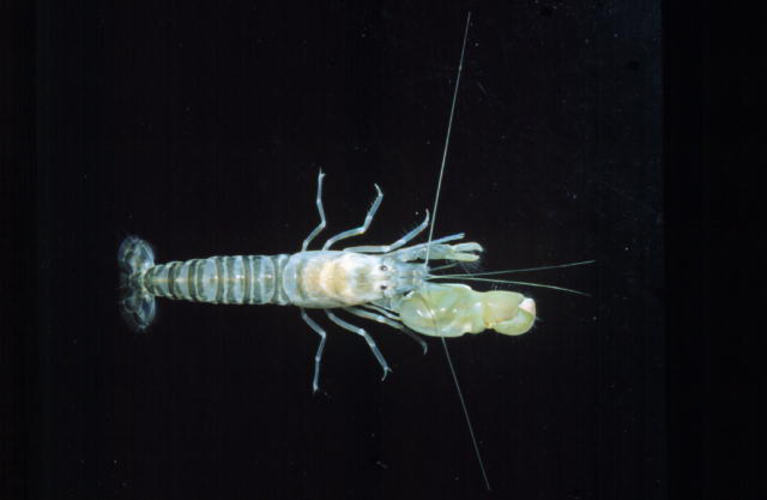 Richardson's Snapping ShrimpAlpheus richardsoni
Compare
Questions and answers
What is the size of Alpheus fasqueli?
The carapace measures approximately 17.5 millimetres in length, and the total body length is approximately 44 millimetres. The chela measures approximately 22 millimetres in length.[20][21][22]
Where was Alpheus fasqueli first recorded?
The species was first recorded in Sri Lanka.[23]
Who was Alpheus fasqueli named after?
The species was named in honour of Frédéric Fasquel, a photographer who supplied rare shrimp specimens to the Muséum national d'histoire naturelle.[24]
Sources
Passages the profile rests on
- The species has a carapace with scattered dorsal setae and shallow grooves in its latero-anterior region. Source passage: “Its carapace is smooth, possessing shallow grooves latero-anteriorly, and scattered setae dorsally.” — English Wikipedia
- The rostrum is well developed and descends from the carapace. Source passage: “its rostrum is well developed and descendant” — English Wikipedia
- The orbital hoods are inflated and lack teeth. Source passage: “its orbital hoods are inflated, lacking teeth.” — English Wikipedia
- The species has well-developed corneas and eyes with small anterior processes. Source passage: “Its corneas are well developed, while its eyes have small anterior processes” — English Wikipedia
- Its antennular peduncles are stout. Source passage: “its antennular peduncles are stout.” — English Wikipedia
- The antenna's basicerite bears an acute ventrolateral tooth. Source passage: “Its antenna shows a basicerite bearing an acute, ventrolateral tooth.” — English Wikipedia
- The incisor process of its mouthparts has fewer than ten teeth. Source passage: “its incisor process bearing less than 10 teeth.” — English Wikipedia
- The epipodial plate on the coxa of the third maxilliped bears thick, blunt setae. Source passage: “The epipodial plate on the coxa of its third maxilliped bears thick, blunt setae.” — English Wikipedia
- The merus has a slightly crenellated mesial margin and lacks teeth. Source passage: “Its merus is slightly crenellated on the mesial margin, and contains no teeth.” — English Wikipedia
- The carpus is very short. Source passage: “Its carpus is very short.” — English Wikipedia
- The uropodal exopod has a moderately developed lateral spine and a sinuous diaresis. Source passage: “Its uropodal exopod has a moderately developed lateral spine, and a sinuous diaresis.” — English Wikipedia
- The telson is broad, tapers distally and bears two pairs of dorsal spines. Source passage: “The species' telson is broad, distally tapering, exhibiting 2 pairs of dorsal spines.” — English Wikipedia
- The carapace is bright red with circular and elongated whitish patches. Source passage: “Its carapace is coloured bright red, with circular and elongated whitish patches.” — English Wikipedia
- The rostrum is red and the orbital hoods are transparent. Source passage: “Its rostrum is red and its orbital hoods transparent.” — English Wikipedia
- The antennal and antennular peduncles are reddish, while both flagella are purplish red. Source passage: “The antennal and antennular peduncles are reddish, while both flagella are purplish red.” — English Wikipedia
- Both major and minor chelipeds are red, with a distal white patch on the merus. Source passage: “Its major and minor chelipeds are red; the merus showing a distal white patch” — English Wikipedia
- The chelae are deep red, with white tips on the fingers. Source passage: “chelae are deep red, white on the tips of fingers.” — English Wikipedia
- The abdomen is red, with bordeaux red coloration on the ventral pleura. Source passage: “The species' abdomen is red, and the pleura exhibiting a bordeaux red colour ventrally.” — English Wikipedia
- The uropods and telson are red. Source passage: “Its uropods are red, as is its telson.” — English Wikipedia
- The carapace measures approximately 17.5 millimetres in length. Source passage: “Alpheus fasqueli has a carapace length of about 17.5 millimetres” — English Wikipedia
- The total body length is approximately 44 millimetres. Source passage: “a total length of 44 millimetres (1.7 in)” — English Wikipedia
- The chela measures approximately 22 millimetres in length. Source passage: “chela length of 22 millimetres (0.87 in).” — English Wikipedia
- The species was first recorded in Sri Lanka. Source passage: “It was first isolated in Sri Lanka.” — English Wikipedia
- The species was named in honour of Frédéric Fasquel, a photographer who supplied rare shrimp specimens to the Muséum national d'histoire naturelle. Source passage: “The species is named after Frédéric Fasquel, a photographer who contributed rare shrimp specimens for the Muséum national d'histoire naturelle.” — English Wikipedia
Data
- Catalogue of Life, 2026-10-16 XR cc by
- Wikidata CC0
- Within the Catalogue of Life, this name comes from The Integrated Taxonomic Information System cc0
References
- Anker, A. (2001). Two new species of snapping shrimps from the Indo-Pacific, with remarks on colour patterns and sibling species in Alpheidae (Crustacea, Caridea). Raffles Bulletin of Zoology. 49: 57-72. where the name was published
- De Grave, Sammy, and C. H. J. M. Fransen. (2011). Carideorum catalogus: the recent species of the Dendrobranchiate, Stenopodidean, Procarididean and Caridean Shrimps (Crustacea: Decapoda). Zoologische Mededelingen, Vol. 85, No. 9.
This species in other databases
Page built on 29 November 2026. See how the catalog is made and all sources and licences.
Cite this page
ScientificNames.org. (2026). Alpheus fasqueli. Retrieved November 29, 2026, from https://scientificnames.org/species/alpheus-fasqueli
“Alpheus fasqueli.” ScientificNames.org, 2026, scientificnames.org/species/alpheus-fasqueli. Accessed 29 Nov. 2026.
ScientificNames.org. “Alpheus fasqueli.” Accessed November 29, 2026. https://scientificnames.org/species/alpheus-fasqueli.
@misc{scientificnames_alpheus_fasqueli,
  author = {{ScientificNames.org}},
  title = {Alpheus fasqueli},
  year = {2026},
  url = {https://scientificnames.org/species/alpheus-fasqueli},
  note = {Accessed 2026-11-29}
}