Species · Fishes
Compressed Cichlid Altolamprologus compressiceps
The scientific name of the Compressed Cichlid is Altolamprologus compressiceps. It is a species of fish in the family Cichlidae (cichlid), order Cichliformes. The name dates from 1898.
- Scientific name
- Altolamprologus compressiceps (Boulenger, 1898)
- Common name
- Compressed Cichlid
- Genus
- Altolamprologus
- Family
- Cichlidae (Cichlid)
- Order
- Cichliformes
- Class
- Teleostei
- Red List category
- LC Least Concern
- Environment
- freshwater
- Recorded in
- 5 countries
- Name status
- accepted in the Catalogue of Life

Overview
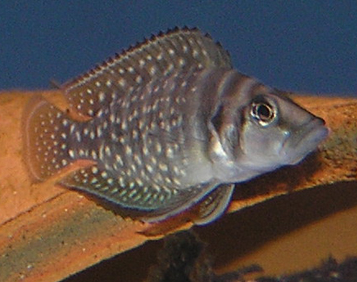
The compressed cichlid is closely related to Altolamprologus calvus. It inhabits shallow rocky areas of Lake Tanganyika and occurs throughout the lake. It has a slender, tall body, shorter jaws and an upward-turning snout.
Written 26 November 2026 from the sources listed below. Each statement was checked against the passage it cites; statements that could not be supported were removed.
Appearance
The compressed cichlid has a slender, tall body and a tapered mouth. Its jaws can extend outward to facilitate suction feeding, and its teeth have a forceps-like shape.[1][2][3]
Its eyes can rotate 90 degrees from their usual position. Its shorter jaws and upward-turning snout distinguish it from Altolamprologus calvus.[4][5]
The three studied populations show morphological differences concentrated primarily in the head region.[6][7]
Habitat
The compressed cichlid inhabits shallow rocky areas of Lake Tanganyika and occurs throughout the lake. It occupies rocky and cobble habitats and sometimes gastropod shell beds.[8][9][10]
Its laterally compressed body is considered an adaptation that facilitates access to narrow rock crevices while foraging.[11]
Behaviour
The compressed cichlid is strongly associated with its specialized habitat.[12]
Conservation
The compressed cichlid is not considered threatened by the IUCN.[13]
Similar species
Altolamprologus calvus is a close relative of the compressed cichlid. The compressed cichlid has shorter jaws and an upward-turning snout, distinguishing it from A. calvus.[4][14]
Classification of the Compressed Cichlid
| Kingdom | Animalia |
|---|---|
| Phylum | Chordata |
| Subphylum | Vertebrata |
| Infraphylum | Gnathostomata |
| Parvphylum | Osteichthyes |
| Gigaclass | Actinopterygii |
| Superclass | Actinopteri |
| Class | Teleostei (Teleost) |
| Order | Cichliformes |
| Family | Cichlidae (Cichlid) |
| Subfamily | Pseudocrenilabrinae |
| Genus | Altolamprologus |
| Species | Altolamprologus compressiceps (Boulenger, 1898) |
Where the Compressed Cichlid is found
Checklists and occurrence records place Altolamprologus compressiceps in 5 countries. GBIF holds 515 georeferenced records of it.
Countries
Regions and cities with the most records
- Northern Province, Zambia 72
- Mpulungu, Zambia 36
- Kigoma, Tanzania 23
- Tanganyika, Democratic Republic of the Congo 23
- Rukwa, Tanzania 20
- Uvira, Democratic Republic of the Congo 17
- Bujumbura Rural, Burundi 10
- Kigoma, Tanzania 8
- Mwandiga, Tanzania 8
- Baudhuinville, Democratic Republic of the Congo 7
- Kirando, Tanzania 7
- Bururi, Burundi 5
- Gatumba, Burundi 5
- Kalemie, Democratic Republic of the Congo 4
- Katavi, Tanzania 4
- Rumonge, Burundi 3
A number beside a place is its count of GBIF occurrence records. A place without a number comes from a checklist alone. Records show where a species has been observed or collected, which can include escapes and vagrants.
Common names
English
- Compressed Cichlid
- Compressiceps
- Yellow Calvus
Names in 5 other languages
- Afrikaans
- Lenda, Lupapa
- Czech
- pestřenec žlutohlavý
- Finnish
- kuonoahven
- Spanish
- Cíclido Lambrologus
- Swahili
- Kaubao
Synonyms
3 other scientific names have been used for this species and are now treated as synonyms of Altolamprologus compressiceps.
- Lamprologus compressiceps Boulenger, 1898
- Neolamprologus compressiceps (Boulenger, 1898)
- Haplochromis compressiceps (Boulenger, 1898) ambiguous synonym
Related species
-
 Calvus CichlidAltolamprologus calvus
-
 OscarAstronotus ocellatus
-
 Nile TilapiaOreochromis niloticus
-
 Green ChromideEtroplus suratensis
-
 Convict CichlidAmatitlania nigrofasciata
-
 Ram CichlidMikrogeophagus ramirezi
-
 Mozambique TilapiaOreochromis mossambicus
-
 Blue AcaraAndinoacara pulcher
Compare
Questions and answers
What is the scientific name of the Compressed Cichlid?
The scientific name of the Compressed Cichlid is Altolamprologus compressiceps. Written with its author, the full name is Altolamprologus compressiceps (Boulenger, 1898).
Which family does the Compressed Cichlid belong to?
Altolamprologus compressiceps belongs to the family Cichlidae, in the order Cichliformes and the class Teleostei.
Where is the Compressed Cichlid found?
Checklists and occurrence records place Altolamprologus compressiceps in 5 countries: Zambia, Democratic Republic of the Congo, Burundi, Tanzania and Republic of the Congo.
What is the conservation status of the Compressed Cichlid?
The IUCN Red List category recorded for Altolamprologus compressiceps is Least Concern (LC).
What other names does the Compressed Cichlid have?
Altolamprologus compressiceps is also known in English as Compressiceps and Yellow Calvus.
Sources
Passages the profile rests on
- This species has a slender, tall body and a tapered mouth. Source passage: “A. compressiceps and A. calvus have a highly specialized morphology (Brichard, 1999), characterized by a very slender and high body and a tapered mouth.” — pmc.ncbi.nlm.nih.gov
- Its jaws can extend outward to facilitate suction feeding. Source passage: “Jaws can be protruded for suction feeding” — pmc.ncbi.nlm.nih.gov
- Its teeth have a forceps-like shape. Source passage: “and its teeth are forceps-like.” — pmc.ncbi.nlm.nih.gov
- This species has shorter jaws and a snout that turns upward, distinguishing it from A. calvus. Source passage: “A. compressiceps are close relatives to A. calvus and can be distinguished by their shorter jaws and turned up snout.” — English Wikipedia
- Its eyes can rotate 90 degrees from their usual position. Source passage: “In addition, eyes can be turned 90° out of their usual position.” — pmc.ncbi.nlm.nih.gov
- The three studied populations show significant genetic and morphological differentiation. Source passage: “Both genetic and morphological analyses revealed significant differentiation among the three studied populations.” — pmc.ncbi.nlm.nih.gov
- Morphological differences among the studied populations are concentrated primarily in the head region. Source passage: “Phenotypic differentiation was primarily found in the head region of A. compressiceps.” — pmc.ncbi.nlm.nih.gov
- This species inhabits shallow rocky areas of Lake Tanganyika. Source passage: “It is endemic to the shallow rocky areas of Lake Tanganyika.” — English Wikipedia
- This species occurs throughout Lake Tanganyika. Source passage: “A. compressiceps is distributed all over the entire lake” — pmc.ncbi.nlm.nih.gov
- This species occupies rocky and cobble habitats and sometimes gastropod shell beds. Source passage: “Both species are restricted to rock- or cobble habitats, and in some cases gastropod shell beds.” — pmc.ncbi.nlm.nih.gov
- Its laterally compressed body is considered an adaptation that facilitates access to narrow rock crevices while foraging. Source passage: “since a laterally depressed body allows easier access to narrow rock crevices.” — pmc.ncbi.nlm.nih.gov
- This species is strongly associated with its specialized habitat. Source passage: “A. compressiceps is such a stenotopic and strongly habitat-bound species” — pmc.ncbi.nlm.nih.gov
- This species is not considered threatened by the IUCN. Source passage: “It is not considered threatened by the IUCN.” — English Wikipedia
- Altolamprologus calvus is a close relative of this species. Source passage: “A. compressiceps are close relatives to A. calvus” — English Wikipedia
Data
- Catalogue of Life, 2026-10-16 XR cc by
- Global Biodiversity Information Facility CC BY 4.0
- Wikidata CC0
- GeoNames CC BY 4.0
- Wikimedia Commons per image; credit shown with each image
- Within the Catalogue of Life, this name comes from World Register of Marine Species cc by
This species in other databases
- Catalogue of Life 65Y5X
- Wikidata Q2557528
- iNaturalist 93723
- WoRMS urn:lsid:marinespecies.org:taxname:1019207
- ITIS 648222
Page built on 27 November 2026. See how the catalog is made and all sources and licences.
Cite this page
ScientificNames.org. (2026). Altolamprologus compressiceps (Compressed Cichlid). Retrieved November 27, 2026, from https://scientificnames.org/species/altolamprologus-compressiceps
“Altolamprologus compressiceps (Compressed Cichlid).” ScientificNames.org, 2026, scientificnames.org/species/altolamprologus-compressiceps. Accessed 27 Nov. 2026.
ScientificNames.org. “Altolamprologus compressiceps (Compressed Cichlid).” Accessed November 27, 2026. https://scientificnames.org/species/altolamprologus-compressiceps.
@misc{scientificnames_altolamprologus_compressiceps_compressed_cichlid,
  author = {{ScientificNames.org}},
  title = {Altolamprologus compressiceps (Compressed Cichlid)},
  year = {2026},
  url = {https://scientificnames.org/species/altolamprologus-compressiceps},
  note = {Accessed 2026-11-27}
}