Species · Other invertebrates
Amargasaurus cazaui
Amargasaurus cazaui has no English name on record in the checklists used here. It is a species of animal in the family Diplodocidae (diplodocids), order Saurischia. The name dates from 1991.
- Scientific name
- Amargasaurus cazaui Salgado & Bonaparte, 1991
- Genus
- Amargasaurus
- Family
- Diplodocidae (Diplodocids)
- Order
- Saurischia
- Name status
- provisionally accepted in the Catalogue of Life
Overview
Amargasaurus cazaui was officially described in 1991 by Leonardo Salgado and José Bonaparte. Amargasaurus inhabited an environment represented by sedimentary rocks of the La Amarga Formation.
Written 26 November 2026 from the sources listed below. Each statement was checked against the passage it cites; statements that could not be supported were removed.
Appearance
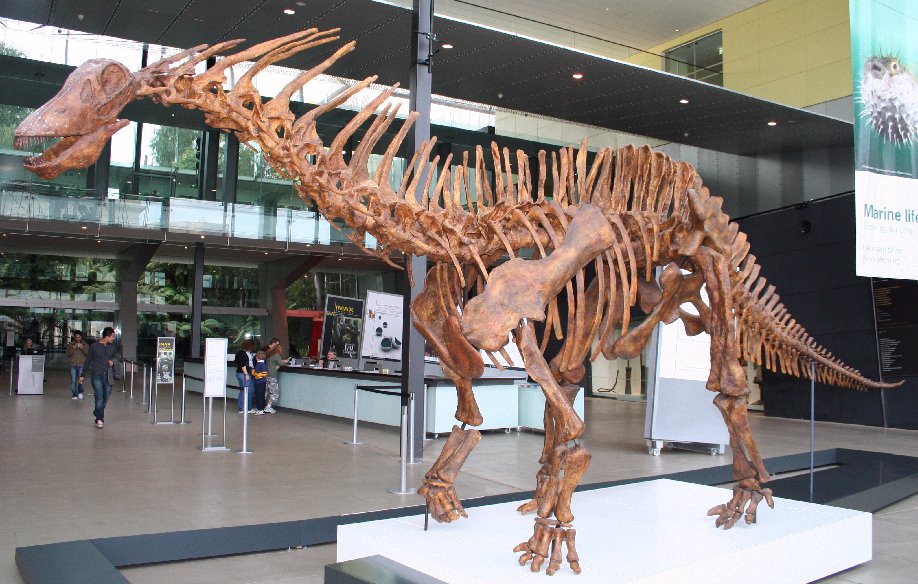
Amargasaurus had a long tail and neck, a small head, a barrel-shaped trunk, and four column-like legs. Its neck was relatively short compared with those of most other sauropods, and it possessed thirteen cervical vertebrae.[1][2][3]
The neck spines were divided along their entire length from the third cervical vertebra onward. The elongated neural spines on the final two dorsal vertebrae, hip region, and foremost tail were not bifurcated and had paddle-shaped upper ends.[4][5]
The forelimbs were somewhat shorter than the hind limbs. Amargasaurus probably had five digits on each hand and foot and a broad, horselike snout equipped with pencil-like teeth.[6][7][8]
Amargasaurus measured approximately 9 to 13 meters in length and weighed approximately 2.5 to 4 metric tons. Its neck measured approximately 2.39 meters in length.[9][10][11]
Amargasaurus habitually held its snout approximately 80 centimeters above the ground and could reach a maximum height of 2.7 meters.[12]
Habitat
Amargasaurus inhabited an environment represented by sedimentary rocks of the La Amarga Formation. It shared this environment with at least three other sauropod genera.[13][14]
Diet
Amargasaurus was a herbivore. It probably fed at intermediate heights above the ground.[15][16]
Behaviour
Amargasaurus may have used its elongated neck spines for display, combat, or defense. Possible functions included courtship displays and intimidation of rivals.[17][18]
Amargasaurus may have generated sounds by clattering its elongated vertebral spines together.[19]
Classification of Amargasaurus cazaui
| Kingdom | Animalia |
|---|---|
| Phylum | Chordata |
| Subphylum | Vertebrata |
| Infraphylum | Gnathostomata |
| Parvphylum | Osteichthyes |
| Megaclass | Tetrapoda |
| Superorder | Dinosauria |
| Order | Saurischia |
| Family | Diplodocidae (Diplodocids) |
| Genus | Amargasaurus (La Armaga Lizard) |
| Species | Amargasaurus cazaui Salgado & Bonaparte, 1991 |
This name was added to the Catalogue of Life from a contributing dataset by automated merging and has not yet been reviewed by its editors.
Related species
-
 Apatosaurus ajax
- Brontosaurus excelsus
- Galeamopus pabsti
- Kaatedocus siberi
- Dicraeosaurus hansemanni
- Dicraeosaurus sattleri
Compare
Questions and answers
Sources
Passages the profile rests on
- Amargasaurus had a long tail and neck, a small head, a barrel-shaped trunk, and four column-like legs. Source passage: “It followed the typical sauropod body plan, with a long tail and neck, a small head, and a barrel-shaped trunk supported by four column-like legs.” — English Wikipedia
- Amargasaurus had a relatively short neck compared with most other sauropods. Source passage: “The neck of Amargasaurus was shorter than in most other sauropods, a common trait within the Dicraeosauridae.” — English Wikipedia
- Amargasaurus possessed thirteen cervical vertebrae. Source passage: “The neck consisted of thirteen cervical vertebrae, which were opisthocoelous” — English Wikipedia
- The neck spines were divided along their entire length from the third cervical vertebra onward. Source passage: “From the third cervical onward, these neural spines were bifurcated along their entire length, forming a double row.” — English Wikipedia
- The elongated neural spines on the final two dorsal vertebrae, hip region, and foremost tail were not bifurcated and had paddle-shaped upper ends. Source passage: “The last two dorsal vertebrae, the hip, and the foremost tail in Amargasaurus also had elongated spines; these were not bifurcated but flared into a paddle-shaped upper end.” — English Wikipedia
- Amargasaurus had forelimbs that were somewhat shorter than its hind limbs. Source passage: “The forelimbs were somewhat shorter than the hind limbs, as in related sauropods.” — English Wikipedia
- Amargasaurus probably had five digits on each hand and foot. Source passage: “Most of the hand and foot bones were not preserved, but Amargasaurus probably possessed five digits each as in all sauropods.” — English Wikipedia
- Amargasaurus probably had a broad, horselike snout equipped with pencil-like teeth. Source passage: “It likely showed a horselike, broad snout equipped with pencil-like teeth, as seen in related sauropods for which more complete skulls are known.” — English Wikipedia
- Amargasaurus measured approximately 9 to 13 meters in length. Source passage: “Amargasaurus was small for a sauropod, measuring 9 to 13 meters (30 to 43 feet) in length” — English Wikipedia
- Amargasaurus weighed approximately 2.5 to 4 metric tons. Source passage: “weighing approximately 2.5–4 metric tons (2.8–4.4 short tons).” — English Wikipedia
- The neck of Amargasaurus measured approximately 2.39 meters in length. Source passage: “Measuring 2.39 meters (7.8 feet) in length, the neck corresponded to 136% of the length of the dorsal vertebral column.” — English Wikipedia
- Amargasaurus habitually held its snout approximately 80 centimeters above the ground and could reach a maximum height of 2.7 meters. Source passage: “which suggest a habitual position of the snout 80 centimeters (31 inches) above the ground and a maximum height of 2.7 meters (8.9 feet).” — English Wikipedia
- Amargasaurus inhabited an environment represented by sedimentary rocks of the La Amarga Formation. Source passage: “Amargasaurus was discovered in sedimentary rocks of the La Amarga Formation, which dates back to the Barremian and Aptian stages of the Early Cretaceous.” — English Wikipedia
- Amargasaurus shared its environment with at least three other sauropod genera. Source passage: “A herbivore, it shared its environment with at least three other sauropod genera” — English Wikipedia
- Amargasaurus was a herbivore. Source passage: “A herbivore, it shared its environment with at least three other sauropod genera” — English Wikipedia
- Amargasaurus probably fed at intermediate heights above the ground. Source passage: “Amargasaurus probably fed at mid-height” — English Wikipedia
- Amargasaurus may have used its elongated neck spines for display, combat, or defense. Source passage: “They might have been used for display, combat, or defense.” — English Wikipedia
- Amargasaurus may have used its neck spines for courtship displays or intimidation of rivals. Source passage: “They also could have served for display, perhaps for courtship or to intimidate rivals.” — English Wikipedia
- Amargasaurus may have generated sounds by clattering its elongated vertebral spines together. Source passage: “He also hypothesized that the spines could have been clattered together to generate sound.” — English Wikipedia
Data
- Catalogue of Life, 2026-10-16 XR cc by
- Wikidata CC0
- Wikimedia Commons per image; credit shown with each image
- Within the Catalogue of Life, this name comes from ZooBank DarwinCore Checklist Data cc0
References
- Salgado, Leonardo & José F. Bonaparte. 1991. Un nuevo sauropodo Dicraeosauridae, Amargasaurus cazaui gen. et sp. nov. de la Formación La Amarga, Neocomiano de la Provincia del Neuquén, Argentina. Ameghiniana 28(3-4): 333-346. where the name was published
This species in other databases
Page built on 26 November 2026. See how the catalog is made and all sources and licences.
Cite this page
ScientificNames.org. (2026). Amargasaurus cazaui. Retrieved November 26, 2026, from https://scientificnames.org/species/amargasaurus-cazaui
“Amargasaurus cazaui.” ScientificNames.org, 2026, scientificnames.org/species/amargasaurus-cazaui. Accessed 26 Nov. 2026.
ScientificNames.org. “Amargasaurus cazaui.” Accessed November 26, 2026. https://scientificnames.org/species/amargasaurus-cazaui.
@misc{scientificnames_amargasaurus_cazaui,
  author = {{ScientificNames.org}},
  title = {Amargasaurus cazaui},
  year = {2026},
  url = {https://scientificnames.org/species/amargasaurus-cazaui},
  note = {Accessed 2026-11-26}
}