Species · Birds
Saint Lucia Amazon Amazona versicolor
The scientific name of the Saint Lucia Amazon is Amazona versicolor. It is a species of bird in the family Psittacidae (macaws), order Psittaciformes. The name dates from 1776.
- Scientific name
- Amazona versicolor (P. L. S. Müller, 1776)
- Common name
- Saint Lucia Amazon
- Genus
- Amazona
- Family
- Psittacidae (Macaws)
- Order
- Psittaciformes
- Class
- Aves
- Red List category
- VU Vulnerable
- Recorded in
- 1 country
- Name status
- accepted in the Catalogue of Life
Overview
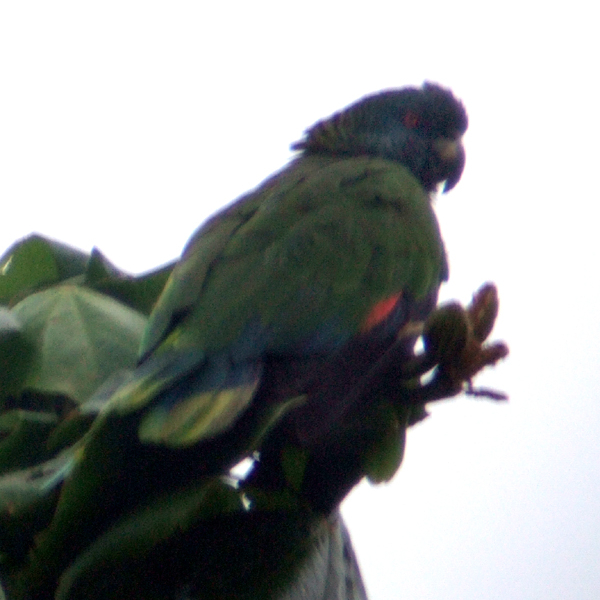
Amazona versicolor is endemic to Saint Lucia in the Lesser Antilles and occurs in the central-southern mountains of Saint Lucia. It has a royal blue forehead, scaly green plumage on the hindcrown, neck and mantle, and a red upper breast.
Written 26 November 2026 from the sources listed below. Each statement was checked against the passage it cites; statements that could not be supported were removed.
Habitat
The Saint Lucia Amazon inhabits tropical moist montane forest at elevations of 500 to 900 metres. It occurs in wet montane forests and sometimes visits orchards.[1][2]
Appearance
The forehead is royal blue, with lighter blue colouring on the crown and remaining face. The hindcrown, nape, sides of the neck and mantle have scaly green plumage, while the remaining upperparts are plain green.[3][4][5]
The upper breast is red, while the lower breast and belly are mottled green and maroon. The vent area is greenish yellow.[6][7]
The wings are green with a red speculum and dark blue primary feathers. The tail feathers are green with broad yellowish tips.[8][9]
The Saint Lucia Amazon measures 42 to 46 centimetres in length. Adults weigh between 505 and 1,000 grams.[10][11]
Diet
The species feeds on seeds and fruits from various palms and other plants.[12]
Behaviour
The species has no known regular movement pattern.[13]
Reproduction and life cycle
The breeding season includes at least February and March and may extend beyond those months. The species nests in cavities in trees, and a typical clutch consists of two eggs.[14][15][16]
In captivity, incubation lasts 28 days. Captive-raised chicks fledge approximately 81 days after hatching.[17][18]
Conservation
The IUCN has classified the Saint Lucia Amazon as Vulnerable since 1994. The estimated population is 1,150 to 1,500 mature individuals and is believed to be increasing.[19][20]
The population was estimated at approximately 1,000 individuals in 1950 and declined to approximately 150 individuals by the late 1970s. It had recovered to approximately 300 individuals by 1990.[21][22][23]
Historical population declines were attributed to habitat loss, hunting for food, the pet trade and hurricanes. The species benefited from conservation measures that received strong national and popular support.[24][25]
Similar species
The Saint Lucia Amazon is closely related to the red-necked Amazon of Dominica.[26]
Uses
The Saint Lucia Amazon is the national bird of Saint Lucia.[27]
Jersey Zoo maintained a breeding colony of the species from 1975 to 2021 and achieved the first successful captive breeding in 1982. Offspring produced through the breeding programme were returned to the wild.[28][29][30]
The last Saint Lucia Amazon at Jersey Zoo died in 2021. The species continues to be maintained in a small number of collections in Europe.[31][32]
Classification of the Saint Lucia Amazon
| Kingdom | Animalia |
|---|---|
| Phylum | Chordata |
| Subphylum | Vertebrata |
| Infraphylum | Gnathostomata |
| Parvphylum | Osteichthyes |
| Megaclass | Tetrapoda |
| Class | Aves (Bird) |
| Order | Psittaciformes (Parrot) |
| Family | Psittacidae (Macaws) |
| Genus | Amazona (Amazon Parrot) |
| Species | Amazona versicolor (P. L. S. Müller, 1776) |
Where the Saint Lucia Amazon is found
Checklists and occurrence records place Amazona versicolor in 1 country across North America. GBIF holds 1,142 georeferenced records of it.
Countries
Regions and cities with the most records
- Castries, Saint Lucia 1,071
- Micoud, Saint Lucia 519
- Gros Islet, Saint Lucia 256
- Soufrière, Saint Lucia 214
- Anse-la-Raye, Saint Lucia 125
- Choiseul, Saint Lucia 77
- Dennery, Saint Lucia 55
- Castries, Saint Lucia 44
- Gros-Islet, Saint Lucia 33
- Vieux-Fort, Saint Lucia 20
- Laborie, Saint Lucia 8
- Canaries, Saint Lucia 6
1 more country has a few records outside this range
These countries hold a few records of Amazona versicolor but lie outside the range the checklists give for it. Such records are often zoo or garden specimens, museum material or vagrants, so the species is not counted as occurring there.
Range as the checklists state it
Caribbean
A number beside a place is its count of GBIF occurrence records. A place without a number comes from a checklist alone. Records show where a species has been observed or collected, which can include escapes and vagrants.
Common names
English
- Saint Lucia Amazon
- Saint Lucia Parrot
- St Lucia Amazon
- St. Lucia Amazon
- St. Lucia Parrot
Names in 33 other languages
- Arabic
- أمازون سانت لوسيا, ببغاء سانت لوسيا
- Armenian
- Կապտերես ամազոն
- Bulgarian
- Сентлусийска амазона
- Catalan
- Amazona de Saint Lucia, papagai de l'illa de Saint Lucia
- Chinese
- 圣卢西亚鹦哥, 聖盧西亞亞馬遜鸚鵡, 聖露西亞亞馬遜鸚哥
- Croatian
- kestenjastoprsa amazonka
- Czech
- amazoňan mnohobarvý
- Danish
- Saint Lucia-amazone, Skt. Lucia-amazone
- Dutch
- Sint-Lucia-amazone
- Esperanto
- sanktalucia amazonpapago
- Estonian
- saint lucia amatsoonpapagoi
- Finnish
- saintlucianamatsoni
- French
- Amazone de Sainte-Lucie
- German
- Blaumaskenamazone, Blaustirnamazone, Saint-Lucia-Amazone
- Hungarian
- kékmaszkos amazon
- Italian
- Amazzone di Saint Lucia
- Japanese
- イロマジリボウシインコ
- Latvian
- Sentlūsijas amazone
- Lithuanian
- mėlynveidė amazonė
- Norwegian
- saintluciaamazon
- Norwegian Bokmål
- Saintluciaamazon (St. Luciaamazon)
- Persian
- آمازون سنت لوسیا
- Polish
- amazonka modrogłowa
- Portuguese
- papagaio-de-santa-lúcia
- Russian
- Разноцветный амазон, Синелицый амазон
- Serbian
- Amazonac sa ostrva Santa Lucija
- Slovak
- amazoňan pestrý
- Spanish
- Amazona de Santa Lucía
- Turkish
- Saint Lucia Amazonu
- Ukrainian
- амазон санта-лусійський
- Welsh
- amason St Lucia
- mrj
- Симсӹ вуян амазон
- pnb
- سینٹ لوسیا ایمیزن
Synonyms
One other scientific name has been used for this species and is now treated as a synonym of Amazona versicolor.
- Psittacus versicolor P. L. S. Müller, 1776
Related species
-
 Red-crowned AmazonAmazona viridigenalis
-
 Puerto Rican AmazonAmazona vittata
-
 Yellow-headed AmazonAmazona oratrix
-
 Blue-fronted AmazonAmazona aestiva
-
 Imperial AmazonAmazona imperialis
-
 Yellow-naped AmazonAmazona auropalliata
-
 Yellow-crowned AmazonAmazona ochrocephala
-
 Orange-winged AmazonAmazona amazonica
Compare
Questions and answers
What is the scientific name of the Saint Lucia Amazon?
The scientific name of the Saint Lucia Amazon is Amazona versicolor. Written with its author, the full name is Amazona versicolor (P. L. S. Müller, 1776).
Which family does the Saint Lucia Amazon belong to?
Amazona versicolor belongs to the family Psittacidae, in the order Psittaciformes and the class Aves.
Where is the Saint Lucia Amazon found?
Checklists and occurrence records place Amazona versicolor in 1 country: Saint Lucia.
What is the conservation status of the Saint Lucia Amazon?
The IUCN Red List category recorded for Amazona versicolor is Vulnerable (VU).
What other names does the Saint Lucia Amazon have?
Amazona versicolor is also known in English as Saint Lucia Parrot, St Lucia Amazon, St. Lucia Amazon and St. Lucia Parrot.
What is the national bird of Saint Lucia?
The Saint Lucia Amazon is the national bird of Saint Lucia.[27]
Sources
Passages the profile rests on
- The species inhabits tropical moist montane forest at elevations of 500 to 900 metres. Source passage: “It inhabits tropical moist montane forest at elevations between 500 and 900 m (1,600 and 3,000 ft).” — English Wikipedia
- The Saint Lucia Amazon inhabits wet montane forests and sometimes visits orchards. Source passage: “A stout inhabitant of wet montane forests; sometimes ventures into orchards.” — ebird.org
- The forehead is royal blue, with lighter blue colouring on the crown and remaining face. Source passage: “Their forehead is royal blue that is lighter on the crown and the rest of the face.” — English Wikipedia
- The hindcrown, nape, sides of the neck and mantle have scaly green plumage. Source passage: “Their hindcrown, nape, sides of the neck, and mantle are scaly green.” — English Wikipedia
- The remaining upperparts are plain green. Source passage: “The rest of their upperparts are plain green.” — English Wikipedia
- The upper breast is red, while the lower breast and belly are mottled green and maroon. Source passage: “Their upper breast is red, their lower breast and belly mottled green and maroon” — English Wikipedia
- The vent area is greenish yellow. Source passage: “and their vent area greenish yellow.” — English Wikipedia
- The wings are green with a red speculum and dark blue primary feathers. Source passage: “Their wings are green with a red speculum and dark blue primaries.” — English Wikipedia
- The tail feathers are green with broad yellowish tips. Source passage: “Their tail feathers are green with wide yellowish tips.” — English Wikipedia
- The Saint Lucia Amazon measures 42 to 46 centimetres in length. Source passage: “The Saint Lucia amazon is 42 to 46 cm (17 to 18 in) long” — English Wikipedia
- Adults weigh between 505 and 1,000 grams. Source passage: “weighs 505 to 1,000 g (18 to 35 oz).” — English Wikipedia
- The species feeds on seeds and fruits from various palms and other plants. Source passage: “The Saint Lucia amazon feeds on seeds and fruit of a variety of palms and other plants.” — English Wikipedia
- The species has no known regular movement pattern. Source passage: “The Saint Lucia amazon has no known pattern of movement.” — English Wikipedia
- The breeding season includes at least February and March and may extend beyond those months. Source passage: “The Saint Lucia amazon's breeding season includes at least February and March and may continue beyond that.” — English Wikipedia
- The species nests in cavities in trees. Source passage: “It nests in a tree cavity.” — English Wikipedia
- A typical clutch consists of two eggs. Source passage: “The clutch size is two eggs.” — English Wikipedia
- In captivity, incubation lasts 28 days. Source passage: “In captivity the incubation period is 28 days” — English Wikipedia
- Captive-raised chicks fledge approximately 81 days after hatching. Source passage: “fledging occurs about 81 days after hatch.” — English Wikipedia
- The IUCN has classified the species as Vulnerable since 1994. Source passage: “since 1994 as Vulnerable.” — English Wikipedia
- The estimated population is 1,150 to 1,500 mature individuals and is believed to be increasing. Source passage: “Its estimated population of 1150 to 1500 mature individuals is believed to be increasing.” — English Wikipedia
- The population was estimated at approximately 1,000 individuals in 1950. Source passage: “The population was thought to total about 1000 in 1950” — English Wikipedia
- The population declined to approximately 150 individuals by the late 1970s. Source passage: “but declined to about 150 by the late 1970s” — English Wikipedia
- The population had recovered to approximately 300 individuals by 1990. Source passage: “the population had increased to about 300 by 1990” — English Wikipedia
- Historical population declines were attributed to habitat loss, hunting for food, the pet trade and hurricanes. Source passage: “as a result of habitat loss, hunting for food, the pet trade, and hurricanes.” — English Wikipedia
- The species benefited from conservation measures that received strong national and popular support. Source passage: “strong national and popular support” — English Wikipedia
- The Saint Lucia Amazon is closely related to the red-necked Amazon of Dominica. Source passage: “The Saint Lucia amazon is closely related to the red-necked amazon (A. arausiaca) of Dominica.” — English Wikipedia
- The Saint Lucia Amazon is the national bird of Saint Lucia. Source passage: “and is the country's national bird.” — English Wikipedia
- Jersey Zoo maintained a breeding colony of the species from 1975 to 2021. Source passage: “Between 1975 and 2021, the Jersey Zoo maintained a breeding colony of Saint Lucia amazons.” — English Wikipedia
- Jersey Zoo achieved the first successful captive breeding of the species in 1982. Source passage: “In 1982, they achieved the first captive breeding success of this species.” — English Wikipedia
- Offspring produced through the Jersey Zoo breeding programme were returned to the wild. Source passage: “The offspring of this breeding were returned to the wild.” — English Wikipedia
- The last Saint Lucia Amazon at Jersey Zoo died in 2021. Source passage: “On 2 May 2021, the Jersey Zoo announced that their last amazon died” — English Wikipedia
- The species continues to be maintained in a small number of collections in Europe. Source passage: “It is maintained in a few other collections in Europe.” — English Wikipedia
Data
- Catalogue of Life, 2026-10-16 XR cc by
- Global Biodiversity Information Facility CC BY 4.0
- Wikidata CC0
- GeoNames CC BY 4.0
- Wikimedia Commons per image; credit shown with each image
- Within the Catalogue of Life, this name comes from The Integrated Taxonomic Information System cc0
References
- Gill, Frank, & and Minturn Wright. (2006). Birds of the World: Recommended English Names.
- Dickinson, E. C., and L. Christidis, eds. (2014). The Howard and Moore Complete Checklist of the Birds of the World, 4th Edition, Vol. 2 Passerines.
This species in other databases
Page built on 29 November 2026. See how the catalog is made and all sources and licences.
Cite this page
ScientificNames.org. (2026). Amazona versicolor (Saint Lucia Amazon). Retrieved November 29, 2026, from https://scientificnames.org/species/amazona-versicolor
“Amazona versicolor (Saint Lucia Amazon).” ScientificNames.org, 2026, scientificnames.org/species/amazona-versicolor. Accessed 29 Nov. 2026.
ScientificNames.org. “Amazona versicolor (Saint Lucia Amazon).” Accessed November 29, 2026. https://scientificnames.org/species/amazona-versicolor.
@misc{scientificnames_amazona_versicolor_saint_lucia_amazon,
  author = {{ScientificNames.org}},
  title = {Amazona versicolor (Saint Lucia Amazon)},
  year = {2026},
  url = {https://scientificnames.org/species/amazona-versicolor},
  note = {Accessed 2026-11-29}
}