Species · Flowering plants
Sweet Sultan Amberboa moschata
The scientific name of the Sweet Sultan is Amberboa moschata. It is a species of flowering plant in the family Asteraceae (composite), order Asterales.
- Scientific name
- Amberboa moschata (L.) DC.
- Common name
- Sweet Sultan
- Genus
- Amberboa
- Family
- Asteraceae (Composite)
- Order
- Asterales
- Class
- Magnoliopsida
- Recorded in
- 15 countries
- Name status
- accepted in the Catalogue of Life
Overview
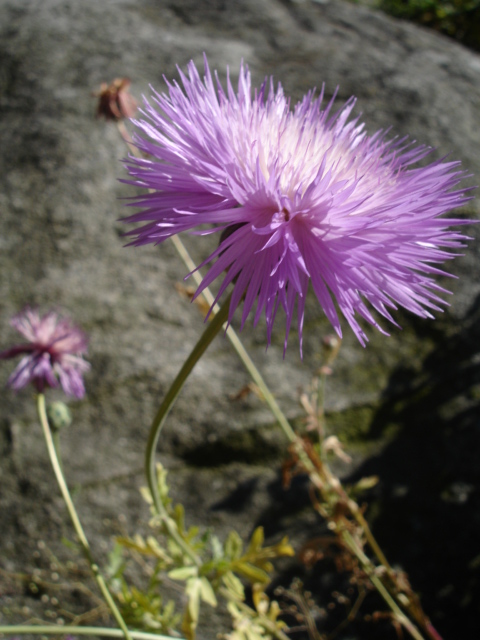
Sweet sultan is an annual, branching flowering herb. It is native to Armenia, Turkey, Iraq, Iran and the Caucasus, and is reportedly naturalized in parts of China and North America. It is distinguished by usually purple, showy, sweet-scented flower heads and thistle-like flowers in several colours.
Written 26 November 2026 from the sources listed below. Each statement was checked against the passage it cites; statements that could not be supported were removed.
Appearance
Sweet sultan has grey-green leaves that are toothed near the base and pinnately divided along the stems. Its flowers are produced on upright stems.[1][2]
Its thistle-like flowers occur in yellow, pink, purple and white shades. The flower heads are usually purple, showy and sweet-scented.[3][4]
Habitat
Sweet sultan thrives in well-drained, neutral or alkaline soil in full sun.[5]
Reproduction and life cycle
Sweet sultan can be sown directly in its growing position during spring because it resents root disturbance.[6]
Young plants can be grown under glass over winter and planted out in spring.[7]
Uses
Sweet sultan is widely cultivated as an ornamental plant in many places.[8]
Classification of the Sweet Sultan
| Kingdom | Plantae |
|---|---|
| Subkingdom | Pteridobiotina |
| Phylum | Tracheophyta |
| Class | Magnoliopsida |
| Order | Asterales |
| Family | Asteraceae (Composite) |
| Subfamily | Carduoideae |
| Tribe | Cardueae |
| Subtribe | Centaureinae |
| Genus | Amberboa (Sweet-sultan) |
| Species | Amberboa moschata (L.) DC. |
Where the Sweet Sultan is found
Checklists and occurrence records place Amberboa moschata in 15 countries across Asia, Europe and North America. GBIF holds 111 georeferenced records of it.
Countries where it is native or its origin is not stated
Countries where it has been introduced
Regions and cities with the most records
- Yerevan, Armenia 19
- Masis, Armenia 18
- Ararat, Armenia 12
- Yerevan, Armenia 12
- Abovyan, Armenia 11
- Artashat, Armenia 9
- Gansu, China 7
- Ararat, Armenia 5
- Balochistan, Pakistan 4
- Chalco de Díaz Covarrubias, Mexico 4
- Emiliano Zapata, Mexico 4
- Ixtapaluca, Mexico 4
- Iztapalapa, Mexico 4
- Juchitepec de Mariano Rivapalacio, Mexico 4
- Los Reyes Acaquilpan, Mexico 4
- Milpa Alta, Mexico 4
- San Antonio Tecómitl, Mexico 4
- San Buenaventura, Mexico 4
- San Francisco Acuautla, Mexico 4
- San Isidro, Mexico 4
- San Jerónimo Cuatro Vientos, Mexico 4
- San Juan Ixtayopan, Mexico 4
- San Martín Cuautlalpan, Mexico 4
- San Mateo Huitzilzingo, Mexico 4
- San Pablo Oztotepec, Mexico 4
- Tláhuac, Mexico 4
- Xico, Mexico 4
- Xochimilco, Mexico 4
- Ashtarak, Armenia 3
- San Miguel Topilejo, Mexico 3
- British Columbia, Canada
- Punjab, India
8 more countries have a few records outside this range
These countries hold a few records of Amberboa moschata but lie outside the range the checklists give for it. Such records are often zoo or garden specimens, museum material or vagrants, so the species is not counted as occurring there.
Range as the checklists state it
Germany [I]; Slovakia [I]; Armenia; Turkey (E-Anatolia); Iran (EC-Iran, NE-Iran: Mts., S-Iran, W-Iran); China [I] (Gansu [I]); Taiwan [I]; Pakistan [I]; India [I] (Punjab [I]); Bangladesh [I]; Myanmar [I]; Canada [I] (British Columbia [I]); Mexico [I]
A number beside a place is its count of GBIF occurrence records. A place without a number comes from a checklist alone. Records show where a species has been observed or collected, which can include escapes and vagrants.
Common names
English
- Sweet Sultan
- Sweet-sultan
Names in 12 other languages
- Arabic
- سلطان حلو
- Armenian
- Վարդատերեփուկ մուշկային
- Estonian
- lõhnav ambralill, lõhnav muskusjumikas
- Finnish
- tuoksukaunokki
- French
- centaurée ambrette
- German
- duftende Bisampflanze
- Japanese
- スイートサルタン
- Mongolian
- Хонгор залаа
- Russian
- Амбербоа мускусная
- Slovak
- amberboa mošusová
- Swedish
- doftklint
- Turkish
- Mis Düğme
Synonyms
8 other scientific names have been used for this species and are now treated as synonyms of Amberboa moschata.
- Amberboa moschata subsp. moschata
- Centaurea imperialis hort.
- Centaurea moschata L.
- Centaurea moschata var. moschata
- Centaurium moschatum (L.) Cass.
- Chryseis moschata (L.) Cass.
- Cyanus moschatus (L.) Gaertn.
- Oligochaeta moschata (L.) M.R.Almeida
Questions and answers
What is the scientific name of the Sweet Sultan?
The scientific name of the Sweet Sultan is Amberboa moschata. Written with its author, the full name is Amberboa moschata (L.) DC..
Which family does the Sweet Sultan belong to?
Amberboa moschata belongs to the family Asteraceae, in the order Asterales and the class Magnoliopsida.
Where is the Sweet Sultan found?
Checklists and occurrence records place Amberboa moschata in 15 countries, including Armenia, Turkey, Turkmenistan, Georgia and Iran.
What other names does the Sweet Sultan have?
Amberboa moschata is also known in English as Sweet-sultan.
Is Sweet Sultan a perennial?
No. Sweet sultan is an annual plant.[9]
What is the Sweet Sultan plant?
Sweet sultan (Amberboa moschata) is an annual flowering herb in the family Asteraceae. It has usually purple, showy, sweet-scented flower heads and thistle-like flowers in yellow, pink, purple and white shades.[3][4][9]
Where to plant sweet sultan?
Plant sweet sultan in well-drained, neutral or alkaline soil in full sun.[5]
Sources
Passages the profile rests on
- Amberboa moschata has grey-green leaves that are toothed near the base and pinnately divided along the stems. Source passage: “with grey-green leaves that are toothed at the base of the plant and pinnately divided on the stems.” — rhs.org.uk
- Its flowers are produced on upright stems. Source passage: “are produced on upright stems from late spring to summer” — rhs.org.uk
- Its flower heads are usually purple, showy and sweet-scented. Source passage: “Flower heads are usually purple, showy, and sweet-scented.” — English Wikipedia
- Its thistle-like flowers occur in yellow, pink, purple and white shades. Source passage: “Sweetly scented, thistle-like flowers in shades of yellow, pink, purple and white” — rhs.org.uk
- Amberboa moschata thrives in well-drained, neutral or alkaline soil in full sun. Source passage: “Thrives in well-drained, neutral or alkaline soil in full sun.” — rhs.org.uk
- Amberboa moschata can be sown directly in its growing position during spring because it resents root disturbance. Source passage: “Plants resent root disturbance, so sow in situ in spring” — rhs.org.uk
- Young Amberboa moschata plants can be grown under glass over winter and planted out in spring. Source passage: “grow young plants under glass over winter and plant out in potfuls in spring” — rhs.org.uk
- Amberboa moschata is widely cultivated as an ornamental plant in many places. Source passage: “It is also widely cultivated in many places as an ornamental” — English Wikipedia
- Amberboa moschata is an annual plant that grows to approximately 60 cm tall. Source passage: “A branching annual to around 60cm high” — rhs.org.uk
Data
- Catalogue of Life, 2026-10-16 XR cc by
- Global Biodiversity Information Facility CC BY 4.0
- Wikidata CC0
- GeoNames CC BY 4.0
- Wikimedia Commons per image; credit shown with each image
- Within the Catalogue of Life, this name comes from Synonymic Checklists of the Vascular Plants of the World cc by
References
- DC. (1838). Prodr. [A.P. de Candolle] 6: 560 (1838). where the name was published
This species in other databases
- Catalogue of Life CKZP
- Wikidata Q1264042
- iNaturalist 158259
- World Flora Online wfo-0000114040
- GRIN 103809
Page built on 26 November 2026. See how the catalog is made and all sources and licences.
Cite this page
ScientificNames.org. (2026). Amberboa moschata (Sweet Sultan). Retrieved November 26, 2026, from https://scientificnames.org/species/amberboa-moschata
“Amberboa moschata (Sweet Sultan).” ScientificNames.org, 2026, scientificnames.org/species/amberboa-moschata. Accessed 26 Nov. 2026.
ScientificNames.org. “Amberboa moschata (Sweet Sultan).” Accessed November 26, 2026. https://scientificnames.org/species/amberboa-moschata.
@misc{scientificnames_amberboa_moschata_sweet_sultan,
  author = {{ScientificNames.org}},
  title = {Amberboa moschata (Sweet Sultan)},
  year = {2026},
  url = {https://scientificnames.org/species/amberboa-moschata},
  note = {Accessed 2026-11-26}
}