Species · Amphibians
Frosted Flatwoods Salamander Ambystoma cingulatum
The scientific name of the Frosted Flatwoods Salamander is Ambystoma cingulatum. It is a species of amphibian in the family Ambystomatidae (mole salamanders), order Caudata. The name dates from 1868.
- Scientific name
- Ambystoma cingulatum Cope, 1868
- Common name
- Frosted Flatwoods Salamander
- Genus
- Ambystoma
- Family
- Ambystomatidae (Mole Salamanders)
- Order
- Caudata
- Class
- Amphibia
- Red List category
- EN Endangered
- Recorded in
- 1 country
- Name status
- accepted in the Catalogue of Life
Overview
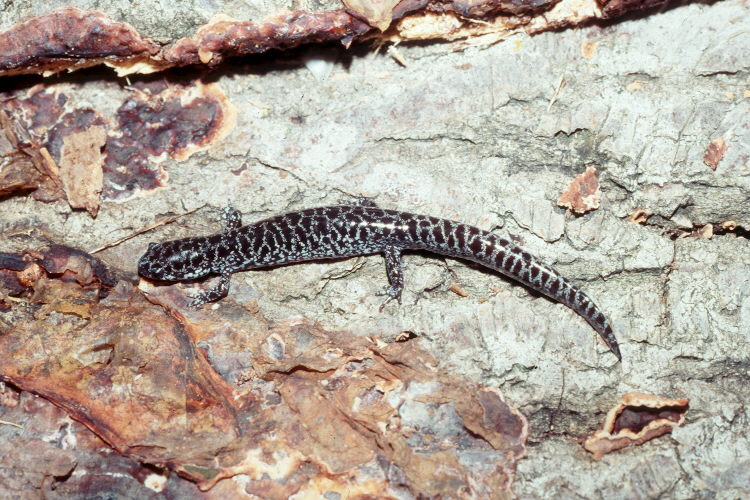
Ambystoma cingulatum occurs in northern Florida, southern Georgia, and southern South Carolina, across the Atlantic and Gulf Coastal Plains. Adults have dark gray or black dorsal surfaces with light gray or grayish-brown markings forming reticulations, frosted lichenlike patterns, or small annuli.
Written 26 November 2026 from the sources listed below. Each statement was checked against the passage it cites; statements that could not be supported were removed.
Similar species
The Frosted Flatwoods Salamander was formerly classified together with the reticulated flatwoods salamander, Ambystoma bishopi.[1]
Appearance
Adults have dark gray or black dorsal surfaces with light gray or grayish-brown markings forming reticulations, frosted lichenlike patterns, or small annuli. Their undersides are dark gray with lighter gray spots or flecks.[2][3]
Adults have a small, indistinct head, short legs, and a long, rounded tail. They average 15 costal grooves, with a documented range of 13–16.[4][5]
Females are generally larger than males, while males have brighter white or silver markings. Adult skin secretes mucus.[6][7]
Larvae have external bushy gills that assist with oxygen consumption. As they mature, they develop a gold stripe extending from their gills to their tail.[8][9]
Adult total length ranges from 9 to 13.5 cm, and adult body mass ranges from 2.5 to 10 grams.[10][11]
Reported adult male mass averages 4.4 ± 1.1 grams. Gravid females average 8.0 ± 2.5 grams, while non-gravid females average 3.9 ± 1.3 grams.[12][13][14]
Newly hatched larvae measure approximately 10–12 mm in length on average.[15]
Habitat
Non-breeding adults inhabit fire-dependent pine flatwoods. Preferred upland habitats include open longleaf pine and slash pine flatwoods or savannas containing wiregrass.[16][17]
Breeding habitats include vernal pools, roadside ditches, cypress swamps, forest swamps, marshes, and sphagnum patches. Breeding ponds are temporary, shallow wetlands that lack fish.[18][19]
Breeding ponds commonly have pond cypress and black tupelo in their overstory. Adults spend most of the year underground in burrows, particularly abandoned crayfish burrows.[20][21]
The species has been recorded at elevations up to 125 meters and below sea level in coastal areas. Individuals can tolerate freshwater habitats with low salt concentrations.[22][23]
Diet
Earthworms constitute most of the documented prey records for adults. Adults are presumed to consume a variety of small invertebrates.[24][25]
Behaviour
Adults migrate to breeding wetlands during rainfall events associated with passing cold fronts between September and December. Individuals may travel up to 1,700 meters within their geographic range to reach breeding sites.[26][27]
Outside the breeding season, individuals generally remain within a few meters of their underground burrows.[28]
Males attract females by secreting pheromones from mental glands beneath their chins. The species exhibits polygynandrous mating behaviour.[29][30]
Reproduction and life cycle
Courtship takes place in dry pond basins or very shallow water. Females receive spermatophores deposited on the substrate by males.[31][32]
Females lay between 100 and 200 eggs per clutch. Eggs are deposited in small groups of 1–12, usually in herbaceous vegetation or crayfish burrow entrances.[33][34]
Eggs are laid terrestrially near crayfish burrows or beneath logs, leaves, bushes, and other detritus in low-elevation dry wetlands. Embryos hatch when rising water inundates the dry breeding ponds.[35][36]
Larval development in breeding ponds lasts between 11 and 24 weeks. Metamorphosed juveniles leave breeding ponds between April and June.[37][38]
Males generally reach sexual maturity at approximately one to two years of age, while females generally reach sexual maturity at approximately two to three years of age. Females may remain dormant for up to 38 days after laying their eggs.[39][40][41]
Conservation
The species is listed as federally threatened according to the University of Georgia species account. Habitat destruction is identified as the primary conservation threat.[42][43]
Populations have become extremely small, discontinuous, and widely fragmented across the species' range.[44]
Conversion of natural pine forest into ditched and bedded slash pine plantations has caused the extirpation of a sizable breeding population. Alteration of natural fire patterns has degraded remaining habitat.[45][46]
Classification of the Frosted Flatwoods Salamander
| Kingdom | Animalia |
|---|---|
| Phylum | Chordata |
| Subphylum | Vertebrata |
| Infraphylum | Gnathostomata |
| Parvphylum | Osteichthyes |
| Megaclass | Tetrapoda |
| Class | Amphibia (Amphibians) |
| Order | Caudata (Salamanders) |
| Family | Ambystomatidae (Mole Salamanders) |
| Genus | Ambystoma (Mole Salamander) |
| Species | Ambystoma cingulatum Cope, 1868 |
Where the Frosted Flatwoods Salamander is found
Checklists and occurrence records place Ambystoma cingulatum in 1 country across North America. GBIF holds 881 georeferenced records of it.
Countries
Regions and cities with the most records
- Florida, United States 80
- South Carolina, United States 61
- North Charleston, United States 33
- Goose Creek, United States 17
- Hanahan, United States 15
- Mount Pleasant, United States 14
- Georgia, United States 13
- Gainesville, United States 9
- Savannah, United States 8
- Bluffton, United States 6
- Pooler, United States 5
1 more country has a few records outside this range
These countries hold a few records of Ambystoma cingulatum but lie outside the range the checklists give for it. Such records are often zoo or garden specimens, museum material or vagrants, so the species is not counted as occurring there.
Range as the checklists state it
North America
A number beside a place is its count of GBIF occurrence records. A place without a number comes from a checklist alone. Records show where a species has been observed or collected, which can include escapes and vagrants.
Common names
English
- Frosted Flatwoods Salamander
- Flatwoods Salamander
Names in 6 other languages
- Arabic
- سمندل الغابات المسطحة
- Chinese
- 網紋鈍口螈
- Czech
- axolotl síťkovaný
- French
- Ambystome des pins argenté
- Russian
- Сетчатая амбистома
- Spanish
- Salamandra de Florida
Synonyms
7 other scientific names have been used for this species and are now treated as synonyms of Ambystoma cingulatum.
- Amblystoma cingulatum Cope, 1868
- Amblystoma lepturum Cope, 1886
- Ambystoma cingulatum cingulatum Cope, 1868
- Ambystoma cingulatus Cope, 1868
- Chondrotus cingulatus (Cope, 1868)
- Linguaelapsus cingulatus (Cope, 1868)
- Linguaelapsus lepturum (Cope, 1886)
Related species
-
 AxolotlAmbystoma mexicanum
-
 Spotted SalamanderAmbystoma maculatum
-
 Tiger SalamanderAmbystoma tigrinum
-
 Blue-spotted SalamanderAmbystoma laterale
-
 Marbled SalamanderAmbystoma opacum
-
 Barred Tiger SalamanderAmbystoma mavortium
-
 Lake Patzcuaro SalamanderAmbystoma dumerilii
-
 Plateau Tiger SalamanderAmbystoma velasci
Compare
Questions and answers
What is the scientific name of the Frosted Flatwoods Salamander?
The scientific name of the Frosted Flatwoods Salamander is Ambystoma cingulatum. Written with its author, the full name is Ambystoma cingulatum Cope, 1868.
Which family does the Frosted Flatwoods Salamander belong to?
Ambystoma cingulatum belongs to the family Ambystomatidae, in the order Caudata and the class Amphibia.
Where is the Frosted Flatwoods Salamander found?
Checklists and occurrence records place Ambystoma cingulatum in 1 country: United States.
What is the conservation status of the Frosted Flatwoods Salamander?
The IUCN Red List category recorded for Ambystoma cingulatum is Endangered (EN).
What other names does the Frosted Flatwoods Salamander have?
Ambystoma cingulatum is also known in English as Flatwoods Salamander.
Why is the frosted flatwoods salamander endangered?
Habitat destruction is the primary conservation threat. Conversion of natural pine forest into ditched and bedded slash pine plantations has caused the extirpation of a sizable breeding population, while alteration of natural fire patterns has degraded remaining habitat. Populations are extremely small, discontinuous, and widely fragmented.[43][44][45][46]
What do frosted flatwoods salamanders eat?
Earthworms constitute most of the documented prey records for adults. Adults are presumed to consume a variety of small invertebrates.[24][25]
Where do flatwoods salamanders live?
The Frosted Flatwoods Salamander occurs in northern Florida, southern Georgia, and southern South Carolina, across the Atlantic and Gulf Coastal Plains. Non-breeding adults inhabit fire-dependent pine flatwoods, while breeding habitats include temporary shallow wetlands such as vernal pools, marshes, and swamps.[47][48][49][16][18][19]
Sources
Passages the profile rests on
- The frosted flatwoods salamander was formerly classified together with the reticulated flatwoods salamander, Ambystoma bishopi. Source passage: “Flatwoods salamanders, also know as frosted flatwoods salamanders, used to be part of the same species with reticulated flatwoods salamanders ( Ambystoma bishopi ).” — animaldiversity.org
- Adults have a dark gray or black dorsal surface with light gray or grayish-brown markings forming reticulations, frosted lichenlike patterns, or small annuli. Source passage: “Adults are a dark gray or black color on the dorsum with a pattern of light gray or grayish brown markings that form reticulations, a frosted lichenlike pattern, or small annuli.” — srelherp.uga.edu
- The adult underside is dark gray with lighter gray spots or flecks. Source passage: “The dark gray venter of adults is covered with lighter gray spots or flecks.” — srelherp.uga.edu
- Adult salamanders have a small, indistinct head, short legs, and a long, rounded tail. Source passage: “It has a small, indistinct head, short legs, and a long, rounded tail.” — English Wikipedia
- Adult salamanders average 15 costal grooves, with a documented range of 13–16. Source passage: “Flatwoods salamanders average 15 costal grooves (range 13-16).” — animaldiversity.org
- Females are generally larger than males, whereas males have brighter white or silver markings. Source passage: “Females, on average, are larger in size while males are more colorful with brighter flecks of white or silver.” — animaldiversity.org
- Adult skin secretes mucus. Source passage: “Like most salamanders, flatwoods salamanders have skin that secretes mucus.” — animaldiversity.org
- Larvae have external bushy gills that assist with oxygen consumption. Source passage: “Flatwoods salamanders have large external bushy gills that assist in oxygen consumption while they are in the larvae stage.” — animaldiversity.org
- Larvae develop a gold stripe extending from their gills to their tail as they mature. Source passage: “The larvae have a faint tan lateral stripe when first hatched and develop a gold stripe that runs vertical from their gills to their tail as they mature.” — animaldiversity.org
- Adult total length ranges from 9 to 13.5 cm. Source passage: “Adult total length ranges from 3.5-5.3 in (9-13.5 cm);” — srelherp.uga.edu
- Adult body mass ranges from 2.5 to 10 grams. Source passage: “Weight of adults vary from 2.5 - 10g.” — animaldiversity.org
- Reported adult male mass averages 4.4 ± 1.1 grams. Source passage: “Palis et al. (2006) reported adult males to weigh 4.4 +/- 1.1g,” — animaldiversity.org
- Gravid females have a reported average mass of 8.0 ± 2.5 grams. Source passage: “gravid (with eggs) females to weigh 8.0 +/- 2.5 g,” — animaldiversity.org
- Non-gravid females have a reported average mass of 3.9 ± 1.3 grams. Source passage: “and non-gravid females to weigh 3.9 +/- 1.3 g.” — animaldiversity.org
- Newly hatched larvae measure approximately 10–12 mm in length on average. Source passage: “Measured to be as small as 9.6 mm and as large as 14.8 mm immediately after hatching they average around 10-12 mm long.” — animaldiversity.org
- Non-breeding adults inhabit fire-dependent pine flatwoods. Source passage: “Non-breeding sites include heavily fire-dependent pine flatwoods” — animaldiversity.org
- Preferred upland habitats include open longleaf pine and slash pine flatwoods or savannas containing wiregrass. Source passage: “They prefer open longleaf pine (Pinus palustris) or slash pine (Pinus elliottii) flatwoods or savannas with wiregrass (Aristida stricta).” — srelherp.uga.edu
- Breeding habitats include vernal pools, roadside ditches, cypress swamps, forest swamps, marshes, and sphagnum patches. Source passage: “breeding sites that include vernal pools, roadside ditches, cypress or other forest swamps, marshes, and sphagnum patches.” — animaldiversity.org
- Breeding ponds are temporary, shallow wetlands that lack fish. Source passage: “Temporary, fishless, wetland depressions are also critical to larvae of this species.” — srelherp.uga.edu
- Breeding ponds commonly have pond cypress and black tupelo in their overstory. Source passage: “generally characterized by an overstory of pond cypress (Taxodium ascendens) and black tupelo (Nyssa sylvatica var. biflora)” — English Wikipedia
- Adults spend most of the year underground in burrows, particularly abandoned crayfish burrows. Source passage: “Adult salamanders spend most of the year underground in burrows, especially those of crayfish,” — English Wikipedia
- The species has been recorded at elevations up to 125 meters and below sea level in coastal areas. Source passage: “Flatwoods salamanders have been found up to 125 meters in elevation and below sea level in coastal areas.” — animaldiversity.org
- Individuals can tolerate freshwater habitats with low salt concentrations. Source passage: “While mainly staying in/near freshwater, these salamanders can tolerate low salt concentrations.” — animaldiversity.org
- Earthworms constitute most of the documented prey records for adults. Source passage: “but the few existing prey records are mostly earthworms.” — English Wikipedia
- Adults are presumed to consume a variety of small invertebrates. Source passage: “where they are presumed to feed on a variety of small invertebrates,” — English Wikipedia
- Adults migrate to breeding wetlands during rainfall events associated with passing cold fronts between September and December. Source passage: “From September through December, adults migrate from surrounding upland habitats to their natal wetlands during rainfall events associated with passing cold fronts.” — English Wikipedia
- Individuals may travel up to 1,700 meters within their geographic range to reach breeding sites. Source passage: “Flatwoods salamander individuals may travel up to 1700 meters within their geographic range to breed in the winter,” — animaldiversity.org
- Outside the breeding season, individuals generally remain within a few meters of their underground burrows. Source passage: “but otherwise will never stray more than a couple meters from their underground burrows.” — animaldiversity.org
- Males attract females by secreting pheromones from mental glands beneath their chins. Source passage: “Males will secrete pheromones using their mental glands located under their chin to attract females.” — animaldiversity.org
- The species exhibits polygynandrous mating behaviour. Source passage: “Flatwoods salamanders are polygynandrous” — animaldiversity.org
- Courtship takes place in dry pond basins or very shallow water. Source passage: “Courtship occurs within dry pond basins or very shallow water,” — English Wikipedia
- Females receive spermatophores deposited on the substrate by males. Source passage: “where the female accepts a spermatophore that has been deposited on the substrate by the male.” — English Wikipedia
- Females lay between 100 and 200 eggs per clutch. Source passage: “Females lay 100–200 eggs,” — English Wikipedia
- Eggs are deposited in small groups of 1–12, usually in herbaceous vegetation or crayfish burrow entrances. Source passage: “placing them in small groups of 1–12, usually within carpets of herbaceous vegetation or in the entrances of crayfish burrows” — English Wikipedia
- Eggs are laid terrestrially near crayfish burrows or beneath logs, leaves, bushes, and other detritus in low-elevation dry wetlands. Source passage: “The eggs are laid terrestrially near crayfish burrows or under logs, leaves, bushes, and other detritus found in low elevation dry wetlands.” — srelherp.uga.edu
- Embryos hatch when rising water inundates the dry breeding ponds. Source passage: “Embryos develop quickly within the egg capsule and will hatch in response to inundation by rising water levels in the pond basins.” — English Wikipedia
- Larval development in breeding ponds lasts between 11 and 24 weeks. Source passage: “The larval period lasts 11–24 weeks,” — English Wikipedia
- Metamorphosed juveniles leave breeding ponds between April and June. Source passage: “with metamorphs leaving the breeding ponds from April to June.” — English Wikipedia
- Males generally reach sexual maturity at approximately one to two years of age. Source passage: “Sexual maturity is approximately 1–2 years for males” — English Wikipedia
- Females generally reach sexual maturity at approximately two to three years of age. Source passage: “and 2–3 years for females.” — English Wikipedia
- Females may remain dormant for up to 38 days after laying their eggs. Source passage: “After the female lays her eggs, she slowly burrows into the surrounding area and goes dormant for up to 38 days.” — animaldiversity.org
- The species is listed as federally threatened according to the University of Georgia species account. Source passage: “The flatwoods salamander is currently listed as a federally threatened species and vulnerable under the IUCN Redlist.” — srelherp.uga.edu
- Habitat destruction is identified as the primary conservation threat. Source passage: “Destruction of habitat is the primary threat.” — srelherp.uga.edu
- Populations have become extremely small, discontinuous, and widely fragmented across the species' range. Source passage: “populations are now extremely small, discontinuous, and widely fragmented throughout the range.” — English Wikipedia
- Conversion of natural pine forest into ditched and bedded slash pine plantations has caused the extirpation of a sizable breeding population. Source passage: “One published study documents the extirpation of a sizable breeding population as a result of a common silvicultural practice of converting natural pine forest to ditched and bedded slash pine plantation.” — English Wikipedia
- Alteration of natural fire patterns has degraded remaining habitat. Source passage: “Further degradation of remaining frosted flatwoods salamander habitat has occurred as a result of alteration of natural fire patterns.” — English Wikipedia
- The species occurs in the southeastern coastal plain of the United States. Source passage: “occurring only in the southeastern coastal plain of the United States.” — English Wikipedia
- Its documented range includes northern Florida, southern Georgia, and southern South Carolina. Source passage: “It inhabits seasonally wet pine flatwoods and pine savannas east of the Apalachicola River in northern Florida, southern South Carolina, and southern Georgia.” — English Wikipedia
- The species occurs across the Atlantic and Gulf Coastal Plains of southern Alabama, Georgia, South Carolina, and northern Florida, although its distribution is widely scattered. Source passage: “Flatwoods salamanders occur throughout the Atlantic and Gulf Coastal Plains of southern Alabama, Georgia, South Carolina, and northern Florida but are widly scattered in distribution.” — srelherp.uga.edu
Data
- Catalogue of Life, 2026-10-16 XR cc by
- Global Biodiversity Information Facility CC BY 4.0
- Wikidata CC0
- GeoNames CC BY 4.0
- Wikimedia Commons per image; credit shown with each image
- Within the Catalogue of Life, this name comes from The Integrated Taxonomic Information System cc0
References
- Banks, R. C., R. W. McDiarmid, and A. L. Gardner. (1987). Checklist of Vertebrates of the United States, the U.S. Territories, and Canada. Resource Publication, No. 166.
- Crother, B. I., J. Boundy, J. A. Campbell, K. de Quieroz, D. Frost, D. M. Green, R. Highton, et al. (2003). Scientific and Standard English Names of Amphibians and Reptiles of North America North of Mexico: Update. Herpetological Review, Vol. 34, No. 3.
- Crother, Brian I., Jeff Boundy, Jonathan A. Campbell, Kevin de Quieroz, Darrel Frost, et al. (2003). Scientific and Standard English Names of Amphibians and Reptiles of North America North of Mexico: Update. Herpetological Review, Vol. 34, No. 3.
- Crother, Brian I., Jeff Boundy, Frank T. Burbrink, et al. / Moriarty, John J., ed. (2008). Scientific and Standard English Names of Amphibians and Reptiles of North America North of Mexico, With Comments Regarding Confidence in Our Understanding, Sixth Ed. Herpetological Circular No. 37.
This species in other databases
Page built on 28 November 2026. See how the catalog is made and all sources and licences.
Cite this page
ScientificNames.org. (2026). Ambystoma cingulatum (Frosted Flatwoods Salamander). Retrieved November 28, 2026, from https://scientificnames.org/species/ambystoma-cingulatum
“Ambystoma cingulatum (Frosted Flatwoods Salamander).” ScientificNames.org, 2026, scientificnames.org/species/ambystoma-cingulatum. Accessed 28 Nov. 2026.
ScientificNames.org. “Ambystoma cingulatum (Frosted Flatwoods Salamander).” Accessed November 28, 2026. https://scientificnames.org/species/ambystoma-cingulatum.
@misc{scientificnames_ambystoma_cingulatum_frosted_flatwoods_salamander,
  author = {{ScientificNames.org}},
  title = {Ambystoma cingulatum (Frosted Flatwoods Salamander)},
  year = {2026},
  url = {https://scientificnames.org/species/ambystoma-cingulatum},
  note = {Accessed 2026-11-28}
}