Species · Molluscs
Amerianna buruana
Amerianna buruana has no English name on record in the checklists used here. It is a species of mollusc in the family Planorbidae (indet. ramshorn). The name dates from 1927.
- Scientific name
- Amerianna buruana (van Benthem Jutting, 1927)
- Genus
- Amerianna
- Family
- Planorbidae (Indet. Ramshorn)
- Class
- Gastropoda
- Name status
- accepted in the Catalogue of Life
Overview
Amerianna buruana inhabits a mountainous freshwater lake and is known only from Lake Rana on the island of Buru, Indonesia. It has a sinistral shell with a short spire, a short dorsal ridge, and a reflected ureter.
Written 28 November 2026 from the sources listed below. Each statement was checked against the passage it cites; statements that could not be supported were removed.
Habitat
Amerianna buruana inhabits a mountainous freshwater lake.[1]
Appearance
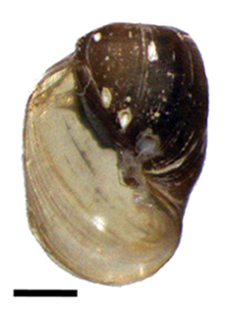
The shell is sinistral, has a short spire, and measures less than 1 cm in length.[2][3]
The species has a short dorsal ridge and a reflected ureter. Its mantle cavity has a short renal ridge and a prominent rectal ridge.[4][5]
The penis has a somewhat rectangular cross-section.[6]
Conservation
The species is classified as vulnerable. It may be threatened by habitat destruction resulting from development.[7][8]
Classification of Amerianna buruana
| Kingdom | Animalia |
|---|---|
| Phylum | Mollusca |
| Class | Gastropoda (Gastropod) |
| Subclass | Heterobranchia |
| Infraclass | Euthyneura |
| Subterclass | Tectipleura |
| Superorder | Hygrophila |
| Family | Planorbidae (Indet. Ramshorn) |
| Subfamily | Miratestinae |
| Genus | Amerianna |
| Species | Amerianna buruana (van Benthem Jutting, 1927) |
Synonyms
One other scientific name has been used for this species and is now treated as a synonym of Amerianna buruana.
- Ameria buruana van Benthem Jutting, 1927
Related species
-
 Carinated PlanorbidAmerianna carinata
- Reeve's Pouch SnailAmerianna reevii
- Amerianna compar
- Amerianna pesigani
- Obese Pouch SnailAmerianna obesula
- Amerianna cumingii
- Amerianna papyracea
- Amerianna obiana
Compare
Questions and answers
Where is Amerianna buruana found?
It has been collected from Lake Rana on the island of Buru, Indonesia. This is its only known location.[9][10]
How large is its shell?
The shell length is less than 1 cm.[3]
What is its conservation status?
The species is classified as vulnerable and may be threatened by habitat destruction resulting from development.[7][8]
Where are preserved specimens held?
At least two specimens have been preserved in the Zoological Museum of Amsterdam.[11]
What was its original scientific name?
It was originally described in 1927 under the name Ameria buruana by W. S. S. van Benthem Jutting.[12]
Sources
Passages the profile rests on
- The species inhabits a mountainous freshwater lake. Source passage: “It inhabits only a single mountainous lake on the island of Buru in Indonesia.” — English Wikipedia
- Amerianna buruana has a sinistral shell with a short spire. Source passage: “Amerianna buruana has a left-coiling (sinistral) shell with a short spire.” — English Wikipedia
- The shell length is less than 1 cm. Source passage: “This species is very small, less than 1 cm (0.39 in) in length.” — English Wikipedia
- The species has a short dorsal ridge and a reflected ureter. Source passage: “A. buruana and A. pesigani both have a reflected ureter (as opposed to S-shaped), and a short dorsal ridge.” — English Wikipedia
- Its mantle cavity has a short renal ridge and a prominent rectal ridge. Source passage: “A. buruana additionally has a short renal ridge and a prominent rectal ridge.” — English Wikipedia
- The penis has a somewhat rectangular cross-section. Source passage: “The penis of this species is somewhat rectangular in cross-section.” — English Wikipedia
- The species is classified as vulnerable. Source passage: “It is considered a vulnerable species.” — English Wikipedia
- The species may be threatened by habitat destruction resulting from development. Source passage: “and therefore may become threatened with habitat destruction if development occurs.” — English Wikipedia
- The species has been collected from Lake Rana on the island of Buru, Indonesia. Source passage: “Specimens have been collected from the mountain Lake Rana in Buru, Indonesia.” — English Wikipedia
- Lake Rana on Buru is the only known location of this species. Source passage: “This is its only known location” — English Wikipedia
- At least two specimens have been preserved in the Zoological Museum of Amsterdam. Source passage: “At least 2 specimens have been preserved, both of which are housed in the Zoological Museum of Amsterdam.” — English Wikipedia
- The species was originally described in 1927 under the name Ameria buruana by W. S. S. van Benthem Jutting. Source passage: “Amerianna buruana was originally described in 1927 as Ameria buruana by W. S. S. van Benthem Jutting.” — English Wikipedia
Data
- Catalogue of Life, 2026-10-16 XR cc by
- Wikidata CC0
- Within the Catalogue of Life, this name comes from World Register of Marine Species cc by
References
- Benthem Jutting, W. S. S. van. (1927). Fauna Buruana. Mollusca. Treubia, 7 (suppl.): 1–35. where the name was published
This species in other databases
Page built on 29 November 2026. See how the catalog is made and all sources and licences.
Cite this page
ScientificNames.org. (2026). Amerianna buruana. Retrieved November 29, 2026, from https://scientificnames.org/species/amerianna-buruana
“Amerianna buruana.” ScientificNames.org, 2026, scientificnames.org/species/amerianna-buruana. Accessed 29 Nov. 2026.
ScientificNames.org. “Amerianna buruana.” Accessed November 29, 2026. https://scientificnames.org/species/amerianna-buruana.
@misc{scientificnames_amerianna_buruana,
  author = {{ScientificNames.org}},
  title = {Amerianna buruana},
  year = {2026},
  url = {https://scientificnames.org/species/amerianna-buruana},
  note = {Accessed 2026-11-29}
}