Species · Insects
White-cloaked Ruby Tiger Moth Amerila astreus
The scientific name of the White-cloaked Ruby Tiger Moth is Amerila astreus. It is a species of insect in the family Erebidae (erebid moths), order Lepidoptera. The name dates from 1773.
- Scientific name
- Amerila astreus (Drury, 1773)
- Common name
- White-cloaked Ruby Tiger Moth
- Genus
- Amerila
- Family
- Erebidae (Erebid Moths)
- Order
- Lepidoptera
- Class
- Insecta
- Recorded in
- 14 countries
- Name status
- accepted in the Catalogue of Life

Overview
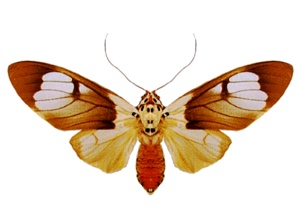
Amerila astreus occurs from the Oriental region, including India and Sri Lanka, eastward to New Guinea. It is distinguished by hyaline wings with fuscous markings and crimson palpi and legs.
Written 27 November 2026 from the sources listed below. Each statement was checked against the passage it cites; statements that could not be supported were removed.
Appearance
The palpi are crimson, with a black spot on each joint. The antennae are red-brown, with a crimson basal joint.[1][2]
The head and thorax are whitish fuscous, and the head bears two black spots. The collar has two pairs of spots, and each of the three thoracic segments bears a pair of spots.[3][4][5]
The forewings are hyaline and have two black spots at the base. They have pale fuscous margins, an apical area, and a band on the discocellulars.[6][7]
The hindwings are hyaline and have a marginal fuscous band. The legs are crimson, with the outer sides of the femora and tibiae whitish fuscous.[8][9]
The larva has a greenish, slightly hairy body with sub-dorsal and lateral rows of small black spots.[10][11]
Habitat
The white-cloaked ruby tiger moth inhabits both primary and secondary habitats. It occurs in habitats extending from lowlands to montane regions.[12][13]
Classification of the White-cloaked Ruby Tiger Moth
| Kingdom | Animalia |
|---|---|
| Phylum | Arthropoda |
| Subphylum | Hexapoda |
| Class | Insecta (Insect) |
| Order | Lepidoptera |
| Superfamily | Noctuoidea |
| Family | Erebidae (Erebid Moths) |
| Subfamily | Arctiinae |
| Tribe | Arctiini |
| Genus | Amerila (Frothers) |
| Species | Amerila astreus (Drury, 1773) |
Where the White-cloaked Ruby Tiger Moth is found
Checklists and occurrence records place Amerila astreus in 14 countries. GBIF holds 1,018 georeferenced records of it.
Countries
- Cambodia 3
- China 25
- Hong Kong 3
- India 93
- Indonesia 18
- Laos 3
- Malaysia 37
- Myanmar 3
- Pakistan 6
- Philippines 23
- Sri Lanka 6
- Taiwan 745
- Thailand 50
- Vietnam 3
Regions and cities with the most records
- Taiwan, Taiwan 496
- Banqiao, Taiwan 125
- New Taipei City, Taiwan 124
- Shulin, Taiwan 121
- Neihu, Taiwan 116
- Taipei, Taiwan 116
- Xizhi, Taiwan 109
- Hengchun, Taiwan 100
- Taipei, Taiwan 95
- Toufen, Taiwan 88
- Zhudong, Taiwan 87
- Miaoli, Taiwan 71
- Hsinchu, Taiwan 67
- Zhubei, Taiwan 65
- Danshui, Taiwan 56
- Nantou, Taiwan 50
- Daxi, Taiwan 47
- Sanxia, Taiwan 47
- Bade, Taiwan 45
- Yingge, Taiwan 45
- Wufeng, Taiwan 41
- Sanzhi, Taiwan 40
- Neili, Taiwan 39
- Taichung, Taiwan 38
- Taoyuan, Taiwan 37
- Zhongxing New Village, Taiwan 35
- Lugu, Taiwan 34
- Caotun, Taiwan 32
- Zhushan, Taiwan 32
- Linnei, Taiwan 31
- Xizhou, Taiwan 31
- Kerala, India 30
- Keelung, Taiwan 29
- Tianzhong, Taiwan 29
- Beidou, Taiwan 28
- Shetou, Taiwan 28
A number beside a place is its count of GBIF occurrence records. A place without a number comes from a checklist alone. Records show where a species has been observed or collected, which can include escapes and vagrants.
Common names
English
- White-cloaked Ruby Tiger Moth
Names in 1 other language
- Chinese
- 閃光玫燈蛾
Synonyms
9 other scientific names have been used for this species and are now treated as synonyms of Amerila astreus.
- Amerila astraea Moore, 1867
- Amerila dohertyi Rothschild, 1914
- Amerila druryi Rothschild, 1914
- Amerila hainana Rothschild, 1910
- Amerila novaeguineae Rothschild, 1914
- Phalaena melanthus Cramer, 1780
- Rhodogastria astreas hainana Rothschild, 1910
- Rhodogastria curtisi Rothschild, 1910
- Sphinx astreus Drury, 1773
Related species
-
 Walker's FrotherAmerila rubripes
-
 Croker's FrotherAmerila crokeri
-
 White FrotherAmerila bubo
-
 Amerila vitrea
-
 Baur's FrotherAmerila bauri
- Amerila vidua
-
 Amerila affinis
-
 Small Redtail FrotherAmerila lupia
Compare
Questions and answers
What is the scientific name of the White-cloaked Ruby Tiger Moth?
The scientific name of the White-cloaked Ruby Tiger Moth is Amerila astreus. Written with its author, the full name is Amerila astreus (Drury, 1773).
Which family does the White-cloaked Ruby Tiger Moth belong to?
Amerila astreus belongs to the family Erebidae, in the order Lepidoptera and the class Insecta.
Where is the White-cloaked Ruby Tiger Moth found?
Checklists and occurrence records place Amerila astreus in 14 countries, including Taiwan, India, Thailand, Malaysia, China and Philippines.
Sources
Passages the profile rests on
- The palpi of Amerila astreus are crimson, with a black spot on each joint. Source passage: “Its palpi are crimson, with a black spot on each joint.” — English Wikipedia
- The antennae of Amerila astreus are red-brown, with a crimson basal joint. Source passage: “Antennae red brown, with the basal joint crimson.” — English Wikipedia
- The head and thorax of Amerila astreus are whitish fuscous, and its head bears two black spots. Source passage: “Head and thorax whitish fuscous, the head with two black spots.” — English Wikipedia
- The collar of Amerila astreus has two pairs of spots. Source passage: “Collar with two pairs of spots.” — English Wikipedia
- Each of the three thoracic segments of Amerila astreus bears a pair of spots. Source passage: “Three segments of thorax are each with a pair of spots.” — English Wikipedia
- The forewings of Amerila astreus are hyaline and have two black spots at the base. Source passage: “Forewings with hyaline (glass like), with two black spots at the base.” — English Wikipedia
- The forewings of Amerila astreus have pale fuscous margins, an apical area, and a band on the discocellulars. Source passage: “The margins, apical area, and a band on discocellulars pale fuscous.” — English Wikipedia
- The hindwings of Amerila astreus are hyaline and have a marginal fuscous band. Source passage: “Hindwings hyaline, with a marginal fuscous band.” — English Wikipedia
- The legs of Amerila astreus are crimson, with the outer sides of the femora and tibiae whitish fuscous. Source passage: “Legs crimson, with the outer side of the femora and tibia whitish fuscous.” — English Wikipedia
- The larva of Amerila astreus has a greenish, slightly hairy body. Source passage: “Larva greenish with slightly hairy body.” — English Wikipedia
- The larva of Amerila astreus has sub-dorsal and lateral rows of small black spots. Source passage: “There are sub-dorsal and lateral rows of small black spots.” — English Wikipedia
- Amerila astreus inhabits both primary and secondary habitats. Source passage: “The species is found in primary and secondary habitats ranging from lowlands to montane regions.” — English Wikipedia
- Amerila astreus occurs in habitats extending from lowlands to montane regions. Source passage: “The species is found in primary and secondary habitats ranging from lowlands to montane regions.” — English Wikipedia
Data
- Catalogue of Life, 2026-10-16 XR cc by
- Global Biodiversity Information Facility CC BY 4.0
- Wikidata CC0
- GeoNames CC BY 4.0
- Wikimedia Commons per image; credit shown with each image
- Within the Catalogue of Life, this name comes from Global Lepidoptera Index cc by
References
- Drury. (1773). Illustrations of natural history; wherein are exhibited ... Figures of exotic insects, &c. http://www.biodiversitylibrary.org/item/125982#page/60/mode/2up Link where the name was published
This species in other databases
Page built on 29 November 2026. See how the catalog is made and all sources and licences.
Cite this page
ScientificNames.org. (2026). Amerila astreus (White-cloaked Ruby Tiger Moth). Retrieved November 29, 2026, from https://scientificnames.org/species/amerila-astreus
“Amerila astreus (White-cloaked Ruby Tiger Moth).” ScientificNames.org, 2026, scientificnames.org/species/amerila-astreus. Accessed 29 Nov. 2026.
ScientificNames.org. “Amerila astreus (White-cloaked Ruby Tiger Moth).” Accessed November 29, 2026. https://scientificnames.org/species/amerila-astreus.
@misc{scientificnames_amerila_astreus_white_cloaked_ruby_tiger_moth,
  author = {{ScientificNames.org}},
  title = {Amerila astreus (White-cloaked Ruby Tiger Moth)},
  year = {2026},
  url = {https://scientificnames.org/species/amerila-astreus},
  note = {Accessed 2026-11-29}
}