Species · Birds
Grasshopper Sparrow Ammodramus savannarum
The scientific name of the Grasshopper Sparrow is Ammodramus savannarum. It is a species of bird in the family Passerellidae (new world sparrow), order Passeriformes. The name dates from 1789.
- Scientific name
- Ammodramus savannarum (J. F. Gmelin, 1789)
- Common name
- Grasshopper Sparrow
- Genus
- Ammodramus
- Family
- Passerellidae (New World Sparrow)
- Order
- Passeriformes
- Class
- Aves
- Red List category
- LC Least Concern
- Environment
- terrestrial
- Recorded in
- 22 countries
- Name status
- accepted in the Catalogue of Life

Overview
The breeding range extends across southern Canada, the United States, Mexico, Central America and the Caribbean. It is distinguished by bright yellow feathers at the bend of the underwing and a yellow-to-amber patch above its lores.
Written 26 November 2026 from the sources listed below. Each statement was checked against the passage it cites; statements that could not be supported were removed.
Appearance
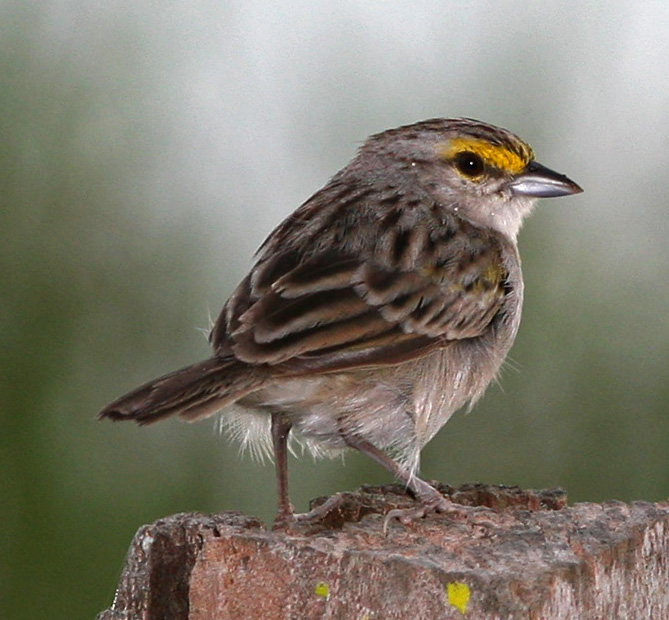
Adults have upperparts marked with brown, grey, black and white streaks, a light brown breast and a white belly. They have a short brown tail, a light brown face with a white eye ring, and a dark brown crown with a narrow light-colored central stripe.[1][2][3][4][5]
Adults have bright yellow feathers at the bend of the underwing and a yellow-to-amber patch above their lores. Males and females cannot be distinguished by their plumage.[6][7][8]
The species measures 10–14 cm in length and has a wingspan of approximately 17.5 cm. Individuals weigh between 13.8 and 28.4 g, with an average body weight of 17 g.[9][10][11][12]
Habitat
The Grasshopper Sparrow breeds in open fields and prairie grasslands and sometimes inhabits crop fields. It readily colonizes reclaimed grassland.[13][14][15]
In the core of its range, the species depends on large grassland areas and avoids trees and shrubs. It selects prairie patches containing dead vegetation for nest concealment and bare ground for foraging.[16][17]
In wetter parts of its range, the species prefers fields burned every two to three years. It seeks moderately grazed areas used by cattle or bison.[18][19]
The breeding range extends across southern Canada, the United States, Mexico, Central America and the Caribbean. A small endangered population occurs in the Andes of Colombia and Ecuador, and the subspecies Ammodramus savannarum savannarum occurs in Jamaica.[20][21][22]
Diet
The species forages on insects, particularly grasshoppers, as well as spiders and seeds.[23]
Nestlings receive an arthropod-rich diet and preferentially consume acridid grasshoppers, spiders and small beetles.[24][25]
Behaviour
The species produces two distinct song types. The primary male song consists of a high trill preceded by short introductory chips.[26][27]
The species frequently disperses between breeding attempts or breeding seasons and exhibits high rates of breeding dispersal between successive breeding sites.[28][29]
Grasshopper Sparrows are socially monogamous. Males select and defend territories in spring before females join them.[30][31]
Reproduction and life cycle
Pairs in southern parts of the range may produce two to four broods per breeding season. Pairs in northern parts of the range generally make one or two nesting attempts.[32][33]
Females construct nests over approximately two days. The nests are inconspicuous, dome-shaped structures on the ground, concealed among grasses and forbs.[34][35]
Nests have a small opening on the side and are constructed from dead and living grasses. Females typically lay four to five eggs per clutch.[36][37]
Females incubate eggs for 10 to 12 days. Nestlings leave the nest after six to nine days.[38][39]
The species is a common host of the brown-headed cowbird.[40]
Conservation
Grasshopper Sparrow populations are declining steeply across the species' range. The Florida Grasshopper Sparrow subspecies is highly endangered.[41][42]
A small endangered population occurs in the Andes of Colombia and Ecuador.[21]
Classification of the Grasshopper Sparrow
| Kingdom | Animalia |
|---|---|
| Phylum | Chordata |
| Subphylum | Vertebrata |
| Infraphylum | Gnathostomata |
| Parvphylum | Osteichthyes |
| Megaclass | Tetrapoda |
| Class | Aves (Bird) |
| Order | Passeriformes (Passerine) |
| Family | Passerellidae (New World Sparrow) |
| Genus | Ammodramus (Grassland Sparrows) |
| Species | Ammodramus savannarum (J. F. Gmelin, 1789) |
Where the Grasshopper Sparrow is found
Checklists and occurrence records place Ammodramus savannarum in 22 countries across North America and South America. GBIF holds 442,122 georeferenced records of it.
Countries
- Bahamas 23
- Belize 766
- Bermuda 110
- Bonaire, Saint Eustatius and Saba 267
- Canada 30,663
- Cayman Islands 5
- Colombia 116
- Costa Rica 623
- Cuba 134
- Curacao 63
- Dominican Republic 252
- El Salvador 38
- Guatemala 215
- Haiti 14
- Honduras 467
- Jamaica 199
- Mexico 4,792
- Nicaragua 119
- Panama 47
- Puerto Rico 2,496
- Saint Pierre and Miquelon 4
- United States 400,709
Regions and cities with the most records
- Texas, United States 34,942
- Maryland, United States 23,884
- Virginia, United States 22,909
- Ontario, Canada 22,896
- Illinois, United States 20,432
- Pennsylvania, United States 20,167
- California, United States 18,876
- Kansas, United States 16,005
- Ohio, United States 15,999
- Minnesota, United States 13,912
- Florida, United States 13,737
- Nebraska, United States 13,162
- Colorado, United States 12,851
- Michigan, United States 12,056
- Wisconsin, United States 11,860
- North Dakota, United States 11,641
- New York, United States 11,379
- North Carolina, United States 10,328
- Indiana, United States 9,652
- New Jersey, United States 9,312
- Montana, United States 7,806
- Massachusetts, United States 7,162
- Oklahoma, United States 6,969
- Georgia, United States 6,773
- Missouri, United States 6,440
- Arizona, United States 6,025
- South Dakota, United States 5,738
- Iowa, United States 5,063
- Tennessee, United States 4,870
- South Carolina, United States 4,696
- Washington, United States 4,348
- Joliet, United States 4,083
- Shorewood, United States 3,753
- Princeton, United States 3,585
- Delaware, United States 3,223
- Hillsborough, United States 3,149
Range as the checklists state it
Middle America
North America
South America
Caribbean
A number beside a place is its count of GBIF occurrence records. A place without a number comes from a checklist alone. Records show where a species has been observed or collected, which can include escapes and vagrants.
Common names
English
- Grasshopper Sparrow
- Grasshopper-Sparrow
- Yellow-winged Sparrow
Names in 30 other languages
- Catalan
- sit pardalenc saltamartí
- Chinese
- 黃胸草鵐, 黄胸草鹀
- Croatian
- smeđolici strnadar
- Czech
- strnadec pustinný
- Danish
- Græshoppespurv
- Dutch
- sprinkhaangors
- Esperanto
- akrida paserelo
- Estonian
- heinasidrik
- Finnish
- heinäsirkkunen
- French
- Bruantin sauterelle, bruant sauterelle
- German
- Heuschreckenammer
- Hungarian
- szöcske verébsármány
- Irish
- Gealóg chasarnaí
- Italian
- Passero cavalletta, passero locustella
- Japanese
- inagohimedori, イナゴヒメドリ
- Latvian
- sienāžu zvirbulis
- Lithuanian
- Vikrusis žvirblelis, žioginė prerinė žvirbliastartė
- Norwegian
- gresshoppespurv
- Papiamento
- Mòfi di Sabana
- Polish
- bagiennik preriowy, preriówek plamisty
- Portuguese
- escrevedeira-dos-gafanhotos, tico-tico-gafanhoto
- Russian
- Кузнечиковая овсянка-барсучок, Кузнечиковая саванная овсянка
- Serbian
- Skakavčev strnad
- Slovak
- strnádlik savanový
- Spanish
- Chingolo saltamontes, Gorrión chapulín, Gorrión chicharra, Sabanero Colicorto, Tumbarrocío
- Swedish
- Gräshoppsparv, gräshoppssparv
- Turkish
- Çekirge Sesli Çayır Serçesi
- Ukrainian
- багновець прерієвий
- Welsh
- bras sioncod
- hat
- Zwazo Kann
Synonyms
One other scientific name has been used for this species and is now treated as a synonym of Ammodramus savannarum.
- Coturniculus savannarum Gmelin, JF, 1789
Subspecies and varieties
- Ammodramus savannarum ammolegus (Arizona Grasshopper Sparrow) subspecies
- Ammodramus savannarum beatriceae subspecies
- Ammodramus savannarum bimaculatus subspecies
- Ammodramus savannarum borinquensis (Puerto Rico Grasshopper Sparrow) subspecies
- Ammodramus savannarum caribaeus subspecies
- Ammodramus savannarum caucae subspecies
- Ammodramus savannarum cracens subspecies
- Ammodramus savannarum floridanus (Florida Grasshopper Sparrow) subspecies
- Ammodramus savannarum intricatus subspecies
- Ammodramus savannarum perpallidus (Western Grasshopper Sparrow) subspecies
- Ammodramus savannarum pratensis (Eastern Grasshopper Sparrow) subspecies
- Ammodramus savannarum savannarum subspecies
Related species
-
 Yellow-browed SparrowAmmodramus aurifrons
-
 Grassland SparrowAmmodramus humeralis
-
 Dark-eyed JuncoJunco hyemalis
-
 White-throated SparrowZonotrichia albicollis
-
 White-crowned SparrowZonotrichia leucophrys
-
 Song SparrowMelospiza melodia
-
 Spotted TowheePipilo maculatus
-
 Lark BuntingCalamospiza melanocorys
Compare
Questions and answers
What is the scientific name of the Grasshopper Sparrow?
The scientific name of the Grasshopper Sparrow is Ammodramus savannarum. Written with its author, the full name is Ammodramus savannarum (J. F. Gmelin, 1789).
Which family does the Grasshopper Sparrow belong to?
Ammodramus savannarum belongs to the family Passerellidae, in the order Passeriformes and the class Aves.
Where is the Grasshopper Sparrow found?
Checklists and occurrence records place Ammodramus savannarum in 22 countries, including United States, Canada, Mexico, Puerto Rico, Belize and Costa Rica.
What is the conservation status of the Grasshopper Sparrow?
The IUCN Red List category recorded for Ammodramus savannarum is Least Concern (LC).
What other names does the Grasshopper Sparrow have?
Ammodramus savannarum is also known in English as Grasshopper-Sparrow and Yellow-winged Sparrow.
Are grasshopper sparrows rare?
Grasshopper Sparrow populations are declining steeply across the species' range. The Florida Grasshopper Sparrow subspecies is highly endangered, and a small endangered population occurs in the Andes of Colombia and Ecuador.[21][41][42]
Sources
Passages the profile rests on
- Adults have upperparts marked with brown, grey, black and white streaks. Source passage: “Adults have upper parts streaked with brown, grey, black and white” — English Wikipedia
- Adults have a light brown breast and a white belly. Source passage: “they have a light brown breast, a white belly” — English Wikipedia
- Adults have a short brown tail. Source passage: “and a short brown tail.” — English Wikipedia
- The face is light brown and has a white eye ring. Source passage: “Their face is light brown with a white eye ring” — English Wikipedia
- Adults have a dark brown crown with a narrow light-colored central stripe. Source passage: “a dark brown crown with a central narrow light stripe.” — English Wikipedia
- Adults have bright yellow feathers at the bend of the underwing. Source passage: “Adults sport bright yellow feathers at the crook of their underwing” — English Wikipedia
- Adults have a yellow-to-amber patch above their lores. Source passage: “and have a yellow-to-amber patch above their lores.” — English Wikipedia
- Males and females cannot be distinguished by their plumage. Source passage: “Males and females cannot be distinguished by their plumage” — English Wikipedia
- The species measures 10–14 cm in length. Source passage: “These small sparrows measure 10–14 cm (3.9–5.5 in) in length” — English Wikipedia
- Its wingspan is approximately 17.5 cm. Source passage: “span about 17.5 cm (6.9 in) across the wings” — English Wikipedia
- Individuals weigh between 13.8 and 28.4 g. Source passage: “weigh from 13.8 to 28.4 g (0.49 to 1.00 oz)” — English Wikipedia
- The average body weight is 17 g. Source passage: “with an average of 17 g (0.60 oz).” — English Wikipedia
- The species breeds in open fields and prairie grasslands. Source passage: “Their breeding habitat is open fields and prairie grasslands” — English Wikipedia
- Grasshopper Sparrows sometimes inhabit crop fields. Source passage: “Grasshopper sparrows are sometimes found in crop fields” — English Wikipedia
- The species readily colonizes reclaimed grassland. Source passage: “they will readily colonize reclaimed grassland.” — English Wikipedia
- In the core of its range, the species depends on large grassland areas and avoids trees and shrubs. Source passage: “In the core of their range, grasshopper sparrows are dependent upon large areas of grassland where they avoid trees and shrubs.” — English Wikipedia
- The species selects prairie patches containing dead vegetation for nest concealment and bare ground for foraging. Source passage: “clumps of dead grass or other vegetation where they conceal their nest, and also contain barer ground where they forage” — English Wikipedia
- In wetter parts of its range, the species prefers fields burned every two to three years. Source passage: “in the wetter parts of their range, prefer fields that are burned every 2–3 years” — English Wikipedia
- The species seeks moderately grazed areas used by cattle or bison. Source passage: “and seek out areas that are moderately grazed by cattle or bison.” — English Wikipedia
- The breeding range extends across southern Canada, the United States, Mexico, Central America and the Caribbean. Source passage: “across southern Canada, the United States, Mexico and Central America, the Caribbean.” — English Wikipedia
- A small endangered population occurs in the Andes of Colombia and Ecuador. Source passage: “There is a small endangered population in the Andes of Colombia and Ecuador.” — English Wikipedia
- The subspecies Ammodramus savannarum savannarum occurs in Jamaica. Source passage: “A. s. savannarum (Gmelin, JF, 1789) – Jamaica” — English Wikipedia
- The species forages on insects, particularly grasshoppers, as well as spiders and seeds. Source passage: “where they forage for insects (especially grasshoppers), spiders, and seeds.” — English Wikipedia
- Nestlings receive an arthropod-rich diet. Source passage: “Nestlings are fed an arthropod rich diet” — English Wikipedia
- Nestlings preferentially consume acridid grasshoppers, spiders and small beetles. Source passage: “preferentially select acridid grasshoppers, spiders, and small beetles.” — English Wikipedia
- The species produces two distinct song types. Source passage: “Grasshopper sparrows are unusual among New World sparrows in that they sing two distinct song types” — English Wikipedia
- The primary male song consists of a high trill preceded by short introductory chips. Source passage: “a high trill preceded by a stereotyped series of short chips” — English Wikipedia
- The species frequently disperses between breeding attempts or breeding seasons. Source passage: “individuals frequently disperse between breeding attempts or breeding seasons.” — English Wikipedia
- The species exhibits high rates of breeding dispersal between successive breeding sites. Source passage: “Grasshopper sparrows are unusual in their particularly high rates of breeding dispersal” — English Wikipedia
- Grasshopper Sparrows are socially monogamous. Source passage: “Grasshopper sparrows are a socially monogamous species” — English Wikipedia
- Males select and defend territories in spring before females join them. Source passage: “In the spring, males select and defend territories before being joined by a female.” — English Wikipedia
- Pairs in southern parts of the range may produce two to four broods per breeding season. Source passage: “In the more southern regions of the species range, pairs may produce 2–4 broods” — English Wikipedia
- Pairs in northern parts of the range generally make one or two nesting attempts. Source passage: “pairs further north are limited by shorter summers leading to 1–2 nesting attempts.” — English Wikipedia
- Females construct nests over approximately two days. Source passage: “Females construct nests over the course of a couple of days.” — English Wikipedia
- The species builds inconspicuous, dome-shaped ground nests concealed among grasses and forbs. Source passage: “Grasshopper sparrows build inconspicuous, dome-shaped nests on the ground, typically very well hidden amongst grasses and forbs.” — English Wikipedia
- Nests have a small opening on the side and are constructed from dead and living grasses. Source passage: “The nests have a small side opening and are usually made of a mix of dead and live grasses.” — English Wikipedia
- Females typically lay four to five eggs per clutch. Source passage: “Females typically lay between 4–5 eggs per clutch.” — English Wikipedia
- Females incubate eggs for 10 to 12 days. Source passage: “Females incubate the eggs from 10 to 12 days” — English Wikipedia
- Nestlings leave the nest after six to nine days. Source passage: “and nestlings fledge after 6–9 days.” — English Wikipedia
- The species is a common host of the brown-headed cowbird. Source passage: “Grasshopper sparrows are a common host of the brown-headed cowbird” — English Wikipedia
- Grasshopper Sparrow populations are declining steeply across the species' range. Source passage: “Grasshopper sparrows are in steep decline across their range” — English Wikipedia
- The Florida Grasshopper Sparrow subspecies is highly endangered. Source passage: “The Florida grasshopper sparrow (Ammodramus savannarum floridanus) is highly endangered.” — English Wikipedia
Data
- Catalogue of Life, 2026-10-16 XR cc by
- Global Biodiversity Information Facility CC BY 4.0
- Wikidata CC0
- GeoNames CC BY 4.0
- Wikimedia Commons per image; credit shown with each image
- Within the Catalogue of Life, this name comes from The Integrated Taxonomic Information System cc0
References
- Syst. Nat., 1(2): 921. 1789 where the name was published
- Banks, R. C., R. W. McDiarmid, and A. L. Gardner. (1987). Checklist of Vertebrates of the United States, the U.S. Territories, and Canada. Resource Publication, No. 166.
- Gill, Frank, & and Minturn Wright. (2006). Birds of the World: Recommended English Names.
- Dickinson, E. C., and L. Christidis, eds. (2014). The Howard and Moore Complete Checklist of the Birds of the World, 4th Edition, Vol. 2 Passerines.
This species in other databases
- Catalogue of Life CTL9
- Wikidata Q1588210
- iNaturalist 10139
- WoRMS urn:lsid:marinespecies.org:taxname:422666
- Avibase graspa
Page built on 28 November 2026. See how the catalog is made and all sources and licences.
Cite this page
ScientificNames.org. (2026). Ammodramus savannarum (Grasshopper Sparrow). Retrieved November 28, 2026, from https://scientificnames.org/species/ammodramus-savannarum
“Ammodramus savannarum (Grasshopper Sparrow).” ScientificNames.org, 2026, scientificnames.org/species/ammodramus-savannarum. Accessed 28 Nov. 2026.
ScientificNames.org. “Ammodramus savannarum (Grasshopper Sparrow).” Accessed November 28, 2026. https://scientificnames.org/species/ammodramus-savannarum.
@misc{scientificnames_ammodramus_savannarum_grasshopper_sparrow,
  author = {{ScientificNames.org}},
  title = {Ammodramus savannarum (Grasshopper Sparrow)},
  year = {2026},
  url = {https://scientificnames.org/species/ammodramus-savannarum},
  note = {Accessed 2026-11-28}
}