Species · Fishes
Midas Cichlid Amphilophus citrinellus
The scientific name of the Midas Cichlid is Amphilophus citrinellus. It is a species of fish in the family Cichlidae (cichlid), order Cichliformes. The name dates from 1864.
- Scientific name
- Amphilophus citrinellus (Günther, 1864)
- Common name
- Midas Cichlid
- Genus
- Amphilophus
- Family
- Cichlidae (Cichlid)
- Order
- Cichliformes
- Class
- Teleostei
- Red List category
- LC Least Concern
- Environment
- freshwater
- Recorded in
- 11 countries
- Name status
- accepted in the Catalogue of Life

Overview
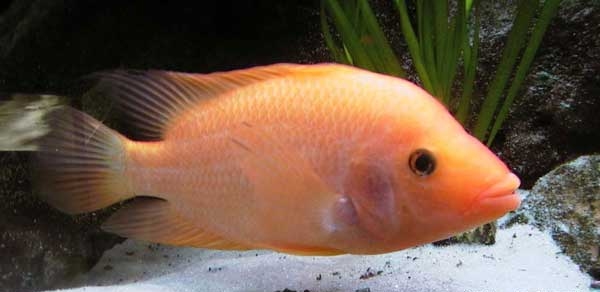
The Midas cichlid is native to the San Juan River and adjacent watersheds in Costa Rica and Nicaragua. It has a heavily built body, powerful jaws and sharp teeth, with naturally occurring variation in body colour.
Written 26 November 2026 from the sources listed below. Each statement was checked against the passage it cites; statements that could not be supported were removed.
Appearance
Wild individuals are predominantly grey to olive brown and typically have black bars along their upper sides. Wild populations also include pink, white, yellow and orange individuals.[1][2]
Colour variation occurs naturally at different frequencies throughout the species group's range. The species exhibits two general colour morphs during its growth.[3][4]
The species has a heavily built body, powerful jaws and sharp teeth.[5][6]
Habitat
The species is native to the San Juan River and adjacent watersheds in Costa Rica and Nicaragua. It has been collected from rice fields in its introduced Malaysian range.[7][8]
It has been reported outside its native range in Australia, Indonesia, Malaysia, the Philippines and Singapore. Established feral populations have been reported in Singapore and Indonesia.[9][10]
Diet
The Midas cichlid has an omnivorous diet. Its documented foods include plant material, molluscs and smaller fish.[11][12]
Stomach examinations of 35 individuals in a Malaysian agroecosystem identified fish, amphibians and gastropods among their prey.[13]
Behaviour
Individuals can engage in fights with other aquarium-sized cichlids over territory. The species exhibits aggression that makes careful selection of aquarium tankmates advisable.[14][15]
The gold colour morph exhibits territorial aggression.[16]
Conservation
The species has been assessed as being of least concern for extinction by the IUCN.[17]
Uses
The species is traded in the aquarium industry under the name Midas cichlid.[18]
Similar species
The Midas cichlid is closely related to Amphilophus labiatus, but the two should not be confused.[19]
Classification of the Midas Cichlid
| Kingdom | Animalia |
|---|---|
| Phylum | Chordata |
| Subphylum | Vertebrata |
| Infraphylum | Gnathostomata |
| Parvphylum | Osteichthyes |
| Gigaclass | Actinopterygii |
| Superclass | Actinopteri |
| Class | Teleostei (Teleost) |
| Order | Cichliformes |
| Family | Cichlidae (Cichlid) |
| Subfamily | Cichlinae |
| Genus | Amphilophus (Midas Cichlids) |
| Species | Amphilophus citrinellus (Günther, 1864) |
Where the Midas Cichlid is found
Checklists and occurrence records place Amphilophus citrinellus in 11 countries. GBIF holds 1,231 georeferenced records of it.
Countries
- Costa Rica 216
- Dominican Republic 3
- Hong Kong 14
- Indonesia 19
- Malaysia 4
- Nicaragua 539
- Philippines 5
- Puerto Rico 26
- Singapore 18
- Taiwan 130
- United States 257
Regions and cities with the most records
- Florida, United States 205
- Managua Department, Nicaragua 167
- Limón Province, Costa Rica 163
- Three Lakes, United States 163
- Country Walk, United States 159
- The Crossings, United States 158
- Cutler Ridge, United States 155
- Kendale Lakes, United States 155
- Palmetto Bay, United States 155
- Richmond West, United States 155
- Sunset, United States 155
- Kendall, United States 154
- Pinecrest, United States 154
- South Miami Heights, United States 154
- The Hammocks, United States 154
- Cutler, United States 153
- Glenvar Heights, United States 153
- Ciudad Sandino, Nicaragua 152
- Cutler Bay, United States 152
- Kendall West, United States 150
- Managua, Nicaragua 148
- University Park, United States 143
- Princeton, United States 141
- Coral Gables, United States 138
- Coconut Grove, United States 135
- Fountainebleau, United States 132
- Sweetwater, United States 132
- Coral Terrace, United States 131
- Tamiami, United States 131
- Westchester, United States 131
- Flagami, United States 130
- Leisure City, United States 121
- Little Havana, United States 112
- Mateare, Nicaragua 95
- Taiwan, Taiwan 81
- Doral, United States 73
1 more country has a few records outside this range
These countries hold a few records of Amphilophus citrinellus but lie outside the range the checklists give for it. Such records are often zoo or garden specimens, museum material or vagrants, so the species is not counted as occurring there.
A number beside a place is its count of GBIF occurrence records. A place without a number comes from a checklist alone. Records show where a species has been observed or collected, which can include escapes and vagrants.
Common names
English
- Midas Cichlid
- Lemon Cichlid
Names in 10 other languages
- Chinese
- 橘色雙冠麗魚, 麥達斯冠麗鯛, 麥達斯慈鯛
- Czech
- kančík citrónový
- Danish
- Rød djævlecichlide
- Finnish
- sitruunakirjoahven
- French
- Citrinellum
- German
- Zitronenbuntbarsch
- Hebrew
- דג מידאס
- Korean
- 레드데블시클리드, 레드데빌시클리드, 마이다스시클리드, 미다스시클리드
- Spanish
- Cíclido Midas, Falso rey rojo, Mojarra Midas, Mojarra de Midas, Rey Midas
- Thai
- ปลาหมอฟลามิงโก
Synonyms
10 other scientific names have been used for this species and are now treated as synonyms of Amphilophus citrinellus.
- Amphilophus citrinellum (Günther, 1864)
- Amphilophus granadense (Meek, 1907)
- Archocentrus citrinellus (Günther, 1864)
- Cichlasoma citrinella (Gïnther, 1864)
- Cichlasoma citrinellum (Günther, 1864)
- Cichlasoma granadense Meek, 1907
- Cichlosoma citrinellum (Günther, 1864)
- Herichthys citrinellus (Günther, 1864)
- Heros basilaris Gill, 1877
- Heros citrinellus Günther, 1864
Related species
-
 Red Devil CichlidAmphilophus labiatus
-
 Arrow CichlidAmphilophus zaliosus
- Chancho CichlidAmphilophus chancho
- Amphilophus margaritifer
-
 Amarillo CichlidAmphilophus amarillo
- Hoga CichlidAmphilophus hogaboomorum
- Lyon's CichlidAmphilophus lyonsi
- Black DevilAmphilophus sagittae
Compare
Questions and answers
What is the scientific name of the Midas Cichlid?
The scientific name of the Midas Cichlid is Amphilophus citrinellus. Written with its author, the full name is Amphilophus citrinellus (Günther, 1864).
Which family does the Midas Cichlid belong to?
Amphilophus citrinellus belongs to the family Cichlidae, in the order Cichliformes and the class Teleostei.
Where is the Midas Cichlid found?
Checklists and occurrence records place Amphilophus citrinellus in 11 countries, including Nicaragua, United States, Costa Rica, Taiwan, Puerto Rico and Indonesia.
What is the conservation status of the Midas Cichlid?
The IUCN Red List category recorded for Amphilophus citrinellus is Least Concern (LC).
What other names does the Midas Cichlid have?
Amphilophus citrinellus is also known in English as Lemon Cichlid.
Sources
Passages the profile rests on
- Wild individuals are predominantly grey to olive brown and typically have black bars along their upper sides. Source passage: “most specimens grey to olive brown with a characteristic pattern of black dorsolateral bars” — English Wikipedia
- Wild populations also include pink, white, yellow and orange individuals. Source passage: “some pink, white, yellow or orange specimens do occur.” — English Wikipedia
- Colour variation occurs naturally at different frequencies throughout the species group’s range. Source passage: “These brightly colored forms, often called "golds", exist in nature at varying frequencies throughout the range of the species group.” — English Wikipedia
- The species exhibits two general colour morphs during its growth. Source passage: “with two general colour morphs throughout its growth” — pmc.ncbi.nlm.nih.gov
- The species has a heavily built body. Source passage: “Midas cichlids are heavily built” — English Wikipedia
- The species possesses powerful jaws and sharp teeth. Source passage: “They have powerful jaws, sharp teeth” — English Wikipedia
- The species is native to the San Juan River and adjacent watersheds in Costa Rica and Nicaragua. Source passage: “endemic to the San Juan River and adjacent watersheds in Costa Rica and Nicaragua.” — English Wikipedia
- The species has been collected from rice fields in its introduced Malaysian range. Source passage: “The samples of A. citrinellus were collected opportunistically from the rice field.” — pmc.ncbi.nlm.nih.gov
- The species has been reported outside its native range in Australia, Indonesia, Malaysia, the Philippines and Singapore. Source passage: “A.citrinellus has been reported from outside its native ranges including Australia (Kroon et al. 2015), Indonesia (Tampubolon et al. 2015), Malaysia (Aqmal-Naser & Ahmad 2018a; 2020), Philippines (Poniente et al. 2019) and Singapore (Tan et al. 2020).” — pmc.ncbi.nlm.nih.gov
- Established feral populations have been reported in Singapore and Indonesia. Source passage: “Established feral populations of A. citrinellus have been reported from several countries including Singapore (Kwik et al. 2013) and Indonesia (Tampubolon et al. 2015)” — pmc.ncbi.nlm.nih.gov
- The species has an omnivorous diet. Source passage: “A. citrinellus are omnivorous” — English Wikipedia
- Its documented foods include plant material, molluscs and smaller fish. Source passage: “their diet consists of plant material, molluscs and smaller fish.” — English Wikipedia
- Stomach examinations of 35 individuals in a Malaysian agroecosystem identified fish, amphibians and gastropods among their prey. Source passage: “The stomach content (n = 35) revealed Midas cichlids feed on a wide array of preys including fish, amphibian and gastropod.” — pmc.ncbi.nlm.nih.gov
- Individuals can engage in fights with other aquarium-sized cichlids over territory. Source passage: “capable of standing up to any other aquarium-sized cichlid in fights over territory.” — English Wikipedia
- The species exhibits aggression that makes careful selection of aquarium tankmates advisable. Source passage: “the aggressivity of Midas cichlids should not be underestimated and cohabitants should be chosen carefully in an aquarium setting.” — English Wikipedia
- The gold colour morph exhibits territorial aggression. Source passage: “We believe such territorial aggression may be demonstrated constantly by A. citrinellus gold morph fish” — pmc.ncbi.nlm.nih.gov
- The species has been assessed as being of least concern for extinction by the IUCN. Source passage: “Amphilophus citrinellus has been evaluated as being of least concern for extinction by the International Union for Conservation of Nature.” — English Wikipedia
- The species is traded in the aquarium industry under the name Midas cichlid. Source passage: “In the aquarium trade A. citrinellus is often sold under the trade name of Midas cichlid.” — English Wikipedia
- The species is closely related to Amphilophus labiatus, but the two should not be confused. Source passage: “The species is closely related to, but not to be mistaken for, Amphilophus labiatus” — English Wikipedia
Data
- Catalogue of Life, 2026-10-16 XR cc by
- Global Biodiversity Information Facility CC BY 4.0
- Wikidata CC0
- GeoNames CC BY 4.0
- Wikimedia Commons per image; credit shown with each image
- Within the Catalogue of Life, this name comes from World Register of Marine Species cc by
This species in other databases
- Catalogue of Life D3GS
- Wikidata Q206453
- iNaturalist 208884
- WoRMS urn:lsid:marinespecies.org:taxname:991188
- ITIS 648192
Page built on 28 November 2026. See how the catalog is made and all sources and licences.
Cite this page
ScientificNames.org. (2026). Amphilophus citrinellus (Midas Cichlid). Retrieved November 28, 2026, from https://scientificnames.org/species/amphilophus-citrinellus
“Amphilophus citrinellus (Midas Cichlid).” ScientificNames.org, 2026, scientificnames.org/species/amphilophus-citrinellus. Accessed 28 Nov. 2026.
ScientificNames.org. “Amphilophus citrinellus (Midas Cichlid).” Accessed November 28, 2026. https://scientificnames.org/species/amphilophus-citrinellus.
@misc{scientificnames_amphilophus_citrinellus_midas_cichlid,
  author = {{ScientificNames.org}},
  title = {Amphilophus citrinellus (Midas Cichlid)},
  year = {2026},
  url = {https://scientificnames.org/species/amphilophus-citrinellus},
  note = {Accessed 2026-11-28}
}