Species · Insects
European Chafer Amphimallon majale
The scientific name of the European Chafer is Amphimallon majale. It is a species of insect in the family Scarabaeidae (dung beetles), order Coleoptera. The name dates from 1789.
- Scientific name
- Amphimallon majale (Razoumowsky, 1789)
- Common name
- European Chafer
- Genus
- Amphimallon
- Family
- Scarabaeidae (Dung Beetles)
- Order
- Coleoptera
- Class
- Insecta
- Recorded in
- 10 countries
- Name status
- accepted in the Catalogue of Life
Overview
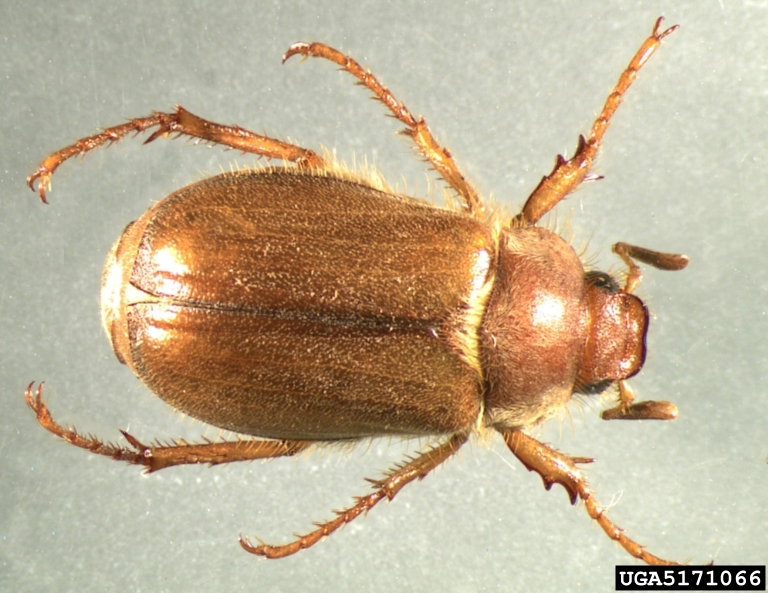
The species was formerly restricted to continental Europe and is now established at temperate latitudes in North America. Adult beetles are light reddish-brown, measure approximately 13–14 millimetres in length and have longitudinal grooves on their wing covers.
Written 26 November 2026 from the sources listed below. Each statement was checked against the passage it cites; statements that could not be supported were removed.
Diet
The larvae feed on grass roots, including the roots of most wild and cultivated grasses growing at cool latitudes.[1][2]
Behaviour
Adult beetles emerge from the soil in late spring, typically at dusk during warm, clear nights in early summer. They are most active when temperatures exceed 19 °C.[3][4][5]
Adult beetles mate in large swarms, usually on low trees and shrubs. They emerge at approximately 8:30 pm, mate overnight and return to the soil by daybreak.[6][7]
Adults may return to trees to mate again several times during the mating period before returning to the ground.[8][9]
Reproduction and life cycle
Female beetles lay between 20 and 40 eggs during their lifetimes. They deposit eggs individually at depths of 5–10 centimetres in moist soil.[10][11]
The eggs hatch approximately two weeks after being laid, and the larvae hatch by late July.[12][13]
Larvae form earthen cells in the soil before pupating.[14]
Appearance
Adult beetles are light reddish-brown and measure approximately 13–14 millimetres in length. The pronotum bears a narrow band of light-yellow setae, and the underside of the thorax also has light-yellow setae.[15][16][17][18]
The adult wing covers have longitudinal grooves, and the tip of the abdomen extends beyond them.[19][20]
Fully grown larvae measure 20–23 millimetres in length. They are white and C-shaped, with yellow-brown heads and six jointed legs.[21][22]
The larval raster has two rows of small spines that diverge outwards at the abdominal tip.[23]
The pupae measure approximately 16 millimetres in length.[24]
Freshly laid eggs are shiny, oval and milky-white, becoming dull grey later. They measure approximately 2.3 by 2.7 millimetres.[25][26]
Habitat
The larvae occupy soil while feeding and developing.[27]
Similar species
Adult European Chafers resemble May/June beetles, which are generally somewhat larger and darker.[28]
European Chafer larvae closely resemble the white grubs of Japanese beetles and May/June beetles. They can be distinguished from similar white grubs by close examination of the abdominal tip.[29][30]
Uses
The larvae serve as a food source for crows, skunks and raccoons.[31]
Conservation
The species is considered a pest because its larvae damage turfgrass. Larval feeding causes damage to residential lawns and can cause more extensive turf damage than Japanese beetle larvae because European Chafer grubs feed for longer during the year.[32][33][34]
Classification of the European Chafer
| Kingdom | Animalia |
|---|---|
| Phylum | Arthropoda |
| Subphylum | Hexapoda |
| Class | Insecta (Insect) |
| Order | Coleoptera (Beetle) |
| Suborder | Polyphaga |
| Series | Staphyliniformia |
| Superfamily | Scarabaeoidea |
| Family | Scarabaeidae (Dung Beetles) |
| Subfamily | Melolonthinae |
| Tribe | Rhizotrogini |
| Subtribe | Rhizotrogina |
| Genus | Amphimallon (Summer Chafers) |
| Species | Amphimallon majale (Razoumowsky, 1789) |
Where the European Chafer is found
Checklists and occurrence records place Amphimallon majale in 10 countries across Europe. GBIF holds 1,777 georeferenced records of it.
Countries
- Belgium
- Canada 773
- France 434
- Germany 13
- Italy 37
- Portugal 9
- Slovenia
- Spain 42
- Switzerland 4
- United States 465
Regions and cities with the most records
- British Columbia, Canada 318
- Ontario, Canada 214
- New Westminster, Canada 192
- Burnaby, Canada 187
- Victoria-Fraserview, Canada 180
- Riley Park, Canada 171
- North Vancouver, Canada 163
- Vancouver, Canada 162
- Île-de-France, France 162
- Richmond, Canada 157
- Washington, United States 147
- Port Moody, Canada 144
- Strawberry Hill, Canada 135
- West Vancouver, Canada 130
- Quebec, Canada 125
- Fleetwood, Canada 120
- Port Coquitlam, Canada 115
- Columbia City, United States 114
- Coquitlam, Canada 114
- Mercer Island, United States 114
- Seattle, United States 111
- Delta, Canada 107
- Bellevue, United States 106
- Surrey, Canada 100
- Bryn Mawr-Skyway, United States 95
- Kirkland, United States 92
- Pitt Meadows, Canada 90
- Burien, United States 88
- Tukwila, United States 86
- Renton, United States 85
- Inglewood-Finn Hill, United States 82
- Bainbridge Island, United States 81
- Paris 14 Observatoire, France 80
- SeaTac, United States 80
- Bagneux, France 79
- Croulebarbe, France 78
Range as the checklists state it
Palaearctic(Belgium, France, Germany, Portugal, Slovenia, Spain, Switzerland), Nearctic(Canada:British Columbia, Ontario, Quebec, USA:California, Indiana, Maryland, Michigan, West Virginia, introduced)
A number beside a place is its count of GBIF occurrence records. A place without a number comes from a checklist alone. Records show where a species has been observed or collected, which can include escapes and vagrants.
Common names
English
- European Chafer
Names in 3 other languages
- French
- Hanneton européen
- Portuguese
- Sanjuanero
- Ukrainian
- Хрущ європейський
Synonyms
5 other scientific names have been used for this species and are now treated as synonyms of Amphimallon majale.
- Amphimallon korbi Reitter, 1894
- Amphimallus majalis pellitulus Reitter, 1902
- Melolontha semirufa Gyllenhal, 1817
- Melolontha rufescens Latreille, 1804 ambiguous synonym
- Scarabaeus majalis Razoumowsky, 1789 ambiguous synonym
Related species
-
 European June BeetleAmphimallon solstitiale
-
 Amphimallon atrum
- Amphimallon assimile
-
 Amphimallon ruficorne
- Amphimallon gianfranceschii
- Amphimallon burmeisteri
- Scarce Summer ChaferAmphimallon ochraceum
- Amphimallon altaicum
Compare
Questions and answers
What is the scientific name of the European Chafer?
The scientific name of the European Chafer is Amphimallon majale. Written with its author, the full name is Amphimallon majale (Razoumowsky, 1789).
Which family does the European Chafer belong to?
Amphimallon majale belongs to the family Scarabaeidae, in the order Coleoptera and the class Insecta.
Where is the European Chafer found?
Checklists and occurrence records place Amphimallon majale in 10 countries, including Canada, United States, France, Spain, Italy and Germany.
Are European chafers invasive?
The species was formerly restricted to continental Europe and is now established at temperate latitudes in North America. It is considered a pest because its larvae damage turfgrass.[35][36][32]
What do European chafer beetles eat?
The larvae feed on grass roots, including those of most wild and cultivated grasses growing at cool latitudes.[1][2]
What is the diet of a beetle?
European Chafer larvae feed on grass roots.[2]
Sources
Passages the profile rests on
- The larvae feed on the roots of most grasses growing at cool latitudes, including wild and cultivated species. Source passage: “The large, white grubs of A. majale feed on the roots of most cool-latitude grasses, both wild and cultivated.” — English Wikipedia
- The larvae feed on grass roots. Source passage: “The European chafer is a beetle that feeds on grass roots while in its larval (grub) phase” — invasivespecies.wa.gov
- Adult beetles emerge from the soil in late spring. Source passage: “The adults come out of the ground in late spring” — English Wikipedia
- Adults are most active on warm, clear nights when temperatures exceed 19 °C. Source passage: “The beetles are most active on warm, clear nights when the temperature is above 19 °C” — English Wikipedia
- Adult beetles typically emerge at dusk during warm, clear nights in early summer. Source passage: “Adult European chafers typically emerge from the soil in early summer at dusk on warm, clear nights.” — extension.umn.edu
- Adult beetles mate in large swarms, usually on low trees and shrubs. Source passage: “mate in large swarms, usually on low trees and shrubs.” — English Wikipedia
- Adult beetles emerge at approximately 8:30 pm, mate overnight and return to the soil by daybreak. Source passage: “They emerge at about 8:30 pm, mate through the night, and return to the soil by daybreak.” — English Wikipedia
- Adults may return to trees to mate again several times during the mating period. Source passage: “Beetles may return to the trees to re-mate several times over the mating period.” — English Wikipedia
- Adults swarm around small trees and shrubs to mate before returning to the ground. Source passage: “They swarm around small trees and shrubs to mate before returning to the ground.” — extension.umn.edu
- Female beetles lay between 20 and 40 eggs during their lifetimes. Source passage: “Female chafers lay 20-40 eggs over their lifespan.” — English Wikipedia
- Females deposit eggs individually at depths of 5–10 centimetres in moist soil. Source passage: “They are laid singly, 5–10 centimetres (2–4 in) deep in moist soil” — English Wikipedia
- The eggs hatch approximately two weeks after being laid. Source passage: “and take 2 weeks to hatch.” — English Wikipedia
- The larvae hatch by late July. Source passage: “The grubs hatch by late July.” — English Wikipedia
- Larvae form earthen cells in the soil before pupating. Source passage: “to form earthen cells and pupate.” — English Wikipedia
- Adult beetles are light reddish-brown in colour. Source passage: “Adult beetles are medium-sized, light reddish-brown” — English Wikipedia
- The adult pronotum bears a narrow band of light-yellow setae. Source passage: “Their pronotum features a narrow band of light-yellow setae” — English Wikipedia
- The underside of the adult thorax has light-yellow setae. Source passage: “the underside of the thorax has similar coloured setae.” — English Wikipedia
- Adult beetles measure approximately 13–14 millimetres in length. Source passage: “approximately 13–14 millimetres” — English Wikipedia
- The tip of the adult abdomen extends beyond the wing covers. Source passage: “The tip of the abdomen protrudes beyond the wing covers.” — English Wikipedia
- The adult wing covers have longitudinal grooves. Source passage: “Wing covers have longitudinal grooves.” — English Wikipedia
- Fully grown larvae measure 20–23 millimetres in length. Source passage: “Fully grown larvae are 20–23 millimetres (25⁄32–29⁄32 in) long.” — English Wikipedia
- The larvae are white and C-shaped, with yellow-brown heads and six jointed legs. Source passage: “Larvae are white-coloured and C-shaped, with a yellow-brown head and six jointed legs.” — English Wikipedia
- The larval raster has two rows of small spines that diverge outwards at the abdominal tip. Source passage: “The raster has two distinct rows of small spines that diverge outward at the tip of the abdomen.” — English Wikipedia
- The pupae measure approximately 16 millimetres in length. Source passage: “Pupae are about 16 millimetres (5⁄8 in) long.” — English Wikipedia
- Freshly laid eggs are shiny, oval and milky-white, becoming dull grey later. Source passage: “Eggs are shiny and oval, milky-white when freshly laid, but later turning dull gray” — English Wikipedia
- The eggs measure approximately 2.3 by 2.7 millimetres. Source passage: “approximately 2.3 by 2.7 millimetres” — English Wikipedia
- The larvae occupy soil while feeding and developing. Source passage: “In frost zones, the grubs feed until November, then move deeper into the soil.” — English Wikipedia
- Adult European chafers resemble May/June beetles, which are generally somewhat larger and darker. Source passage: “It resembles a May/June beetle, although May/June beetles are usually a little larger and darker in color.” — extension.umn.edu
- European chafer larvae closely resemble the white grubs of Japanese beetles and May/June beetles. Source passage: “They look very similar to Japanese beetle and May/June beetle white grubs” — extension.umn.edu
- European chafer larvae can be distinguished from similar white grubs by close examination of the abdominal tip. Source passage: “can only be distinguished by close examination of the tip of their abdomen.” — extension.umn.edu
- The larvae serve as a food source for crows, skunks and raccoons. Source passage: “its grubs are an attractive food source for local fauna such as crows, skunks and raccoons” — English Wikipedia
- The species is considered a pest because its larvae damage turfgrass. Source passage: “European chafer (Amphimallon majale) is a severe pest of turfgrass.” — extension.umn.edu
- Larval feeding causes damage to residential lawns. Source passage: “This has made the European chafer an enemy of lawns.” — English Wikipedia
- Larval feeding can cause more extensive turf damage than Japanese beetle larvae because European chafer grubs feed for longer during the year. Source passage: “the larvae (grubs) are considered more destructive to turf than Japanese beetles because they feed longer during the year.” — extension.umn.edu
- The species was formerly restricted to continental Europe. Source passage: “Formerly found only in continental Europe” — English Wikipedia
- The species is now established at temperate latitudes in North America. Source passage: “this invasive species is now found at temperate latitudes in North America.” — English Wikipedia
Data
- Catalogue of Life, 2026-10-16 XR cc by
- Global Biodiversity Information Facility CC BY 4.0
- Wikidata CC0
- GeoNames CC BY 4.0
- Wikimedia Commons per image; credit shown with each image
- iNaturalist per image; credit shown with each image
- Within the Catalogue of Life, this name comes from World Scarabaeidae Database cc by
References
- Razoumowsky, G. G. (1789). Histoire naturelle du Jorat et de ses environs et celle des trois lacs de Neufchatel, Morat et Bienne. Lousanne, Mourer 8 Volume 1:1-322 (289-290). https://archive.org/download/histoirenaturell01razu/histoirenaturell01razu.pdf Link where the name was published
This species in other databases
Page built on 26 November 2026. See how the catalog is made and all sources and licences.
Cite this page
ScientificNames.org. (2026). Amphimallon majale (European Chafer). Retrieved November 26, 2026, from https://scientificnames.org/species/amphimallon-majale
“Amphimallon majale (European Chafer).” ScientificNames.org, 2026, scientificnames.org/species/amphimallon-majale. Accessed 26 Nov. 2026.
ScientificNames.org. “Amphimallon majale (European Chafer).” Accessed November 26, 2026. https://scientificnames.org/species/amphimallon-majale.
@misc{scientificnames_amphimallon_majale_european_chafer,
  author = {{ScientificNames.org}},
  title = {Amphimallon majale (European Chafer)},
  year = {2026},
  url = {https://scientificnames.org/species/amphimallon-majale},
  note = {Accessed 2026-11-26}
}