Species · Insects
Anacampsis nocturna
Anacampsis nocturna has no English name on record in the checklists used here. It is a species of insect in the family Gelechiidae (gelechiid moths), order Lepidoptera. The name dates from 1914.
- Scientific name
- Anacampsis nocturna (Meyrick, 1914)
- Genus
- Anacampsis
- Family
- Gelechiidae (Gelechiid Moths)
- Order
- Lepidoptera
- Class
- Insecta
- Environment
- terrestrial
- Name status
- accepted in the Catalogue of Life
Overview
Anacampsis nocturna is an insect in the family Gelechiidae, order Lepidoptera, and class Insecta. Anacampsis nocturna occurs in Guyana. It has dark fuscous forewings with indistinct markings and dark fuscous hindwings, and an approximate wingspan of 12 mm.
Written 28 November 2026 from the sources listed below. Each statement was checked against the passage it cites; statements that could not be supported were removed.
Appearance
The wingspan is approximately 12 mm. The forewings are dark fuscous with varying amounts of pale greyish-ochreous irroration, and their markings are indistinct, formed by areas lacking pale irroration.[1][2][3]
A subbasal dot occurs in the middle of each forewing, and an erect mark extends from the base of the dorsum. An irregular transverse line crosses the forewing at approximately one-fifth of its length, angling inward beneath the costa and outward in the middle.[4][5][6][7]
The forewings have elongate spots on the costa before the middle and before the subterminal line. An oval spot beneath the first elongate costal spot is partially confluent with it.[8][9]
The forewing stigmata are moderate in size, with the discal stigmata positioned close together. The plical stigma lies obliquely before the first discal stigma.[10][11]
An indistinct pale greyish-ochreous subterminal line extends from three-fourths of the costa to the tornus. Its upper portion curves inward and its lower portion curves outward.[12][13]
Several dark marginal dots occur around the apical portions of the costa and termen. The hindwings are dark fuscous.[14][15]
Classification of Anacampsis nocturna
| Kingdom | Animalia |
|---|---|
| Phylum | Arthropoda |
| Subphylum | Hexapoda |
| Class | Insecta (Insect) |
| Order | Lepidoptera |
| Superfamily | Gelechioidea |
| Family | Gelechiidae (Gelechiid Moths) |
| Subfamily | Anacampsinae |
| Genus | Anacampsis |
| Species | Anacampsis nocturna (Meyrick, 1914) |
Synonyms
One other scientific name has been used for this species and is now treated as a synonym of Anacampsis nocturna.
- Agriastis nocturna Meyrick, 1914
Related species
-
 Poplar SoberAnacampsis populella
-
 Anacampsis scintillella
-
 Coverdale's AnacampsisAnacampsis coverdalella
-
 Birch SoberAnacampsis blattariella
-
 Silver-dashed AnacampsisAnacampsis levipedella
-
 Anacampsis timidella
-
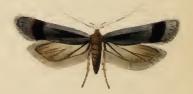 Black SoberAnacampsis temerella
- Lupine Leafroller MothAnacampsis lupinella
Compare
Questions and answers
Where does Anacampsis nocturna occur?
Anacampsis nocturna occurs in Guyana.[16]
What is the wingspan of Anacampsis nocturna?
Its wingspan is approximately 12 mm.[1]
What are the forewing colours and markings of Anacampsis nocturna?
The forewings are dark fuscous with varying amounts of pale greyish-ochreous irroration. Their indistinct markings include a subbasal dot, an erect mark, an irregular transverse line, elongate costal spots, and a pale greyish-ochreous subterminal line.[2][3][4][5][6][8][12]
What colour are the hindwings?
The hindwings are dark fuscous.[15]
Who described Anacampsis nocturna and when?
Edward Meyrick described Anacampsis nocturna in 1914.[17]
Which family does Anacampsis nocturna belong to?
It belongs to the moth family Gelechiidae.[18]
Sources
Passages the profile rests on
- The wingspan of Anacampsis nocturna is approximately 12 mm. Source passage: “The wingspan is about 12 mm.” — English Wikipedia
- The forewings are dark fuscous with varying amounts of pale greyish-ochreous irroration. Source passage: “The forewings are dark fuscous, more or less irrorated with pale greyish-ochreous” — English Wikipedia
- The forewing markings are indistinct and are formed by areas lacking pale irroration. Source passage: “the markings obscure, formed by the absence of pale irroration.” — English Wikipedia
- A subbasal dot occurs in the middle of each forewing. Source passage: “There is a subbasal dot in the middle” — English Wikipedia
- Each forewing has an erect mark extending from the base of the dorsum. Source passage: “and an erect mark from the base of the dorsum.” — English Wikipedia
- An irregular transverse line crosses the forewing at approximately one-fifth of its length. Source passage: “An irregular transverse line is found at one-fifth” — English Wikipedia
- The transverse forewing line angles inward beneath the costa and outward in the middle. Source passage: “angulated inwards beneath the costa and outwards in the middle.” — English Wikipedia
- The forewings have elongate spots on the costa before the middle and before the subterminal line. Source passage: “There are elongate spots on the costa before the middle and before the subterminal line” — English Wikipedia
- An oval spot beneath the first elongate costal spot is partially confluent with it. Source passage: “and an oval spot beneath the first of these partially confluent with it.” — English Wikipedia
- The forewing stigmata are moderate in size, with the discal stigmata positioned close together. Source passage: “The stigmata are moderate, with the discal approximated” — English Wikipedia
- The plical stigma lies obliquely before the first discal stigma. Source passage: “the plical obliquely before the first discal.” — English Wikipedia
- An indistinct pale greyish-ochreous subterminal line extends from three-fourths of the costa to the tornus. Source passage: “An obscure pale greyish-ochreous subterminal line is found from three-fourths of the costa to the tornus” — English Wikipedia
- The upper portion of the subterminal line curves inward, while its lower portion curves outward. Source passage: “sinuate inwards on the upper portion and outwards on the lower.” — English Wikipedia
- Several dark marginal dots occur around the apical portions of the costa and termen. Source passage: “There are also several dark marginal dots around the apical part of the costa and termen.” — English Wikipedia
- The hindwings are dark fuscous. Source passage: “The hindwings are dark fuscous.” — English Wikipedia
- Anacampsis nocturna occurs in Guyana. Source passage: “It is found in Guyana.” — English Wikipedia
- Edward Meyrick described Anacampsis nocturna in 1914. Source passage: “It was described by Edward Meyrick in 1914.” — English Wikipedia
- Anacampsis nocturna belongs to the moth family Gelechiidae. Source passage: “Anacampsis nocturna is a moth of the family Gelechiidae.” — English Wikipedia
Data
- Catalogue of Life, 2026-10-16 XR cc by
- Wikidata CC0
- Within the Catalogue of Life, this name comes from Catalogue of World Gelechiidae cc0
This species in other databases
Page built on 28 November 2026. See how the catalog is made and all sources and licences.
Cite this page
ScientificNames.org. (2026). Anacampsis nocturna. Retrieved November 28, 2026, from https://scientificnames.org/species/anacampsis-nocturna
“Anacampsis nocturna.” ScientificNames.org, 2026, scientificnames.org/species/anacampsis-nocturna. Accessed 28 Nov. 2026.
ScientificNames.org. “Anacampsis nocturna.” Accessed November 28, 2026. https://scientificnames.org/species/anacampsis-nocturna.
@misc{scientificnames_anacampsis_nocturna,
  author = {{ScientificNames.org}},
  title = {Anacampsis nocturna},
  year = {2026},
  url = {https://scientificnames.org/species/anacampsis-nocturna},
  note = {Accessed 2026-11-28}
}