Species · Flowering plants
Jericho-rose Anastatica hierochuntica
The scientific name of the Jericho-rose is Anastatica hierochuntica. It is a species of flowering plant in the family Brassicaceae (crucifer), order Capparales.
- Scientific name
- Anastatica hierochuntica L.
- Common name
- Jericho-rose
- Genus
- Anastatica
- Family
- Brassicaceae (Crucifer)
- Order
- Capparales
- Class
- Magnoliopsida
- Recorded in
- 23 countries
- Name status
- accepted in the Catalogue of Life
Overview
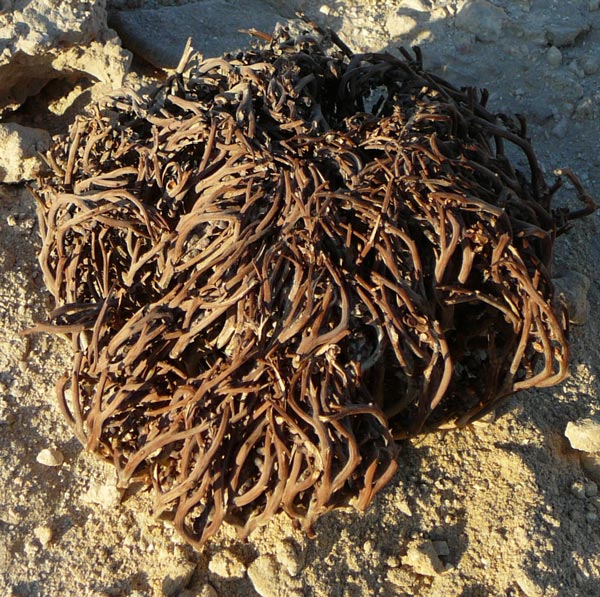
The Jericho-rose is a small gray annual flowering herb with minute white flowers. The species occurs in arid regions of the Middle East and the Sahara Desert. Its branches contract into a ball when dry and reopen when exposed to moisture.
Written 26 November 2026 from the sources listed below. Each statement was checked against the passage it cites; statements that could not be supported were removed.
Appearance
The Jericho-rose is a small gray annual herb with minute white flowers. It rarely exceeds 15 centimetres in height.[1][2][3]
After completing its life cycle, the plant develops a persistent woody skeleton.[4]
Behaviour
The plant's branches contract into a closed-fist shape when dry. Moisture or contact with water causes the contracted branches to reopen.[5][6]
The curling and uncurling movements are reversible and can occur repeatedly. The plant remains closed in dry weather, opens slowly in wet weather and opens conspicuously when rain threatens.[7][8][9][10]
After the rainy season, the plant dries, sheds its leaves, curls its branches into a ball and enters aestivation. Its dead woody skeleton can remain in place for many years.[11][12]
The plant is not considered a true resurrection plant because its dead tissues do not revive or become green.[13]
Reproduction and life cycle
The plant's closed fruits remain attached inside its curled branches, protecting its seeds. The plant maintains its seed bank within its contracted branches.[14][15]
Moisture during a subsequent rainy season causes the curled plant to reopen and its fruits to release seeds. When sufficient water is available, dispersed seeds can germinate within hours.[16][17]
Some seeds are dispersed near the parent plant when raindrops strike their spoon-like appendages. Their sticky coats help them attach to soil.[18][19]
The seeds can remain dormant for years. Seeds carried downstream by surface water do not survive.[20][21]
Habitat
The species occurs in arid regions of the Middle East and the Sahara Desert. Its recorded distribution includes parts of North Africa and Iran, Egypt, Israel, Saudi Arabia, Iraq, Jordan and Pakistan.[22][23]
The species is native to western Asia.[24]
Uses
The plant has historically been used as a natural indicator for predicting weather conditions. Its opening and closing behaviour has also been used as a natural hygrometer.[25][26]
Similar species
Anastatica hierochuntica is distinguished from Selaginella lepidophylla, which is also called the false rose of Jericho.[27]
Classification of the Jericho-rose
| Kingdom | Plantae |
|---|---|
| Subkingdom | Pteridobiotina |
| Phylum | Tracheophyta |
| Class | Magnoliopsida |
| Order | Capparales |
| Family | Brassicaceae (Crucifer) |
| Subfamily | Brassicoideae |
| Tribe | Anastaticeae |
| Genus | Anastatica |
| Species | Anastatica hierochuntica L. |
Where the Jericho-rose is found
Checklists and occurrence records place Anastatica hierochuntica in 23 countries across Africa and Asia. GBIF holds 1,278 georeferenced records of it.
Countries
- Algeria 78
- Bahrain 11
- Egypt 69
- Iran 13
- Iraq 6
- Israel 607
- Jordan 16
- Kuwait 4
- Libya 5
- Mali
- Mauritania 46
- Morocco 223
- Oman 14
- Pakistan 6
- Palestinian Territory 13
- Qatar 15
- Saudi Arabia 75
- Sudan 2
- Syria 3
- Tunisia
- United Arab Emirates 57
- Western Sahara 10
- Yemen 5
Regions and cities with the most records
- Southern District, Israel 575
- Sharjah, United Arab Emirates 41
- Eilat, Israel 40
- Safi, Jordan 40
- Aqaba, Jordan 37
- Arad, Israel 35
- Dimona, Israel 32
- West Bank, Palestinian Territory 30
- Adh Dhayd, United Arab Emirates 26
- Ouarzazate, Morocco 17
- Tabount, Morocco 17
- Tiris Zemmour, Mauritania 16
- Riyadh Region, Saudi Arabia 14
- Abū an Numrus, Egypt 13
- Al Ḩawāmidīyah, Egypt 13
- Giza, Egypt 13
- Cairo, Egypt 12
- ‘Ar‘ara BaNegev, Israel 12
- Tabuk Region, Saudi Arabia 11
- Awsīm, Egypt 10
- Dar Naim, Mauritania 10
- Illizi, Algeria 10
- Kirdāsah, Egypt 10
- Mecca Region, Saudi Arabia 10
- Tata, Morocco 10
- Aqaba, Jordan 9
- Biskra, Algeria 9
- Biskra, Algeria 9
- Cairo, Egypt 9
- Ksar, Mauritania 9
- Nouakchott, Mauritania 9
- Tamanrasset, Algeria 9
- Tevragh Zeina, Mauritania 9
- Al Badrashayn, Egypt 8
- Shubrā al Khaymah, Egypt 8
- Tinghir, Morocco 8
2 more countries have a few records outside this range
These countries hold a few records of Anastatica hierochuntica but lie outside the range the checklists give for it. Such records are often zoo or garden specimens, museum material or vagrants, so the species is not counted as occurring there.
Range as the checklists state it
Morocco; Western Sahara; Algeria; Tunisia; Libya; Egypt (Desert Oases, Eastern Desert, Great Southwestern Desert, SE-Egypt); Canary Isl. (Fuerteventura); Mauritania; N-Mali; Sudan; Iran (S-Iran); Israel (Rift Valley, Negev Desert, Judean Desert); Sinai peninsula (N-Sinai, S-Sinai); Jordania (S-Jordania); Saudi Arabia (C-Saudi Arabia, Dahana, NE-Saudi Arabia, N-Saudi Arabia, Hejaz, Rub al Khali, Asir, Nejd Desert); Kuwait; Bahrain; Qatar; United Arab Emirates; Oman; Yemen (Inner Hadhramaut, N-Inner Yemen, W-Yemen); Pakistan (Baluchistan)
A number beside a place is its count of GBIF occurrence records. A place without a number comes from a checklist alone. Records show where a species has been observed or collected, which can include escapes and vagrants.
Common names
English
- Jericho-rose
- Rose-of-Jericho
- True Rose of Jericho
Names in 10 other languages
- Arabic
- شجرة الكف, كف مريم
- Czech
- choulivka jerišská
- Finnish
- jerikonruusu
- Hebrew
- שושנת-יריחו אמיתית
- Italian
- Rosa di Gerico
- Polish
- Anastatika rezurekcyjna, róża jerychońska, zmartwychwstanka jerychońska
- Russian
- Анастатика иерихонская
- Slovak
- chúlivka jerišská
- Spanish
- Rosa de Jericó
- Swedish
- jerikoros
Synonyms
2 other scientific names have been used for this species and are now treated as synonyms of Anastatica hierochuntica.
- Anastatica littoralis Salisb.
- Myagrum hierochunticum (L.) Crantz
Related species
-
 WasabiEutrema japonicum
-
 RapeseedBrassica napus
-
 HorseradishArmoracia rusticana
-
 Wild CabbageBrassica oleracea
-
 RadishRaphanus sativus
-
 WatercressNasturtium officinale
-
 WoadIsatis tinctoria
-
 Indian MustardBrassica juncea
Compare
Questions and answers
What is the scientific name of the Jericho-rose?
The scientific name of the Jericho-rose is Anastatica hierochuntica. Written with its author, the full name is Anastatica hierochuntica L..
Which family does the Jericho-rose belong to?
Anastatica hierochuntica belongs to the family Brassicaceae, in the order Capparales and the class Magnoliopsida.
Where is the Jericho-rose found?
Checklists and occurrence records place Anastatica hierochuntica in 23 countries, including Israel, Morocco, Algeria, Saudi Arabia, Egypt and United Arab Emirates.
What other names does the Jericho-rose have?
Anastatica hierochuntica is also known in English as Rose-of-Jericho and True Rose of Jericho.
How long does a Rose of Jericho live?
The Jericho-rose is an annual plant. After completing its life cycle, it develops a persistent woody skeleton that can remain in place for many years.[11][3][4]
How does the Rose of Jericho grow?
After the rainy season, the plant dries, sheds its leaves and curls its branches into a ball. Moisture during a subsequent rainy season causes it to reopen and release seeds. When sufficient water is available, dispersed seeds can germinate within hours.[12][16][17]
Sources
Passages the profile rests on
- Anastatica hierochuntica is a small gray annual herb with minute white flowers. Source passage: “The plant is a small gray annual herb that rarely grows above 15 centimetres (6 in) high, and bears minute white flowers.” — English Wikipedia
- The plant rarely exceeds 15 centimetres in height. Source passage: “rarely grows above 15 centimetres (6 in) high” — English Wikipedia
- Anastatica hierochuntica is an annual plant. Source passage: “Despite it being an annual” — English Wikipedia
- After completing its life cycle, the plant develops a persistent woody skeleton. Source passage: “the plant lignifies after completing its life cycle, turning into a persistent woody skeleton.” — English Wikipedia
- The plant's branches contract into a closed-fist shape when dry. Source passage: “Its branches have the property of contracting with dryness into the shape of a closed fist” — English Wikipedia
- Moisture or contact with water causes the plant's contracted branches to reopen. Source passage: “reopening with moisture or contact with water.” — English Wikipedia
- The plant's curling and uncurling movements are reversible and can occur repeatedly. Source passage: “The process of curling and uncurling is completely reversible and can be repeated many times.” — English Wikipedia
- The plant remains closed in dry weather. Source passage: “In dry weather the plant remains completely closed” — English Wikipedia
- The plant opens slowly in wet weather. Source passage: “in wet weather, it opens slowly” — English Wikipedia
- The plant opens conspicuously when rain threatens. Source passage: “if it threatens rain, it opens in a very showy way” — English Wikipedia
- The plant's dead woody skeleton can remain in place for many years. Source passage: “The dead skeletal form can remain in situ for many years” — English Wikipedia
- After the rainy season, the plant dries, sheds its leaves, curls its branches into a ball and enters aestivation. Source passage: “After the rainy season, the plant dries up, dropping leaves and curling branches into a tight ball, and aestivates.” — English Wikipedia
- Anastatica hierochuntica is not considered a true resurrection plant because its dead tissues do not revive or become green. Source passage: “it is not a true resurrection plant, because the plant's dead tissues do not revive and turn green.” — English Wikipedia
- The plant's closed fruits remain attached inside its curled branches, protecting its seeds. Source passage: “Within the ball, the fruits remain attached and closed, protecting the seeds” — English Wikipedia
- The plant maintains its seed bank within its contracted branches. Source passage: “maintaining its seed bank.” — English Wikipedia
- Moisture during a subsequent rainy season causes the curled plant to reopen and its fruits to release seeds. Source passage: “Moistened again in a later rainy season, the ball uncurls and the plant wakes up from its dormant state, which causes the capsular fruits to open to disperse the seeds.” — English Wikipedia
- When sufficient water is available, dispersed seeds can germinate within hours. Source passage: “If water is sufficient, the dispersed seeds germinate within hours.” — English Wikipedia
- Some seeds are dispersed near the parent plant when raindrops strike their spoon-like appendages. Source passage: “A fraction of the seeds are dispersed in the vicinity of the parent plant by raindrops hitting a spoon-like appendix on the seeds.” — English Wikipedia
- The seeds have sticky coats that help them attach to soil. Source passage: “The seeds have a sticky coat that helps them adhere to the soil” — English Wikipedia
- The plant's seeds can remain dormant for years. Source passage: “The seeds are very hardy and can remain dormant for years.” — English Wikipedia
- Seeds carried downstream by surface water do not survive. Source passage: “However, seeds swept downstream do not survive.” — English Wikipedia
- The species occurs in arid regions of the Middle East and the Sahara Desert. Source passage: “Anastatica is found in arid areas in the Middle East and the Sahara Desert” — English Wikipedia
- Its recorded distribution includes parts of North Africa and Iran, Egypt, Israel, Saudi Arabia, Iraq, Jordan and Pakistan. Source passage: “including parts of North Africa and regions of Iran, Egypt, Israel, Saudi Arabia, Iraq, Jordan and Pakistan.” — English Wikipedia
- The species is native to western Asia. Source passage: “The true rose of Jericho (Anastatica hierochuntica) is native to western Asia” — britannica.com
- The plant has historically been used as a natural indicator for predicting weather conditions. Source passage: “Since ancient times it was used as an element to guess the climate” — English Wikipedia
- The plant's opening and closing behaviour has been used as a natural hygrometer. Source passage: “since being a vegetable hygrometer” — English Wikipedia
- Anastatica hierochuntica is distinguished from Selaginella lepidophylla, which is also called the false rose of Jericho. Source passage: “This species is not to be confused with Selaginella lepidophylla, also sometimes referred to as "rose of Jericho", or "false rose of Jericho"” — English Wikipedia
Data
- Catalogue of Life, 2026-10-16 XR cc by
- Global Biodiversity Information Facility CC BY 4.0
- Wikidata CC0
- GeoNames CC BY 4.0
- Wikimedia Commons per image; credit shown with each image
- Within the Catalogue of Life, this name comes from Synonymic Checklists of the Vascular Plants of the World cc by
References
- L. (1753). Sp. Pl. [Linnaeus] 2: 641 (1753). where the name was published
This species in other databases
Page built on 27 November 2026. See how the catalog is made and all sources and licences.
Cite this page
ScientificNames.org. (2026). Anastatica hierochuntica (Jericho-rose). Retrieved November 27, 2026, from https://scientificnames.org/species/anastatica-hierochuntica
“Anastatica hierochuntica (Jericho-rose).” ScientificNames.org, 2026, scientificnames.org/species/anastatica-hierochuntica. Accessed 27 Nov. 2026.
ScientificNames.org. “Anastatica hierochuntica (Jericho-rose).” Accessed November 27, 2026. https://scientificnames.org/species/anastatica-hierochuntica.
@misc{scientificnames_anastatica_hierochuntica_jericho_rose,
  author = {{ScientificNames.org}},
  title = {Anastatica hierochuntica (Jericho-rose)},
  year = {2026},
  url = {https://scientificnames.org/species/anastatica-hierochuntica},
  note = {Accessed 2026-11-27}
}