Species · Amphibians
American Toad Anaxyrus americanus
The scientific name of the American Toad is Anaxyrus americanus. It is a species of amphibian in the family Bufonidae (true toad), order Anura. The name dates from 1836.
- Scientific name
- Anaxyrus americanus (Holbrook, 1836)
- Common name
- American Toad
- Genus
- Anaxyrus
- Family
- Bufonidae (True Toad)
- Order
- Anura
- Class
- Amphibia
- Red List category
- LC Least Concern
- Environment
- freshwater, terrestrial
- Recorded in
- 3 countries
- Name status
- accepted in the Catalogue of Life

Overview
Anaxyrus americanus occurs throughout the eastern half of Canada and the United States. It has a wartlike, kidney-shaped parotoid gland behind each eye.
Written 24 November 2026 from the sources listed below. Each statement was checked against the passage it cites; statements that could not be supported were removed.
Similar species
American toads can hybridize with Fowler's toads where their ranges overlap. American toad subspecies in Missouri have also been documented hybridizing with Fowler's toads and Rocky Mountain toads.[1][2]
Appearance
American toads have gray, greenish gray, brown, or reddish brown skin, sometimes with blackish spots on the back. They have a wartlike, kidney-shaped parotoid gland behind each eye.[3][4]
Their belly is white, cream-colored, or dark-gray-mottled, sometimes with dark spots on the breast. The bony ridge above each eye usually does not touch the parotoid gland.[5][6]
Female American toads are generally larger than males.[7]
Habitat
American toads inhabit forests, fields, and urban areas where moisture and sufficient food are available. They also occupy disturbed habitats, including urban, suburban, agricultural, and mined sites.[8][9]
In Missouri, American toads prefer rocky, wooded habitats and commonly inhabit the edges of hardwood forests.[10]
They commonly shelter beneath rocks, logs, and loose soil during the day. They require shallow freshwater ponds or pools for breeding and early development.[11][12]
Diet
American toads eat earthworms and a wide variety of insects. Their documented prey includes slugs, spiders, and centipedes.[13][14]
Adult American toads may consume crickets, mealworms, ants, moths, and other small invertebrates. Their tadpoles feed on algae in their aquatic pools.[15][16]
Behaviour
American toads are primarily nocturnal and commonly become active at dusk. They can also become active during rainy weather and feed on worms and insects.[17][18]
American toads hibernate during winter in soil or soft leaf litter. They commonly return to their natal ponds to breed.[19][20]
Male American toads produce a sustained, high-pitched trill lasting 6–30 seconds. Siblings rarely mate despite potentially encountering one another at their natal breeding ponds.[21][22]
Reproduction and life cycle
American toads breed in temporary pools, permanent ponds, and slow, shallow streams. In Missouri, breeding peaks from late April through May.[23][24]
Females lay between 2,000 and 20,000 eggs in long, double strands. The eggs are deposited in shallow water, either on the bottom or entwined in aquatic vegetation.[25][26]
Eggs hatch into tadpoles within approximately one week. Hatching occurs within 3–12 days.[27][28]
Tadpoles commonly swarm in shallow water near the shore. They complete metamorphosis in approximately 5–10 weeks and can reach adulthood approximately 50–65 days after hatching.[29][30][31]
American toads generally reach sexual maturity within 2–4 years.[32]
Conservation
The Hudson Bay toad is a rare Canadian subspecies of the American toad. It has been recorded in isolated populations in northern Ontario.[33][34]
Uses
American toads provide an ecosystem service by consuming insects and other small organisms that affect gardens.[35]
Classification of the American Toad
| Kingdom | Animalia |
|---|---|
| Phylum | Chordata |
| Subphylum | Vertebrata |
| Infraphylum | Gnathostomata |
| Parvphylum | Osteichthyes |
| Megaclass | Tetrapoda |
| Class | Amphibia (Amphibians) |
| Order | Anura (Frogs) |
| Family | Bufonidae (True Toad) |
| Genus | Anaxyrus (North American Toads) |
| Species | Anaxyrus americanus (Holbrook, 1836) |
Where the American Toad is found
Checklists and occurrence records place Anaxyrus americanus in 3 countries across North America. GBIF holds 188,967 georeferenced records of it.
Countries
Regions and cities with the most records
- Ontario, Canada 33,713
- New York, United States 12,674
- Pennsylvania, United States 11,996
- Ohio, United States 9,943
- Virginia, United States 9,334
- Michigan, United States 9,227
- Quebec, Canada 7,653
- Maryland, United States 6,526
- Minnesota, United States 6,245
- Massachusetts, United States 6,220
- Wisconsin, United States 5,702
- North Carolina, United States 5,577
- Illinois, United States 5,256
- Vermont, United States 4,650
- New Hampshire, United States 3,624
- Indiana, United States 3,371
- Nova Scotia, Canada 3,033
- Maine, United States 2,865
- Tennessee, United States 2,507
- Connecticut, United States 2,473
- Potomac, United States 2,309
- Missouri, United States 2,305
- McLean, United States 2,262
- Ottawa South, Canada 2,093
- Oklahoma, United States 2,089
- Nepean, Canada 2,083
- Ottawa, Canada 2,075
- Aylmer, Canada 2,071
- Bethesda, United States 1,994
- Gloucester, Canada 1,975
- West Virginia, United States 1,972
- Aspen Hill, United States 1,925
- Newton, United States 1,913
- Rockville, United States 1,894
- Reston, United States 1,882
- Waltham, United States 1,876
1 more country has a few records outside this range
These countries hold a few records of Anaxyrus americanus but lie outside the range the checklists give for it. Such records are often zoo or garden specimens, museum material or vagrants, so the species is not counted as occurring there.
Range as the checklists state it
North America
A number beside a place is its count of GBIF occurrence records. A place without a number comes from a checklist alone. Records show where a species has been observed or collected, which can include escapes and vagrants.
Common names
English
- American Toad
- Hudson Bay American Toad
- Hudson Bay Toad
Names in 18 other languages
- Arabic
- علجوم أمريكي
- Chinese
- 美國蟾蜍
- Czech
- ropucha americká
- Danish
- Amerikansk tudse
- Dutch
- Amerikaanse pad, Hudsonbaaipad
- French
- crapaud d'Amérique
- German
- Amerikanische Kröte
- Hungarian
- amerikai varangy
- Italian
- rospo americano
- Japanese
- アメリカヒキガエル
- Polish
- Ropucha amerykańska
- Portuguese
- Sapo-americano
- Russian
- Американская жаба
- Scottish Gaelic
- losgann-dubh
- Serbian
- америчка крастача
- Spanish
- Sapo Americano
- Ukrainian
- Ропуха американська
- oji
- Kitchi mokomini Dende
Synonyms
17 other scientific names have been used for this species and are now treated as synonyms of Anaxyrus americanus.
- Anaxyrus americanus americanus (Holbrook, 1836)
- Anaxyrus americanus charlesmithi (Bragg, 1954)
- Anaxyrus charlesmithi (Bragg, 1954)
- Bufo americanus Holbrook, 1836
- Bufo americanus alani Long, 1982
- Bufo americanus americanus Holbrook, 1836
- Bufo americanus charlesmithi Bragg, 1954
- Bufo americanus copei Yarrow & Henshaw, 1878
- Bufo americanus quadripunctatus Jan, 1857
- Bufo copei Yarrow & Henshaw, 1878
- Bufo copeii Yarrow & Henshaw, 1878
- Bufo lentiginosus americanus Holbrook, 1836
- Bufo terrestris americanus Holbrook, 1836
- Bufo terrestris charlesmithi Bragg, 1954
- Bufo terrestris copei Yarrow & Henshaw, 1878
- Chilophryne americana (Holbrook, 1836)
- Incilius americanus (Holbrook, 1836)
Related species
-
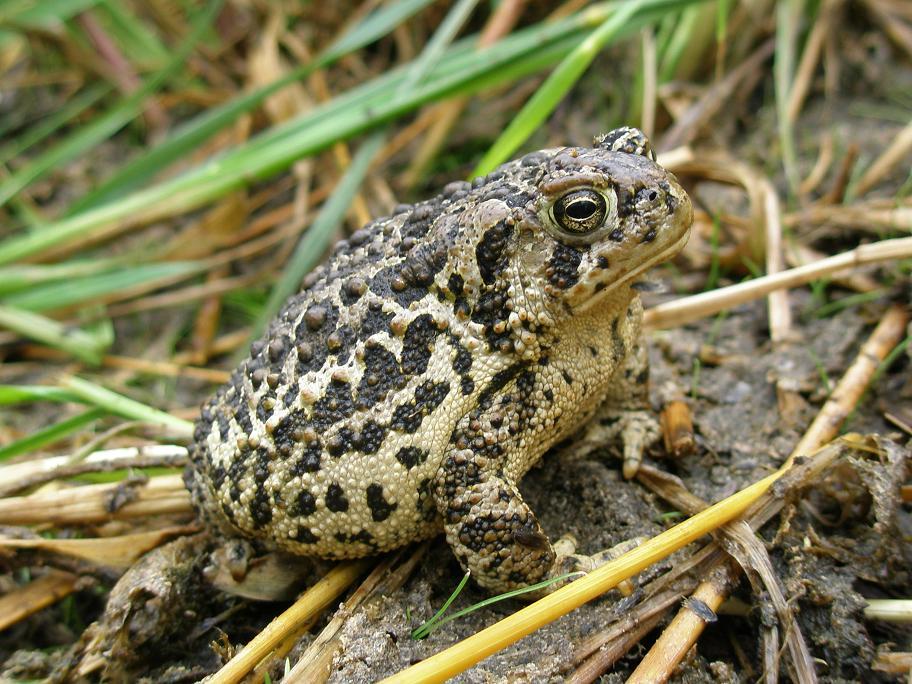 Wyoming ToadAnaxyrus baxteri
-
 Fowler's ToadAnaxyrus fowleri
-
 Western ToadAnaxyrus boreas
-
 Southern ToadAnaxyrus terrestris
-
 Woodhouse's ToadAnaxyrus woodhousii
-
 Red-spotted ToadAnaxyrus punctatus
-
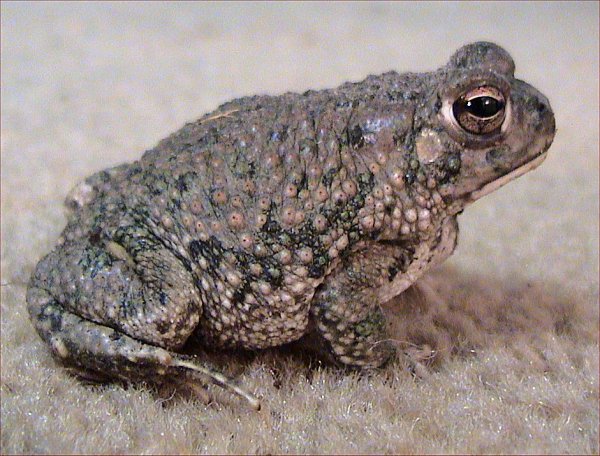 Texas ToadAnaxyrus speciosus
-
 Houston ToadAnaxyrus houstonensis
Compare
Questions and answers
What is the scientific name of the American Toad?
The scientific name of the American Toad is Anaxyrus americanus. Written with its author, the full name is Anaxyrus americanus (Holbrook, 1836).
Which family does the American Toad belong to?
Anaxyrus americanus belongs to the family Bufonidae, in the order Anura and the class Amphibia.
Where is the American Toad found?
Checklists and occurrence records place Anaxyrus americanus in 3 countries: United States, Canada and Mexico.
What is the conservation status of the American Toad?
The IUCN Red List category recorded for Anaxyrus americanus is Least Concern (LC).
What other names does the American Toad have?
Anaxyrus americanus is also known in English as Hudson Bay American Toad and Hudson Bay Toad.
Are American toads poisonous or venomous?
American toads possess skin warts that secrete toxins capable of irritating predators' mucous membranes.[36]
What habitat do American toads live in?
American toads inhabit forests, fields, and urban areas where moisture and sufficient food are available. They also occupy disturbed habitats, including urban, suburban, agricultural, and mined sites.[8][9]
Sources
Passages the profile rests on
- American toads can hybridize with Fowler's toads in areas where their ranges overlap. Source passage: “Races tend to hybridize with Anaxyrus woodhousii in their overlapping ranges.” — English Wikipedia
- American toad subspecies in Missouri have been documented hybridizing with Fowler's toads and Rocky Mountain toads. Source passage: “The two subspecies of the American toad in Missouri have been known to hybridize with the Fowler’s toad (Anaxyrus fowleri) and the Rocky Mountain toad (Anaxyrus woodhousii woodhousii)” — mdc.mo.gov
- American toads have gray, greenish gray, brown, or reddish brown skin, sometimes with blackish spots on the back. Source passage: “The general color is gray, greenish gray, brown, or reddish brown. Blackish spots may be present on the back” — mdc.mo.gov
- The species has a wartlike, kidney-shaped parotoid gland behind each eye. Source passage: “They have a wartlike, kidney-shaped gland (parotoid gland) behind each eye.” — mdc.mo.gov
- American toads have a white, cream-colored, or dark-gray-mottled belly, sometimes with dark spots on the breast. Source passage: “The belly is white, mottled with dark gray, or cream-colored, with dark gray spots on the breast.” — mdc.mo.gov
- The bony ridge above each eye usually does not touch the parotoid gland. Source passage: “The bony ridge above each eye usually does not touch the parotoid gland” — mdc.mo.gov
- Female American toads are generally larger than males. Source passage: “Females are generally larger than males.” — mdc.mo.gov
- American toads inhabit forests, fields, and urban areas where moisture and sufficient food are available. Source passage: “these toads can be found anywhere that moisture and ample food are available, including multiple forest types, fields and urban areas.” — extension.umaine.edu
- American toads also occupy disturbed habitats, including urban, suburban, agricultural, and mined sites. Source passage: “They are also found in disturbed habitats, such as urban and suburban, agricultural, and mined sites.” — mdc.mo.gov
- In Missouri, American toads prefer rocky, wooded habitats and commonly inhabit the edges of hardwood forests. Source passage: “but they prefer rocky, wooded areas. They often live along the edge of hardwood forests.” — mdc.mo.gov
- American toads require shallow freshwater ponds or pools for breeding and early development. Source passage: “American toads require a semi-permanent freshwater pond or pool with shallow water” — English Wikipedia
- American toads commonly shelter beneath rocks, logs, and loose soil during the day. Source passage: “Individuals hide during the day under rocks and logs where there is loose, moist dirt” — mdc.mo.gov
- American toads eat earthworms and a wide variety of insects. Source passage: “American toads eat earthworms and a wide variety of insects.” — mdc.mo.gov
- Their documented prey includes slugs, spiders, and centipedes. Source passage: “They consume what is available and may eat a variety of larval insects, slugs, spiders, and centipedes, for example.” — extension.umaine.edu
- Adult American toads may consume crickets, mealworms, ants, moths, and other small invertebrates. Source passage: “Their diet includes crickets, mealworms, earthworms, ants, spiders, slugs, centipedes, moths, and other small invertebrates.” — English Wikipedia
- American toad tadpoles feed on algae in their aquatic pools. Source passage: “Tadpoles feed on algae within their pools.” — extension.umaine.edu
- American toads are primarily nocturnal and commonly become active at dusk. Source passage: “Like most toads, this species becomes active at dusk.” — mdc.mo.gov
- American toads can become active during rainy weather and feed on worms and insects. Source passage: “When it rains, these toads will become active and can be observed eating worms and insects.” — English Wikipedia
- American toads hibernate during winter in soil or soft leaf litter. Source passage: “American toads will spend the winter months hibernating within soil or soft leaf litter.” — extension.umaine.edu
- American toads commonly return to their natal ponds to breed. Source passage: “Toads display breeding site fidelity, as do many other amphibians.” — English Wikipedia
- Male American toads produce a sustained, high-pitched trill lasting 6–30 seconds. Source passage: “The male’s call is a sustained, high-pitched trill lasting 6–30 seconds.” — mdc.mo.gov
- American toad siblings rarely mate despite potentially encountering one another at their natal breeding ponds. Source passage: “Although incest is possible, Anaxyrus americanus siblings rarely mate.” — English Wikipedia
- American toads breed in temporary pools, permanent ponds, and slow, shallow streams. Source passage: “Breeding sites include temporary pools (such as water-filled ditches and road ruts), permanent ponds (such as natural sinkhole ponds and human-made ponds), and slow, shallow streams.” — mdc.mo.gov
- In Missouri, American toad breeding peaks from late April through May. Source passage: “Breeding peaks from late April into May” — mdc.mo.gov
- Female American toads lay between 2,000 and 20,000 eggs in long, double strands. Source passage: “A female can lay 2,000–20,000 eggs.” — mdc.mo.gov
- American toad eggs are deposited in shallow water, either on the bottom or entwined in aquatic vegetation. Source passage: “Females lay eggs in long, double strands, depositing them on the bottom in shallow water or entwined in aquatic plants.” — mdc.mo.gov
- American toad eggs hatch into tadpoles within approximately one week. Source passage: “After about a week, these hatch into tiny black tadpoles.” — mdc.mo.gov
- American toad eggs hatch within 3–12 days. Source passage: “They will hatch in 3-12 days” — extension.umaine.edu
- American toad tadpoles complete metamorphosis in approximately 5–10 weeks. Source passage: “requiring 5-10 weeks to complete metamorphosis” — extension.umaine.edu
- American toad tadpoles commonly swarm in shallow water near the shore. Source passage: “The tadpoles often swarm in shallow water near the shore.” — mdc.mo.gov
- American toad tadpoles can reach adulthood approximately 50–65 days after hatching. Source passage: “They reach adulthood in 50–65 days.” — English Wikipedia
- American toads generally reach sexual maturity within 2–4 years. Source passage: “2-4 years to reach sexual maturity.” — extension.umaine.edu
- The Hudson Bay toad is described as a rare Canadian subspecies of the American toad. Source passage: “The Hudson Bay toad (A. a. copei) is a rare Canadian subspecies of A. americanus.” — English Wikipedia
- The Hudson Bay toad subspecies has been recorded in isolated populations in northern Ontario. Source passage: “This subspecies of the American toad has been seen in the northern parts of Ontario where there are a few isolated populations.” — English Wikipedia
- American toads provide an ecosystem service by consuming insects and other small organisms that affect gardens. Source passage: “During summer nights, toads help us by consuming insects and other small organisms that are pests or annoyances to us and our gardens.” — mdc.mo.gov
- American toads possess skin warts that secrete toxins capable of irritating predators' mucous membranes. Source passage: “The numerous warts over most of a toad’s body are a form of defense. The warts secret toxins that are irritating to a predator’s mucous membranes.” — mdc.mo.gov
Data
- Catalogue of Life, 2026-10-16 XR cc by
- Global Biodiversity Information Facility CC BY 4.0
- Wikidata CC0
- GeoNames CC BY 4.0
- Wikimedia Commons per image; credit shown with each image
- Within the Catalogue of Life, this name comes from The Integrated Taxonomic Information System cc0
References
- Crother, Brian I., Jeff Boundy, Frank T. Burbrink, et al. / Moriarty, John J., ed. (2008). Scientific and Standard English Names of Amphibians and Reptiles of North America North of Mexico, With Comments Regarding Confidence in Our Understanding, Sixth Ed. Herpetological Circular No. 37.
This species in other databases
- Catalogue of Life 66LTT
- Wikidata Q694496
- iNaturalist 64968
- WoRMS urn:lsid:marinespecies.org:taxname:1525331
Page built on 24 November 2026. See how the catalog is made and all sources and licences.
Cite this page
ScientificNames.org. (2026). Anaxyrus americanus (American Toad). Retrieved November 24, 2026, from https://scientificnames.org/species/anaxyrus-americanus
“Anaxyrus americanus (American Toad).” ScientificNames.org, 2026, scientificnames.org/species/anaxyrus-americanus. Accessed 24 Nov. 2026.
ScientificNames.org. “Anaxyrus americanus (American Toad).” Accessed November 24, 2026. https://scientificnames.org/species/anaxyrus-americanus.
@misc{scientificnames_anaxyrus_americanus_american_toad,
  author = {{ScientificNames.org}},
  title = {Anaxyrus americanus (American Toad)},
  year = {2026},
  url = {https://scientificnames.org/species/anaxyrus-americanus},
  note = {Accessed 2026-11-24}
}