Species · Fishes
Three-eye Flounder Ancylopsetta dilecta
The scientific name of the Three-eye Flounder is Ancylopsetta dilecta. It is a species of fish in the family Paralichthyidae (sand flounders), order Pleuronectiformes. The name dates from 1883.
- Scientific name
- Ancylopsetta dilecta (Goode & Bean, 1883)
- Common name
- Three-eye Flounder
- Genus
- Ancylopsetta
- Family
- Paralichthyidae (Sand Flounders)
- Order
- Pleuronectiformes
- Class
- Teleostei
- Red List category
- LC Least Concern
- Environment
- marine
- Recorded in
- 2 countries
- Name status
- accepted in the Catalogue of Life

Overview
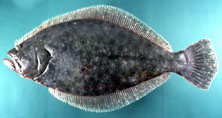
Ancylopsetta dilecta, the three-eye flounder, is a species of large-tooth flounder found along the Atlantic and Caribbean coasts of North and Central America. It is found down to depths of 137 m (449 ft). This species grows to 25 cm (9.8 in) in total length.
Classification of the Three-eye Flounder
| Kingdom | Animalia |
|---|---|
| Phylum | Chordata |
| Subphylum | Vertebrata |
| Infraphylum | Gnathostomata |
| Parvphylum | Osteichthyes |
| Gigaclass | Actinopterygii |
| Superclass | Actinopteri |
| Class | Teleostei (Teleost) |
| Order | Pleuronectiformes |
| Suborder | Pleuronectoidei |
| Family | Paralichthyidae (Sand Flounders) |
| Genus | Ancylopsetta (Ocellated Flounders) |
| Species | Ancylopsetta dilecta (Goode & Bean, 1883) |
Where the Three-eye Flounder is found
Checklists and occurrence records place Ancylopsetta dilecta in 2 countries. GBIF holds 346 georeferenced records of it.
Countries
A number beside a place is its count of GBIF occurrence records. A place without a number comes from a checklist alone. Records show where a species has been observed or collected, which can include escapes and vagrants.
Common names
English
- Three-eye Flounder
Names in 4 other languages
- Chinese
- 三眼彎鮃
- Japanese
- Hirenaga-darumagarei, ヒレナガダルマガレイ
- Russian
- камбала-анцилопсетта
- Spanish
- lenguado tres manchas
Synonyms
One other scientific name has been used for this species and is now treated as a synonym of Ancylopsetta dilecta.
- Notosema dilecta Goode & Bean, 1883
Related species
- Threespot Sand FlounderAncylopsetta dendritica
- Cyclope FlounderAncylopsetta cycloidea
- Foureyed FlounderAncylopsetta kumperae
- Ancylopsetta antillarum
- Ancylopsetta microctenus
- Ocellated FlounderAncylopsetta quadrocellata
-
 Summer FlounderParalichthys dentatus
- Pacific SanddabCitharichthys sordidus
Compare
Questions and answers
What is the scientific name of the Three-eye Flounder?
The scientific name of the Three-eye Flounder is Ancylopsetta dilecta. Written with its author, the full name is Ancylopsetta dilecta (Goode & Bean, 1883).
Which family does the Three-eye Flounder belong to?
Ancylopsetta dilecta belongs to the family Paralichthyidae, in the order Pleuronectiformes and the class Teleostei.
Where is the Three-eye Flounder found?
Checklists and occurrence records place Ancylopsetta dilecta in 2 countries: United States and Mexico.
What is the conservation status of the Three-eye Flounder?
The IUCN Red List category recorded for Ancylopsetta dilecta is Least Concern (LC).
Sources
Data
- Catalogue of Life, 2026-10-16 XR cc by
- Global Biodiversity Information Facility CC BY 4.0
- Wikidata CC0
- English Wikipedia CC BY-SA 4.0
- GeoNames CC BY 4.0
- Wikimedia Commons per image; credit shown with each image
- Within the Catalogue of Life, this name comes from World Register of Marine Species cc by
This species in other databases
- Catalogue of Life DP6H
- Wikidata Q4725508
- iNaturalist 316946
- WoRMS urn:lsid:marinespecies.org:taxname:276008
- ITIS 172754
Page built on 25 November 2026. See how the catalog is made and all sources and licences.
Cite this page
ScientificNames.org. (2026). Ancylopsetta dilecta (Three-eye Flounder). Retrieved November 25, 2026, from https://scientificnames.org/species/ancylopsetta-dilecta
“Ancylopsetta dilecta (Three-eye Flounder).” ScientificNames.org, 2026, scientificnames.org/species/ancylopsetta-dilecta. Accessed 25 Nov. 2026.
ScientificNames.org. “Ancylopsetta dilecta (Three-eye Flounder).” Accessed November 25, 2026. https://scientificnames.org/species/ancylopsetta-dilecta.
@misc{scientificnames_ancylopsetta_dilecta_three_eye_flounder,
  author = {{ScientificNames.org}},
  title = {Ancylopsetta dilecta (Three-eye Flounder)},
  year = {2026},
  url = {https://scientificnames.org/species/ancylopsetta-dilecta},
  note = {Accessed 2026-11-25}
}