Species · Other invertebrates
Rat Lungworm Angiostrongylus cantonensis
The scientific name of the Rat Lungworm is Angiostrongylus cantonensis. It is a species of animal in the family Metastrongylidae, order Rhabditida. The name dates from 1935.
- Scientific name
- Angiostrongylus cantonensis (Chen, 1935)
- Common name
- Rat Lungworm
- Genus
- Angiostrongylus
- Family
- Metastrongylidae
- Order
- Rhabditida
- Class
- Chromadorea
- Environment
- terrestrial
- Recorded in
- 20 countries
- Name status
- accepted in the Catalogue of Life
Overview
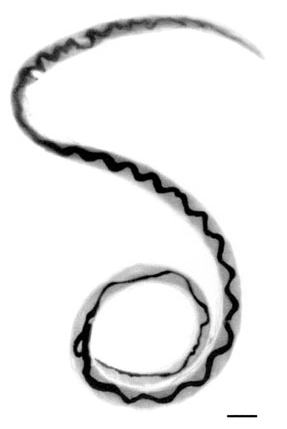
Rat Lungworm is a parasitic nematode in the family Metastrongylidae, order Rhabditida, and class Chromadorea. It occurs in Southeast Asia, the Pacific Islands, and other reported locations, and adult worms inhabit the pulmonary arteries of rats. Its larvae can migrate into the central nervous system of accidental hosts, including humans, where infection can cause eosinophilic meningitis.
Written 24 November 2026 from the sources listed below. Each statement was checked against the passage it cites; statements that could not be supported were removed.
Appearance
Rat Lungworm has an unsegmented body covered by a tough outer cuticle. Its infective third-stage larvae have a pointed projection at the end of their tails and measure approximately 0.5 mm in length.[1][2][3]
Habitat
Adult worms inhabit the pulmonary arteries of their definitive rat hosts. Third-stage larvae remain dormant within infected snail hosts.[4][5][6]
The parasite occurs in Southeast Asia and the Pacific Islands. It has also been reported in Africa, the Caribbean, Australia, Hawaii, and the southern United States.[7][8]
In 2023, the parasite was detected in continental Europe for the first time, in Valencia, Spain. It is endemic throughout all islands of the State of Hawaiʻi, where infected intermediate hosts and human cases have been identified on every island.[9][10][11]
At least 17 rat species have been identified as definitive hosts, including black rats, brown rats, and cotton rats. More than 200 intermediate-host species have been reported, including gastropods from the genera Achatina, Biomphlalaria, Bulinus, Lymnaea, and Pomaecea.[12][13][14][15]
Paratenic hosts can carry infective third-stage larvae without supporting their further development. These hosts include amphibians, centipedes, crustaceans, planarians, and reptiles.[16][17]
The parasite has been documented in wild and domestic mammals and birds outside its usual host relationships. It was identified in a captive yellow-tailed black cockatoo and two free-living tawny frogmouths in 2004, and in two North African hedgehogs in Mallorca in 2018.[18][19][20]
Behaviour
Infected rats acquire the parasite when they prey on infected snails. Third-stage larvae penetrate the gastrointestinal tract and travel through the circulatory system into the brain before young adult worms migrate back through the circulatory system to the pulmonary arteries.[21][22][23]
First-stage larvae migrate from the rat lungs through the trachea into the oropharynx before being swallowed. They are subsequently released into the environment through rat feces.[24][25]
Humans are accidental hosts in which larvae can migrate to the central nervous system. In accidental hosts, subadult worms cannot leave the central nervous system.[26][27]
In Hawaiʻi, freshwater shrimp, prawns, land crabs, and frogs can become infected by ingesting parasite larvae.[28]
Reproduction and life cycle
Adult worms reproduce sexually within the pulmonary arteries of rats. Female adults lay eggs in the pulmonary arteries, and the eggs travel through the bloodstream to the lungs, where they hatch into first-stage larvae.[29][30][31]
Classification of the Rat Lungworm
| Kingdom | Animalia |
|---|---|
| Phylum | Nematoda |
| Class | Chromadorea |
| Subclass | Chromadoria |
| Order | Rhabditida |
| Suborder | Rhabditina |
| Infraorder | Rhabditomorpha |
| Family | Metastrongylidae |
| Genus | Angiostrongylus |
| Species | Angiostrongylus cantonensis (Chen, 1935) |
This name was added to the Catalogue of Life from a contributing dataset by automated merging and has not yet been reviewed by its editors.
Where the Rat Lungworm is found
Checklists and occurrence records place Angiostrongylus cantonensis in 20 countries. GBIF holds 558 georeferenced records of it.
Countries
- Australia 78
- Barbados 4
- Brazil 160
- Cambodia 3
- China 28
- Ecuador 11
- French Polynesia 5
- Guadeloupe 3
- Haiti 14
- Indonesia 5
- Italy 4
- Japan 44
- Martinique 3
- Micronesia 3
- New Caledonia 3
- Samoa 3
- Spain 44
- Taiwan 47
- Thailand 37
- United States 59
Regions and cities with the most records
- Toyama, Japan 26
- Uozu, Japan 26
- Chachoengsao, Thailand 23
- Chachoengsao, Thailand 23
- Neihu, Taiwan 19
- New Taipei City, Taiwan 19
- Taipei, Taiwan 19
- Xizhi, Taiwan 19
- Banqiao, Taiwan 18
- Danshui, Taiwan 18
- Taipei, Taiwan 18
- Artibonite, Haiti 14
- Dessalines, Haiti 14
- Saint-Marc, Haiti 14
- Queensland, Australia 12
- Taiwan, Taiwan 12
- Mato Grosso, Brazil 8
- Chaozhou, Taiwan 6
- Rio de Janeiro, Brazil 6
- Taichung, Taiwan 6
- Fengshan, Taiwan 5
- Kaohsiung, Taiwan 5
- Louisiana, United States 5
- Pará, Brazil 5
- Rio de Janeiro, Brazil 5
- São Paulo, Brazil 5
- Botafogo, Brazil 4
- Cordovil, Brazil 4
- Franco da Rocha, Brazil 4
- Kenner, United States 4
- Metairie, United States 4
- New Orleans, United States 4
- Niterói, Brazil 4
- Duque de Caxias, Brazil 3
- Kansas, United States 3
- São Gonçalo, Brazil 3
3 more countries have a few records outside this range
These countries hold a few records of Angiostrongylus cantonensis but lie outside the range the checklists give for it. Such records are often zoo or garden specimens, museum material or vagrants, so the species is not counted as occurring there.
A number beside a place is its count of GBIF occurrence records. A place without a number comes from a checklist alone. Records show where a species has been observed or collected, which can include escapes and vagrants.
Common names
English
- Rat Lungworm
Names in 3 other languages
- Korean
- 광동주혈선충
- Spanish
- Gusano pulmonar de la rata
- Thai
- พยาธิปอดหนู, พยาธิหอยโข่ง
Synonyms
One other scientific name has been used for this species and is now treated as a synonym of Angiostrongylus cantonensis.
- Pulmonema cantonensis Chen, 1935
Questions and answers
What is the scientific name of the Rat Lungworm?
The scientific name of the Rat Lungworm is Angiostrongylus cantonensis. Written with its author, the full name is Angiostrongylus cantonensis (Chen, 1935).
Which family does the Rat Lungworm belong to?
Angiostrongylus cantonensis belongs to the family Metastrongylidae, in the order Rhabditida and the class Chromadorea.
Where is the Rat Lungworm found?
Checklists and occurrence records place Angiostrongylus cantonensis in 20 countries, including Brazil, Australia, United States, Taiwan, Japan and Spain.
What is neuroangiostrongyliasis?
Neuroangiostrongyliasis is an infection associated with Rat Lungworm in which larvae migrate into the central nervous system. In humans, this infection can cause eosinophilic meningitis.[26][32][33]
Do snails carry rat lungworm?
Yes. Infected snail hosts carry dormant third-stage larvae, which can infect rats when the rats prey on them.[6][21]
Where do rat lungworms live?
Adult Rat Lungworms inhabit the pulmonary arteries of rats. Their third-stage larvae remain dormant in infected snails, while larvae in accidental hosts, including humans, can migrate into the central nervous system. The parasite occurs in Southeast Asia, the Pacific Islands, and several other reported locations.[4][6][7][8][26]
Sources
Passages the profile rests on
- The nematode has an unsegmented body covered by a tough outer cuticle. Source passage: “Nematodes are roundworms characterized by a tough outer cuticle, unsegmented bodies, and a fully developed gastrointestinal tract.” — English Wikipedia
- The infective third-stage larvae have a pointed projection at the end of their tails. Source passage: “They are around 0.5 mm long, possess a pointed terminal projection on the end of the tail” — cdc.gov
- The infective third-stage larvae measure approximately 0.5 mm in length. Source passage: “They are around 0.5 mm long” — cdc.gov
- Adult worms inhabit the pulmonary arteries of rats. Source passage: “The nematode commonly resides in the pulmonary arteries of rats” — English Wikipedia
- Adult worms occupy the pulmonary arteries of their definitive rat hosts. Source passage: “Angiostrongylus cantonensis adults reside in the pulmonary arteries of rats” — pmc.ncbi.nlm.nih.gov
- Third-stage larvae remain dormant within infected snail hosts. Source passage: “The L3 become dormant, remaining in the snail host until the life cycle continues when a rat preys on the infected snail.” — pmc.ncbi.nlm.nih.gov
- The parasite occurs in Southeast Asia and the Pacific Islands. Source passage: “Most cases of A. cantonensis-associated eosinophilic meningitis originate from Southeast Asia and Pacific Islands.” — cdc.gov
- The parasite has also been reported in Africa, the Caribbean, Australia, Hawaii, and the southern United States. Source passage: “The parasite has also been reported from Africa, the Caribbean, Australia, Hawaii, and recently the southern United States.” — cdc.gov
- The parasite was detected in continental Europe for the first time in Valencia, Spain, in 2023. Source passage: “In 2023 it was detected for the first time in continental Europe in the city of Valencia on the Spanish mainland.” — English Wikipedia
- The parasite is endemic throughout all islands of the State of Hawaiʻi. Source passage: “rat lungworm disease is endemic in all of the islands in the State of Hawaiʻi.” — health.hawaii.gov
- In Hawaiʻi, infected intermediate hosts and human cases have been identified on every island. Source passage: “Human cases and infected intermediate hosts (snails and slugs) have been identified on all of the islands.” — health.hawaii.gov
- At least 17 rat species have been identified as definitive hosts. Source passage: “At least 17 species of rats have been identified as definitive hosts of A. cantonensis” — pmc.ncbi.nlm.nih.gov
- More than 200 intermediate-host species have been reported for the parasite. Source passage: “more than 200 species of intermediate hosts have been reported” — pmc.ncbi.nlm.nih.gov
- Black rats, brown rats, and cotton rats are documented definitive hosts. Source passage: “including black rats (Rattus rattus), brown rats, (Rattus norvegicus), and cotton rats (Sigmodon hispidus).” — cdc.gov
- Intermediate hosts include several genera of gastropods, including Achatina, Biomphlalaria, Bulinus, Lymnaea, and Pomaecea. Source passage: “Gastropod (snail and slug) intermediate hosts are numerous and include Achatina spp., Biomphlalaria spp., Bulinus spp., Lymnaea spp., Pomaecea spp., and more.” — cdc.gov
- Paratenic hosts can carry infective third-stage larvae without supporting their further development. Source passage: “In paratenic hosts, of which there are many [3], L3 larvae do not continue development, but remain infective to other paratenic hosts, accidental hosts, and definitive hosts.” — pmc.ncbi.nlm.nih.gov
- Paratenic hosts include amphibians, centipedes, crustaceans, planarians, and reptiles. Source passage: “include amphibians, centipedes, crustaceans, planarians, and reptiles.” — pmc.ncbi.nlm.nih.gov
- The parasite has been documented in wild and domestic mammals and birds outside its usual host relationships. Source passage: “Apart from humans, aberrant infections have occurred in several species of wild and domestic mammals and birds.” — cdc.gov
- The parasite was identified in a captive yellow-tailed black cockatoo and two free-living tawny frogmouths in 2004. Source passage: “In 2004, a captive yellow-tailed black cockatoo (Calyptorhynchus funereus) and two free-living tawny frogmouths (Podargus strigoides) suffering neurological symptoms were shown to have the parasite.” — English Wikipedia
- The parasite was identified in two North African hedgehogs in Mallorca in 2018. Source passage: “In 2018, in Mallorca two North African hedgehogs with signs of acute neurological disease were found to have A. cantonensis in their brains” — English Wikipedia
- Infected rats acquire the parasite when they prey on infected snails. Source passage: “the life cycle continues when a rat preys on the infected snail.” — pmc.ncbi.nlm.nih.gov
- Third-stage larvae penetrate the gastrointestinal tract of rats and subsequently travel through the circulatory system into the brain. Source passage: “L3 penetrate the rat’s gastrointestinal tract and travel via the circulatory system, eventually entering the brain.” — pmc.ncbi.nlm.nih.gov
- Young adult worms migrate from the brain into the circulatory system before reaching the pulmonary arteries. Source passage: “Young adults then reenter the circulatory system and migrate to the pulmonary arteries” — pmc.ncbi.nlm.nih.gov
- The parasite's first-stage larvae are released into the environment through rat feces. Source passage: “passed through the alimentary canal, and released in feces.” — pmc.ncbi.nlm.nih.gov
- First-stage larvae migrate from the rat lungs through the trachea into the oropharynx before being swallowed. Source passage: “L1 larvae migrate from the lungs via the trachea into the oropharynx, are swallowed by the host” — pmc.ncbi.nlm.nih.gov
- Humans are accidental hosts in which the larvae can migrate to the central nervous system. Source passage: “In accidental hosts, L3 larvae migrate from the gastrointestinal tract to the central nervous system, notably the brain in humans” — pmc.ncbi.nlm.nih.gov
- In accidental hosts, the subadult worms cannot leave the central nervous system. Source passage: “in accidental hosts, L5 larvae are unable to leave the central nervous system” — pmc.ncbi.nlm.nih.gov
- In Hawaiʻi, freshwater shrimp, prawns, land crabs, and frogs can become infected by ingesting parasite larvae. Source passage: “Snails, slugs, and certain other animals (including freshwater shrimp or prawns, land crabs, and frogs) can become infected by ingesting these larvae” — health.hawaii.gov
- Adult worms reproduce sexually within the pulmonary arteries of rats. Source passage: “where they reproduce sexually and females lay eggs.” — pmc.ncbi.nlm.nih.gov
- Female adult worms lay eggs in the pulmonary arteries of rats. Source passage: “where they reproduce sexually and females lay eggs.” — pmc.ncbi.nlm.nih.gov
- The eggs travel through the bloodstream to the lungs, where they hatch into first-stage larvae. Source passage: “The eggs travel via the bloodstream to the lungs, where they hatch into first-stage larvae (L1).” — pmc.ncbi.nlm.nih.gov
- In humans, infection can cause eosinophilic meningitis following larval migration into the central nervous system. Source passage: “and as a result cause eosinophilic meningitis—the disease in humans known as neuroangiostrongyliasis” — pmc.ncbi.nlm.nih.gov
- The parasite is a leading cause of eosinophilic meningitis in humans. Source passage: “A. cantonensis is also an emerging threat to human and animal health as one of the leading causes of eosinophilic meningitis” — pmc.ncbi.nlm.nih.gov
Data
- Catalogue of Life, 2026-10-16 XR cc by
- Global Biodiversity Information Facility CC BY 4.0
- Wikidata CC0
- GeoNames CC BY 4.0
- Wikimedia Commons per image; credit shown with each image
- iNaturalist per image; credit shown with each image
- Within the Catalogue of Life, this name comes from World Register of Marine Species cc by
References
- Jaume-Ramis, S., Martínez-Ortí, A., Delgado-Serra, S., Bargues, M. D., Mas-Coma, S., Foronda, P., & Paredes-Esquivel, C. (2023). Potential intermediate hosts of Angiostrongylus cantonensis in the European Mediterranean region (Mallorca, Spain).
This species in other databases
- Catalogue of Life BXY56
- Wikidata Q1449098
- iNaturalist 498806
- WoRMS urn:lsid:marinespecies.org:taxname:1731608
- ITIS 63977
- NCBI Taxonomy txid6313
Page built on 24 November 2026. See how the catalog is made and all sources and licences.
Cite this page
ScientificNames.org. (2026). Angiostrongylus cantonensis (Rat Lungworm). Retrieved November 24, 2026, from https://scientificnames.org/species/angiostrongylus-cantonensis
“Angiostrongylus cantonensis (Rat Lungworm).” ScientificNames.org, 2026, scientificnames.org/species/angiostrongylus-cantonensis. Accessed 24 Nov. 2026.
ScientificNames.org. “Angiostrongylus cantonensis (Rat Lungworm).” Accessed November 24, 2026. https://scientificnames.org/species/angiostrongylus-cantonensis.
@misc{scientificnames_angiostrongylus_cantonensis_rat_lungworm,
  author = {{ScientificNames.org}},
  title = {Angiostrongylus cantonensis (Rat Lungworm)},
  year = {2026},
  url = {https://scientificnames.org/species/angiostrongylus-cantonensis},
  note = {Accessed 2026-11-24}
}