Species · Amphibians
Stephen's Rocket Frog Anomaloglossus stepheni
The scientific name of the Stephen's Rocket Frog is Anomaloglossus stepheni. It is a species of amphibian in the family Aromobatidae (rocket frogs), order Anura. The name dates from 1989.
- Scientific name
- Anomaloglossus stepheni (Martins, 1989)
- Common name
- Stephen's Rocket Frog
- Genus
- Anomaloglossus
- Family
- Aromobatidae (Rocket Frogs)
- Order
- Anura
- Class
- Amphibia
- Red List category
- LC Least Concern
- Recorded in
- 3 countries
- Name status
- accepted in the Catalogue of Life

Overview
Stephen's Rocket Frog is an amphibian in the family Aromobatidae. It occurs in French Guiana, Suriname and Brazil. Its general coloration is brown, with dark stripes along the sides and bluish-white specks below the stripes and on the toes.
Written 27 November 2026 from the sources listed below. Each statement was checked against the passage it cites; statements that could not be supported were removed.
Appearance
Males measure approximately 14–17 mm from snout to vent. Females measure approximately 16–18 mm from snout to vent.[1][2]
The frog's general coloration is brown. A dark stripe runs along each side of the body for approximately half its length, with bluish-white specks below the stripes and on the toes.[3][4][5]
Males have a white or grey vocal sac. Females have a pale throat.[6][7]
Habitat
In Brazil, Stephen's Rocket Frog occurs in the Amazon rainforest. It is widespread in the Adolfo Ducke Forest Reserve near the confluence of the Rio Negro and Solimões River.[8][9]
The species lives on the ground and spends its life in forest litter.[10][11]
Diet
Stephen's Rocket Frog feeds on invertebrates, including termites, beetles and flies.[12]
Behaviour
The species is active during the day and lives on the ground. Males call to attract females after finding a suitable location.[10][13]
Males defend their territories by driving away intruding males. They seldom move farther than 20 cm from the nest.[14][15]
Females remain at the nest for approximately one hour after laying eggs before departing. Males return after the females depart and guard the eggs.[16][17]
Males remain near the nest while tadpoles develop.[18]
Reproduction and life cycle
Breeding occurs during the rainy season. The nesting site consists of a curled, boat-shaped fallen leaf covered by another leaf that serves as a roof.[19][20]
Females lay between three and six eggs inside the hollow nesting leaf. Each egg is enclosed in a gelatinous capsule.[21]
Multiple females may lay eggs in the same nest, resulting in several developing clutches of different ages.[22]
The developing larvae complete their development on land rather than being transported to water. Metamorphosis into juvenile frogs occurs after approximately 31 days.[23][24]
Conservation
Stephen's Rocket Frog is listed as Least Concern on the IUCN Red List of Threatened Species. Its population appears to be stable.[25][26]
The species is assumed to have a large population and a wide geographical range.[27]
Classification of the Stephen's Rocket Frog
| Kingdom | Animalia |
|---|---|
| Phylum | Chordata |
| Subphylum | Vertebrata |
| Infraphylum | Gnathostomata |
| Parvphylum | Osteichthyes |
| Megaclass | Tetrapoda |
| Class | Amphibia (Amphibians) |
| Order | Anura (Frogs) |
| Superfamily | Dendrobatoidea |
| Family | Aromobatidae (Rocket Frogs) |
| Subfamily | Anomaloglossinae |
| Genus | Anomaloglossus |
| Species | Anomaloglossus stepheni (Martins, 1989) |
Where the Stephen's Rocket Frog is found
Checklists and occurrence records place Anomaloglossus stepheni in 3 countries. GBIF holds 2,257 georeferenced records of it.
Countries
Regions and cities with the most records
- Amazonas, Brazil 116
- Manaus, Brazil 80
- Pará, Brazil 62
- Oriximiná, Brazil 20
- Presidente Figueiredo, Brazil 7
- Sipaliwini District, Suriname 6
- Brokopondo District, Suriname 5
A number beside a place is its count of GBIF occurrence records. A place without a number comes from a checklist alone. Records show where a species has been observed or collected, which can include escapes and vagrants.
Common names
English
- Stephen's Rocket Frog
Names in 3 other languages
- Czech
- pralesnička Stephenova
- French
- Anomaloglosse de Stephen, Anomaloglosse de Stephen (L')
- Portuguese
- Rã de Stephen
Synonyms
One other scientific name has been used for this species and is now treated as a synonym of Anomaloglossus stepheni.
- Colostethus stepheni Martins, 1989
Related species
-
 Beebe's Rocket FrogAnomaloglossus beebei
-
 Eastern Tepui Rocket FrogAnomaloglossus roraima
-
 Guiana Rocket FrogAnomaloglossus baeobatrachus
-
 Kaie Rock FrogAnomaloglossus kaiei
-
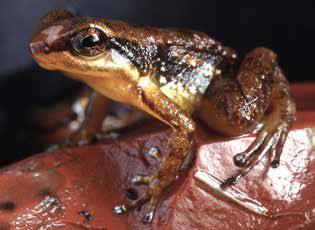 Cueva Del Fantasma Rocket FrogAnomaloglossus breweri
-
 La Escalera Rocket FrogAnomaloglossus parkerae
-
 Degranville's Rocket FrogAnomaloglossus degranvillei
-
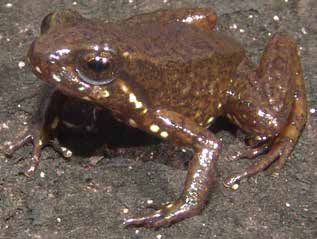 Chimantá Poison FrogAnomaloglossus rufulus
Compare
Questions and answers
What is the scientific name of the Stephen's Rocket Frog?
The scientific name of the Stephen's Rocket Frog is Anomaloglossus stepheni. Written with its author, the full name is Anomaloglossus stepheni (Martins, 1989).
Which family does the Stephen's Rocket Frog belong to?
Anomaloglossus stepheni belongs to the family Aromobatidae, in the order Anura and the class Amphibia.
Where is the Stephen's Rocket Frog found?
Checklists and occurrence records place Anomaloglossus stepheni in 3 countries: Brazil, Suriname and French Guiana.
What is the conservation status of the Stephen's Rocket Frog?
The IUCN Red List category recorded for Anomaloglossus stepheni is Least Concern (LC).
Sources
Passages the profile rests on
- Males measure approximately 14–17 mm from snout to vent. Source passage: “Males measure about 14–17 millimetres (0.55–0.67 in) from snout to vent” — English Wikipedia
- Females measure approximately 16–18 mm from snout to vent. Source passage: “females about 16–18 mm (0.63–0.71 in)” — English Wikipedia
- The frog's general coloration is brown. Source passage: “Its general colour is some shade of brown” — English Wikipedia
- A dark stripe runs along each side of the body for approximately half its length. Source passage: “it has a dark stripe running down either side extending about halfway along the body.” — English Wikipedia
- Bluish-white specks occur below the dark stripes and on the toes. Source passage: “There are bluish-white specks below this and on the toes.” — English Wikipedia
- Males have a white or grey vocal sac. Source passage: “The male has a white or grey vocal sac” — English Wikipedia
- Females have a pale throat. Source passage: “the female a pale throat.” — English Wikipedia
- In Brazil, the species occurs in the Amazon rainforest. Source passage: “in the Amazon rainforest of Brazil” — English Wikipedia
- The species is widespread in the Adolfo Ducke Forest Reserve near the confluence of the Rio Negro and Solimões River. Source passage: “where it is widespread in the Adolfo Ducke Forest Reserve near the confluence of the Rio Negro and Solimões River.” — English Wikipedia
- The species is active during the day and lives on the ground. Source passage: “is a diurnal, terrestrial species” — English Wikipedia
- The species spends its life in forest litter. Source passage: “spending its life in forest litter” — English Wikipedia
- The species feeds on invertebrates, including termites, beetles and flies. Source passage: “where it forages on invertebrates such as termites, beetles and flies.” — English Wikipedia
- Males call to attract females after finding a suitable location. Source passage: “The male finds a suitable location and calls to attract a female.” — English Wikipedia
- Males defend their territories by driving away intruding males. Source passage: “He is territorial and drives off male intruders” — English Wikipedia
- Males seldom move farther than 20 cm from the nest. Source passage: “seldom goes further than 20 centimetres (7.9 in) from the nest” — English Wikipedia
- Females remain at the nest for approximately one hour after laying eggs before departing. Source passage: “and remains at the nest for about an hour. After that she departs” — English Wikipedia
- Males return to the nest after females depart and guard the eggs. Source passage: “the male returns and guards the eggs.” — English Wikipedia
- Males remain near the nest while tadpoles develop. Source passage: “continuing to remain nearby as the tadpoles develop.” — English Wikipedia
- Breeding occurs during the rainy season. Source passage: “Breeding takes place in the rainy season.” — English Wikipedia
- The nesting site consists of a curled, boat-shaped fallen leaf covered by another leaf that serves as a roof. Source passage: “The nesting site is a boat-shaped curled up fallen leaf with another above acting as a roof.” — English Wikipedia
- Females lay between three and six eggs inside the hollow nesting leaf, each enclosed in a gelatinous capsule. Source passage: “The female lays three to six eggs with gelatinous capsules inside the hollow leaf” — English Wikipedia
- Multiple females may lay eggs in the same nest, resulting in several developing clutches of different ages. Source passage: “Further females are encouraged to lay inside the nest which may come to have several developing clutches of eggs of different ages.” — English Wikipedia
- The developing larvae complete their development on land rather than being transported to water. Source passage: “The developing larvae are not transported to water, as is the case with the related dendrobatids, but complete their development on land.” — English Wikipedia
- Metamorphosis into juvenile frogs occurs after approximately 31 days. Source passage: “Metamorphosis into juvenile frogs occurs after about 31 days.” — birdnet.cornell.edu
- The species is listed as Least Concern on the IUCN Red List of Threatened Species. Source passage: “Colostethus stepheni is listed as being of "Least Concern" in the IUCN Red List of Threatened Species.” — English Wikipedia
- The species' population appears to be stable. Source passage: “the population appears to be stable.” — English Wikipedia
- The species is assumed to have a large population and a wide geographical range. Source passage: “It is assumed to have a large population and wide range” — English Wikipedia
Data
- Catalogue of Life, 2026-10-16 XR cc by
- Global Biodiversity Information Facility CC BY 4.0
- Wikidata CC0
- GeoNames CC BY 4.0
- Wikimedia Commons per image; credit shown with each image
- Within the Catalogue of Life, this name comes from The Integrated Taxonomic Information System cc0
This species in other databases
Page built on 28 November 2026. See how the catalog is made and all sources and licences.
Cite this page
ScientificNames.org. (2026). Anomaloglossus stepheni (Stephen's Rocket Frog). Retrieved November 28, 2026, from https://scientificnames.org/species/anomaloglossus-stepheni
“Anomaloglossus stepheni (Stephen's Rocket Frog).” ScientificNames.org, 2026, scientificnames.org/species/anomaloglossus-stepheni. Accessed 28 Nov. 2026.
ScientificNames.org. “Anomaloglossus stepheni (Stephen's Rocket Frog).” Accessed November 28, 2026. https://scientificnames.org/species/anomaloglossus-stepheni.
@misc{scientificnames_anomaloglossus_stepheni_stephens_rocket_frog,
  author = {{ScientificNames.org}},
  title = {Anomaloglossus stepheni (Stephen's Rocket Frog)},
  year = {2026},
  url = {https://scientificnames.org/species/anomaloglossus-stepheni},
  note = {Accessed 2026-11-28}
}