Species · Mammals
Tailed Tailless Bat Anoura caudifer
The scientific name of the Tailed Tailless Bat is Anoura caudifer. It is a species of mammal in the family Phyllostomidae (new world leaf-nosed bats), order Chiroptera. The name dates from 1818.
- Scientific name
- Anoura caudifer (E. Geoffroy, 1818)
- Common name
- Tailed Tailless Bat
- Genus
- Anoura
- Family
- Phyllostomidae (New World Leaf-nosed Bats)
- Order
- Chiroptera
- Class
- Mammalia
- Red List category
- LC Least Concern
- Recorded in
- 10 countries
- Name status
- accepted in the Catalogue of Life

Overview
Anoura caudifer inhabits tropical forests on both sides of the Andes, at elevations reaching 1,500 m. It has an elongated, extensible tongue that can reach approximately 3 cm and normally has a very short tail embedded in the uropatagium.
Written 26 November 2026 from the sources listed below. Each statement was checked against the passage it cites; statements that could not be supported were removed.
Appearance
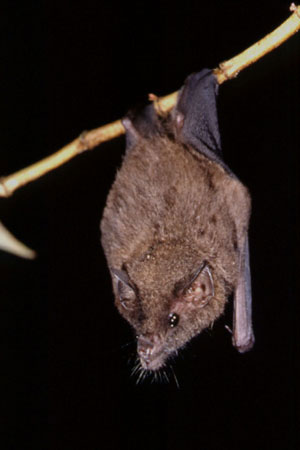
The species has silky, dark-brown fur covering its body and parts of its wings and upper arms. Some individuals have paler, often reddish patches on their upper back, neck, and head.[1][2]
The hairless portions of the wing membranes are dark brown or black. The upper lip has a small, narrow nose-leaf and is otherwise smooth.[3][4]
The species has a relatively long and narrow head, an elongated, extensible tongue, and relatively small ears that are widely separated and lack an antitragus. The tongue can extend to approximately 3 cm.[5][6][7]
The species normally has a very short tail embedded in the uropatagium, although some individuals have no tail.[8][9]
Its total head-and-body length is 4.7–7.0 cm. Adults weigh approximately 8.5–13 g, and the tail measures approximately 3–7 mm.[10][11][12]
Habitat
The species inhabits tropical forests on both sides of the Andes and occurs at elevations reaching 1,500 m.[13][14]
Daytime roosts include caves, tree hollows, and some human-made structures.[15]
Diet
The species consumes flower nectar using its long tongue. It also eats small beetles, bugs, and lepidopterans.[16][17]
Behaviour
The species is nocturnal. Colonies more commonly contain between five and fifteen individuals, although they can contain as many as 100.[18][19][20]
The species commonly shares larger roosts with other bat species. It requires at least four hours of feeding each night.[21][22]
The species has a measured metabolic rate of 28 ml O2 per hour. It can maintain its body temperature in relatively cool weather.[23][24]
Reproduction and life cycle
The breeding season varies across the species' geographic range and remains uncertain. Studies have generally recorded fertile adults between August and November, during the rainy season.[25][26]
Individuals are generally infertile outside the August–November period, although exceptions occur. The species probably breeds only once annually.[27][28]
Females give birth to a single offspring.[29]
Similar species
The equatorial tailless bat was distinguished from the Tailed Tailless Bat in 2006.[30]
Classification of the Tailed Tailless Bat
| Kingdom | Animalia |
|---|---|
| Phylum | Chordata |
| Subphylum | Vertebrata |
| Infraphylum | Gnathostomata |
| Parvphylum | Osteichthyes |
| Megaclass | Tetrapoda |
| Class | Mammalia (Mammal) |
| Subclass | Theria |
| Infraclass | Eutheria |
| Order | Chiroptera (Bat) |
| Suborder | Yangochiroptera |
| Superfamily | Noctilionoidea |
| Family | Phyllostomidae (New World Leaf-nosed Bats) |
| Subfamily | Glossophaginae |
| Tribe | Choeronycterini (Tailless Bats) |
| Subtribe | Anourina (Tailless Bats) |
| Genus | Anoura (Tailless Bats) |
| Species | Anoura caudifer (E. Geoffroy, 1818) |
Where the Tailed Tailless Bat is found
Checklists and occurrence records place Anoura caudifer in 10 countries across South America. GBIF holds 2,853 georeferenced records of it.
Countries
- Argentina 20
- Bolivia 41
- Brazil 1,520
- Colombia 582
- Ecuador 155
- French Guiana 43
- Guyana 102
- Peru 215
- Suriname 22
- Venezuela 153
Regions and cities with the most records
- São Paulo, Brazil 256
- Minas Gerais, Brazil 250
- Espírito Santo, Brazil 117
- Santa Catarina, Brazil 71
- Rio de Janeiro, Brazil 66
- Valle del Cauca Department, Colombia 57
- Goiás, Brazil 50
- Antioquia, Colombia 45
- Caquetá, Colombia 45
- Amazonas, Brazil 44
- Santa Teresa, Brazil 39
- Cuzco Department, Peru 37
- Guapiara, Brazil 37
- Cuyuni-Mazaruni, Guyana 36
- Paraná, Brazil 36
- Potaro-Siparuni, Guyana 36
- Zamora Chinchipe, Ecuador 35
- Caldas Department, Colombia 34
- Juquiá, Brazil 33
- Tolima Department, Colombia 33
- Cundinamarca, Colombia 31
- Huila Department, Colombia 31
- Bolívar, Venezuela 30
- Risaralda Department, Colombia 30
- Barinas, Venezuela 29
- Barinitas, Venezuela 29
- Cariacica, Brazil 29
- Orellana Province, Ecuador 28
- Ucayali, Peru 28
- Manaus, Brazil 27
- Nariño, Colombia 26
- Blumenau, Brazil 25
- Gaspar, Brazil 25
- Guarulhos, Brazil 25
- Mato Grosso, Brazil 25
- Vila Galvão, Brazil 25
1 more country has a few records outside this range
These countries hold a few records of Anoura caudifer but lie outside the range the checklists give for it. Such records are often zoo or garden specimens, museum material or vagrants, so the species is not counted as occurring there.
Range as the checklists state it
South America
A number beside a place is its count of GBIF occurrence records. A place without a number comes from a checklist alone. Records show where a species has been observed or collected, which can include escapes and vagrants.
Common names
English
- Tailed Tailless Bat
Names in 6 other languages
- Finnish
- pikkuhännätönleikko
- French
- Anoura des tunnels
- German
- Geschwänzte Langnasenfledermaus
- Japanese
- コロンビアハナナガヘラコウモリ
- Polish
- Brakogonek ogoniasty
- Spanish
- Murcielaguito hocicudo, Murciélago trompudo cocolo
Synonyms
4 other scientific names have been used for this species and are now treated as synonyms of Anoura caudifer.
- Anoura caudifera (E. Geoffroy, 1818)
- Anoura caudifera (Geoffroy Saint-Hilaire, 1818)
- Glossophaga caudifer E. Geoffroy, 1818
- Glossophaga caudifer Geoffroy Saint-Hilaire, 1818
Related species
- Tube-lipped Nectar BatAnoura fistulata
-
 Geoffroy's Tailless BatAnoura geoffroyi
-
 Tschudi's Tailless BatAnoura peruana
-
 Handley's Tailless BatAnoura cultrata
- Ecuadorian Tailless BatAnoura aequatoris
-
 Broad-toothed Tailless BatAnoura latidens
- Cadena's Tailless BatAnoura cadenai
- Luis Manuel's Tailless BatAnoura luismanueli
Compare
Questions and answers
What is the scientific name of the Tailed Tailless Bat?
The scientific name of the Tailed Tailless Bat is Anoura caudifer. Written with its author, the full name is Anoura caudifer (E. Geoffroy, 1818).
Which family does the Tailed Tailless Bat belong to?
Anoura caudifer belongs to the family Phyllostomidae, in the order Chiroptera and the class Mammalia.
Where is the Tailed Tailless Bat found?
Checklists and occurrence records place Anoura caudifer in 10 countries, including Brazil, Colombia, Peru, Ecuador, Venezuela and Guyana.
What is the conservation status of the Tailed Tailless Bat?
The IUCN Red List category recorded for Anoura caudifer is Least Concern (LC).
Sources
Passages the profile rests on
- The species has silky, dark-brown fur covering its body and parts of its wings and upper arms. Source passage: “It has silky, dark-brown hair covering the body and parts of the wings and upper arms.” — English Wikipedia
- Some individuals have paler, often reddish patches on their upper back, neck, and head. Source passage: “Some individuals have paler, often reddish, patches on the upper back, and extending onto the back of the neck and head.” — English Wikipedia
- The hairless portions of the wing membranes are dark brown or black. Source passage: “The hairless parts of the wing membranes are dark brown or black in color.” — English Wikipedia
- The upper lip has a small, narrow nose-leaf and is otherwise smooth. Source passage: “A small, narrow, nose-leaf is found on the upper lip, which is otherwise smooth.” — English Wikipedia
- The species has a relatively long and narrow head and an elongated, extensible tongue. Source passage: “The head is relatively long and narrow, and the tongue is long and extensible” — English Wikipedia
- The tongue can extend to approximately 3 cm. Source passage: “reaching up to 3 cm (1.2 in).” — English Wikipedia
- The species has relatively small ears that are widely separated and lack an antitragus. Source passage: “the ears are relatively small and widely separated, and lack an antitragus.” — English Wikipedia
- The species normally has a very short tail embedded in the uropatagium. Source passage: “this is very short, only 3 to 7 mm (0.1 to 0.3 in) in length, and does not reach beyond the edge of the uropatagium (membrane between the legs), in which it is embedded.” — English Wikipedia
- Some individuals have no tail. Source passage: “Some individuals, however, have no tail at all” — English Wikipedia
- The species has a total head-and-body length of 4.7–7.0 cm. Source passage: “with a total head and body length of 4.7 to 7.0 cm (1.9 to 2.8 in)” — English Wikipedia
- Adults weigh approximately 8.5–13 g. Source passage: “weighing just 8.5 to 13 g (0.30 to 0.46 oz).” — English Wikipedia
- The species' tail measures approximately 3–7 mm. Source passage: “only 3 to 7 mm (0.1 to 0.3 in) in length” — English Wikipedia
- The species inhabits tropical forests on both sides of the Andes. Source passage: “It inhabits tropical forests on both sides of the Andes” — English Wikipedia
- The species occurs in tropical forests at elevations reaching 1,500 m. Source passage: “at elevations up to 1,500 m (4,900 ft).” — English Wikipedia
- The species uses caves, tree hollows, and some human-made structures as daytime roosts. Source passage: “spending the day roosting in caves, tree hollows, and some man-made structures.” — English Wikipedia
- The species consumes flower nectar using its long tongue. Source passage: “using their long tongues to lap nectar from flowers” — English Wikipedia
- The species also eats small beetles, bugs, and lepidopterans. Source passage: “but also eating some small beetles, bugs, and lepidopterans.” — English Wikipedia
- The species is nocturnal. Source passage: “The tailed tailless bat is nocturnal” — English Wikipedia
- Colonies can contain as many as 100 individuals. Source passage: “Colonies can contain up to 100 individuals” — English Wikipedia
- Colonies more commonly contain between five and fifteen individuals. Source passage: “although more typically they range from just five to 15 individuals.” — English Wikipedia
- The species commonly shares larger roosts with other bat species. Source passage: “it typically shares its larger roosts with other species” — English Wikipedia
- The species requires at least four hours of feeding each night. Source passage: “they require a high calorific intake for their size, and must spend at least four hours every night feeding.” — English Wikipedia
- The species has a measured metabolic rate of 28 ml O2 per hour. Source passage: “having been measured at 28 ml O2/h.” — English Wikipedia
- The species can maintain its body temperature in relatively cool weather. Source passage: “they are able to maintain their body temperatures even in relatively cool weather” — English Wikipedia
- The breeding season varies across the species' geographic range and remains uncertain. Source passage: “The exact breeding season of tailed tailless bats is unclear, and may vary across its range.” — English Wikipedia
- Studies have generally recorded fertile adults between August and November, during the rainy season. Source passage: “Studies have generally found fertile adults between August and November, during the rainy season” — English Wikipedia
- Individuals are generally infertile outside the August–November period, although exceptions occur. Source passage: “and infertile individuals at other times of the year, although with some exceptions.” — English Wikipedia
- The species probably breeds only once annually. Source passage: “Tailed tailless bats probably only breed once a year” — English Wikipedia
- Females give birth to a single offspring. Source passage: “giving birth to a single offspring.” — English Wikipedia
- The equatorial tailless bat was distinguished from this species in 2006. Source passage: “the equatorial tailless bat, was only distinguished from A. caudifer in 2006.” — English Wikipedia
Data
- Catalogue of Life, 2026-10-16 XR cc by
- Global Biodiversity Information Facility CC BY 4.0
- Wikidata CC0
- GeoNames CC BY 4.0
- Wikimedia Commons per image; credit shown with each image
- Within the Catalogue of Life, this name comes from The Integrated Taxonomic Information System cc0
References
- Mem. Mus. Natn. Hist. Nat. Paris vol.4 p.418 where the name was published
- Wilson, Don E., and F. Russell Cole. (2000). Common Names of Mammals of the World.
- Simmons, Nancy B. / Wilson, Don E., and DeeAnn M. Reeder, eds. (2005). Order Chiroptera. Mammal Species of the World: A Taxonomic and Geographic Reference, 3rd Ed., Vols. 1 & 2.
- Mantilla-Meluk, Hugo, and Robert J. Baker. (2006). Systematics of small Anoura (Chiroptera: Phyllostomidae) from Colombia, with description of a new species. Occasional Papers of the Museum of Texas Tech University, No. 261.
- Mantilla-Meluk, Hugo, and Robert J. Baker. (2010). New species of Anoura (Chiroptera: Phyllostomidae) from Colombia, with systematic remarks and notes on the distribution of the A. geoffroyi complex. Occasional Papers of the Museum of Texas Tech University, No. 292.
- Wilson, D. E., and R. A. Mittermeier, eds. (2019). Handbook of the Mammals of the World. Vol. 9: Bats.
This species in other databases
Page built on 27 November 2026. See how the catalog is made and all sources and licences.
Cite this page
ScientificNames.org. (2026). Anoura caudifer (Tailed Tailless Bat). Retrieved November 27, 2026, from https://scientificnames.org/species/anoura-caudifer
“Anoura caudifer (Tailed Tailless Bat).” ScientificNames.org, 2026, scientificnames.org/species/anoura-caudifer. Accessed 27 Nov. 2026.
ScientificNames.org. “Anoura caudifer (Tailed Tailless Bat).” Accessed November 27, 2026. https://scientificnames.org/species/anoura-caudifer.
@misc{scientificnames_anoura_caudifer_tailed_tailless_bat,
  author = {{ScientificNames.org}},
  title = {Anoura caudifer (Tailed Tailless Bat)},
  year = {2026},
  url = {https://scientificnames.org/species/anoura-caudifer},
  note = {Accessed 2026-11-27}
}