Species · Birds
Magpie Goose Anseranas semipalmata
The scientific name of the Magpie Goose is Anseranas semipalmata. It is a species of bird in the family Anseranatidae (magpie goose), order Anseriformes. The name dates from 1798.
- Scientific name
- Anseranas semipalmata (Latham, 1798)
- Common name
- Magpie Goose
- Genus
- Anseranas
- Family
- Anseranatidae (Magpie Goose)
- Order
- Anseriformes
- Class
- Aves
- Red List category
- LC Least Concern
- Environment
- freshwater, terrestrial
- Recorded in
- 2 countries
- Name status
- accepted in the Catalogue of Life
Overview
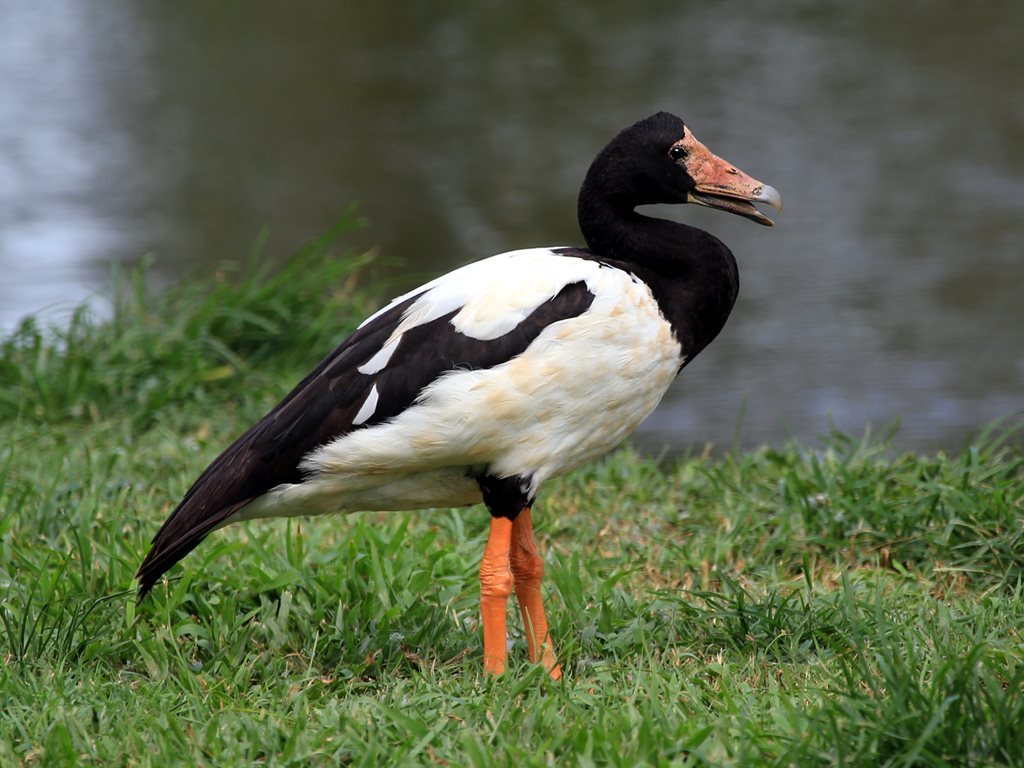
Anseranas semipalmata occurs in northern Australia and southern New Guinea. It has black-and-white plumage, partially webbed feet, and a noticeable knob on its head.
Written 26 November 2026 from the sources listed below. Each statement was checked against the passage it cites; statements that could not be supported were removed.
Appearance
The Magpie Goose has black-and-white plumage in both sexes, a long neck, long legs, and a hooked bill. Its legs and feet are orange.[1][2]
The head, neck, tail, and wings are black, while the remaining body is white. Its feet are partially webbed, and it has a noticeable knob on its head.[3][4]
Juveniles lack the head knob and have grayer rather than white body markings.[5]
Adult males measure 75–90 cm in length and weigh an average of 2.76 kg. Adult females measure 70–80 cm in length and weigh an average of 2.07 kg.[6][7][8][9]
The species has a wingspan of 130–180 cm and a body mass ranging from 2 to 3 kg.[10][11]
Habitat
The Magpie Goose inhabits open wetlands, including floodplains, swamps, wet grasslands, and coastal marshlands. It swims and wades in these wetlands and may roost in wooded areas.[12][13][14][15]
Diet
The Magpie Goose mainly eats swamp grass seeds, dry grass blades, and spike-rush bulbs. It also consumes large quantities of wild rice.[16][17][18]
Although mainly herbivorous, it occasionally ingests small invertebrates. During the dry season, it relies primarily on roots and bulbs, while during the wet season it can switch to grass as its main food.[19][20][21]
Behaviour
The Magpie Goose is not truly migratory and is relatively sedentary, although it sometimes travels long distances to find food and water. Its movements include seasonal travel between areas during wet and dry periods.[22][23][24]
Outside the breeding season, it forms large, noisy flocks that sometimes number several thousand individuals. It communicates using loud honking calls.[25][26]
During the dry season, the species generally concentrates near the Mary River and South Alligator River. During the wet season, it may disperse to other rivers for breeding.[27][28]
The species may shake its wings when threatened or following antagonistic encounters.[29]
Reproduction and life cycle
The Magpie Goose breeds colonially, with breeding groups commonly consisting of one male and two females. The two females in a breeding trio are usually related to each other.[30][31][32]
Breeding is seasonal and takes place at the end of the wet season, between February and June.[33]
Clutch size is reported as three to eight eggs, with typical clutch size also reported as five to nine eggs. Eggs measure 64–84 mm in length and 46–63 mm in width.[34][35][36]
The incubation period ranges from 24 to 35 days. Both parents and the additional female in breeding trios share incubation and care of the young.[37][38]
Young typically fledge at approximately three months of age. Sexual maturity occurs at approximately two years of age.[39][40]
Conservation
The Magpie Goose is considered least concern on the IUCN Red List and is not considered threatened across Australia as a whole. It is listed as endangered in Victoria and South Australia and vulnerable in New South Wales.[41][42][43][44]
The species was formerly widespread in southern Australia but disappeared from much of that region. Most southern populations were eliminated during the mid-twentieth century through overhunting and habitat destruction.[45][46]
Uses
The Magpie Goose is hunted by humans for food and sport. It is an important seasonal food source for Aboriginal people.[47][48]
Classification of the Magpie Goose
| Kingdom | Animalia |
|---|---|
| Phylum | Chordata |
| Subphylum | Vertebrata |
| Infraphylum | Gnathostomata |
| Parvphylum | Osteichthyes |
| Megaclass | Tetrapoda |
| Class | Aves (Bird) |
| Order | Anseriformes (Ducks) |
| Family | Anseranatidae (Magpie Goose) |
| Genus | Anseranas (Magpie Geese) |
| Species | Anseranas semipalmata (Latham, 1798) |
Where the Magpie Goose is found
Checklists and occurrence records place Anseranas semipalmata in 2 countries across Oceania. GBIF holds 206,539 georeferenced records of it.
Countries
Regions and cities with the most records
- Northern Territory, Australia 106,806
- Queensland, Australia 68,667
- New South Wales, Australia 9,553
- Victoria, Australia 9,467
- Townsville, Australia 9,354
- Brisbane, Australia 9,279
- Palmerston, Australia 8,633
- Darwin, Australia 8,193
- Capalaba, Australia 7,979
- South Australia, Australia 6,170
- Cairns, Australia 5,308
- Geelong, Australia 4,433
- Logan City, Australia 3,979
- Western Australia, Australia 3,628
- Narangba, Australia 2,949
- Newcastle, Australia 2,804
- Gold Coast, Australia 2,457
- Bundaberg, Australia 2,090
- Mackay, Australia 1,462
- Frankston East, Australia 1,360
- Hervey Bay, Australia 821
- Burwood, Australia 806
- Sunshine Coast, Australia 751
- Rockhampton, Australia 635
- Gympie, Australia 634
- Warrnambool, Australia 592
- Ballarat, Australia 511
- Torquay, Australia 506
- Maitland, Australia 504
- Wollongong, Australia 443
- Grafton, Australia 427
- Gladstone, Australia 404
- Caloundra, Australia 350
- Griffith, Australia 244
- Port Macquarie, Australia 233
- Maryborough, Australia 162
6 more countries have a few records outside this range
These countries hold a few records of Anseranas semipalmata but lie outside the range the checklists give for it. Such records are often zoo or garden specimens, museum material or vagrants, so the species is not counted as occurring there.
Range as the checklists state it
Australia
A number beside a place is its count of GBIF occurrence records. A place without a number comes from a checklist alone. Records show where a species has been observed or collected, which can include escapes and vagrants.
Common names
English
- Magpie Goose
- Magpie-Goose
Names in 33 other languages
- Arabic
- أوز الثرثار, أوز العقعق, وزة خرجاء
- Catalan
- oca garsera
- Chinese
- 鵲鵝, 鹊雁
- Croatian
- dugonoga guska
- Czech
- husovec strakatý
- Danish
- Skadegås
- Dutch
- Ekstergans
- Esperanto
- Anseranasedoj, piga ansero
- Estonian
- harakhani
- Finnish
- puuhanhi
- French
- Canaroie semipalmée
- German
- Spaltfußgans
- Hebrew
- אווז עורבני
- Hungarian
- ujjas lúd
- Icelandic
- Skjógæs
- Indonesian
- Boha wasur
- Italian
- Oca gazza
- Japanese
- カササギガン
- Lithuanian
- Skeltapėdės žąsys, ančiažąsė
- Norwegian
- skjæregås
- Polish
- bezpłetwiec
- Portuguese
- Ganso-da-Oceania, ganso-alvinegro, ganso-pega
- Russian
- Полулапчатый гусь
- Serbian
- Svrakasta guska
- Slovak
- husiarka strakatá
- Spanish
- Ganso urraca, Ganso urraco
- Swedish
- skatgås
- Turkish
- Avustralyalı Kazsı, Saksağankazı
- Ukrainian
- урако
- Welsh
- gwydd fraith
- fry
- Spaltpoatguozzen
- kgs
- jinamurrin
- xdk
- nuwalgang
Synonyms
4 other scientific names have been used for this species and are now treated as synonyms of Anseranas semipalmata.
- Anas melanoleuca Latham, J, 1801
- Anas semipalmata Latham, 1798
- Anseranas melanoleuca
- Anseranas semipalmata hamiltoni Mathews, GM, 1912
Questions and answers
What is the scientific name of the Magpie Goose?
The scientific name of the Magpie Goose is Anseranas semipalmata. Written with its author, the full name is Anseranas semipalmata (Latham, 1798).
Which family does the Magpie Goose belong to?
Anseranas semipalmata belongs to the family Anseranatidae, in the order Anseriformes and the class Aves.
Where is the Magpie Goose found?
Checklists and occurrence records place Anseranas semipalmata in 2 countries: Australia and Papua New Guinea.
What is the conservation status of the Magpie Goose?
The IUCN Red List category recorded for Anseranas semipalmata is Least Concern (LC).
What other names does the Magpie Goose have?
Anseranas semipalmata is also known in English as Magpie-Goose.
What do magpies eat?
The Magpie Goose mainly consumes swamp grass seeds, dry grass blades, and spike-rush bulbs. It also eats large quantities of wild rice and occasionally ingests small invertebrates.[17][18][19]
Where do magpie goose live?
The Magpie Goose occurs in northern Australia and southern New Guinea. It inhabits open wetlands, including floodplains, swamps, wet grasslands, and coastal marshlands.[12][13][49]
Are magpies carnivores or omnivores?
The Magpie Goose is mainly herbivorous but occasionally ingests small invertebrates.[19]
Are geese carnivores, herbivores, or omnivores?
The Magpie Goose is mainly herbivorous, although it occasionally eats small invertebrates.[19]
Sources
Passages the profile rests on
- The species has black-and-white plumage in both sexes, with a long neck, long legs, and a hooked bill. Source passage: “The magpie goose has black-and-white plumage in both sexes, with a long neck and legs and a long hooked bill.” — English Wikipedia
- The species has orange legs and feet. Source passage: “Its legs and feet are orange.” — English Wikipedia
- The head, neck, tail, and wings are black, while the remaining body is white. Source passage: “Magpie geese are black on the head, neck, tail, and wings. The rest of the body is white, with orange feet and legs.” — animaldiversity.org
- The species has partially webbed feet and a noticeable knob on its head. Source passage: “Magpie geese have only partially webbed feet and the head has a fairly obvious "knob" on it.” — animaldiversity.org
- Juveniles lack the head knob and have grayer rather than white body markings. Source passage: “Juveniles lack this "knob" and the white areas on their bodies are more gray.” — animaldiversity.org
- Adult males measure 75–90 cm in length. Source passage: “The males are 75–90 cm (30–35 in) in length” — English Wikipedia
- Adult females measure 70–80 cm in length. Source passage: “The female is smaller, being 70–80 cm (28–31 in) in length” — English Wikipedia
- Adult males weigh an average of 2.76 kg. Source passage: “weigh 2.76 kg (6.1 lb) on average.” — English Wikipedia
- Adult females weigh an average of 2.07 kg. Source passage: “weighing 2.07 kg (4.6 lb).” — English Wikipedia
- The species has a wingspan of 130–180 cm. Source passage: “The wingspan of this bird spans 130–180 cm (4.3–5.9 ft).” — English Wikipedia
- The species has a body mass ranging from 2 to 3 kg. Source passage: “Their body mass varies between 2 and 3 kg and their length ranges from 70 to 90 cm.” — animaldiversity.org
- The species inhabits open wetlands, including floodplains and swamps. Source passage: “The magpie goose is found in a variety of open wetland areas such as floodplains and swamps” — English Wikipedia
- The species commonly inhabits wet grasslands, swamps, and coastal marshlands. Source passage: “Most magpie geese are found in wet grasslands, swamps, and other marshlands along the coast and rarely stray inland.” — animaldiversity.org
- The species swims and wades in the wetlands it inhabits. Source passage: “These geese swim and wade in the swamps and wetlands they inhabit.” — animaldiversity.org
- The species may roost in wooded areas. Source passage: “They may roost in wooded areas.” — animaldiversity.org
- The species eats dry grass blades, grass seeds, spike-rush bulbs, and wild rice. Source passage: “They eat mostly vegetation such as dry grass blades, grass seeds, spike rush bulbs and wild rice.” — English Wikipedia
- The species mainly consumes swamp grass seeds, dry grass blades, and spike-rush bulbs. Source passage: “Magpie geese mainly eat swamp grass seeds, blades of dry grasses, and bulbs of spike-rush.” — animaldiversity.org
- The species consumes large quantities of wild rice. Source passage: “They also eat large quantities of wild rice.” — animaldiversity.org
- The species occasionally ingests small invertebrates despite being mainly herbivorous. Source passage: “Although they are mainly herbivores, they incidentally ingest occasional small invertebrates.” — animaldiversity.org
- During the dry season, the species relies primarily on roots and bulbs for food. Source passage: “During the dry season, magpie geese must rely on roots and bulbs as their primary source of food.” — animaldiversity.org
- During the wet season, the species can switch to grass as its main food. Source passage: “During the wet season, they can switch to grass as their main food.” — animaldiversity.org
- The species is not truly migratory but sometimes travels long distances to find food and water. Source passage: “The species is not truly migratory but it sometimes travels large distances to find food and water” — English Wikipedia
- The species is relatively sedentary except for some movements during the dry season. Source passage: “Magpie geese are fairly sedentary apart from some movement during the dry season.” — English Wikipedia
- The species is social and lives in flocks that travel between areas during seasonal wet and dry periods. Source passage: “These flocks travel together when migrating between areas during the wet and dry seasons.” — animaldiversity.org
- The species forms large, noisy flocks outside the breeding season, sometimes numbering several thousand individuals. Source passage: “when they can form large and noisy flocks of up to a few thousand individuals.” — English Wikipedia
- The species communicates using loud honking calls. Source passage: “Magpie geese communicate vocally with loud "honks."” — animaldiversity.org
- During the dry season, the species generally concentrates near the Mary River and South Alligator River. Source passage: “During the dry season, magpie geese generally concentrate near the Mary River and the South Alligator River.” — animaldiversity.org
- During the wet season, the species may disperse to other rivers for breeding. Source passage: “During the wet season, they may spread to other rivers for breeding.” — animaldiversity.org
- The species may shake its wings when threatened or following antagonistic encounters. Source passage: “These geese may shake their wings when feeling threatened or after antagonistic encounters.” — animaldiversity.org
- The species breeds colonially. Source passage: “They are colonial breeders” — English Wikipedia
- Breeding groups commonly consist of one male and two females. Source passage: “Each group of three consists of a male and two females.” — animaldiversity.org
- The two females in a breeding trio are usually related to each other. Source passage: “In each trio, the two females are usually related to each other.” — animaldiversity.org
- The species breeds seasonally at the end of the wet season, between February and June. Source passage: “They breed seasonally at the end of the wet season (February-June) in the floodplains that they live in.” — animaldiversity.org
- Clutch size is reported as three to eight eggs. Source passage: “Magpie geese clutch size is between 3 and 8 eggs.” — animaldiversity.org
- Typical clutch size is reported as five to nine eggs. Source passage: “Their typical clutch is between five and nine eggs.” — English Wikipedia
- Eggs measure 64–84 mm in length and 46–63 mm in width. Source passage: “Eggs measure 64–84 mm (2.5–3.3 in) in length and 46–63 mm (1.8–2.5 in) in width” — English Wikipedia
- The incubation period ranges from 24 to 35 days. Source passage: “The incubation period varies from 24-35 days” — animaldiversity.org
- Both parents and the additional female in trios share incubation and care of the young. Source passage: “Both parents (and the second female when in trios) care for the young.” — animaldiversity.org
- Young typically fledge at approximately three months of age. Source passage: “fledgling occurs after about 3 months.” — animaldiversity.org
- Sexual maturity occurs at approximately two years of age. Source passage: “Sexual maturity occurs at approximately 2 years of age.” — animaldiversity.org
- The species is not considered threatened across Australia as a whole. Source passage: “For Australia as a whole, it is not threatened” — English Wikipedia
- The species is considered least concern on the IUCN Red List. Source passage: “They are considered "least concern" by the IUCN red list.” — animaldiversity.org
- The species is listed as endangered in Victoria and South Australia. Source passage: “Magpie geese are listed as "endangered" in Victoria and South Australia” — animaldiversity.org
- The species is listed as vulnerable in New South Wales. Source passage: “"vulnerable" in New South Wales.” — animaldiversity.org
- The species was formerly widespread in southern Australia but disappeared from much of that region. Source passage: “The species was once also widespread in southern Australia but disappeared from there largely due to the drainage of the wetlands where the birds once bred.” — English Wikipedia
- Most southern populations were eliminated during the mid-twentieth century through overhunting and habitat destruction. Source passage: “most of the southern populations were extirpated in the mid-20th century by overhunting and habitat destruction.” — English Wikipedia
- The species is hunted by humans for food and sport. Source passage: “Humans hunt magpie geese for sport and for food.” — animaldiversity.org
- The species is an important seasonal food source for Aboriginal people. Source passage: “their importance to Aboriginal people as a seasonal food source” — English Wikipedia
- The species occurs in northern Australia and southern New Guinea. Source passage: “This waterbird is found in northern Australia and southern New Guinea.” — English Wikipedia
Data
- Catalogue of Life, 2026-10-16 XR cc by
- Global Biodiversity Information Facility CC BY 4.0
- Wikidata CC0
- GeoNames CC BY 4.0
- iNaturalist per image; credit shown with each image
- Within the Catalogue of Life, this name comes from The Integrated Taxonomic Information System cc0
References
- Dickinson, Edward C., ed. (2003). The Howard and Moore Complete Checklist of the Birds of the World, 3rd Edition.
- Gill, Frank, & and Minturn Wright. (2006). Birds of the World: Recommended English Names.
- Dickinson, E. C., and J. V. Remsen Jr., eds. (2013). The Howard and Moore Complete Checklist of the Birds of the World, 4th Edition, Vol. 1 Non-Passerines.
This species in other databases
- Catalogue of Life 66XX5
- Wikidata Q212937
- iNaturalist 6905
- WoRMS urn:lsid:marinespecies.org:taxname:1594609
- Avibase maggoo1
Page built on 27 November 2026. See how the catalog is made and all sources and licences.
Cite this page
ScientificNames.org. (2026). Anseranas semipalmata (Magpie Goose). Retrieved November 27, 2026, from https://scientificnames.org/species/anseranas-semipalmata
“Anseranas semipalmata (Magpie Goose).” ScientificNames.org, 2026, scientificnames.org/species/anseranas-semipalmata. Accessed 27 Nov. 2026.
ScientificNames.org. “Anseranas semipalmata (Magpie Goose).” Accessed November 27, 2026. https://scientificnames.org/species/anseranas-semipalmata.
@misc{scientificnames_anseranas_semipalmata_magpie_goose,
  author = {{ScientificNames.org}},
  title = {Anseranas semipalmata (Magpie Goose)},
  year = {2026},
  url = {https://scientificnames.org/species/anseranas-semipalmata},
  note = {Accessed 2026-11-27}
}