Species · Mammals
Dusky Antechinus Antechinus swainsonii
The scientific name of the Dusky Antechinus is Antechinus swainsonii. It is a species of mammal in the family Dasyuridae (carnivorous marsupials), order Dasyuromorphia. The name dates from 1840.
- Scientific name
- Antechinus swainsonii (Waterhouse, 1840)
- Common name
- Dusky Antechinus
- Genus
- Antechinus
- Family
- Dasyuridae (Carnivorous Marsupials)
- Order
- Dasyuromorphia
- Class
- Mammalia
- Red List category
- LC Least Concern
- Recorded in
- 1 country
- Name status
- accepted in the Catalogue of Life

Overview
Antechinus swainsonii occurs in south-eastern Australia and Tasmania. It is the largest species of antechinus and has fur ranging from dark gray to black.
Written 26 November 2026 from the sources listed below. Each statement was checked against the passage it cites; statements that could not be supported were removed.
Appearance
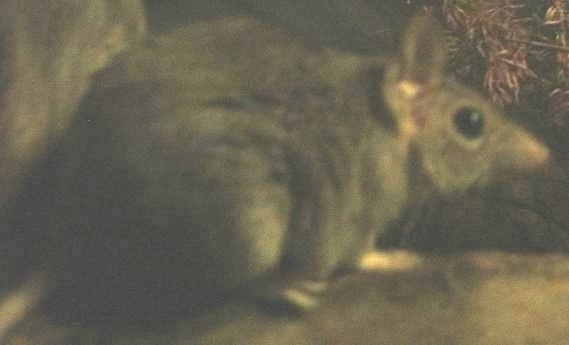
The Dusky Antechinus has fur ranging in colour from dark gray to black. It can be distinguished from related antechinuses by its darker fur, including in its pale form.[1][2]
The largest and darkest-furred individuals occur at higher altitudes.[3]
Habitat
The Dusky Antechinus commonly inhabits moist sclerophyll forests and rainforests on mainland Australia and Tasmania. It also inhabits fields overgrown with tall grasses and favours habitats with dense understory vegetation.[4][5][6]
It occurs in alpine heath and tall open forest with a dense understorey in mountainous regions. Individuals construct nests from eucalypt leaves in hollow tree trunks or dense forest-floor understory.[7][8]
Diet
The Dusky Antechinus feeds primarily on soil invertebrates, including worms and insects. It has also been observed eating lizards, small birds, fruit and vegetation.[9][10][11]
It occasionally eats small lizards and skinks. Individuals have been estimated to consume approximately 60% of their body weight during winter.[12][13]
Behaviour
The Dusky Antechinus is primarily nocturnal. Captive individuals have been observed active both during the day and at night.[14][15]
Adults are solitary, with social interactions occurring during mating and between mothers and their young. Individuals maintain home ranges but are not territorial.[16][17]
The species is unusually vocal for an antechinus and has been observed hissing and chattering. Males compete intensely for access to mates.[18][19]
Reproduction and life cycle
The breeding season occurs between May and September. Gestation lasts between 29 and 36 days, and females have eight teats.[20][21][22]
Litter size ranges from six to eight young. Newborn young average 4.5 mm in length and are bright pink.[23][24][25]
Young begin developing fur at approximately eight weeks of age and begin eating solid food at approximately 12 weeks. They are completely weaned by approximately 14 weeks of age.[26][27][28]
Individuals reach full maturity at approximately eight months of age. Males generally die shortly after copulation.[29][30]
Conservation
The Dusky Antechinus is not considered threatened. Controlled burning and replacing native forests with pine plantations have reduced some local populations.[31][32][33]
Domestic cats are identified as a serious predation threat. The red fox is believed to have detrimental effects on local populations.[34][35]
Uses
The Dusky Antechinus helps regulate soil invertebrate populations through its feeding activity.[36]
Classification of the Dusky Antechinus
| Kingdom | Animalia |
|---|---|
| Phylum | Chordata |
| Subphylum | Vertebrata |
| Infraphylum | Gnathostomata |
| Parvphylum | Osteichthyes |
| Megaclass | Tetrapoda |
| Class | Mammalia (Mammal) |
| Subclass | Theria |
| Infraclass | Metatheria |
| Order | Dasyuromorphia |
| Family | Dasyuridae (Carnivorous Marsupials) |
| Subfamily | Dasyurinae |
| Tribe | Phascogalini |
| Genus | Antechinus (Antechinuses) |
| Species | Antechinus swainsonii (Waterhouse, 1840) |
Where the Dusky Antechinus is found
Checklists and occurrence records place Antechinus swainsonii in 1 country across Oceania. GBIF holds 627 georeferenced records of it.
Countries
Regions and cities with the most records
- Tasmania, Australia 270
- New South Wales, Australia 66
- Victoria, Australia 58
- Hobart, Australia 39
- South Australia, Australia 5
- Devonport, Australia 3
Range as the checklists state it
Australia
A number beside a place is its count of GBIF occurrence records. A place without a number comes from a checklist alone. Records show where a species has been observed or collected, which can include escapes and vagrants.
Common names
English
- Dusky Antechinus
- Tasmanian Dusky Antechinus
Names in 10 other languages
- Arabic
- أنتيكينوس تسمانيا الداكن
- Dutch
- Donkere Buidelmuis
- Finnish
- tummapussipeto
- German
- Dunkle Breitfußbeutelmaus, Swainson-Breitfußbeutelmaus
- Italian
- Antechino scuro
- Japanese
- ツメナガアンテキヌス
- Norwegian Bokmål
- Svart Pungspissekorn
- Polish
- chutliwiec ciemny
- Russian
- Сумчатая мышь Свайнсона
- Spanish
- Antequino Oscuro de Tasmania, Antequino bruno Antequino de Swanson
Synonyms
One other scientific name has been used for this species and is now treated as a synonym of Antechinus swainsonii.
- Phascogale swainsonii Waterhouse, 1840
Subspecies and varieties
- Antechinus swainsonii swainsonii subspecies
Related species
-
 Brown AntechinusAntechinus stuartii
-
 Yellow-footed AntechinusAntechinus flavipes
-
 Agile AntechinusAntechinus agilis
-
 Swamp AntechinusAntechinus minimus
-
 Tropical AntechinusAntechinus adustus
-
 Fawn AntechinusAntechinus bellus
- Cinnamon AntechinusAntechinus leo
- Atherton AntechinusAntechinus godmani
Compare
Questions and answers
What is the scientific name of the Dusky Antechinus?
The scientific name of the Dusky Antechinus is Antechinus swainsonii. Written with its author, the full name is Antechinus swainsonii (Waterhouse, 1840).
Which family does the Dusky Antechinus belong to?
Antechinus swainsonii belongs to the family Dasyuridae, in the order Dasyuromorphia and the class Mammalia.
Where is the Dusky Antechinus found?
Checklists and occurrence records place Antechinus swainsonii in 1 country: Australia.
What is the conservation status of the Dusky Antechinus?
The IUCN Red List category recorded for Antechinus swainsonii is Least Concern (LC).
What other names does the Dusky Antechinus have?
Antechinus swainsonii is also known in English as Tasmanian Dusky Antechinus.
What is antechinus known for?
The Dusky Antechinus is unusually vocal for an antechinus and has been observed hissing and chattering. Males compete intensely for access to mates and generally die shortly after copulation.[18][19][30]
Is the antechinus endangered?
The Dusky Antechinus is not considered threatened.[31]
Sources
Passages the profile rests on
- The Dusky Antechinus has fur ranging in colour from dark gray to black. Source passage: “A. swainsonii range in color from dark gray to black.” — animaldiversity.org
- The species can be distinguished from related antechinuses by its darker fur, including in its pale form. Source passage: “It can be distinguished from its relatives by its much darker fur, which is also apparent in the pale form.” — English Wikipedia
- The largest and darkest-furred individuals occur at higher altitudes. Source passage: “The largest and darkest fur Dusky Antechinus occur in higher altitudes.” — English Wikipedia
- The species commonly inhabits moist sclerophyll forests and rainforests on mainland Australia and Tasmania. Source passage: “A. swainsonii are most commonly found in the moist sclerophyll forests and rainforests of the Australian mainland and Tasmania.” — animaldiversity.org
- The species also inhabits fields overgrown with tall grasses. Source passage: “A. swainsonii have also been found to inhabit fields overgrown with high grasses” — animaldiversity.org
- The species favours habitats with dense understory vegetation. Source passage: “but favor any habitat with a dense understory” — animaldiversity.org
- The species occurs in alpine heath and tall open forest with a dense understorey in mountainous regions. Source passage: “where they are found in alpine heath or tall open forest with a dense understorey.” — English Wikipedia
- Individuals construct nests from eucalypt leaves in hollow tree trunks or dense forest-floor understory. Source passage: “A. swainsonii construct nests from eucalypt leaves that are balled up in hollow tree trunks or in the dense understory of the forest floor” — animaldiversity.org
- The species feeds primarily on soil invertebrates. Source passage: “A. swainsonii feed mostly on soil invertebrates” — animaldiversity.org
- Its diet includes worms and insects. Source passage: “Along with worms and insects they have been observed eating lizards, small birds, fruit and vegetation” — animaldiversity.org
- The species has been observed eating lizards, small birds, fruit and vegetation. Source passage: “they have been observed eating lizards, small birds, fruit and vegetation” — animaldiversity.org
- The species occasionally eats small lizards and skinks. Source passage: “although it will occasionally devour small lizards and skinks.” — English Wikipedia
- Individuals have been estimated to consume approximately 60% of their body weight during winter. Source passage: “some individuals have been estimated to eat about 60% of their body weight during the winter months” — animaldiversity.org
- The Dusky Antechinus is primarily nocturnal. Source passage: “A. swainsonii are nocturnal.” — animaldiversity.org
- Captive individuals have been observed active both during the day and at night. Source passage: “In captivity however, individuals were observed to be active day and night” — animaldiversity.org
- Adults are solitary, with social interactions occurring during mating and between mothers and their young. Source passage: “Fully developed adults are solitary with social interactions occurring during mating and between mother and young.” — animaldiversity.org
- Individuals maintain home ranges but are not territorial. Source passage: “Members of the species seem to have a definite home range, but are not territorial.” — animaldiversity.org
- The species is unusually vocal for an antechinus and has been observed hissing and chattering. Source passage: “The dusky antechinus is also known for being unusually vocal for an antechinus, and has been observed hissing and chattering.” — English Wikipedia
- Males compete intensely for access to mates. Source passage: “Competition for mates is extremely high among males.” — animaldiversity.org
- The breeding season occurs between May and September. Source passage: “Females breed once, sometime between May and September” — animaldiversity.org
- Gestation lasts between 29 and 36 days. Source passage: “Gestation lasts 29-36 days.” — animaldiversity.org
- Females have eight teats. Source passage: “A sexually mature female has eight teats” — animaldiversity.org
- Litter size ranges from six to eight young. Source passage: “litter size ranges from 6-8 young” — animaldiversity.org
- Newborn young average 4.5 mm in length. Source passage: “Young average 4.5mm in length at birth” — animaldiversity.org
- Newborn young are bright pink. Source passage: “The young are bright pink at birth” — animaldiversity.org
- Young begin developing fur at approximately eight weeks of age. Source passage: “begin to develop fur at 8 weeks” — animaldiversity.org
- Young begin eating solid food at approximately 12 weeks of age. Source passage: “begin to eat solid food at 12 weeks.” — animaldiversity.org
- Young are completely weaned by approximately 14 weeks of age. Source passage: “By the 14th week the young are completely weaned” — animaldiversity.org
- Individuals reach full maturity at approximately eight months of age. Source passage: “fully mature around 8 months” — animaldiversity.org
- Males generally die shortly after copulation. Source passage: “males die shortly after copulation” — animaldiversity.org
- The species is not considered threatened. Source passage: “The species is not threatened” — English Wikipedia
- Controlled burning has reduced some local populations. Source passage: “local populations have been reduced by controlled burning” — English Wikipedia
- Replacing native forests with pine plantations has reduced some local populations. Source passage: “the instigation of pine plantations in the place of native forests.” — English Wikipedia
- Domestic cats are identified as a serious predation threat to the species. Source passage: “Domestic cats are the only serious threat of predation to A. swainsonii” — animaldiversity.org
- The red fox is believed to have detrimental effects on local populations. Source passage: “The cat and the red fox are also believed to be detrimental to local populations.” — English Wikipedia
- The species helps regulate soil invertebrate populations through its feeding activity. Source passage: “A. swainsonii help control the population of soil invertebrates with their voracious appetites.” — animaldiversity.org
- The Dusky Antechinus is the largest species of antechinus. Source passage: “The dusky antechinus is the largest antechinus.” — English Wikipedia
- Adult males average 65 grams in weight, while adult females average 41 grams. Source passage: “Males and females are sexually dimorphic with an average weight of 65 grams for males, and 41 grams for females” — animaldiversity.org
- Males can reach 130 grams and females can reach 70 grams in weight. Source passage: “Males have been reported to reach 130 grams and females 70 grams” — animaldiversity.org
- The average head and body length is 128 mm. Source passage: “The average head and body length of A. swainsonii is 128mm” — animaldiversity.org
- The average tail length is 116 mm. Source passage: “the average tail length is 116mm” — animaldiversity.org
Data
- Catalogue of Life, 2026-10-16 XR cc by
- Global Biodiversity Information Facility CC BY 4.0
- Wikidata CC0
- GeoNames CC BY 4.0
- Wikimedia Commons per image; credit shown with each image
- Within the Catalogue of Life, this name comes from The Integrated Taxonomic Information System cc0
References
- Mag. Nat. Hist. [Charlesworth's] vol.4 p.299 where the name was published
- Nowak, Ronald M. (1991). Walker’s Mammals of the World, Vol. 1, 5th Ed.
- Wilson, Don E., and DeeAnn M. Reeder, eds. (1993). Mammal Species of the World: A Taxonomic and Geographic Reference, 2nd Ed., 3rd Printing.
- Wilson, Don E., and DeeAnn M. Reeder, eds. (2005). Mammal Species of the World: A Taxonomic and Geographic Reference, 3rd Ed., Vols. 1 & 2.
- Clayton, Mark, John C. Wombey, Ian J. Mason, R. Terry Chesser, and Alice Wells, eds. (2006). CSIRO List of Australian Vertebrates: A Reference with Conservation Status, 2nd Ed.
- Baker, Andrew W., Thomas Y. Mutton, and Harry B. Hines. (2013). A new dasyurid marsupial from Kroombit Tops, south-east Queensland, Australia: the Silver-headed Antechinus, Antechinus argentus sp. nov. (Marsupialia: Dasyuridae). Zootaxa, Vol. 3746. Link
- Wilson, Don E., and Russell A. Mittermeier, eds. (2015). Handbook of the Mammals of the World, Vol. 5. Monotremes and Marsupials.
- Burgin, Connor J., Don E. Wilson, Russell A. Mittermeier, Anthony B. Rylands, et al. (2020). Illustrated Checklist of the Mammals of the World. Vol. 1. Monotremata to Rodentia.
This species in other databases
Page built on 29 November 2026. See how the catalog is made and all sources and licences.
Cite this page
ScientificNames.org. (2026). Antechinus swainsonii (Dusky Antechinus). Retrieved November 29, 2026, from https://scientificnames.org/species/antechinus-swainsonii
“Antechinus swainsonii (Dusky Antechinus).” ScientificNames.org, 2026, scientificnames.org/species/antechinus-swainsonii. Accessed 29 Nov. 2026.
ScientificNames.org. “Antechinus swainsonii (Dusky Antechinus).” Accessed November 29, 2026. https://scientificnames.org/species/antechinus-swainsonii.
@misc{scientificnames_antechinus_swainsonii_dusky_antechinus,
  author = {{ScientificNames.org}},
  title = {Antechinus swainsonii (Dusky Antechinus)},
  year = {2026},
  url = {https://scientificnames.org/species/antechinus-swainsonii},
  note = {Accessed 2026-11-29}
}