Species · Birds
Alpine Pipit Anthus gutturalis
The scientific name of the Alpine Pipit is Anthus gutturalis. It is a species of bird in the family Motacillidae (pipits), order Passeriformes. The name dates from 1894.
- Scientific name
- Anthus gutturalis De Vis, 1894
- Common name
- Alpine Pipit
- Genus
- Anthus
- Family
- Motacillidae (Pipits)
- Order
- Passeriformes
- Class
- Aves
- Red List category
- LC Least Concern
- Recorded in
- 2 countries
- Name status
- accepted in the Catalogue of Life
Overview
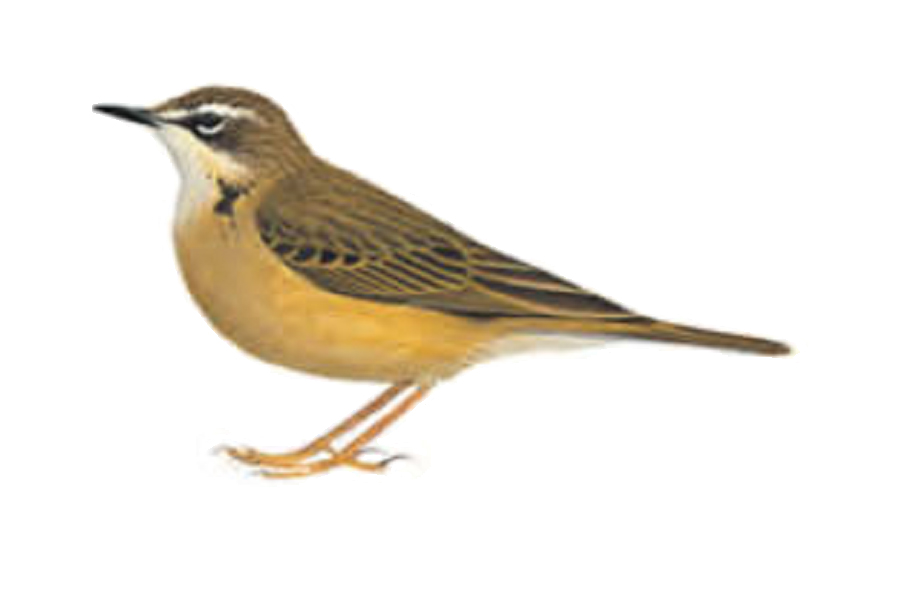
The Alpine Pipit is a medium-sized bird. It inhabits alpine grasslands at elevations of approximately 3,200–4,500 metres in Papua New Guinea. It has a light brown back and wings with tan-colored feather tips and a strongly tan-colored chest.
Written 26 November 2026 from the sources listed below. Each statement was checked against the passage it cites; statements that could not be supported were removed.
Appearance
The Alpine Pipit has a light brown back and wings with tan-colored feather tips. Its chest is strongly tan-colored, and it has a thin, pointed beak.[1][2][3]
It has medium-length red legs and long-toed feet.[4]
Habitat
The Alpine Pipit inhabits alpine grasslands in Papua New Guinea, generally at elevations of approximately 3,200–4,500 metres. It sometimes descends to mountains at elevations of approximately 2,500 metres.[5][6]
It is often found near shrubs and short grass.[7]
Diet
The Alpine Pipit eats insects and their larvae. Its diet also includes arthropods, grass seeds, berries, and green herbaceous matter.[8][9]
Behaviour
The Alpine Pipit forages on the ground while waddling and sometimes forages in groups. When threatened, it flies to rocks, bushes, or trees along forest edges.[10][11][12]
While scavenging, it sometimes holds its bill at a 45-degree angle toward the sky.[13]
The Alpine Pipit sings while flying just above the ground. Its song consists of repeated, high-pitched sounds described as "tsee tsee".[14][15]
The Alpine Pipit remains in the same locations throughout the year rather than migrating for breeding.[16]
Reproduction and life cycle
The Alpine Pipit breeds during the wet season in April, September, and October.[17]
Its nests are constructed from fine grass and located on steep banks. Single nestlings have been recorded during its breeding season.[18][19][20]
Conservation
The Alpine Pipit is classified as Least Concern globally. The IUCN Red List lists the species as Least Concern, with its most recent assessment conducted in 2024.[21][22][23]
Its population trend is stable. Its restricted distribution does not appear to affect its population.[24][25]
Classification of the Alpine Pipit
| Kingdom | Animalia |
|---|---|
| Phylum | Chordata |
| Subphylum | Vertebrata |
| Infraphylum | Gnathostomata |
| Parvphylum | Osteichthyes |
| Megaclass | Tetrapoda |
| Class | Aves (Bird) |
| Order | Passeriformes (Passerine) |
| Family | Motacillidae (Pipits) |
| Genus | Anthus (Pipit) |
| Species | Anthus gutturalis De Vis, 1894 |
Where the Alpine Pipit is found
Checklists and occurrence records place Anthus gutturalis in 2 countries. GBIF holds 514 georeferenced records of it.
Countries
Regions and cities with the most records
- Chimbu Province, Papua New Guinea 224
- Papua, Indonesia 222
- Oro Province, Papua New Guinea 24
- Wamena, Indonesia 14
- Hela Province, Papua New Guinea 10
- Eastern Highlands Province, Papua New Guinea 4
- Central Province, Papua New Guinea 3
- Western Highlands Province, Papua New Guinea 3
A number beside a place is its count of GBIF occurrence records. A place without a number comes from a checklist alone. Records show where a species has been observed or collected, which can include escapes and vagrants.
Common names
English
- Alpine Pipit
Names in 27 other languages
- Catalan
- piula de Nova Guinea
- Chinese
- 斑喉鷚, 斑喉鹨
- Croatian
- novogvinejska trepteljka
- Czech
- linduška papuánská
- Danish
- Papuapiber
- Dutch
- Papoeapieper
- Esperanto
- novgvinea pipio
- Estonian
- paapua kiur
- Finnish
- papuankirvinen
- French
- Pipit de Nouvelle-Guinée
- German
- Papua-Pieper, Papuapieper
- Hungarian
- pápua pityer
- Indonesian
- Apung papua
- Italian
- Pispola alpina
- Japanese
- パプアタヒバリ
- Lithuanian
- Naujosios Gvinėjos kalviukas
- Norwegian
- papuapiplerke
- Polish
- świergotek górski
- Portuguese
- petinha-da-papua, petinha-papua
- Russian
- Очковый конёк
- Serbian
- Novozelandska trepteljka
- Slovak
- ľabtuška okuliarnatá
- Spanish
- Bisbita Papúa, Bisbita papú
- Swedish
- papuapiplärka
- Turkish
- Papua İncirkuşu
- Ukrainian
- щеврик новогвінейський
- Welsh
- corhedydd Papwa
Subspecies and varieties
- Anthus gutturalis gutturalis subspecies
- Anthus gutturalis rhododendri subspecies
- Anthus gutturalis wollastoni subspecies
Related species
-
 Meadow PipitAnthus pratensis
-
 American PipitAnthus rubescens
-
 Tree PipitAnthus trivialis
-
 Water PipitAnthus spinoletta
-
 Tawny PipitAnthus campestris
-
 European Rock PipitAnthus petrosus
-
 South Georgia PipitAnthus antarcticus
-
 Richard's PipitAnthus richardi
Compare
Questions and answers
What is the scientific name of the Alpine Pipit?
The scientific name of the Alpine Pipit is Anthus gutturalis. Written with its author, the full name is Anthus gutturalis De Vis, 1894.
Which family does the Alpine Pipit belong to?
Anthus gutturalis belongs to the family Motacillidae, in the order Passeriformes and the class Aves.
Where is the Alpine Pipit found?
Checklists and occurrence records place Anthus gutturalis in 2 countries: Papua New Guinea and Indonesia.
What is the conservation status of the Alpine Pipit?
The IUCN Red List category recorded for Anthus gutturalis is Least Concern (LC).
Sources
Passages the profile rests on
- The Alpine Pipit has a light brown back and wings with tan-colored feather tips. Source passage: “It has a light brown back and wings with tan colored tips to its back feathers.” — English Wikipedia
- The Alpine Pipit has a strongly tan-colored chest. Source passage: “Its chest is a strong tan color” — English Wikipedia
- The Alpine Pipit has a thin, pointed beak. Source passage: “The pipit has a skinny pointed beak.” — English Wikipedia
- The Alpine Pipit has medium-length red legs and long-toed feet. Source passage: “the bird has medium length red legs attached to long-toed pronged feet.” — English Wikipedia
- The Alpine Pipit lives in alpine grasslands at elevations of approximately 3,200–4,500 metres in Papua New Guinea. Source passage: “It lives in alpine grassland at the highest part of the mountain ranges in Papua New Guinea. These mountains are from 3200m to 4500m high” — English Wikipedia
- The Alpine Pipit sometimes descends to mountains at elevations of approximately 2,500 metres. Source passage: “sometimes the alpine pipit will go down to mountains 2500 m high.” — English Wikipedia
- The Alpine Pipit is often found near shrubs and short grass. Source passage: “The alpine pipit is often found near shrubs and short grass.” — English Wikipedia
- The Alpine Pipit eats insects and their larvae. Source passage: “Alpine pipits eats insects and their larvae.” — English Wikipedia
- The Alpine Pipit consumes arthropods, grass seeds, berries, and green herbaceous matter. Source passage: “Alpine pipit eat arthropods, grass seeds, berries and green herbaceous matter.” — English Wikipedia
- The Alpine Pipit forages on the ground while waddling. Source passage: “Alpine pipit forage on the ground, waddling” — English Wikipedia
- The Alpine Pipit sometimes forages in groups. Source passage: “will also forage in groups.” — English Wikipedia
- When threatened, the Alpine Pipit flies to rocks, bushes, or trees along forest edges. Source passage: “Alpine pipit fly up to rocks, bushes, or trees on the forest's edges when they are threatened.” — English Wikipedia
- The Alpine Pipit sometimes holds its bill at a 45-degree angle toward the sky while scavenging. Source passage: “Alpine pipits will also hold their bill at a 45-degree angle towards the sky while scavenging.” — English Wikipedia
- The Alpine Pipit sings while flying just above the ground. Source passage: “Alpine pipit sing when they are in flight right above the ground.” — English Wikipedia
- The Alpine Pipit's song consists of repeated, high-pitched sounds described as "tsee tsee". Source passage: “The alpine pipit's song sounds like "tsee tsee'' repeatedly. It is a high-pitched quick noise.” — English Wikipedia
- The Alpine Pipit remains in the same locations throughout the year rather than migrating for breeding. Source passage: “Alpine pipits do not migrate for breeding since they stay in the same locations all year round.” — English Wikipedia
- The Alpine Pipit breeds during the wet season in April, September, and October. Source passage: “Alpine pipit breed in the wet season during the months April, September, and October.” — English Wikipedia
- Alpine Pipit nests are constructed from fine grass. Source passage: “they are made up of fine grass” — English Wikipedia
- Alpine Pipit nests are located on steep banks. Source passage: “located on a steep bank.” — English Wikipedia
- The Alpine Pipit has been recorded with single nestlings during its breeding season. Source passage: “Their single nestlings have been found during this time” — English Wikipedia
- The Alpine Pipit is classified as Least Concern globally. Source passage: “The globally threat ranking is under the "Least Concern" category.” — English Wikipedia
- The Alpine Pipit was most recently assessed for the IUCN Red List in 2024. Source passage: “has most recently been assessed for The IUCN Red List of Threatened Species in 2024.” — iucnredlist.org
- The IUCN Red List lists the Alpine Pipit as Least Concern. Source passage: “Anthus gutturalis is listed as Least ...” — iucnredlist.org
- The Alpine Pipit's population trend is stable. Source passage: “as the population trend is stable.” — English Wikipedia
- The Alpine Pipit's restricted distribution does not appear to affect its population. Source passage: “this does not seem to effect the population” — English Wikipedia
Data
- Catalogue of Life, 2026-10-16 XR cc by
- Global Biodiversity Information Facility CC BY 4.0
- Wikidata CC0
- GeoNames CC BY 4.0
- Wikimedia Commons per image; credit shown with each image
- Within the Catalogue of Life, this name comes from The Integrated Taxonomic Information System cc0
References
- Gill, Frank, & and Minturn Wright. (2006). Birds of the World: Recommended English Names.
This species in other databases
Page built on 28 November 2026. See how the catalog is made and all sources and licences.
Cite this page
ScientificNames.org. (2026). Anthus gutturalis (Alpine Pipit). Retrieved November 28, 2026, from https://scientificnames.org/species/anthus-gutturalis
“Anthus gutturalis (Alpine Pipit).” ScientificNames.org, 2026, scientificnames.org/species/anthus-gutturalis. Accessed 28 Nov. 2026.
ScientificNames.org. “Anthus gutturalis (Alpine Pipit).” Accessed November 28, 2026. https://scientificnames.org/species/anthus-gutturalis.
@misc{scientificnames_anthus_gutturalis_alpine_pipit,
  author = {{ScientificNames.org}},
  title = {Anthus gutturalis (Alpine Pipit)},
  year = {2026},
  url = {https://scientificnames.org/species/anthus-gutturalis},
  note = {Accessed 2026-11-28}
}