Species · Birds
Wood Pipit Anthus nyassae
The scientific name of the Wood Pipit is Anthus nyassae. It is a species of bird in the family Motacillidae (pipits), order Passeriformes. The name dates from 1906.
- Scientific name
- Anthus nyassae Neumann, 1906
- Common name
- Wood Pipit
- Genus
- Anthus
- Family
- Motacillidae (Pipits)
- Order
- Passeriformes
- Class
- Aves
- Red List category
- LC Least Concern
- Recorded in
- 11 countries
- Name status
- accepted in the Catalogue of Life
Overview
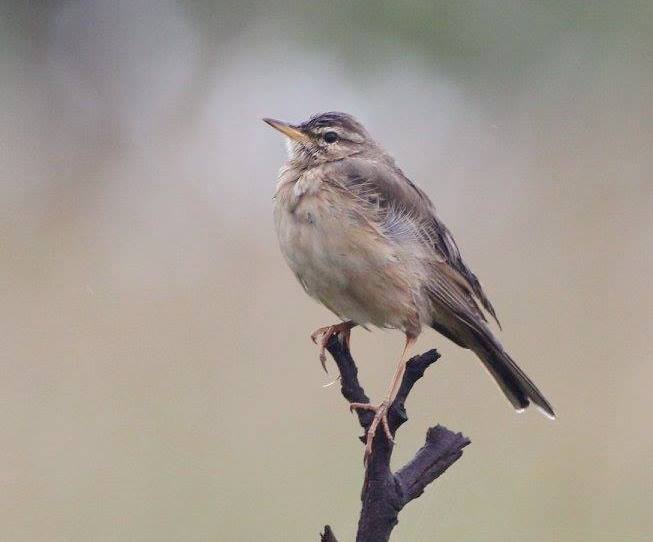
Anthus nyassae inhabits miombo woodland in south-central Africa. It has warm brown, dark-streaked upperparts, pale underparts and a dark eyestripe.
Written 27 November 2026 from the sources listed below. Each statement was checked against the passage it cites; statements that could not be supported were removed.
Appearance
The Wood Pipit measures 16–18 centimetres in length. Its upperparts are warm brown with dark streaks, while its underparts are pale with some streaking on the breast. It has a dark eyestripe, a white supercilium and pale outer tail-feathers.[1][2][3][4]
Juveniles have dark spots on their upperparts and more streaking on their underparts than adults.[5][6]
Habitat
The Wood Pipit inhabits miombo woodland in south-central Africa. Its range extends from south-east Gabon eastwards to southern and western Tanzania, and southwards to north-east Namibia, northern Botswana, Zimbabwe and north-west Mozambique.[7][8][9]
Diet
The Wood Pipit forages on the ground for invertebrates.[10]
Behaviour
When flushed, the Wood Pipit perches in trees. Its song is high-pitched and monotonous.[11][12]
Similar species
The Long-billed Pipit resembles the Wood Pipit but has a slightly longer bill and tail. It has a smaller pale area in its outer tail-feathers, and its voice is slightly lower.[13][14][15]
Classification of the Wood Pipit
| Kingdom | Animalia |
|---|---|
| Phylum | Chordata |
| Subphylum | Vertebrata |
| Infraphylum | Gnathostomata |
| Parvphylum | Osteichthyes |
| Megaclass | Tetrapoda |
| Class | Aves (Bird) |
| Order | Passeriformes (Passerine) |
| Family | Motacillidae (Pipits) |
| Genus | Anthus (Pipit) |
| Species | Anthus nyassae Neumann, 1906 |
Where the Wood Pipit is found
Checklists and occurrence records place Anthus nyassae in 11 countries across Africa. GBIF holds 1,520 georeferenced records of it.
Countries
- Angola 105
- Botswana 34
- Democratic Republic of the Congo 56
- Gabon 36
- Malawi 94
- Mozambique 10
- Namibia 42
- Republic of the Congo 9
- Tanzania 45
- Zambia 875
- Zimbabwe 214
Regions and cities with the most records
- Central Province, Zambia 189
- Southern Province, Zambia 146
- Lusaka Province, Zambia 139
- Ntandabale, Zambia 133
- Chisankane, Zambia 129
- Choma, Zambia 128
- Palabana, Zambia 125
- Madido, Zambia 120
- North-Western, Zambia 115
- Copperbelt, Zambia 113
- Muchinga, Zambia 110
- Mashonaland East Province, Zimbabwe 90
- Marondera, Zimbabwe 86
- Huambo, Angola 52
- Mashonaland Central, Zimbabwe 41
- Chingola, Zambia 40
- Chambishi, Zambia 39
- Western Province, Zambia 39
- Haut-Ogooué, Gabon 36
- Manicaland, Zimbabwe 29
- Kitwe, Zambia 26
- Londuimbali, Angola 22
- North-West, Botswana 22
- Haut-Katanga, Democratic Republic of the Congo 19
- Machipanda, Mozambique 19
- Mutare, Zimbabwe 19
- Kwanza Sul, Angola 18
- Lusaka, Zambia 18
- Kinshasa, Democratic Republic of the Congo 17
- Mashonaland West, Zimbabwe 17
- Iringa, Tanzania 16
- Masvingo Province, Zimbabwe 13
- Chobe, Botswana 12
- Ndiyona, Namibia 12
- Lualaba, Democratic Republic of the Congo 9
- Mbeya, Tanzania 9
A number beside a place is its count of GBIF occurrence records. A place without a number comes from a checklist alone. Records show where a species has been observed or collected, which can include escapes and vagrants.
Common names
English
- Wood Pipit
- WOPI
- Woodland Pipit
Names in 26 other languages
- Afrikaans
- Miombokoester (Boskoester)
- Bulgarian
- Дървесна бъбрица
- Catalan
- piula boscana
- Chinese
- 林地長嘴鷚, 林地鹨
- Croatian
- šumska trepteljka
- Czech
- linduška malawijská
- Danish
- Malawipiber
- Dutch
- Bospieper
- Esperanto
- arbara pipio
- Estonian
- miombokiur
- Finnish
- afrikanmetsäkirvinen
- French
- Pipit forestier
- German
- Waldlandpieper
- Italian
- Pispola boschereccia
- Japanese
- アンゴラタヒバリ
- Lithuanian
- afrikinis miškinis kalviukas
- Norwegian
- miombopiplerke
- Polish
- świergotek brązowy
- Portuguese
- petinha-das-matas, petinha-do-niassa
- Russian
- Древесный конёк
- Slovak
- ľabtuška lesná
- Spanish
- Bisbita de Nyasa, Bisbita del Nyasa
- Swedish
- miombopiplärka
- Turkish
- Orman İncirkuşu
- Ukrainian
- щеврик ангольський
- Welsh
- corhedydd y coetir
Synonyms
3 other scientific names have been used for this species and are now treated as synonyms of Anthus nyassae.
- Anthus nicholsoni nyassae Neumann, OR, 1906
- Anthus nyansae Neumann, OR, 1906
- Anthus similis nyassae Neumann, OR, 1906
Subspecies and varieties
- Anthus nyassae chersophilus subspecies
- Anthus nyassae frondicolus subspecies
- Anthus nyassae nyassae subspecies
- Anthus nyassae schoutedeni subspecies
Related species
-
 Meadow PipitAnthus pratensis
-
 American PipitAnthus rubescens
-
 Tree PipitAnthus trivialis
-
 Water PipitAnthus spinoletta
-
 Tawny PipitAnthus campestris
-
 European Rock PipitAnthus petrosus
-
 South Georgia PipitAnthus antarcticus
-
 Richard's PipitAnthus richardi
Compare
Questions and answers
What is the scientific name of the Wood Pipit?
The scientific name of the Wood Pipit is Anthus nyassae. Written with its author, the full name is Anthus nyassae Neumann, 1906.
Which family does the Wood Pipit belong to?
Anthus nyassae belongs to the family Motacillidae, in the order Passeriformes and the class Aves.
Where is the Wood Pipit found?
Checklists and occurrence records place Anthus nyassae in 11 countries, including Zambia, Zimbabwe, Angola, Malawi, Democratic Republic of the Congo and Tanzania.
What is the conservation status of the Wood Pipit?
The IUCN Red List category recorded for Anthus nyassae is Least Concern (LC).
What other names does the Wood Pipit have?
Anthus nyassae is also known in English as WOPI and Woodland Pipit.
Sources
Passages the profile rests on
- The Wood Pipit measures 16–18 centimetres in length. Source passage: “It is 16-18 centimetres long.” — English Wikipedia
- The Wood Pipit's upperparts are warm brown with dark streaks. Source passage: “The upperparts are warm brown with dark streaks” — English Wikipedia
- The Wood Pipit's underparts are pale and have some streaking on the breast. Source passage: “the underparts are pale with some streaking on the breast.” — English Wikipedia
- The Wood Pipit has a dark eyestripe, a white supercilium and pale outer tail-feathers. Source passage: “The bird has a dark eyestripe, white supercilium and pale outer tail-feathers.” — English Wikipedia
- Juvenile Wood Pipits have dark spots on their upperparts. Source passage: “Juveniles have dark spots above” — English Wikipedia
- Juvenile Wood Pipits have more streaking on their underparts than adults. Source passage: “have more streaking below than the adults.” — English Wikipedia
- The Wood Pipit inhabits miombo woodland in south-central Africa. Source passage: “It is a bird of miombo woodland in south-central Africa” — English Wikipedia
- The Wood Pipit's range extends from south-east Gabon eastwards to southern and western Tanzania. Source passage: “The range of the wood pipit extends from south-east Gabon eastwards to southern and western Tanzania” — English Wikipedia
- The Wood Pipit's range extends southwards to north-east Namibia, northern Botswana, Zimbabwe and north-west Mozambique. Source passage: “and southwards as far as north-east Namibia, northern Botswana, Zimbabwe and north-west Mozambique.” — English Wikipedia
- The Wood Pipit forages on the ground for invertebrates. Source passage: “forages on the ground for invertebrates.” — English Wikipedia
- The Wood Pipit perches in trees when flushed. Source passage: “It perches in trees when flushed” — English Wikipedia
- The Wood Pipit's song is high-pitched and monotonous. Source passage: “The bird's song is high-pitched and monotonous.” — English Wikipedia
- The Long-billed Pipit resembles the Wood Pipit but has a slightly longer bill and tail. Source passage: “The long-billed pipit is very similar but has a slightly longer bill and tail” — English Wikipedia
- The Long-billed Pipit has a smaller pale area in its outer tail-feathers than the Wood Pipit. Source passage: “a smaller pale area in the outer tail-feathers” — English Wikipedia
- The Long-billed Pipit's voice is slightly lower than the Wood Pipit's. Source passage: “and a slightly lower voice.” — English Wikipedia
Data
- Catalogue of Life, 2026-10-16 XR cc by
- Global Biodiversity Information Facility CC BY 4.0
- Wikidata CC0
- GeoNames CC BY 4.0
- Wikimedia Commons per image; credit shown with each image
- Within the Catalogue of Life, this name comes from The Integrated Taxonomic Information System cc0
References
- Gill, Frank, & and Minturn Wright. (2006). Birds of the World: Recommended English Names.
This species in other databases
Page built on 27 November 2026. See how the catalog is made and all sources and licences.
Cite this page
ScientificNames.org. (2026). Anthus nyassae (Wood Pipit). Retrieved November 27, 2026, from https://scientificnames.org/species/anthus-nyassae
“Anthus nyassae (Wood Pipit).” ScientificNames.org, 2026, scientificnames.org/species/anthus-nyassae. Accessed 27 Nov. 2026.
ScientificNames.org. “Anthus nyassae (Wood Pipit).” Accessed November 27, 2026. https://scientificnames.org/species/anthus-nyassae.
@misc{scientificnames_anthus_nyassae_wood_pipit,
  author = {{ScientificNames.org}},
  title = {Anthus nyassae (Wood Pipit)},
  year = {2026},
  url = {https://scientificnames.org/species/anthus-nyassae},
  note = {Accessed 2026-11-27}
}