Species · Insects
Black-banded Hairstreak Antigius attilia
The scientific name of the Black-banded Hairstreak is Antigius attilia. It is a species of insect in the family Lycaenidae (blues), order Lepidoptera. The name dates from 1861.
- Scientific name
- Antigius attilia (Bremer, 1861)
- Common name
- Black-banded Hairstreak
- Genus
- Antigius
- Family
- Lycaenidae (Blues)
- Order
- Lepidoptera
- Class
- Insecta
- Recorded in
- 4 countries
- Name status
- accepted in the Catalogue of Life

Overview
Antigius attilia occurs in Japan, the Korean Peninsula, the Russian Far East, northern, central and western China, and Taiwan. It has black-brown upper wing surfaces, greyish-white undersides and thin black hindwing tails measuring 3–4 millimetres.
Written 27 November 2026 from the sources listed below. Each statement was checked against the passage it cites; statements that could not be supported were removed.
Appearance
Adults have a wingspan of 14–16 millimetres. The upper surfaces of the wings are black-brown in both sexes, with uniformly coloured upper wing surfaces in males.[1][2][3]
Females have one or two chains of faint whitish submarginal spots along the outer edge of the upper hindwings. The undersides are greyish-white, with black marginal spots and a brown transverse stripe.[4][5]
The forewing has a rectangular spot with distinct edges at the apex of its central cell. The posterior corner of each hindwing has two pairs of small orange-black spots, and the hindwings bear thin black tails measuring 3–4 millimetres in length.[6][7][8]
Habitat
The species occurs in Japan, the Korean Peninsula, the Russian Far East, northern, central and western China, and Taiwan.[9]
The subspecies Antigius attilia tropicanus is recorded from Myanmar, Antigius attilia yamanakashoji from Japan, and Antigius attilia obsoletus from Taiwan.[10][11][12]
Diet
The larvae feed on Quercus serrata. The subspecies Antigius attilia yamanakashoji has also been recorded feeding on Quercus acutissima.[13][14]
Classification of the Black-banded Hairstreak
| Kingdom | Animalia |
|---|---|
| Phylum | Arthropoda |
| Subphylum | Hexapoda |
| Class | Insecta (Insect) |
| Order | Lepidoptera |
| Superfamily | Papilionoidea |
| Family | Lycaenidae (Blues) |
| Subfamily | Theclinae |
| Tribe | Theclini |
| Genus | Antigius |
| Species | Antigius attilia (Bremer, 1861) |
Where the Black-banded Hairstreak is found
Checklists and occurrence records place Antigius attilia in 4 countries. GBIF holds 1,007 georeferenced records of it.
Countries
Regions and cities with the most records
- Komae, Japan 50
- Azamino, Japan 49
- Machida, Japan 49
- Minamirinkan, Japan 49
- Noborito, Japan 49
- Chōfu, Japan 48
- Hokkaido, Japan 46
- Nishi-Tokyo-shi, Japan 45
- Higashimurayama, Japan 44
- Fuchū, Japan 43
- Higashikurume, Japan 43
- Kokubunji, Japan 43
- Kunitachi, Japan 43
- Musashino, Japan 43
- Tama, Japan 43
- Inagi, Japan 42
- Tachikawa, Japan 42
- Aichi, Japan 41
- Hino, Japan 41
- Kodaira, Japan 41
- Koganei, Japan 41
- Nagakute, Japan 39
- Seto, Japan 39
- Nisshin, Japan 38
- Kamiigusa, Japan 37
- Sekimachi-minami, Japan 37
- Toyota, Japan 37
- Yamato, Japan 37
- Miyoshi, Japan 36
- Morowa, Japan 36
- Kiyose, Japan 35
- Kanagawa, Japan 34
- Zama, Japan 34
- Minawa, Japan 33
- Den’enchōfu, Japan 32
- Higashiyamato, Japan 32
1 more country has a few records outside this range
These countries hold a few records of Antigius attilia but lie outside the range the checklists give for it. Such records are often zoo or garden specimens, museum material or vagrants, so the species is not counted as occurring there.
A number beside a place is its count of GBIF occurrence records. A place without a number comes from a checklist alone. Records show where a species has been observed or collected, which can include escapes and vagrants.
Common names
English
- Black-banded Hairstreak
Names in 4 other languages
- Chinese
- 折線灰蝶, 水色長尾小灰蝶, 淡青小灰蝶, 淡青灰蝶, 淡青色小灰蝶, 淡青色長尾小灰蝶, 青灰蝶
- Japanese
- ミズイロオナガシジミ, 水色尾長小灰蝶
- Korean
- 물빛긴꼬리부전나비
- Russian
- зефир Аттила
Synonyms
4 other scientific names have been used for this species and are now treated as synonyms of Antigius attilia.
- Thecla attilia Bremer, 1861
- Zephyrus neoattilia Sugitani, 1932
- Zephyrus sagamiensis Kyuzaki, 1938
- Zephyrus sayamensis Watari, 1936
Subspecies and varieties
- Antigius attilia obsoleta subspecies
Related species
-
 Brown-banded HairstreakAntigius butleri
- Antigius jinpingi
-
 Common BluePolyommatus icarus
-
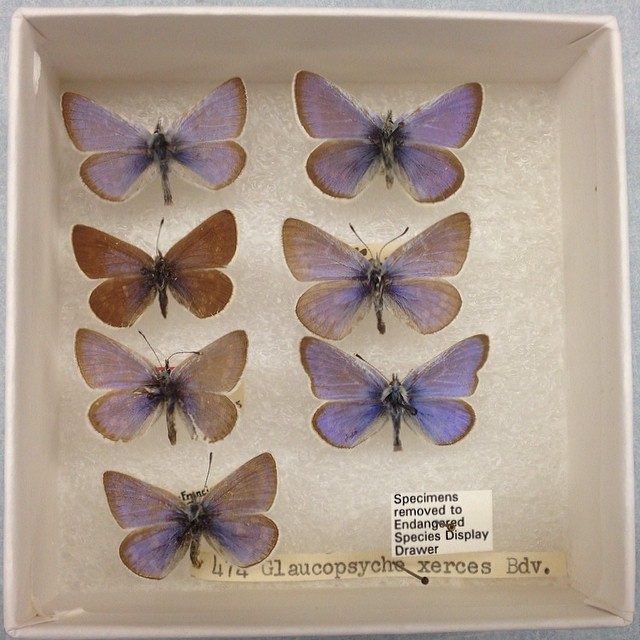 Xerces BlueGlaucopsyche xerces
-
 Adonis BlueLysandra bellargus
-
 Western Pygmy BlueBrephidium exilis
-
 AtalaEumaeus atala
-
 Holly BlueCelastrina argiolus
Compare
Questions and answers
What is the scientific name of the Black-banded Hairstreak?
The scientific name of the Black-banded Hairstreak is Antigius attilia. Written with its author, the full name is Antigius attilia (Bremer, 1861).
Which family does the Black-banded Hairstreak belong to?
Antigius attilia belongs to the family Lycaenidae, in the order Lepidoptera and the class Insecta.
Where is the Black-banded Hairstreak found?
Checklists and occurrence records place Antigius attilia in 4 countries: Japan, South Korea, Taiwan and China.
Sources
Passages the profile rests on
- Adults have a wingspan of 14–16 millimetres. Source passage: “The wingspan is 14–16 millimetres (0.55–0.63 in).” — English Wikipedia
- The upper surfaces of the wings are black-brown in both sexes. Source passage: “The upper side of the wings of both sexes is the same - black brown.” — English Wikipedia
- Male individuals have uniformly coloured upper wing surfaces. Source passage: “The male is unicolorous.” — English Wikipedia
- Females have one or two chains of faint whitish submarginal spots along the outer edge of the upper hindwings. Source passage: “In the female the hind wings on the upper side with one or two chains of small, faintly visible whitish submarginal spots along the outer edge.” — English Wikipedia
- The undersides of the wings are greyish-white, with black marginal spots and a brown transverse stripe. Source passage: “The underside of the wings is greyish-white with black marginal spots and a brown transverse stripe.” — English Wikipedia
- The forewing has a rectangular spot with distinct edges at the apex of its central cell. Source passage: “The spot at the apex of the central cell of the fore wing is rectangular in shape, with distinct edges.” — English Wikipedia
- The posterior corner of each hindwing has two pairs of small orange-black spots. Source passage: “At the posterior corner of the hindwing there are two pairs of small orange-black spots.” — English Wikipedia
- The hindwings bear thin black tails measuring 3–4 millimetres in length. Source passage: “The tail on the hind wings is thin, black, 3–4 mm long” — English Wikipedia
- The species occurs in Japan, the Korean Peninsula, the Russian Far East, northern, central and western China, and Taiwan. Source passage: “It is widespread from Japan, the Korean Peninsula, the Russian Far East throughout northern, central and western China to Taiwan.” — English Wikipedia
- The subspecies Antigius attilia tropicanus is recorded from Myanmar. Source passage: “Antigius attilia tropicanus (Myanmar)” — English Wikipedia
- The subspecies Antigius attilia yamanakashoji is recorded from Japan. Source passage: “Antigius attilia yamanakashoji (Japan)” — English Wikipedia
- The subspecies Antigius attilia obsoletus is recorded from Taiwan. Source passage: “Antigius attilia obsoletus (Taiwan)” — English Wikipedia
- The larvae feed on Quercus serrata. Source passage: “The larvae feed on Quercus serrata,” — English Wikipedia
- The subspecies Antigius attilia yamanakashoji has been recorded feeding on Quercus acutissima. Source passage: “Subspecies yamanakashoji has been recorded on Quercus acutissima.” — English Wikipedia
Data
- Catalogue of Life, 2026-10-16 XR cc by
- Global Biodiversity Information Facility CC BY 4.0
- Wikidata CC0
- GeoNames CC BY 4.0
- Wikimedia Commons per image; credit shown with each image
- Within the Catalogue of Life, this name comes from Global Lepidoptera Index cc by
References
- Bremer. (1861). Bulletin de l’Académie Impériale des Sciences de St.Petersbourg. 3. http://www.biodiversitylibrary.org/item/105501#page/258/mode/2up Link where the name was published
This species in other databases
Page built on 29 November 2026. See how the catalog is made and all sources and licences.
Cite this page
ScientificNames.org. (2026). Antigius attilia (Black-banded Hairstreak). Retrieved November 29, 2026, from https://scientificnames.org/species/antigius-attilia
“Antigius attilia (Black-banded Hairstreak).” ScientificNames.org, 2026, scientificnames.org/species/antigius-attilia. Accessed 29 Nov. 2026.
ScientificNames.org. “Antigius attilia (Black-banded Hairstreak).” Accessed November 29, 2026. https://scientificnames.org/species/antigius-attilia.
@misc{scientificnames_antigius_attilia_black_banded_hairstreak,
  author = {{ScientificNames.org}},
  title = {Antigius attilia (Black-banded Hairstreak)},
  year = {2026},
  url = {https://scientificnames.org/species/antigius-attilia},
  note = {Accessed 2026-11-29}
}