Species · Insects
Northern Grey Twist Aphelia unitana
The scientific name of the Northern Grey Twist is Aphelia unitana. It is a species of insect in the family Tortricidae (tortricids), order Lepidoptera. The name dates from 1796.
- Scientific name
- Aphelia unitana (Hübner, [1796-1799])
- Common name
- Northern Grey Twist
- Genus
- Aphelia
- Family
- Tortricidae (Tortricids)
- Order
- Lepidoptera
- Class
- Insecta
- Environment
- terrestrial
- Recorded in
- 11 countries
- Name status
- accepted in the Catalogue of Life
Overview
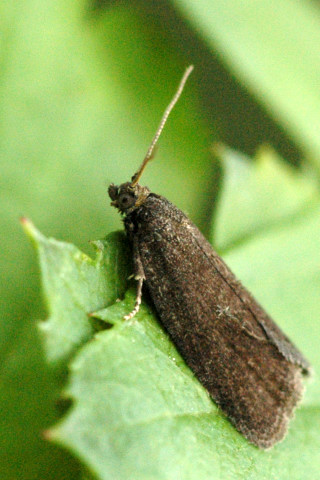
Aphelia unitana occurs from Ireland and Great Britain eastward through Fennoscandia and central and south-eastern Europe to the Russian Far East and the Near East. It has a dark body, silky grey forewings, grey hindwings and white fringes on all wings.
Written 27 November 2026 from the sources listed below. Each statement was checked against the passage it cites; statements that could not be supported were removed.
Appearance
The moth has a dark body and silky grey forewings that often have darker outer margins. All wings have white fringes.[1][2]
The hindwings are grey and slightly darker behind the wing tip. Its wingspan ranges from 17 to 24 mm.[3][4]
Habitat
The Northern Grey Twist occurs from Ireland and Great Britain eastward through Fennoscandia and central and south-eastern Europe to the Russian Far East and the Near East.[5]
Diet
The larvae feed on low-growing plants, including species of Heracleum and Rubus. They feed between spun leaves.[6][7]
Behaviour
Adult Northern Grey Twist moths are active from June through July.[8]
Similar species
The Northern Grey Twist closely resembles Aphelia paleana.[9]
Classification of the Northern Grey Twist
| Kingdom | Animalia |
|---|---|
| Phylum | Arthropoda |
| Subphylum | Hexapoda |
| Class | Insecta (Insect) |
| Order | Lepidoptera |
| Superfamily | Tortricoidea |
| Family | Tortricidae (Tortricids) |
| Subfamily | Tortricinae |
| Tribe | Archipini |
| Genus | Aphelia |
| Species | Aphelia unitana (Hübner, [1796-1799]) |
Where the Northern Grey Twist is found
Checklists and occurrence records place Aphelia unitana in 11 countries. GBIF holds 1,633 georeferenced records of it.
Countries
- Aland Islands 30
- Austria 38
- Denmark 158
- Estonia 38
- Finland 756
- France 28
- Germany 64
- Norway 312
- Russia 11
- Sweden 151
- United Kingdom 47
Regions and cities with the most records
- Nordland, Norway 145
- Kajaani, Finland 64
- Trondheim, Norway 55
- Skåne, Sweden 42
- Central Jutland, Denmark 40
- England, United Kingdom 39
- Oulu, Finland 34
- Capital Region, Denmark 31
- Kangasala, Finland 29
- Zealand, Denmark 28
- Haukipudas, Finland 27
- Mo i Rana, Norway 27
- Tilst, Denmark 25
- Mariehamn, Aland Islands 22
- Auvergne-Rhône-Alpes, France 21
- Leek, United Kingdom 21
- Raseborg, Finland 21
- Saxony, Germany 21
- Kalmar, Sweden 20
- Rauma, Finland 20
- Møre og Romsdal, Norway 18
- Pori, Finland 17
- Stjørdalshalsen, Norway 17
- Lempäälä, Finland 16
- Valkeakoski, Finland 16
- Bavaria, Germany 15
- Hillerød, Denmark 13
- Sibbo, Finland 13
- Tampere, Finland 13
- Vallensbæk, Denmark 13
- Örebro, Sweden 13
- Frederikssund, Denmark 12
- Lower Saxony, Germany 12
- Annaberg-Buchholz, Germany 11
- Aue, Germany 11
- Bodø, Norway 11
A number beside a place is its count of GBIF occurrence records. A place without a number comes from a checklist alone. Records show where a species has been observed or collected, which can include escapes and vagrants.
Common names
English
- Northern Grey Twist
Names in 7 other languages
- Dutch
- Grijsgele bladroller
- Finnish
- keltarullakääriäinen
- Lithuanian
- Vienspalvė afelija
- Norwegian Bokmål
- nordlig gulbladvikler
- Norwegian Nynorsk
- nordleg gulbladviklar
- Slovak
- obaľovač boľševníkový
- Swedish
- sidengrå bredvecklare
Synonyms
10 other scientific names have been used for this species and are now treated as synonyms of Aphelia unitana.
- Aphelia carpathica (Toll, 1951)
- Aphelia fischeri (Toll, 1951)
- Aphelia fumatana (Toll, 1951)
- Aphelia pseudoviburniana (Toll, 1951)
- Tortrix paleana carpathica Toll, 1951
- Tortrix paleana fischeri Toll, 1951
- Tortrix paleana fumatana Toll, 1951
- Tortrix paleana pseudoviburniana Toll, 1951
- Tortrix unitana Hübner, [1796-1799]
- Zelotherses unitana (Hübner, [1799])
Related species
-
 Timothy TortrixAphelia paleana
-
 Bilberry TortrixAphelia viburnana
- Wide-striped LeafrollerAphelia alleniana
- Aphelia aglossana
- Aphelia cinerarialis
- Aphelia inumbratana
- Aphelia christophi
- Aphelia fuscialis
Compare
Questions and answers
What is the scientific name of the Northern Grey Twist?
The scientific name of the Northern Grey Twist is Aphelia unitana. Written with its author, the full name is Aphelia unitana (Hübner, [1796-1799]).
Which family does the Northern Grey Twist belong to?
Aphelia unitana belongs to the family Tortricidae, in the order Lepidoptera and the class Insecta.
Where is the Northern Grey Twist found?
Checklists and occurrence records place Aphelia unitana in 11 countries, including Finland, Norway, Denmark, Sweden, Germany and United Kingdom.
Sources
Passages the profile rests on
- The moth has a dark body and silky grey forewings that often have darker outer margins. Source passage: “The body is dark, the forewing is silky grey, often with darker outer margin.” — English Wikipedia
- All wings have white fringes. Source passage: “All wings have white fringes.” — English Wikipedia
- The wingspan of Aphelia unitana ranges from 17 to 24 mm. Source passage: “The wingspan is 17–24 mm.” — English Wikipedia
- The hindwings are grey and slightly darker behind the wing tip. Source passage: “The hindwings are grey, slightly darkened behind the wing tip.” — English Wikipedia
- Aphelia unitana occurs from Ireland and Great Britain eastward through Fennoscandia and central and south-eastern Europe to the Russian Far East and the Near East. Source passage: “It is found from Ireland and Great Britain, east Fennoscandia and central and south-eastern Europe to the Russian Far East and the Near East.” — English Wikipedia
- The larvae feed on low-growing plants, including species of Heracleum and Rubus. Source passage: “The larvae feed on various low-growing plants, including Heracleum and Rubus species.” — English Wikipedia
- The larvae feed between spun leaves. Source passage: “They feed between spun leaves.” — English Wikipedia
- Adult Aphelia unitana moths are active from June through July. Source passage: “Adults are on wing from June to July.” — English Wikipedia
- Aphelia unitana closely resembles Aphelia paleana. Source passage: “It is very similar to Aphelia paleana.” — English Wikipedia
Data
- Catalogue of Life, 2026-10-16 XR cc by
- Global Biodiversity Information Facility CC BY 4.0
- Wikidata CC0
- GeoNames CC BY 4.0
- Within the Catalogue of Life, this name comes from World Catalogue of the Tortricidae cc by
References
- Hübner. (1796). Samml. Eur. Schmett., 7, pl. 19, fig. 123. where the name was published
This species in other databases
Page built on 28 November 2026. See how the catalog is made and all sources and licences.
Cite this page
ScientificNames.org. (2026). Aphelia unitana (Northern Grey Twist). Retrieved November 28, 2026, from https://scientificnames.org/species/aphelia-unitana
“Aphelia unitana (Northern Grey Twist).” ScientificNames.org, 2026, scientificnames.org/species/aphelia-unitana. Accessed 28 Nov. 2026.
ScientificNames.org. “Aphelia unitana (Northern Grey Twist).” Accessed November 28, 2026. https://scientificnames.org/species/aphelia-unitana.
@misc{scientificnames_aphelia_unitana_northern_grey_twist,
  author = {{ScientificNames.org}},
  title = {Aphelia unitana (Northern Grey Twist)},
  year = {2026},
  url = {https://scientificnames.org/species/aphelia-unitana},
  note = {Accessed 2026-11-28}
}