Species · Insects
Woolly Apple Aphid Wasp Parasitoid Aphelinus mali
The scientific name of the Woolly Apple Aphid Wasp Parasitoid is Aphelinus mali. It is a species of insect in the family Aphelinidae, order Hymenoptera. The name dates from 1851.
- Scientific name
- Aphelinus mali (Haldeman, 1851)
- Common name
- Woolly Apple Aphid Wasp Parasitoid
- Genus
- Aphelinus
- Family
- Aphelinidae
- Order
- Hymenoptera
- Class
- Insecta
- Recorded in
- 10 countries
- Name status
- accepted in the Catalogue of Life
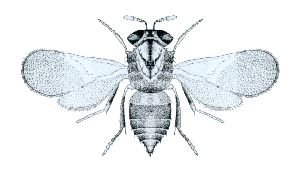
Overview
The species occurs in apple orchards where its woolly apple aphid host is present. The adult wasp is black and has transparent membranous wings that extend beyond its abdomen.
Written 26 November 2026 from the sources listed below. Each statement was checked against the passage it cites; statements that could not be supported were removed.
Appearance
The adult wasp is black and has transparent membranous wings that extend beyond its abdomen. It is slightly smaller than its woolly apple aphid host.[1][2]
The immature larvae are yellow with red eyes, while the pupae are black.[3]
Behaviour
Although capable of flight, the wasp prefers walking and jumping and frequently hides beneath leaves. Parasitized woolly apple aphids develop blackish, puffy mummified bodies, and successful adult emergence can be identified by a rounded hole in the mummified aphid.[4][5][6]
Honeydew consumption increases female longevity when water is also available. Its presence also allows the wasps to perform longer stinging events on woolly apple aphids and stimulates oviposition despite the absence of an observed olfactory preference for it.[7][8][9]
Adult females emerge from diapause in spring. During autumn, larvae and pupae enter diapause and overwinter inside blackened, mummified host bodies.[10][11]
Reproduction and life cycle
Females lay eggs inside woolly apple aphids by inserting their ovipositors into the aphids' undersides. The eggs hatch approximately three days after being laid.[12][13]
The larval stage lasts approximately 10 to 12 days before pupation inside the host. Adult wasps emerge by chewing a round exit hole through the upper surface of the aphid.[14][15]
The complete life cycle takes approximately 20 to 25 days. The species can produce six or seven generations during a growing season.[16][17]
Habitat
The species occurs in apple orchards where its woolly apple aphid host is present.[18]
Diet
Adult individuals consume honeydew produced by woolly apple aphids under laboratory and field conditions. The species also exploits nectar and honeydew as adult food sources.[19][20]
The larvae feed on their insect hosts.[21]
Uses
The species is used as a biological control agent against woolly apple aphids. It can completely control woolly apple aphids on aboveground plant parts when broad-spectrum insecticides are not applied.[22][23]
Classification of the Woolly Apple Aphid Wasp Parasitoid
| Kingdom | Animalia |
|---|---|
| Phylum | Arthropoda |
| Subphylum | Hexapoda |
| Class | Insecta (Insect) |
| Order | Hymenoptera (Ants) |
| Suborder | Apocrita (Ants) |
| Infraorder | Terebrantes |
| Superfamily | Chalcidoidea |
| Family | Aphelinidae |
| Subfamily | Aphelininae |
| Tribe | Aphelinini |
| Genus | Aphelinus |
| Species | Aphelinus mali (Haldeman, 1851) |
This name was added to the Catalogue of Life from a contributing dataset by automated merging and has not yet been reviewed by its editors.
Where the Woolly Apple Aphid Wasp Parasitoid is found
Checklists and occurrence records place Aphelinus mali in 10 countries. GBIF holds 325 georeferenced records of it.
Countries
- Australia 15
- Bulgaria 3
- Canada 38
- Mexico 16
- New Zealand 40
- Norway 15
- South Korea 120
- Sweden 5
- United Kingdom 26
- United States 47
Regions and cities with the most records
- England, United Kingdom 25
- Chingford, United Kingdom 19
- Manitoba, Canada 19
- Ponders End, United Kingdom 19
- Benito Juarez, Mexico 16
- Ciudad Nezahualcoyotl, Mexico 16
- Coyoacán, Mexico 16
- Cuauhtémoc, Mexico 16
- Delegación Cuajimalpa de Morelos, Mexico 16
- Emiliano Zapata, Mexico 16
- Iztacalco, Mexico 16
- Iztapalapa, Mexico 16
- Jesús del Monte, Mexico 16
- Los Reyes Acaquilpan, Mexico 16
- Magdalena Contreras, Mexico 16
- Mexico City, Mexico 16
- Miguel Hidalgo, Mexico 16
- Milpa Alta, Mexico 16
- San Antonio Tecómitl, Mexico 16
- San Isidro, Mexico 16
- San Juan Ixtayopan, Mexico 16
- San Miguel Ajusco, Mexico 16
- San Miguel Topilejo, Mexico 16
- San Pablo Oztotepec, Mexico 16
- Tlalpan, Mexico 16
- Tláhuac, Mexico 16
- Xico, Mexico 16
- Xochimilco, Mexico 16
- Ontario, Canada 14
- Auckland, New Zealand 9
- Auckland, New Zealand 9
- Avondale, New Zealand 9
- Mangere, New Zealand 9
- Mount Eden, New Zealand 9
- New Lynn, New Zealand 9
- New South Wales, Australia 9
1 more country has a few records outside this range
These countries hold a few records of Aphelinus mali but lie outside the range the checklists give for it. Such records are often zoo or garden specimens, museum material or vagrants, so the species is not counted as occurring there.
A number beside a place is its count of GBIF occurrence records. A place without a number comes from a checklist alone. Records show where a species has been observed or collected, which can include escapes and vagrants.
Common names
English
- Woolly Apple Aphid Wasp Parasitoid
- Woolly Aphis Parasite
- Woolly Apple Aphid Parasitoid
- Woolly Apple-aphid Chalcid
- Woolly Aphid Parasite
Names in 6 other languages
- Czech
- mšicovník vlnatkový
- Danish
- Blodlussnyltehveps
- Korean
- 면충좀벌
- Polish
- osiec korówkowy
- Russian
- Афелинус
- Slovak
- voškár vlnačkový
Synonyms
3 other scientific names have been used for this species and are now treated as synonyms of Aphelinus mali.
- Aphelinus rosae Ashmead, 1886
- Aphelinus varicornis Girault, 1909
- Eriophilus mali Haldeman, 1851
Questions and answers
What is the scientific name of the Woolly Apple Aphid Wasp Parasitoid?
The scientific name of the Woolly Apple Aphid Wasp Parasitoid is Aphelinus mali. Written with its author, the full name is Aphelinus mali (Haldeman, 1851).
Which family does the Woolly Apple Aphid Wasp Parasitoid belong to?
Aphelinus mali belongs to the family Aphelinidae, in the order Hymenoptera and the class Insecta.
Where is the Woolly Apple Aphid Wasp Parasitoid found?
Checklists and occurrence records place Aphelinus mali in 10 countries, including South Korea, United States, New Zealand, Canada, United Kingdom and Mexico.
What other names does the Woolly Apple Aphid Wasp Parasitoid have?
Aphelinus mali is also known in English as Woolly Aphis Parasite, Woolly Apple Aphid Parasitoid, Woolly Apple-aphid Chalcid and Woolly Aphid Parasite.
Sources
Passages the profile rests on
- The adult wasp is black and has transparent membranous wings that extend beyond its abdomen. Source passage: “The adult A. mali is a tiny black wasp slightly smaller than its woolly aphid host. Its transparent membranous wings are longer than its abdomen” — English Wikipedia
- The adult wasp is slightly smaller than its woolly apple aphid host. Source passage: “slightly smaller than its woolly aphid host.” — English Wikipedia
- The immature larvae are yellow with red eyes, while the pupae are black. Source passage: “the larvae are yellow with red eyes, and the pupae are black.” — English Wikipedia
- Although capable of flight, the wasp prefers walking and jumping and frequently hides beneath leaves. Source passage: “Although it can fly, it prefers to walk and jump, and often conceals itself under leaves.” — English Wikipedia
- Parasitized woolly apple aphids develop blackish, puffy mummified bodies. Source passage: “Woolly apple aphids parasitized by A. mali become blackish, puffy mummies.” — ipm.ucanr.edu
- Successful adult emergence can be identified by a rounded hole in the mummified aphid. Source passage: “After the adult wasp emerges, parasitism can be recognized by a rounded hole in the mummified aphids.” — ipm.ucanr.edu
- Honeydew consumption increases female longevity when water is also available. Source passage: “honeydew increased longevity of A. mali females if water was provided.” — pmc.ncbi.nlm.nih.gov
- The presence of honeydew allows the wasps to perform longer stinging events on woolly apple aphids. Source passage: “The presence of honeydew allowed longer stinging events by A. mali on E. lanigerum.” — pmc.ncbi.nlm.nih.gov
- Honeydew stimulates oviposition in this species despite the absence of an observed olfactory preference for it. Source passage: “Although no olfactory preference was observed, honeydew also stimulated oviposition by A. mali.” — pmc.ncbi.nlm.nih.gov
- Adult females emerge from diapause in spring. Source passage: “The adult female A. mali emerges from diapause in the spring.” — English Wikipedia
- Larvae and pupae enter diapause during autumn and overwinter inside blackened, mummified host bodies. Source passage: “In the fall, larvae and pupae enter diapause and overwinter in the blackened mummified bodies of their hosts.” — English Wikipedia
- Females lay eggs inside woolly apple aphids by inserting their ovipositors into the aphids' undersides. Source passage: “It inserts its ovipositor into the underside of a woolly aphid and lays an egg” — English Wikipedia
- The eggs hatch approximately three days after being laid. Source passage: “which hatches in about three days.” — English Wikipedia
- The larval stage lasts approximately 10 to 12 days before pupation inside the host. Source passage: “The larva takes ten to twelve days to develop before pupating inside the body of its host.” — English Wikipedia
- Adult wasps emerge by chewing a round exit hole through the upper surface of the aphid. Source passage: “the adult chews its way out through the upper surface of the aphid, leaving a neat round hole.” — English Wikipedia
- The complete life cycle takes approximately 20 to 25 days. Source passage: “The whole life cycle takes 20 to 25 days” — English Wikipedia
- The species can produce six or seven generations during a growing season. Source passage: “there may be six or seven generations during the season.” — English Wikipedia
- The species occurs in apple orchards where its woolly apple aphid host is present. Source passage: “Aphelinus mali Haldeman (Hymenoptera: Aphelinidae) is the main parasitoid of the woolly apple aphid (Eriosoma lanigerum Hausmann (Hemiptera: Aphididae) in apple orchards” — pmc.ncbi.nlm.nih.gov
- Adult individuals consume honeydew produced by woolly apple aphids under laboratory and field conditions. Source passage: “Results suggested that A. mali is able to consume honeydew in laboratory and field conditions” — pmc.ncbi.nlm.nih.gov
- The species exploits nectar and honeydew as adult food sources. Source passage: “It has been observed exploiting both plant-derived food sources such as nectar and host-derived sugar sources such as honeydew.” — pmc.ncbi.nlm.nih.gov
- The larvae feed on their insect hosts. Source passage: “whereas as larvae they feed on their insect host” — pmc.ncbi.nlm.nih.gov
- The species is used as a biological control agent against woolly apple aphids. Source passage: “A. mali was one of the earliest examples of controlling pests biologically.” — English Wikipedia
- The wasp can completely control woolly apple aphids on aboveground plant parts when broad-spectrum insecticides are not applied. Source passage: “On aboveground plant parts, woolly apple aphid can be completely controlled by a parasitoid (parasitic) wasp, Aphelinus mali, if broad-spectrum insecticide is not applied for any pests on its hosts.” — ipm.ucanr.edu
Data
- Catalogue of Life, 2026-10-16 XR cc by
- Global Biodiversity Information Facility CC BY 4.0
- Wikidata CC0
- GeoNames CC BY 4.0
- Wikimedia Commons per image; credit shown with each image
- Within the Catalogue of Life, this name comes from United Kingdom Species Inventory (UKSI) cc by
This species in other databases
Page built on 26 November 2026. See how the catalog is made and all sources and licences.
Cite this page
ScientificNames.org. (2026). Aphelinus mali (Woolly Apple Aphid Wasp Parasitoid). Retrieved November 26, 2026, from https://scientificnames.org/species/aphelinus-mali
“Aphelinus mali (Woolly Apple Aphid Wasp Parasitoid).” ScientificNames.org, 2026, scientificnames.org/species/aphelinus-mali. Accessed 26 Nov. 2026.
ScientificNames.org. “Aphelinus mali (Woolly Apple Aphid Wasp Parasitoid).” Accessed November 26, 2026. https://scientificnames.org/species/aphelinus-mali.
@misc{scientificnames_aphelinus_mali_woolly_apple_aphid_wasp_parasitoid,
  author = {{ScientificNames.org}},
  title = {Aphelinus mali (Woolly Apple Aphid Wasp Parasitoid)},
  year = {2026},
  url = {https://scientificnames.org/species/aphelinus-mali},
  note = {Accessed 2026-11-26}
}