Species · Insects
Common Albatross Appias paulina
The scientific name of the Common Albatross is Appias paulina. It is a species of insect in the family Pieridae (whites), order Lepidoptera. The name dates from 1777.
- Scientific name
- Appias paulina (Cramer, [1777] )
- Common name
- Common Albatross
- Genus
- Appias
- Family
- Pieridae (Whites)
- Order
- Lepidoptera
- Class
- Insecta
- Recorded in
- 12 countries
- Name status
- accepted in the Catalogue of Life
Overview
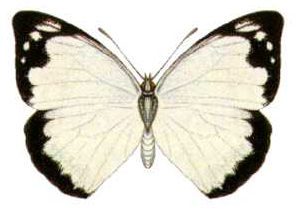
The species occurs across a range extending from India to Samoa, with recorded distribution including Indonesia, Japan, Malaysia, New Caledonia, Thailand and Australia. Its wings are white to light yellow, with broad black borders and white spots on the upper surfaces of the forewing tips.
Written 26 November 2026 from the sources listed below. Each statement was checked against the passage it cites; statements that could not be supported were removed.
Habitat
The species occurs across a range extending from India to Samoa. Its recorded distribution includes Indonesia, Japan, Malaysia, New Caledonia, Thailand and Australia.[1][2]
Diet
The larvae feed on Drypetes australasica and Alchornea ilicifolia.[3][4]
Appearance
Adult males and females have white to light yellow coloration on both wing surfaces. The forewing tips have broad black borders decorated with white spots on their upper surfaces.[5][6]
In yellow forms, the hindwings are entirely yellow, while only the forewing tips are yellow. The wingspan is approximately 50 mm.[7][8]
Classification of the Common Albatross
| Kingdom | Animalia |
|---|---|
| Phylum | Arthropoda |
| Subphylum | Hexapoda |
| Class | Insecta (Insect) |
| Order | Lepidoptera |
| Superfamily | Papilionoidea |
| Family | Pieridae (Whites) |
| Genus | Appias (Albatrosses and Puffins) |
| Species | Appias paulina (Cramer, [1777] ) |
Where the Common Albatross is found
Checklists and occurrence records place Appias paulina in 12 countries across Asia. GBIF holds 4,644 georeferenced records of it.
Countries
- Australia 2,780
- China 3
- India 31
- Indonesia 531
- Japan 930
- Malaysia 98
- Myanmar 8
- Philippines 55
- Sri Lanka 107
- Taiwan 40
- Thailand 32
- Vietnam 29
Regions and cities with the most records
- Queensland, Australia 1,959
- New South Wales, Australia 489
- Brisbane, Australia 403
- Logan City, Australia 154
- Capalaba, Australia 145
- Okinawa, Japan 95
- Northern Territory, Australia 93
- Narangba, Australia 87
- Gold Coast, Australia 82
- Darwin, Australia 72
- Palmerston, Australia 65
- Cairns, Australia 58
- Townsville, Australia 58
- Coffs Harbour, Australia 55
- Sunshine Coast, Australia 46
- Toowoomba, Australia 41
- Padalarang, Indonesia 38
- Ciranjang-hilir, Indonesia 37
- Bundaberg, Australia 35
- Okinawa, Japan 30
- Sydney, Australia 30
- Caloundra, Australia 28
- Chatan, Japan 28
- Ginowan, Japan 28
- Kishaba, Japan 28
- Mackay, Australia 28
- Nakagusuku, Japan 28
- Nishihara, Japan 28
- Urasoe, Japan 28
- Hervey Bay, Australia 27
- Hornsby, Australia 27
- Ishigaki, Japan 27
- Kanegusuku, Japan 27
- Naha, Japan 27
- Yonabaru, Japan 27
- Gladstone, Australia 26
6 more countries have a few records outside this range
These countries hold a few records of Appias paulina but lie outside the range the checklists give for it. Such records are often zoo or garden specimens, museum material or vagrants, so the species is not counted as occurring there.
A number beside a place is its count of GBIF occurrence records. A place without a number comes from a checklist alone. Records show where a species has been observed or collected, which can include escapes and vagrants.
Common names
English
- Common Albatross
- Ceylon Lesser Albatross
- Christmas Island White
- Yellow Albatross
Names in 2 other languages
- Chinese
- 寶玲尖粉蝶, 波江白蝶, 蘭嶼粉蝶, 衽環粉蝶, 黃尖粉蝶, 黑緣尖粉蝶
- Japanese
- ナミエシロチョウ, ナミエシロチョウ(広義)
Synonyms
7 other scientific names have been used for this species and are now treated as synonyms of Appias paulina.
- Appias leis caledonica (C. Felder, 1862)
- Appias paulina ega (Boisduval, 1836)
- Appias paulina minato (Fruhstorfer) 1898
- Catophaga paulina minato Fruhstorfer, 1899
- Papilio paulina Cramer, 1777
- Pieris ega Boisduval, 1836
- Pieris neombo Boisduval, 1836
Related species
-
 Common AlbatrossAppias albina
-
 Chocolate AlbatrossAppias lyncida
-
 Eastern Striped AlbatrossAppias olferna
-
 Striped AlbatrossAppias libythea
-
 Orange AlbatrossAppias nero
-
 Plain PuffinAppias indra
-
 Flame AlbatrossAppias zarinda
-
 Spot PuffinAppias lalage
Compare
Questions and answers
What is the scientific name of the Common Albatross?
The scientific name of the Common Albatross is Appias paulina. Written with its author, the full name is Appias paulina (Cramer, [1777] ).
Which family does the Common Albatross belong to?
Appias paulina belongs to the family Pieridae, in the order Lepidoptera and the class Insecta.
Where is the Common Albatross found?
Checklists and occurrence records place Appias paulina in 12 countries, including Australia, Japan, Indonesia, Sri Lanka, Malaysia and Philippines.
What other names does the Common Albatross have?
Appias paulina is also known in English as Ceylon Lesser Albatross, Christmas Island White and Yellow Albatross.
Sources
Passages the profile rests on
- The species occurs across a range extending from India to Samoa. Source passage: “It is found from India to Samoa” — English Wikipedia
- Its recorded distribution includes Indonesia, Japan, Malaysia, New Caledonia, Thailand and Australia. Source passage: “including Indonesia, Japan, Malaysia, New Caledonia, Thailand and Australia.” — English Wikipedia
- The larvae feed on Drypetes australasica. Source passage: “The larvae feed on Drypetes australasica” — English Wikipedia
- The larvae feed on Alchornea ilicifolia. Source passage: “Alchornea ilicifolia.” — English Wikipedia
- Adult males and females have white to light yellow coloration on both wing surfaces. Source passage: “The male and female are a white to light yellow colour on both sides.” — English Wikipedia
- The forewing tips have broad black borders decorated with white spots on their upper surfaces. Source passage: “The tip of the front wings is broadly edged with black and decorated with white spots on top.” — English Wikipedia
- In yellow forms, the hindwings are entirely yellow, while only the forewing tips are yellow. Source passage: “In the yellow forms, the hind wing is entirely yellow, while on the front wing only the tip is yellow.” — English Wikipedia
- The wingspan is approximately 50 mm. Source passage: “The wingspan is about 50 mm.” — English Wikipedia
Data
- Catalogue of Life, 2026-10-16 XR cc by
- Global Biodiversity Information Facility CC BY 4.0
- Wikidata CC0
- GeoNames CC BY 4.0
- Wikimedia Commons per image; credit shown with each image
- Within the Catalogue of Life, this name comes from Global Butterfly Information System cc by
This species in other databases
Page built on 29 November 2026. See how the catalog is made and all sources and licences.
Cite this page
ScientificNames.org. (2026). Appias paulina (Common Albatross). Retrieved November 29, 2026, from https://scientificnames.org/species/appias-paulina
“Appias paulina (Common Albatross).” ScientificNames.org, 2026, scientificnames.org/species/appias-paulina. Accessed 29 Nov. 2026.
ScientificNames.org. “Appias paulina (Common Albatross).” Accessed November 29, 2026. https://scientificnames.org/species/appias-paulina.
@misc{scientificnames_appias_paulina_common_albatross,
  author = {{ScientificNames.org}},
  title = {Appias paulina (Common Albatross)},
  year = {2026},
  url = {https://scientificnames.org/species/appias-paulina},
  note = {Accessed 2026-11-29}
}