Species · Birds
Golden Eagle Aquila chrysaetos
The scientific name of the Golden Eagle is Aquila chrysaetos. It is a species of bird in the family Accipitridae (hawks), order Accipitriformes. The name dates from 1758.
- Scientific name
- Aquila chrysaetos (Linnaeus, 1758)
- Common name
- Golden Eagle
- Genus
- Aquila
- Family
- Accipitridae (Hawks)
- Order
- Accipitriformes
- Class
- Aves
- Red List category
- LC Least Concern
- Environment
- terrestrial
- Recorded in
- 79 countries
- Name status
- accepted in the Catalogue of Life

Overview
Aquila chrysaetos occurs throughout the Northern Hemisphere, across substantial parts of Eurasia, North America and northern Africa. It has a dark brown body, broad wings and golden-brown feathers on the nape.
Written 24 November 2026 from the sources listed below. Each statement was checked against the passage it cites; statements that could not be supported were removed.
Appearance
Adult Golden Eagles have dark brown plumage, with lighter golden-brown feathers on the nape and gold feathers on the back of the crown. Some grey feathers occur on the wings and tail.[1][2]
Immature Golden Eagles typically have white tail feathers and often display white markings on their wings. They have broad wings, a dark brown body, a dark-tipped bill that fades to a lighter horn color, and a yellow cere.[3][4][5]
Golden Eagles measure 66–102 cm in body length and have wingspans ranging from 1.8 to 2.34 m. Females are larger than males; adult males average approximately 3.6 kg and adult females approximately 5.1 kg.[6][7][8][9]
Habitat
Golden Eagles inhabit alpine parkland, open forests, mid-elevation clear-cuts, chaparral and plains. They use open areas containing large rocky cliffs or large trees, including pines, cypresses and sycamores.[10][11]
Golden Eagles generally occur in sparsely populated areas of the Northern Hemisphere.[12]
Diet
Golden Eagles primarily hunt hares, rabbits, marmots and other ground squirrels. In North America, they predominantly prey on medium-sized mammals, particularly rabbits and ground squirrels.[13][14]
Their prey also includes foxes, martens, young deer and small livestock, including lambs and small goats. They can also prey on birds ranging from jays to swans.[15][16][17]
Golden Eagles sometimes steal prey from other raptors and can displace vultures and other raptors from carrion.[18][19]
Behaviour
Golden Eagles capture prey using agility, speed and powerful feet equipped with large, sharp talons. They can dive at speeds approaching 200 miles per hour.[20][21]
Golden Eagles maintain home ranges or territories that can reach 200 km². Some remain in their nesting territories throughout the year, while others migrate when winter food is scarce.[22][23]
Golden Eagles generally do not need to migrate long distances because of their hunting abilities.[24]
Reproduction and life cycle
Golden Eagles are monogamous and usually mate for life. Pairs may remain together for several years or potentially throughout their lives.[25][26]
Golden Eagles build large nests on cliffs and other elevated locations and may reuse them for several breeding years. Females usually lay two eggs, although they can lay as many as four, with laying occurring between January and September depending on location.[27][28][29]
Eggs hatch after approximately 40–45 days of incubation. Golden Eagle nestlings are fed for approximately 50 days before attempting their first flights and eating independently.[30][31]
Chicks generally become capable of fledging at approximately three months of age. In most broods, only the older chick survives.[32][33]
Conservation
Golden Eagles have disappeared from many areas with high human population densities. They are classified as a fully protected species in California.[34][35]
Uses
Golden Eagles have been used extensively in falconry for centuries.[36]
Golden Eagles and their feathers are incorporated into ceremonies in many Native American cultures.[37]
Classification of the Golden Eagle
| Kingdom | Animalia |
|---|---|
| Phylum | Chordata |
| Subphylum | Vertebrata |
| Infraphylum | Gnathostomata |
| Parvphylum | Osteichthyes |
| Megaclass | Tetrapoda |
| Class | Aves (Bird) |
| Order | Accipitriformes (Hawks) |
| Family | Accipitridae (Hawks) |
| Genus | Aquila (Golden Eagles) |
| Species | Aquila chrysaetos (Linnaeus, 1758) |
Where the Golden Eagle is found
Checklists and occurrence records place Aquila chrysaetos in 79 countries across Africa, Asia, North America and Oceania. GBIF holds 787,643 georeferenced records of it.
Countries
- Afghanistan 18
- Aland Islands 11
- Albania 154
- Algeria 228
- Andorra 728
- Armenia 1,147
- Austria 8,460
- Azerbaijan 423
- Belarus 81
- Belgium 21
- Bhutan 45
- Bosnia and Herzegovina 24
- Bulgaria 988
- Canada 47,646
- China 2,665
- Croatia 77
- Czechia 28
- Denmark 18,562
- Egypt 18
- Estonia 1,912
- Ethiopia 149
- Finland 19,296
- France 68,909
- Georgia 1,094
- Germany 1,231
- Greece 1,170
- Hungary 66
- India 3,574
- Iran 2,165
- Iraq 29
- Ireland 93
- Israel 1,137
- Italy 7,512
- Japan 115
- Jordan 11
- Kazakhstan 1,571
- Kosovo 14
- Kuwait 17
- Kyrgyzstan 1,005
- Latvia 49
- Lebanon 4
- Liechtenstein 47
- Lithuania 38
- Mauritania 6
- Mexico 2,119
- Mongolia 1,874
- Montenegro 67
- Morocco 446
- Nepal 494
- North Macedonia 31
- Norway 30,518
- Oman 88
- Pakistan 52
- Palestinian Territory 3
- Poland 213
- Portugal 4,406
- Romania 261
- Russia 3,260
- Saint Pierre and Miquelon 6
- Saudi Arabia 6
- Serbia 21
- Slovakia 516
- Slovenia 111
- South Korea 179
- Spain 52,260
- Sweden 117,552
- Switzerland 8,227
- Syria 6
- Tajikistan 139
- The Netherlands 1,189
- Tunisia 57
- Turkey 3,303
- Turkmenistan 34
- Ukraine 397
- United Arab Emirates 64
- United Kingdom 1,551
- United States 365,335
- Uzbekistan 299
- Western Sahara 21
Regions and cities with the most records
- California, United States 79,294
- Colorado, United States 45,500
- Provence-Alpes-Côte d'Azur, France 33,625
- Utah, United States 30,730
- Montana, United States 23,426
- Oregon, United States 20,729
- Wyoming, United States 17,308
- Pennsylvania, United States 16,486
- Occitanie, France 16,049
- Skåne, Sweden 15,383
- Arizona, United States 13,883
- Auvergne-Rhône-Alpes, France 13,707
- Gotland, Sweden 12,742
- Washington, United States 12,333
- Idaho, United States 11,576
- British Columbia, Canada 11,011
- Västra Götaland, Sweden 10,972
- Aragon, Spain 10,374
- Ontario, Canada 10,287
- New Mexico, United States 10,036
- Alaska, United States 9,690
- Quebec, Canada 9,638
- Alberta, Canada 9,162
- Uppsala, Sweden 8,438
- Nevada, United States 8,002
- Kalmar, Sweden 7,223
- Fremont, United States 6,955
- Newark, United States 6,732
- New York, United States 6,556
- Michigan, United States 6,404
- Union City, United States 5,799
- Milpitas, United States 5,788
- Jönköping, Sweden 5,345
- Pleasanton, United States 5,261
- Örebro, Sweden 5,192
- San Jose, United States 5,157
Range as the checklists state it
Europe & Northern Asia (excluding China)
Middle America
North America
Southern Asia
A number beside a place is its count of GBIF occurrence records. A place without a number comes from a checklist alone. Records show where a species has been observed or collected, which can include escapes and vagrants.
Common names
English
- Golden Eagle
- American War Bird
- Bird of Jupiter
- Calumet Bird
- GOEA
- Jackrabbit Eagle
- King of Birds
- Mountain Eagle
- Royal Eagle
Names in 100 other languages
- Albanian
- Shqiponja e Gurëve, shqipja e malit (shkypja, shqiponja e malit, shqypja)
- Arabic
- العقاب الذهبي, العقاب الذهبي عقاب, عقاب ذهبية
- Armenian
- Քարարծիվ
- Asturian
- Aigla Rial, águila prieta
- Azerbaijani
- Berqut
- Basque
- Arrano beltz
- Belarusian
- Арол-маркут
- Breton
- Erer meur
- Bulgarian
- Скален орел
- Burmese
- ရွှေရောင်ဝံလူ
- Catalan
- Àguila reial, àguila daurada
- Chinese
- 金雕, 金鵰
- Czech
- orel skalní
- Dutch
- steenarend
- Esperanto
- reĝa aglo
- Estonian
- kaljukotkas, kaljukotkas e. maakotkas, maakotkas
- Faroese
- Kongaørn
- Finnish
- maakotka
- French
- Aigle doré, Aigle fauve, Aigle royal
- Galician
- Aguia real
- Georgian
- მთის არწივი
- German
- Steinadler
- Greek
- Χρυσαετός
- Hebrew
- עיט זהב, עיט זהוב, עיט סלעים )עיט זהוב( *
- Hungarian
- szirti sas
- Icelandic
- Gullörn
- Indonesian
- Elang Emas
- Irish
- Iolar firéan
- Italian
- aquila reale
- Japanese
- イヌワシ
- Kazakh
- Бүркіт
- Korean
- 검독수리
- Latin
- Aquila
- Latvian
- klinšu ērglis
- Lithuanian
- kilnusis erelis
- Luxembourgish
- Adler
- Macedonian
- златен орел
- Malayalam
- സ്വർണ്ണപ്പരുന്ത്
- Maltese
- Ajkla rjali
- Mongolian
- Цармын бүргэд
- Northern Sami
- Goaskin
- Norwegian
- Kongeørn
- Occitan
- Agla reiala
- Persian
- عقاب طلایی
- Polish
- orzeł przedni
- Portuguese
- águia-real
- Romanian
- Acvilă de munte, acvila de munte
- Russian
- Холзан
- Scottish Gaelic
- Iolair dhubh, Iolair-bhuidhe, iolair(e) bhuidhe, iolairean buidhe, iolar fíréan
- Serbian
- Suri orao, сури орао
- Slovak
- orol skalný
- Slovenian
- planinski orel
- Spanish
- Águila real
- Swahili
- Tai Mfalme
- Swedish
- kungsörn
- Tamil
- பொன்னாங் கழுகு
- Thai
- นกอินทรีทอง
- Turkish
- Altın Kartal, kaya kartali
- Ukrainian
- Беркут
- Vietnamese
- Ưng vàng
- Welsh
- Eryrod Euraid, eryr euraid
- abk
- Ахалза
- arg
- Alica
- bar
- Stoahodler
- bla
- otaikimmio'tokaan, piitaa, pitau
- che
- Darta
- chv
- Пӗрхӗт
- chy
- Tó'too'he
- ckb
- هەڵۆی پەڕکوور
- cor
- Gwrer, Owrer
- cos
- Acula
- dsb
- Jerjeł
- fry
- Keningsearn
- fur
- Acuile
- glv
- Urley, Urley buigh
- hsb
- Worjoł
- ido
- Orea aglo
- kjh
- Киикчін
- kur
- Eylo
- lim
- Erend
- lld
- Eguia
- lmo
- Aquila Nègra
- mhr
- куткыж, пӱркыт
- moh
- Skatsi’é:ra
- mus
- fus herv, fus-hērv
- nav
- Atsátsoh
- nrm
- Aigl'ye
- oji
- Giniw
- oss
- Дурдзæргæс
- pdc
- Aadler
- pms
- Aghia real
- pnb
- سنہری عقاب
- roh
- Evla
- sah
- Хотой
- sco
- Earn
- srd
- Ŕcuila
- tuk
- Bürgüt
- tyv
- Бургут
- vec
- Aquila real
- zea
- Stêenoarnd
Synonyms
14 other scientific names have been used for this species and are now treated as synonyms of Aquila chrysaetos.
- Aquila aurea Forster, T, 1817
- Aquila aurea Brisson, 1759
- Aquila chryaetus Hodgsoni Ticehurst
- Aquila chrysea Blyth, E, 1836
- Aquila daphanea Hodgson, BH, 1844
- Aquila fulva Linnaeus, C, 1758
- Aquila fulva daphanea Menzbier.1888
- Aquila germana Gessner, 1585
- Aquila pyrenaica
- Aquila regalis
- Aquila sarmatica Siemonuszowa-Pietruski, SK, 1847
- Chrysaetus aquilinus Sweeting, RH, 1837
- Falco chrysaetos Linnaeus, 1758
- Falco fulvus Linnaeus, 1758
Subspecies and varieties
- Aquila chrysaetos canadensis (North American Golden Eagle) subspecies
- Aquila chrysaetos chrysaetos (African Black-winged Kite) subspecies
- Aquila chrysaetos daphanea (Berkut) subspecies
- Aquila chrysaetos homeyeri (Iberian Golden Eagle) subspecies
- Aquila chrysaetos japonica (Japanese Golden Eagle) subspecies
- Aquila chrysaetos kamtschatica (Siberian Golden Eagle) subspecies
Related species
-
 Wedge-tailed EagleAquila audax
-
 Verreaux's EagleAquila verreauxii
-
 Steppe EagleAquila nipalensis
-
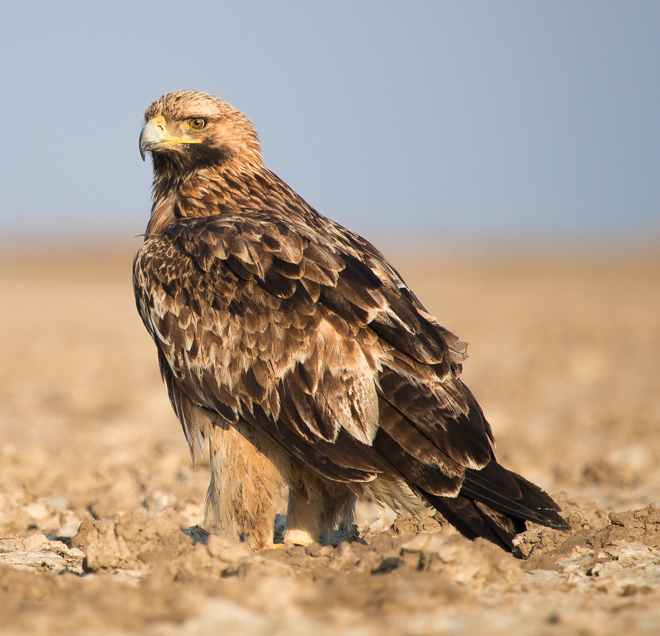 Eastern Imperial EagleAquila heliaca
-
 Bonelli's EagleAquila fasciata
-
 Tawny EagleAquila rapax
-
 Spanish Imperial EagleAquila adalberti
-
 African Hawk-eagleAquila spilogaster
Compare
Questions and answers
What is the scientific name of the Golden Eagle?
The scientific name of the Golden Eagle is Aquila chrysaetos. Written with its author, the full name is Aquila chrysaetos (Linnaeus, 1758).
Which family does the Golden Eagle belong to?
Aquila chrysaetos belongs to the family Accipitridae, in the order Accipitriformes and the class Aves.
Where is the Golden Eagle found?
Checklists and occurrence records place Aquila chrysaetos in 79 countries, including United States, Sweden, France, Spain, Canada and Norway.
What is the conservation status of the Golden Eagle?
The IUCN Red List category recorded for Aquila chrysaetos is Least Concern (LC).
What other names does the Golden Eagle have?
Aquila chrysaetos is also known in English as American War Bird, Bird of Jupiter, Calumet Bird, GOEA, Jackrabbit Eagle and King of Birds.
What is a golden eagle's diet?
Golden Eagles primarily eat hares, rabbits, marmots and other ground squirrels. They also prey on foxes, martens, young deer, small livestock and birds, and sometimes steal prey from other raptors or displace them from carrion.[13][15][16][17][18][19]
What is the habitat of the golden eagle?
Golden Eagles inhabit alpine parkland, open forests, mid-elevation clear-cuts, chaparral and plains. They use open areas with large rocky cliffs or large trees, including pines, cypresses and sycamores.[10][11]
What are the eating habits of eagles?
Golden Eagles primarily hunt ground-dwelling mammals, including hares, rabbits, marmots and ground squirrels. They also eat other mammals and birds, sometimes steal prey from other raptors, and can displace vultures and other raptors from carrion.[13][14][15][17][18][19]
Sources
Passages the profile rests on
- Adult golden eagles have dark brown plumage with lighter golden-brown feathers on the nape. Source passage: “These birds are dark brown, with lighter golden-brown plumage on their napes.” — English Wikipedia
- Adult golden eagles have gold feathers on the back of the crown and nape, with some grey on their wings and tail. Source passage: “Adults are primarily brown, with gold on the back of the crown and nape, and some grey on the wings and tail.” — nps.gov
- Immature golden eagles typically have white tail feathers and often display white markings on their wings. Source passage: “Immature eagles of this species typically have white on the tail and often have white markings on the wings.” — English Wikipedia
- Golden eagles have broad wings and a dark brown body. Source passage: “The golden eagle is a large, dark brown raptor with broad wings.” — nps.gov
- Golden eagles have a dark-tipped bill that fades to a lighter horn color and a yellow cere. Source passage: “The bill is dark at the tip, fading to a lighter horn color, with the waxy top of the beak, called a cere, colored yellow.” — nps.gov
- Golden eagles measure 66–102 cm in body length. Source passage: “The golden eagle is a very large raptor, 66 to 102 centimetres (26 to 40 in) in length.” — English Wikipedia
- Golden eagles have wingspans ranging from 1.8 to 2.34 m. Source passage: “Its wings are broad and the wingspan is 1.8 to 2.34 metres (5 ft 11 in to 7 ft 8 in).” — English Wikipedia
- Female golden eagles are larger than males. Source passage: “Females are larger than males, with a bigger difference in larger subspecies.” — English Wikipedia
- Adult males average approximately 3.6 kg, while adult females average approximately 5.1 kg. Source passage: “In the species overall, males average around 3.6 kg (7.9 lb) and females around 5.1 kg (11 lb).” — English Wikipedia
- Golden eagles use open areas containing large rocky cliffs or large trees, including pines, cypresses and sycamores. Source passage: “The golden eagle seeks open areas with large, rocky cliffs or large trees, such as pines, cypress or sycamores.” — nps.gov
- Golden eagles inhabit alpine parkland, open forests, mid-elevation clear-cuts, chaparral and plains. Source passage: “They are often found in alpine parkland, open forests and mid-elevation clear-cuts, as well as in chaparral or plains areas.” — nps.gov
- Golden eagles are generally found in sparsely populated areas of the Northern Hemisphere. Source passage: “Golden eagles can be found throughout much of the northern hemisphere, typically in sparsely populated areas” — nps.gov
- Golden eagles primarily hunt hares, rabbits, marmots and other ground squirrels. Source passage: “mainly hares, rabbits, marmots, and other ground squirrels.” — English Wikipedia
- Golden eagles in North America predominantly prey on medium-sized mammals, particularly rabbits and ground squirrels. Source passage: “The golden eagle's predominant prey in North America are medium-sized mammals such as rabbits and ground squirrels.” — nps.gov
- Golden eagles also prey on foxes, martens and young deer. Source passage: “Other species, such as foxes, martens, young deer are also taken.” — nps.gov
- Golden eagles may prey on small livestock, including lambs and small goats. Source passage: “Ranchers have historically battled the eagle because of its ability to prey upon small livestock such as lambs and small goats.” — nps.gov
- Golden eagles can prey on virtually any bird, including jays and swans. Source passage: “Other important prey include birds; indeed,virtually any bird, from jays to swans, are potential prey.” — nps.gov
- Golden eagles sometimes steal prey from other raptors. Source passage: “Golden eagles also r steal prey from other raptors.” — nps.gov
- Golden eagles can displace vultures and other raptors from carrion. Source passage: “golden eagles are capable of driving vultures and other raptors from carrion.” — nps.gov
- Golden eagles use agility, speed and powerful feet equipped with large sharp talons to capture prey. Source passage: “Golden eagles use their agility and speed combined with powerful feet and large, sharp talons to hunt a variety of prey” — English Wikipedia
- Golden eagles can dive at speeds approaching 200 miles per hour. Source passage: “Diving from great heights, they have been clocked at close to 200 miles per hour.” — nps.gov
- Golden eagles maintain home ranges or territories that can reach 200 km². Source passage: “Golden eagles maintain home ranges or territories that may be as large as 200 km2 (77 sq mi).” — English Wikipedia
- Some golden eagles remain in their nesting territories throughout the year, while others migrate when winter food is scarce. Source passage: “Some golden eagles live in their nesting territory all year. Others may migrate due to lack of food during the winter.” — nps.gov
- Golden eagles generally do not need to migrate long distances because of their hunting abilities. Source passage: “As a rule, they do not have to migrate large distances because of their excellent hunting abilities.” — nps.gov
- Golden eagles are monogamous and may remain paired for several years or potentially throughout their lives. Source passage: “They are monogamous and may remain together for several years or possibly for life.” — English Wikipedia
- Golden eagles usually mate for life. Source passage: “Golden eagles usually mate for life.” — nps.gov
- Golden eagles build large nests on cliffs and other elevated locations and may reuse them for several breeding years. Source passage: “They build large nests in cliffs and other high places to which they may return for several breeding years.” — English Wikipedia
- Female golden eagles can lay as many as four eggs. Source passage: “Females lay up to four eggs” — English Wikipedia
- Female golden eagles usually lay two eggs, with laying occurring between January and September depending on location. Source passage: “The female usually lays two eggs between January and September, depending on the locality.” — nps.gov
- Golden eagle eggs hatch after approximately 40–45 days of incubation. Source passage: “after 40 to 45 days the young hatch.” — nps.gov
- Golden eagle nestlings are fed for approximately 50 days before attempting their first flights and eating independently. Source passage: “They are covered in fluffy white down and are fed for fifty days before they are able to make their first flight attempts and eat on their own.” — nps.gov
- Golden eagle chicks generally become capable of fledging at approximately three months of age. Source passage: “Typically, one or two young survive to fledge in about three months.” — English Wikipedia
- In most golden eagle broods, only the older chick survives. Source passage: “In most cases only the older chick survives, while the younger one dies without leaving the eyrie.” — nps.gov
- Golden eagles have disappeared from many areas with high human population densities. Source passage: “it has disappeared from many areas that are heavily populated by humans.” — English Wikipedia
- Golden eagles are classified as a fully protected species in California. Source passage: “The golden eagle (Aquila chrysaetos) is listed as a fully protected species in California.” — wildlife.ca.gov
- Golden eagles have been used extensively in falconry for centuries. Source passage: “For centuries, this species has been one of the most highly regarded birds used in falconry.” — English Wikipedia
- Golden eagles and their feathers are incorporated into ceremonies in many Native American cultures. Source passage: “Golden eagles are important to many Native American cultures, which include the bird and its feathers in ceremonies.” — nps.gov
Data
- Catalogue of Life, 2026-10-16 XR cc by
- Global Biodiversity Information Facility CC BY 4.0
- Wikidata CC0
- GeoNames CC BY 4.0
- Wikimedia Commons per image; credit shown with each image
- Within the Catalogue of Life, this name comes from The Integrated Taxonomic Information System cc0
References
- Syst. Nat., ed. 10, 1: 88. 1758 where the name was published
- Banks, R. C., R. W. McDiarmid, and A. L. Gardner. (1987). Checklist of Vertebrates of the United States, the U.S. Territories, and Canada. Resource Publication, No. 166.
- Gill, Frank, & and Minturn Wright. (2006). Birds of the World: Recommended English Names.
This species in other databases
- Catalogue of Life FZLP
- Wikidata Q41181
- iNaturalist 5074
- WoRMS urn:lsid:marinespecies.org:taxname:159107
- Avibase goleag
Page built on 24 November 2026. See how the catalog is made and all sources and licences.
Cite this page
ScientificNames.org. (2026). Aquila chrysaetos (Golden Eagle). Retrieved November 24, 2026, from https://scientificnames.org/species/aquila-chrysaetos
“Aquila chrysaetos (Golden Eagle).” ScientificNames.org, 2026, scientificnames.org/species/aquila-chrysaetos. Accessed 24 Nov. 2026.
ScientificNames.org. “Aquila chrysaetos (Golden Eagle).” Accessed November 24, 2026. https://scientificnames.org/species/aquila-chrysaetos.
@misc{scientificnames_aquila_chrysaetos_golden_eagle,
  author = {{ScientificNames.org}},
  title = {Aquila chrysaetos (Golden Eagle)},
  year = {2026},
  url = {https://scientificnames.org/species/aquila-chrysaetos},
  note = {Accessed 2026-11-24}
}