Species · Birds
Dusky-headed Parakeet Aratinga weddellii
The scientific name of the Dusky-headed Parakeet is Aratinga weddellii. It is a species of bird in the family Psittacidae (macaws), order Psittaciformes. The name dates from 1851.
- Scientific name
- Aratinga weddellii (Deville, 1851)
- Common name
- Dusky-headed Parakeet
- Genus
- Aratinga
- Family
- Psittacidae (Macaws)
- Order
- Psittaciformes
- Class
- Aves
- Red List category
- LC Least Concern
- Recorded in
- 5 countries
- Name status
- accepted in the Catalogue of Life

Overview
Aratinga weddellii inhabits wooded areas in the western Amazon basin of South America. It is distinguished by predominantly green plumage, a dusty grey head and a blue-tipped tail.
Written 26 November 2026 from the sources listed below. Each statement was checked against the passage it cites; statements that could not be supported were removed.
Appearance
The Dusky-headed Parakeet has predominantly green plumage and a dusty grey or gray-brown head. Its tail is blue-tipped, and its flight feathers are dark gray underneath and mainly blue above.[1][2]
It has a broad, bare, white eye-ring that can sometimes have a yellow tinge. Rare lutino and blue color mutations occur in captive birds.[3][4]
Habitat
The Dusky-headed Parakeet inhabits wooded areas in the western Amazon basin of South America. It prefers semi-open habitats, including várzea, forest edges and forest remnants, and also occurs in coffee plantations.[5][6][7]
Diet
The Dusky-headed Parakeet eats fruit, seeds and flowers. It also searches decaying wood for insect larvae.[8][9]
The species supplements its diet by ingesting mineral-rich soil from places such as clay licks. Clay consumption is believed to provide minerals and neutralize toxins in its diet.[10][11]
Behaviour
The Dusky-headed Parakeet is social and usually occurs in pairs or small groups. It sometimes forms mixed-species flocks with other conures.[12][13]
When food is plentiful, it may form flocks containing up to 100 individuals. Compared with other conures, it is relatively quiet but remains energetic and playful.[14][15]
Reproduction and life cycle
The Dusky-headed Parakeet nests in woodpecker holes in trees or in arboreal termite nests. Pairs jointly raise their offspring.[16][17]
In captivity, the species can produce up to three clutches annually when provided with a durable nest box.[18]
Conservation
The Dusky-headed Parakeet is considered generally common and less vulnerable than many other Amazonian species because of its habitat preferences. BirdLife International and IUCN classify it as Least Concern.[19][20][21]
Classification of the Dusky-headed Parakeet
| Kingdom | Animalia |
|---|---|
| Phylum | Chordata |
| Subphylum | Vertebrata |
| Infraphylum | Gnathostomata |
| Parvphylum | Osteichthyes |
| Megaclass | Tetrapoda |
| Class | Aves (Bird) |
| Order | Psittaciformes (Parrot) |
| Family | Psittacidae (Macaws) |
| Genus | Aratinga (Parakeets) |
| Species | Aratinga weddellii (Deville, 1851) |
Where the Dusky-headed Parakeet is found
Checklists and occurrence records place Aratinga weddellii in 5 countries across South America. GBIF holds 33,463 georeferenced records of it.
Countries
Regions and cities with the most records
- Madre de Dios, Peru 8,583
- Loreto, Peru 5,090
- Orellana Province, Ecuador 2,592
- Puerto Maldonado, Peru 2,177
- Sucumbíos, Ecuador 2,109
- Napo, Ecuador 1,643
- Amazonas Department, Colombia 1,635
- Putumayo Department, Colombia 1,377
- Cuzco Department, Peru 1,281
- Beni Department, Bolivia 1,251
- Santa Cruz Department, Bolivia 1,241
- Rondônia, Brazil 1,232
- Tambopata, Peru 1,030
- Acre, Brazil 1,001
- San Juan, Peru 921
- Iquitos, Peru 897
- Leticia, Colombia 769
- Tabatinga, Brazil 752
- Puerto Asís, Colombia 743
- Pando, Bolivia 686
- Tena, Ecuador 628
- Ucayali, Peru 509
- Amazonas, Brazil 507
- Caquetá, Colombia 506
- Riberalta, Bolivia 414
- San Martín Department, Peru 388
- Santa Cruz de la Sierra, Bolivia 361
- Cobija, Bolivia 358
- Epitaciolândia, Brazil 354
- Brasiléia, Brazil 350
- Mato Grosso, Brazil 312
- Cotoca, Bolivia 300
- Rio Branco, Brazil 298
- Florencia, Colombia 296
- Trinidad, Bolivia 263
- La Banda, Peru 246
1 more country has a few records outside this range
These countries hold a few records of Aratinga weddellii but lie outside the range the checklists give for it. Such records are often zoo or garden specimens, museum material or vagrants, so the species is not counted as occurring there.
Range as the checklists state it
South America
A number beside a place is its count of GBIF occurrence records. A place without a number comes from a checklist alone. Records show where a species has been observed or collected, which can include escapes and vagrants.
Common names
English
- Dusky-headed Parakeet
Names in 26 other languages
- Catalan
- aratinga de cap turquesa
- Chinese
- 暗头鹦哥, 暗頭鸚哥
- Croatian
- sivoglava jandaja
- Czech
- aratinga tmavohlavý
- Danish
- Gråhovdet Aratinga, Gråhovedet Aratinga
- Dutch
- Weddells Aratinga
- Esperanto
- malhelkapa papago
- Estonian
- lodu-aratinga
- Finnish
- harmaapääaratti
- French
- Conure de Weddell
- German
- Weddell-Sittich, Weddellsittich
- Hungarian
- barnafejű aratinga, tambopatai aratinga
- Italian
- Parrocchetto testascura
- Japanese
- シモフリインコ
- Lithuanian
- melsvagalvė aratinga
- Norwegian
- hvitøreparakitt
- Polish
- konura łuskogłowa
- Portuguese
- Jandaia-de-cabeça-azulada, periquito-de-cabeça-suja, periquitão-de-cabeça-fusca
- Russian
- Буроголовая аратинга
- Serbian
- Vedelova aratinga
- Slovak
- klinochvost tmavohlavý
- Spanish
- Aratinga cabecifusca, Lorita Pico Negro
- Swedish
- skifferhuvad parakit, weddellparakit
- Turkish
- Gri Başlı Papağan
- Ukrainian
- аратинга сіроголовий
- Welsh
- conwra penllwyd
Synonyms
3 other scientific names have been used for this species and are now treated as synonyms of Aratinga weddellii.
- Aratinga weddelli (Deville, 1851)
- Conurus canibuccalis Rothschild, LW, 1907
- Conurus weddellii Deville, 1851
Related species
-
 Sun ConureAratinga solstitialis
-
 Nanday ParakeetAratinga nenday
-
 Jandaya ParakeetAratinga jandaya
-
 Golden-capped ParakeetAratinga auricapillus
-
 Sulphur-breasted ParakeetAratinga maculata
-
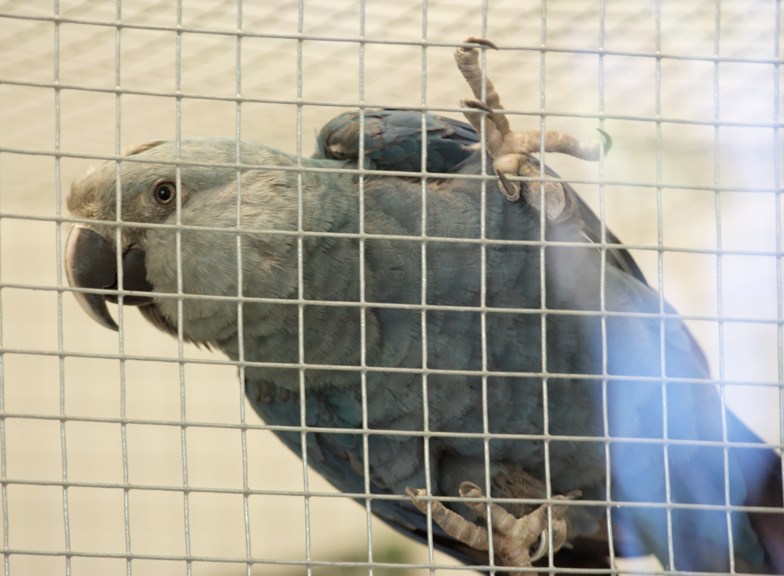 Spix's MacawCyanopsitta spixii
-
 Grey ParrotPsittacus erithacus
-
 Scarlet MacawAra macao
Compare
Questions and answers
What is the scientific name of the Dusky-headed Parakeet?
The scientific name of the Dusky-headed Parakeet is Aratinga weddellii. Written with its author, the full name is Aratinga weddellii (Deville, 1851).
Which family does the Dusky-headed Parakeet belong to?
Aratinga weddellii belongs to the family Psittacidae, in the order Psittaciformes and the class Aves.
Where is the Dusky-headed Parakeet found?
Checklists and occurrence records place Aratinga weddellii in 5 countries: Peru, Ecuador, Colombia, Bolivia and Brazil.
What is the conservation status of the Dusky-headed Parakeet?
The IUCN Red List category recorded for Aratinga weddellii is Least Concern (LC).
Sources
Passages the profile rests on
- The Dusky-headed Parakeet has predominantly green plumage and a dusty grey head. Source passage: “a small green Neotropical parrot with dusty grey head” — English Wikipedia
- The species has a gray-brown head, a blue-tipped tail, and flight feathers that are dark gray underneath and mainly blue above. Source passage: “with a gray-brown head, a blue-tipped tail, and remiges that are dark gray from below, mainly blue from above.” — English Wikipedia
- The species has a broad, bare, white eye-ring that can sometimes have a yellow tinge. Source passage: “a broad, bare, white (sometimes yellow-tinged) eye-ring.” — English Wikipedia
- Rare lutino and blue color mutations occur in captive Dusky-headed Parakeets. Source passage: “both lutino and blue mutations are rare, but do exist in captivity” — English Wikipedia
- The species inhabits wooded areas in the western Amazon basin of South America. Source passage: “found in wooded habitats in the western Amazon basin of South America.” — English Wikipedia
- The Dusky-headed Parakeet prefers semi-open habitats, including várzea, forest edges, and forest remnants. Source passage: “It prefers semiopen habitats such as várzea, forest edge, and forest remnants” — English Wikipedia
- The species also occurs in coffee plantations. Source passage: “but can also be found in coffee plantations.” — English Wikipedia
- The Dusky-headed Parakeet eats fruit, seeds, and flowers. Source passage: “It eats fruit, seeds, and flowers” — English Wikipedia
- The species searches decaying wood for insect larvae. Source passage: “searches decaying wood for insect larvae.” — English Wikipedia
- The Dusky-headed Parakeet supplements its diet by ingesting mineral-rich soil from places such as clay licks. Source passage: “It also ingests mineral-rich soil, e.g., from a clay lick, as a supplement.” — English Wikipedia
- Clay consumption is believed to provide minerals and neutralize toxins in the species' diet. Source passage: “Consuming clay is believed to provide a mineral supplement and neutralise toxins in their diet.” — English Wikipedia
- The Dusky-headed Parakeet is social and usually occurs in pairs or small groups. Source passage: “It is social, and usually found in pairs or small groups.” — English Wikipedia
- The species sometimes forms mixed-species flocks with other conures. Source passage: “It may even flock with different species of conures.” — English Wikipedia
- When food is plentiful, the species may form flocks containing up to 100 individuals. Source passage: “When food is plentiful, it may form flocks of up to 100 members.” — English Wikipedia
- Compared with other conures, the Dusky-headed Parakeet is relatively quiet but remains energetic and playful. Source passage: “They are known to be quiet, compared to other conure species, but still very energetic and playful, like most conures.” — English Wikipedia
- Pairs of Dusky-headed Parakeets jointly raise their offspring. Source passage: “A pair raises their offspring together” — English Wikipedia
- The species nests in woodpecker holes in trees or in arboreal termite nests. Source passage: “nesting in woodpecker holes in trees or arboreal termite nests.” — English Wikipedia
- In captivity, the Dusky-headed Parakeet can produce up to three clutches annually when provided with a durable nest box. Source passage: “They are fairly easy to breed if provided with a durable nest box, and will lay up to three clutches per year.” — English Wikipedia
- The Dusky-headed Parakeet is considered generally common. Source passage: “It is generally common” — English Wikipedia
- The species is considered less vulnerable than many other Amazonian species because of its habitat preferences. Source passage: “its habitat preference makes it less vulnerable than many other Amazonian species.” — English Wikipedia
- BirdLife International and IUCN classify the Dusky-headed Parakeet as Least Concern. Source passage: “it is considered to be of least concern by BirdLife International and IUCN.” — English Wikipedia
Data
- Catalogue of Life, 2026-10-16 XR cc by
- Global Biodiversity Information Facility CC BY 4.0
- Wikidata CC0
- GeoNames CC BY 4.0
- Wikimedia Commons per image; credit shown with each image
- Within the Catalogue of Life, this name comes from The Integrated Taxonomic Information System cc0
References
- Gill, Frank, & and Minturn Wright. (2006). Birds of the World: Recommended English Names.
- Dickinson, E. C., and L. Christidis, eds. (2014). The Howard and Moore Complete Checklist of the Birds of the World, 4th Edition, Vol. 2 Passerines.
This species in other databases
Page built on 26 November 2026. See how the catalog is made and all sources and licences.
Cite this page
ScientificNames.org. (2026). Aratinga weddellii (Dusky-headed Parakeet). Retrieved November 26, 2026, from https://scientificnames.org/species/aratinga-weddellii
“Aratinga weddellii (Dusky-headed Parakeet).” ScientificNames.org, 2026, scientificnames.org/species/aratinga-weddellii. Accessed 26 Nov. 2026.
ScientificNames.org. “Aratinga weddellii (Dusky-headed Parakeet).” Accessed November 26, 2026. https://scientificnames.org/species/aratinga-weddellii.
@misc{scientificnames_aratinga_weddellii_dusky_headed_parakeet,
  author = {{ScientificNames.org}},
  title = {Aratinga weddellii (Dusky-headed Parakeet)},
  year = {2026},
  url = {https://scientificnames.org/species/aratinga-weddellii},
  note = {Accessed 2026-11-26}
}