Species · Spiders and other arachnids
Arctosa cinerea
Arctosa cinerea has no English name on record in the checklists used here. It is a species of arachnid in the family Lycosidae (wolf spider), order Araneae. The name dates from 1777.
- Scientific name
- Arctosa cinerea (Fabricius, 1777)
- Genus
- Arctosa
- Family
- Lycosidae (Wolf Spider)
- Order
- Araneae
- Class
- Arachnida
- Recorded in
- 38 countries
- Name status
- accepted in the Catalogue of Life
Overview
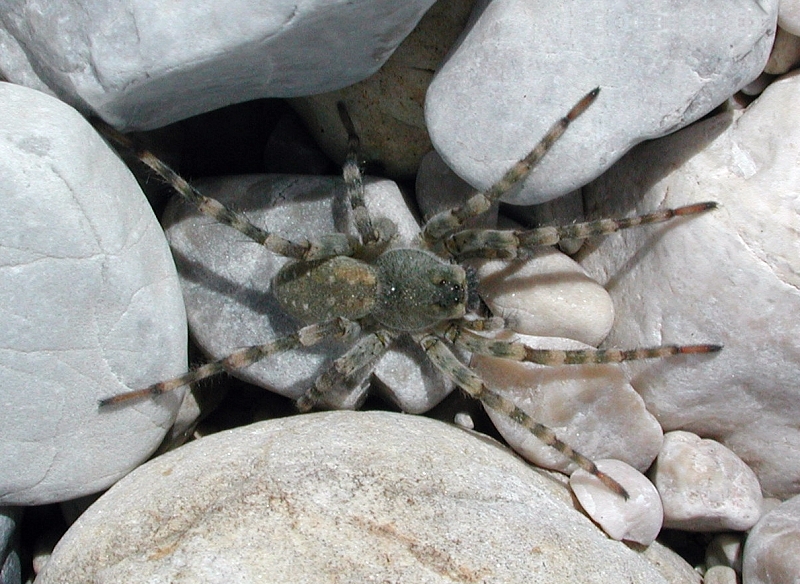
Arctosa cinerea occurs on sandy beaches along rivers, lakes and oceans and inhabits coarse gravel areas on river gravel bars. Its grey-brown coloration provides camouflage.
Written 26 November 2026 from the sources listed below. Each statement was checked against the passage it cites; statements that could not be supported were removed.
Appearance
Arctosa cinerea has a grey-brown coloration that provides camouflage. Its body length reaches up to 17 mm, while males reach up to 14 mm.[1][2]
Habitat
The species occurs on sandy beaches along rivers, lakes and oceans. It inhabits non-silted, coarse gravel areas on river gravel bars and favors gravel habitats without vegetation cover.[3][4][5]
Behaviour
The species may wander around during daylight. It digs holes in the ground and covers them with silk.[6][7]
Arctosa cinerea can move on the water surface using surface tension. Its hydrophobic hair structures improve survival when individuals become trapped in inundated gravel.[8][9]
Classification of Arctosa cinerea
| Kingdom | Animalia |
|---|---|
| Phylum | Arthropoda |
| Subphylum | Chelicerata |
| Class | Arachnida (Arachnid) |
| Order | Araneae (Spider) |
| Family | Lycosidae (Wolf Spider) |
| Genus | Arctosa (Bear Spiders) |
| Species | Arctosa cinerea (Fabricius, 1777) |
Where Arctosa cinerea is found
Checklists and occurrence records place Arctosa cinerea in 38 countries across Africa, Asia and Europe. GBIF holds 8,370 georeferenced records of it.
Countries
- Albania 7
- Algeria 1
- Austria 97
- Belgium 29
- Bulgaria 6
- Chad 4
- China
- Czechia 8
- Democratic Republic of the Congo 1
- Denmark 149
- Eritrea
- Estonia 17
- Finland 125
- France 298
- Georgia 13
- Germany 190
- Greece 26
- Hungary 4
- Iran 1
- Italy 40
- Japan 1
- Kazakhstan 6
- Latvia 8
- Lithuania 13
- Norway 5,974
- Poland 128
- Portugal 16
- Romania 7
- Russia 119
- Slovakia 3
- Slovenia 8
- Spain 71
- Sweden 260
- Switzerland 34
- The Netherlands 479
- Turkey 5
- Ukraine 33
- United Kingdom 189
Regions and cities with the most records
- Stjørdalshalsen, Norway 2,168
- Levanger, Norway 548
- Gelderland, The Netherlands 434
- Nijmegen, The Netherlands 375
- Elst, The Netherlands 368
- Beuningen, The Netherlands 357
- Huissen, The Netherlands 342
- Duiven, The Netherlands 338
- Groesbeek, The Netherlands 338
- Velp, The Netherlands 324
- Arnhem, The Netherlands 322
- Zevenaar, The Netherlands 320
- Didam, The Netherlands 284
- Kleve, Germany 283
- Wijchen, The Netherlands 268
- Emmerich, Germany 213
- Gennep, The Netherlands 176
- Wageningen, The Netherlands 159
- Oss, The Netherlands 123
- Pays de la Loire, France 120
- Tiel, The Netherlands 117
- Wales, United Kingdom 115
- Rhenen, The Netherlands 109
- Bennekom, The Netherlands 108
- Zaltbommel, The Netherlands 84
- Geldermalsen, The Netherlands 83
- Skåne, Sweden 76
- 's-Hertogenbosch, The Netherlands 69
- Culemborg, The Netherlands 66
- Leerdam, The Netherlands 64
- Trondheim, Norway 62
- Bavaria, Germany 59
- Drunen, The Netherlands 59
- Wijk bij Duurstede, The Netherlands 57
- England, United Kingdom 51
- Lower Austria, Austria 48
1 more country has a few records outside this range
These countries hold a few records of Arctosa cinerea but lie outside the range the checklists give for it. Such records are often zoo or garden specimens, museum material or vagrants, so the species is not counted as occurring there.
Range as the checklists state it
Europe, North Africa, Eritrea, DR Congo, Russia (Europe to Far East), Turkey, Caucasus, Middle East, Iran, Kazakhstan, China, Korea, Japan
Kazakhstan
Algeria
Britain
A number beside a place is its count of GBIF occurrence records. A place without a number comes from a checklist alone. Records show where a species has been observed or collected, which can include escapes and vagrants.
Common names
Names in 10 other languages
- Czech
- slíďák břehový
- Danish
- Sandgraveedderkop, Strandjagtedderkop
- Dutch
- Grindwolfspin
- Finnish
- jättiotsokki
- French
- Lycose cendrée
- German
- Flussuferwolfspinne, Uferwühlwolf
- Japanese
- タイリクミズコモリグモ
- Norwegian Bokmål
- stor elvebreddedderkopp
- Polish
- Wymyk szarawy
- Swedish
- sandvargspindel, strandjaktspindel
Synonyms
11 other scientific names have been used for this species and are now treated as synonyms of Arctosa cinerea.
- Aranea cinerea Fabricius, 1777
- Arctosa allodroma (Walckenaer, 1802)
- Arctosa allodroma Blackwall
- Arctosa cinerea cinerea (Fabricius, 1777)
- Arctosa invasa (Savelyeva, 1972)
- Arctosa leucophaea (Blackwall, 1837)
- Arctosa lynx (Hahn, 1833)
- Arctosa pilipes (Lucas, 1846)
- Hyaenosa invasa Savelyeva, 1972
- Lycosa cinerea (Fabricius, 1777)
- Trochosa cinerea (J.C.Fabricius, 1777)
Related species
-
 Sand Wolf SpiderArctosa perita
-
 Beach Wolf SpiderArctosa littoralis
- Yellow-striped Bear-spiderArctosa fulvolineata
-
 Leopard Bear-spiderArctosa leopardus
-
 Hilltop Wolf SpiderArctosa alpigena
-
 Raptor Wolf SpiderArctosa raptor
-
 Shiny Wolf SpiderArctosa rubicunda
- Santa Rosa Wolf SpiderArctosa sanctaerosae
Compare
Questions and answers
How large does Arctosa cinerea grow?
The species reaches a body length of up to 17 mm. Males reach up to 14 mm.[2]
Where does Arctosa cinerea live?
It occurs on sandy beaches along rivers, lakes and oceans and inhabits non-silted, coarse gravel areas on river gravel bars.[3][4]
Is Arctosa cinerea active during daylight?
The species may wander around during daylight.[6]
How does Arctosa cinerea cope with inundated gravel?
Its hydrophobic hair structures improve survival when individuals become trapped in inundated gravel. It can also move on the water surface using surface tension.[8][9]
What is the distribution of Arctosa cinerea?
The species has a Palearctic distribution and is also recorded from Congo.[10]
Sources
Passages the profile rests on
- Arctosa cinerea has a grey-brown coloration that provides camouflage. Source passage: “Its grey-brown color makes for a good camouflage” — English Wikipedia
- The species reaches a body length of up to 17 mm, with males reaching up to 14 mm. Source passage: “The spider reaches a length of 17 mm (males only 14 mm)” — English Wikipedia
- The species occurs on sandy beaches along rivers, lakes and oceans. Source passage: “occurs only on sandy beaches of rivers, lakes and oceans.” — English Wikipedia
- The species inhabits non-silted, coarse gravel areas on river gravel bars. Source passage: “Common and important habitat features were non-silted and coarse gravel areas” — pmc.ncbi.nlm.nih.gov
- The species favors gravel habitats without vegetation cover. Source passage: “the absence of vegetation cover as well the absence of ants was crucial for the occurrence of the three model species.” — pmc.ncbi.nlm.nih.gov
- The species may wander around during daylight. Source passage: “even if it wanders around during daylight.” — English Wikipedia
- The species digs holes in the ground and covers them with silk. Source passage: “They dig holes in the ground, which they cover with silk” — English Wikipedia
- The species can move on the water surface using surface tension. Source passage: “the two spider genera Arctosa and Pardosa make use of the surface tension” — pmc.ncbi.nlm.nih.gov
- The species has hydrophobic hair structures that improve survival when individuals become trapped in inundated gravel. Source passage: “A hydrophobic hair structure in spiders also improves the chance of survival of individuals trapped in inundated gravel” — pmc.ncbi.nlm.nih.gov
- The species has a Palearctic distribution and is also recorded from Congo. Source passage: “with a palearctic distribution and also found in Congo.” — English Wikipedia
Data
- Catalogue of Life, 2026-10-16 XR cc by
- Global Biodiversity Information Facility CC BY 4.0
- Wikidata CC0
- GeoNames CC BY 4.0
- Wikimedia Commons per image; credit shown with each image
- Within the Catalogue of Life, this name comes from The World Spider Catalog cc by
References
- Fabricius, J. C. (1777). Genera insectorum eorumque characteres naturales, secundum numerum, figuram, situm et proportionem omnium partium oris; adjecta mantissa specierum nuper detectarum. Michael Friedrich Bartsch, Chilonii [= Kiel], 310 pp. (Araneae, pp. 152, 249-250). doi: <a href="https://doi.org/10.5962/bhl.title.12286" target="_blank">10.5962/bhl.title.12286 Link where the name was published
This species in other databases
Page built on 29 November 2026. See how the catalog is made and all sources and licences.
Cite this page
ScientificNames.org. (2026). Arctosa cinerea. Retrieved November 29, 2026, from https://scientificnames.org/species/arctosa-cinerea
“Arctosa cinerea.” ScientificNames.org, 2026, scientificnames.org/species/arctosa-cinerea. Accessed 29 Nov. 2026.
ScientificNames.org. “Arctosa cinerea.” Accessed November 29, 2026. https://scientificnames.org/species/arctosa-cinerea.
@misc{scientificnames_arctosa_cinerea,
  author = {{ScientificNames.org}},
  title = {Arctosa cinerea},
  year = {2026},
  url = {https://scientificnames.org/species/arctosa-cinerea},
  note = {Accessed 2026-11-29}
}